

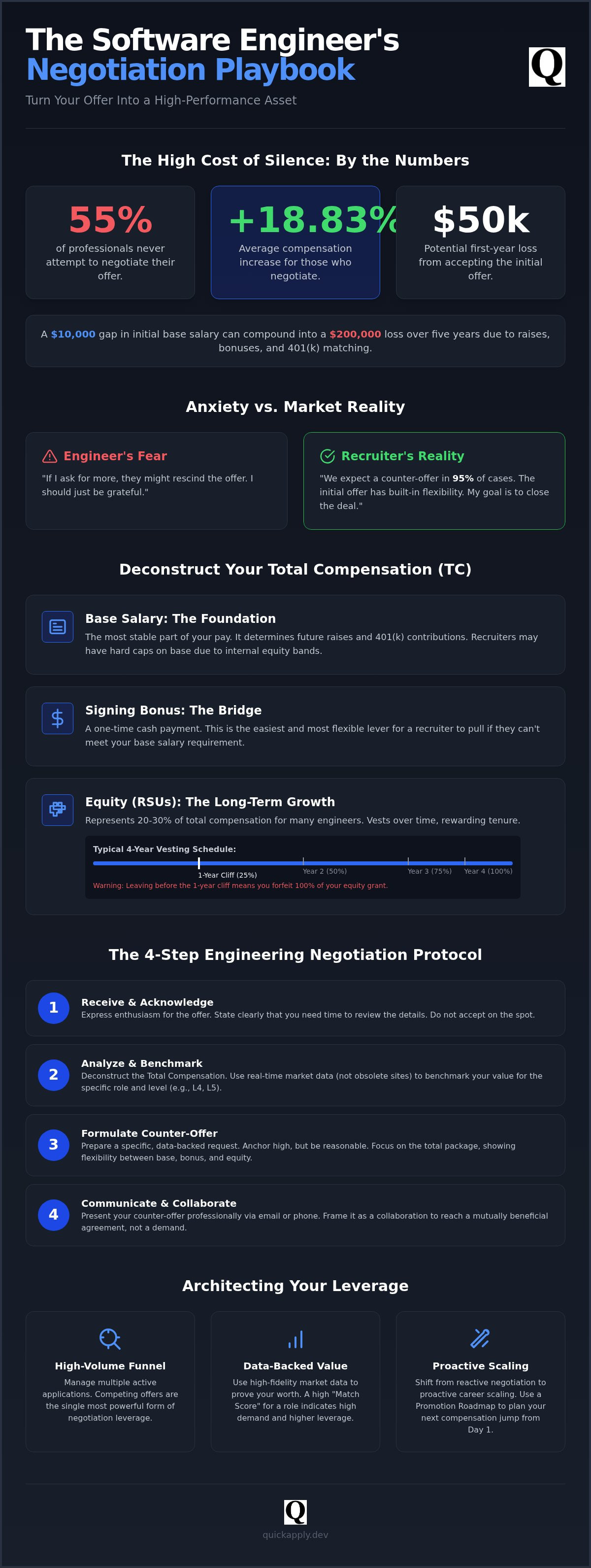
Your software engineer offer isn't a final verdict. It's a baseline for optimization. While 55% of professionals never attempt to negotiate, those who treat the closing process as a technical challenge secure an average increase of 18.83%. In a 2026 market where AI specialists command an 18.7% premium, leaving money on the table is a systemic error. It's a failure to value your own technical output.
You likely fear that pushing for more will lead to a rescinded offer. It's a common anxiety, especially when RSU valuations and complex vesting schedules make the math feel opaque. This guide changes the variable. You'll learn exactly how to negotiate salary for software engineer positions by leveraging real-time market data and proven communication frameworks. We're moving past guesswork to help you secure a $20,000 to $50,000 increase in total compensation.
We will analyze current 2026 compensation structures, demystify equity benchmarks, and provide the precise scripts you need to communicate with recruiters. Prepare to turn your pipeline into leverage and maximize your career ROI.
Key Takeaways
- Treat negotiation as a standard protocol rather than a personal favor. Recruiters expect a counter-offer in nearly 95% of software engineering roles.
- Deconstruct your total compensation into its core components. Master the math behind RSUs, signing bonuses, and base salary floors to maximize long-term earnings.
- Implement a step-by-step communication framework to learn how to negotiate salary for software engineer positions without risking offer rescission.
- Build systemic leverage by managing a high-volume application funnel. Use an Application Tracker to maintain a source of truth for multiple-offer bidding wars.
- Shift from reactive negotiation to proactive career scaling. Use a Promotion Roadmap to ensure your next compensation jump begins the moment you sign.
The Software Engineer’s Negotiation Paradox: Why Gratitude Costs You $50k
You are hired for your ability to optimize complex systems. Yet, when an offer arrives, many engineers abandon logic for gratitude. This is the Negotiation Paradox. You possess high technical value but perceive yourself as having low leverage. It's a calculation error that costs the average developer $50,000 in their first year alone. Don't let relief dictate your financial future.
Tech recruiters expect a counter-offer in 95% of software engineering roles. They build wiggle room into the initial package. If you accept the first number, you aren't being easy to work with. You are simply leaving the company's allocated budget on the table. Understanding the basics of salary negotiation is as critical as mastering a new deployment pipeline. Treat the first offer as a baseline, not a ceiling.
The math is brutal. A $10,000 gap in your base salary today compounds rapidly. Between annual raises, 401(k) matching, and future bonus percentages, that missed five-figure sum grows into a $200,000 loss over five years. Learning how to negotiate salary for software engineer roles is the highest ROI activity you can perform in 2026. Stop settling for the floor when the ceiling is within reach.
The Scarcity Mindset vs. Market Reality
Fear of offer rescission is the most common reason engineers stay silent. In reality, rescissions are statistically rare. By the time you have an offer, the company has spent thousands of dollars on the interview loop. The recruiter is incentivized to close the deal. They want you to sign because their metrics depend on it. Shift your perspective. You aren't a lucky candidate. You are a high-value asset solving a specific business problem.
Benchmarking Your Value in 2026
Don't rely on obsolete data. By 2026, traditional salary sites often lag behind real-time market shifts. You need to identify specific market bands for your level, whether you are an L3 or an L5. Knowing how to negotiate salary for software engineer positions requires high-fidelity data. General averages won't help you when you're discussing specialized AI or backend roles.
Leverage tools that provide Match Scores to gauge your demand. If your profile hits a 95% match for a role, your leverage increases. High demand equals high leverage. You can find detailed benchmarks in the QuickApply salary negotiation guide to drive your counter-offer with data-backed confidence. Use these numbers to prove your market worth rather than guessing your value.
Decoding Total Compensation (TC): The Full Comp Architecture
Stop looking at the base salary in isolation. In the tech sector, your base is merely the foundation of a much larger structure. Total Compensation (TC) is the sum of base salary, annual bonuses, equity grants, and one-time signing bonuses. Mastering understanding total compensation allows you to identify where a recruiter has hidden flexibility. If you only focus on the monthly deposit, you're missing the largest wealth-building levers available to you.
Your base salary is the floor. It determines your future merit increases and 401(k) matching contributions. However, recruiters often hit hard ceilings on base pay due to internal equity bands. This is where the signing bonus becomes a critical tool. It's a one-time cash payment that doesn't affect the recurring budget. If a company can't meet your base salary requirements, pivot immediately to the signing bonus to bridge the gap. It's the easiest lever for a recruiter to pull when their hands are tied on salary.
Equity typically represents 20% to 30% of an engineer's TC package. Most grants follow a four-year vesting schedule. You don't own the stock on day one. You earn it through tenure. This is why you must calculate the real value of a grant based on current market trends and projected growth. If you're managing multiple offers, use an Application Tracker to compare these complex variables side-by-side without losing your mind.
Equity 101 for Engineers
In 2026, Restricted Stock Units (RSUs) remain the gold standard for public companies because they hold intrinsic value even if the stock price dips. Stock options offer higher upside but carry the risk of ending up underwater if the company's valuation stalls. A vesting cliff is a mandatory one-year service period that acts as a binary trigger for your equity; if you leave before this milestone, you forfeit 100% of your initial grant. Always factor this timeline into your long-term career strategy. Knowing how to negotiate salary for software engineer roles requires a deep understanding of these non-cash assets.
The Non-Monetary Levers
Cash isn't the only currency. If the financial offer is stagnant, look at lifestyle optimizations. Remote work flexibility, home office stipends, and dedicated learning days for professional development are high-value additions. Be wary of Unlimited PTO structures. While they sound generous, they often result in employees taking less time off and provide no payout for unused days when you exit. Negotiating for a fixed, high-tier vacation policy often yields better long-term value than a vague unlimited promise.
The Engineering Negotiation Protocol: Exactly What to Say
Negotiation is a logic-driven sequence. It requires a script, not an improvisation. When the recruiter calls with the verbal offer, your goal is to transition from the interview phase to the optimization phase without losing momentum. Knowing how to negotiate salary for software engineer roles starts with controlling the tempo of the conversation.
Step 1: Express enthusiasm without 'accepting'. Use a phrase like: "I’m very excited about the team’s roadmap and the technical challenges we discussed." This signals interest without surrendering your leverage. Step 2: Ask for the written breakdown immediately. Say: "Can you provide the full compensation architecture in writing? I need to review the base, bonus structure, and equity vesting schedule in detail." Never negotiate against a verbal number you haven't seen on paper.
Step 3: Deploy the 'Silence Strategy'. When the recruiter finally delivers the numbers, wait. Count to five in your head. Let the recruiter fill the dead air. Often, they will immediately follow up with, "We might have some flexibility on the signing bonus," simply to break the tension. Step 4: Present your counter-offer. Frame it around market alignment. "Based on current 2026 benchmarks for an L5 backend role, I was expecting a total compensation package closer to $210,000."
The 'Competing Offer' Script
You don't need a formal offer letter from a rival to create leverage. You need a healthy pipeline. Use your automated job application tracker to demonstrate you are deep in the funnel with other high-value firms. When asked about other offers, say: "I am currently in the final stages with two other companies for similar specialized roles. I expect to have a full picture of my options by Friday." This creates a sense of urgency without sounding like a threat. If you don't have another offer yet, focus on the interviews you have scheduled to prove your market demand.
Handling the 'Non-Negotiable' Objection
Recruiters often use "this is our best offer" as a standard resistance tactic. Test it. If they claim the base is fixed, pivot immediately to one-time levers. "If the base salary is at the hard ceiling for this level, can we bridge the gap with a $25,000 signing bonus or an additional equity grant?" This 'Closing the Gap' technique allows the recruiter to meet your total compensation target while staying within their internal salary bands. It's a win-win that turns a 'no' into a tactical pivot. It solves the recruiter's problem while hitting your financial target.
Architecting Leverage: Managing Your Application Funnel
Leverage is a byproduct of supply and demand. If you only have one offer, your supply is zero and their demand is fixed. True negotiation power is architected long before the recruiter calls. It begins with your first application for job. By saturating your pipeline, you create a bidding war environment where companies compete for your time. This isn't just about volume. It's about synchronization.
Sync your interview schedule. Aim to have all final rounds occur within the same ten day period. This ensures that when offers arrive, they land in a tight seven day window. This overlap is your primary weapon. It allows you to tell Company A that you have a deadline from Company B, forcing an accelerated decision and a more aggressive initial package. Using an Application Tracker allows you to visualize these timelines and identify which firms are most likely to negotiate based on historical data. Stop guessing and start tracking your pipeline like a professional.
The Power of the Full Pipeline
A single "dream" offer is a vulnerability. Three active final rounds are a fortress. When you have multiple paths to a high TC, your body language and verbal tone shift. You stop asking and start deciding. Use your pipeline health to justify higher asks. If a firm sees you have a high Match Score and multiple competing interests, they know a low-ball offer will result in an immediate rejection. Managing these recruiter timelines is essential. If one company moves too fast, tell them. "I'm in the final stages with another team and want to make an informed comparison."
Exploding Offers and Pressure Tactics
Recruiters use 48 hour "exploding" deadlines to prevent you from shopping their offer. Don't panic. These deadlines are often arbitrary and designed to create artificial scarcity. Buy time using the 'Family or Financial Advisor' stall. Tell them: "I need to review the equity vesting and tax implications with my advisor before signing." This buys you an extra 72 hours without looking disinterested. Knowing how to negotiate salary for software engineer roles means knowing when to walk. If a company uses high pressure tactics and refuses to budge on a low-ball offer, it's a signal of how they treat employees. Walking away is the ultimate display of leverage.
Scaling Your Earnings with the QuickApply Ecosystem
Negotiation isn't a one-time event. It's the initialization of your career's growth loop. Learning how to negotiate salary for software engineer roles gives you the immediate win, but the QuickApply ecosystem ensures that momentum doesn't stall. Use the salary negotiation guide for real-time script assistance during your final calls. It converts raw market data into high-leverage dialogue that recruiters can't dismiss.
Once you sign, the work of your next raise begins. The Promotion Roadmap automates the tracking of your technical impact from Day 1. Instead of scrambling before a performance review, you'll have a documented ledger of contributions ready for display. This positioning prepares you for a 20% jump in your next career cycle by removing the friction of manual reporting. You're not just getting a job; you're installing a system for continuous optimization.
The Promotion Roadmap: Day 1 to Day 365
Use the final negotiation phase to set clear success metrics with your new manager. Ask: "What does an exceptional first six months look like for this role?" Document these answers immediately. QuickApply helps you track 'Impact Wins'-code deployments, architectural shifts, or mentorship milestones-that align with these specific goals. This data-driven approach makes your first review a formality rather than a negotiation. You're also already planning your next career transition by maintaining a live, AI-optimized portfolio of your achievements as they happen.
Final Protocol: Signing with Confidence
Before you click 'sign', run through the final checklist. Verify the RSU grant date, the specific vesting cliff, and the signing bonus payout timeline. Ensure every verbal promise is codified in the final PDF. If anything is missing, don't hesitate to ask for a revision. Accuracy today prevents disputes tomorrow. Don't let excitement lead to an oversight of the fine print.
Optimize your salary and career growth with QuickApply to turn every job offer into a high-yield investment.
The QuickApply Advantage provides software engineers with a technical framework to automate career advancement and maximize lifetime earnings through systemic optimization.
Initialize Your Career Optimization Loop
Negotiation is the final pull request in your job search. You have learned how to deconstruct total compensation architecture and architect leverage through a synchronized application funnel. By applying these protocols, you shift from a passive candidate to a high-value asset in a 2026 market that rewards specialized expertise. Mastering how to negotiate salary for software engineer positions ensures your career trajectory reflects your actual technical impact.
Stop leaving $50,000 on the table because of a calculation error. Leverage AI-powered market band analysis and automated application tracking to maintain a source of truth for every offer. With an integrated Promotion Roadmap, your growth doesn't stop at the signature; it scales with you. Your technical value is high, and the market data finally proves it. Master your salary negotiation with QuickApply AI and secure the compensation you have earned. The system is ready for your input. Take the lead and optimize your future today.
Frequently Asked Questions
Is it risky to negotiate my software engineer salary in 2026?
Negotiating is not risky; it is expected. By 2026, recruiters view a counter-offer as a sign of professional market awareness. A company invests significant resources into your interview cycle. They don't want to restart the process over a reasonable request. Focus on how to negotiate salary for software engineer roles by using data rather than emotion. This keeps the conversation technical and objective, which minimizes friction and protects your offer.
How much more can I realistically ask for in a tech negotiation?
A realistic target is typically 10% to 20% above the initial offer. If you are an AI or machine learning specialist, your leverage may be significantly higher due to the 18.7% pay premium these roles command in 2026. Use a Match Score to justify your ask. If you are a high-percent match for the technical requirements, you have the data to support an aggressive counter-offer that aligns with the top of the market band.
What if I don't have a competing offer to use as leverage?
You don't need a written offer to create leverage. Pipeline health is a valid substitute. Inform the recruiter that you are in final rounds with multiple firms for similar specialized positions. This creates a bidding war environment and forces the company to lead with their best numbers. Use an Application Tracker to manage these timelines. It ensures you can honestly state that you have other active opportunities without needing a signed letter in hand.
Should I share my current salary or expectations with recruiters early on?
Never share your current salary. It acts as an artificial anchor that limits your future earnings. In many states, this practice is legally restricted. Instead, pivot to market expectations. State that you are focused on a total compensation package that reflects your 2026 market value. Knowing how to negotiate salary for software engineer positions requires you to keep the focus on the role's value, not your personal history. Let the company move first.
How do I negotiate for more RSUs instead of base salary?
Frame the request as a long-term investment in the company. Recruiters often have more flexibility in equity pools because RSUs don't impact the immediate cash budget. Tell the recruiter you are bullish on the company's roadmap and prefer more skin in the game. This shifts the conversation from a cost center to a partnership. It is a powerful way to increase your total compensation when base salary budgets have reached their hard ceiling.
How do I handle a recruiter who says the offer is 'non-negotiable'?
Treat non-negotiable as a technical constraint to be bypassed. If the base salary is truly fixed, move to different levers. Companies frequently have separate budgets for signing bonuses, relocation, or additional equity. Ask: "If the base is at its limit, what other variables can we adjust to bridge the gap to my target?" This forces the recruiter to look into secondary pools of capital that are often less regulated than the base salary bands.
What are the most important non-cash benefits to negotiate for in tech?
Prioritize levers that impact your daily efficiency and growth. Remote work flexibility, home office stipends, and dedicated professional development budgets are high-value targets. Ask for a specific learning budget to cover certifications or conferences. These benefits don't affect your tax bracket the same way cash does but provide massive long-term ROI. They are often easier for managers to approve because they come from departmental growth budgets rather than HR payroll.
How do I ask for a signing bonus if it wasn't mentioned?
Use a signing bonus to solve a specific delta. If the base salary or equity doesn't meet your requirements, suggest a one-time bonus as the fix. Say: "I'm ready to sign, but we are still $15,000 apart on the total first-year value. Can we bridge this with a signing bonus?" It is a low-friction request for recruiters because it is a one-time expense that doesn't compound into future raises or bonus calculations.


