

Resume tailoring isn't a writing exercise. It's a data-matching race you're currently losing to an algorithm. Spending two hours manually editing a single CV is a legacy process that kills your momentum and leads to instant rejection. With 97.4% of Fortune 500 companies using an ATS in 2026, your manual efforts can't keep pace with the semantic analysis software recruiters use to filter talent. You need the fastest way to tailor a resume for each job to stop the cycle of ghosting and start landing interviews.
It's frustrating to manage dozens of resume versions without a system, especially when you're unsure which keywords actually trigger a callback. We're ending that inefficiency today. You'll learn how to use AI to optimize your profile for any job description in under 60 seconds, achieving a high match score every time. This article covers the technical shift from manual formatting to automated precision. We will show you how to apply to ten or more high-quality roles daily, leveraging smart technology to maintain a competitive edge in a crowded market.
Key Takeaways
- Stop treating resume tailoring as a writing task. Modern job hunting requires a data-matching approach that prioritizes speed and automated precision.
- Discover the fastest way to tailor a resume for each job by using NLP to extract core requirements from descriptions in under 60 seconds.
- Move beyond simple keyword stuffing. Learn how 2026 ATS logic uses semantic search and skill clusters to rank your experience.
- Build a centralized master resume that serves as a baseline for all automated versions. This structure eliminates manual formatting and ensures consistency across submissions.
- Accelerate your output to 10+ high-quality applications daily. Use integrated tracking and instant generation to maintain a competitive edge without the burnout.
The Manual Tailoring Trap: Why Traditional Methods Are Obsolete
Manual resume editing is a legacy bug in your career operating system. It is a high-latency process in a low-latency market. You spend sixty minutes tweaking bullet points while the job market moves at the speed of an API call. This bottleneck stops you. It turns a strategic operation into a tedious chore that yields diminishing returns. In 2026, relying on your own typing speed is the primary reason you are losing out to more efficient candidates.
The 6-Second Recruiter Reality
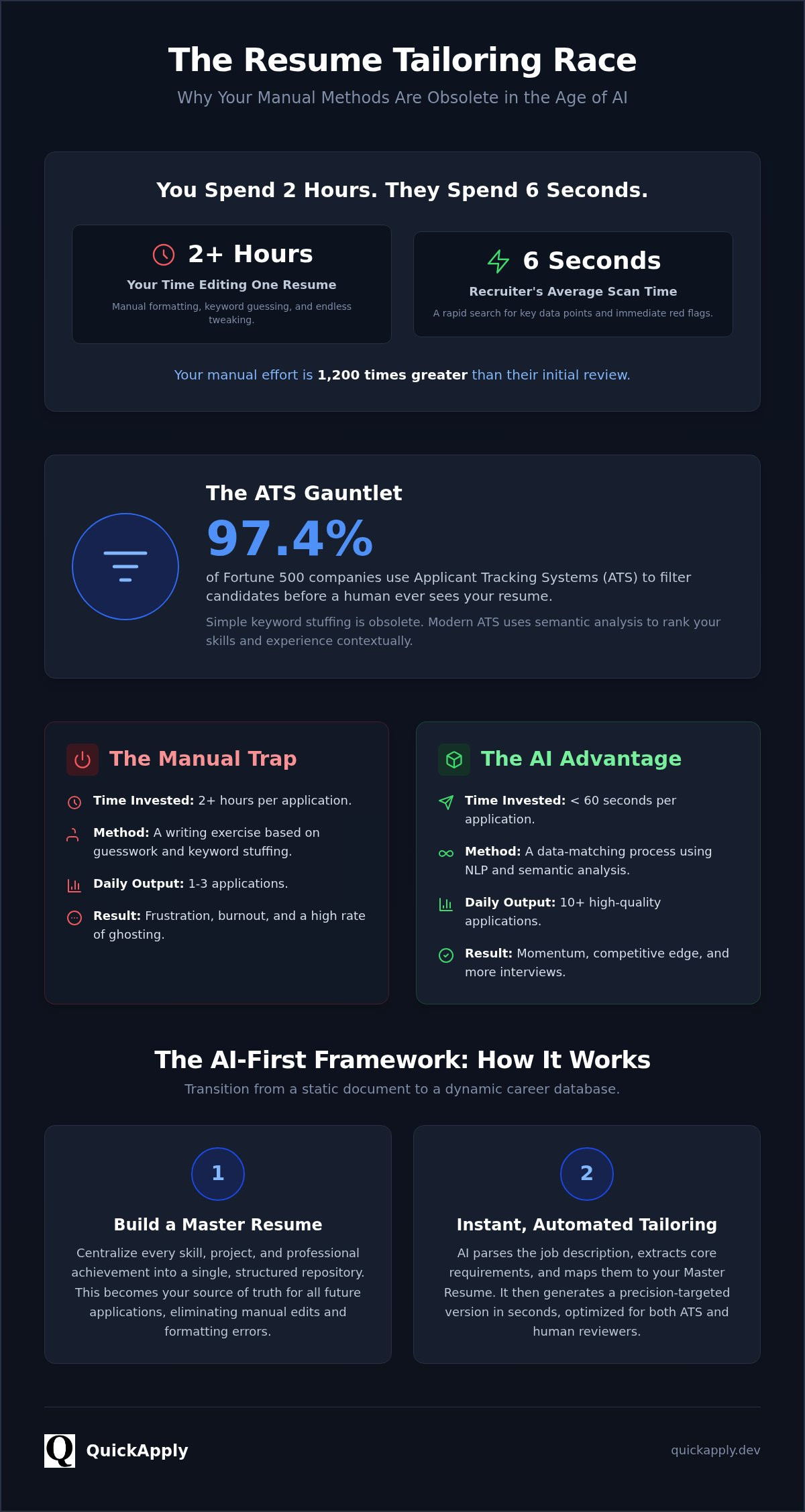
Recruiters don't read resumes. They scan for specific data points. Industry metrics confirm the average human scan lasts just six seconds. When you spend an hour manually drafting a custom version, you invest 600 times more effort than the person reviewing it. The math doesn't work. This massive disconnect often results in buried achievements. Manual edits frequently clutter the visual hierarchy, making it harder for a human to find the match they need. Time is your edge. Don't waste it on formatting that no one notices.
The old advice says to focus on quality by spending hours on a single application. This is a myth. In the current market, quality is defined by data accuracy and relevance, not the time you spent staring at a screen. If you aren't using the fastest way to tailor a resume for each job, you are artificially limiting your reach. High-volume, high-precision output is the only way to beat the statistical odds of modern hiring.
The Failure of Manual Keyword Stuffing
Traditional methods suggest highlighting keywords in a job description and pasting them into your CV. This approach is obsolete. Modern Applicant Tracking Systems (ATS) use semantic analysis to understand the context of your experience. They don't just count words; they evaluate skill clusters. Manual stuffing often triggers red flags in these systems because it lacks the logical flow expected by modern resume standards.
Attempting to guess which terms an algorithm wants is a losing game. Most candidates fail because they focus on exact-match phrases rather than contextual relevance. To see how your current version stacks up, use an ATS resume checker to identify gaps in your semantic profile. Machine-learning evaluators can spot human-inserted keyword blocks instantly. You need a system that integrates these terms naturally into your professional narrative.
Beyond the technical failure, manual tailoring is emotionally draining. Spending a full evening on one application only to get ghosted leads to burnout. It makes the job search feel like a struggle instead of a series of calculated moves. By finding the fastest way to tailor a resume for each job, you reclaim your mental energy. You move from a state of frustration to a state of continuous productivity.
The AI-First Framework: The Fastest Way to Tailor Your Resume
Efficiency is the only metric that matters in a high-volume job search. Transitioning from a manual workflow to an AI-first framework isn't just a minor improvement; it's a total system upgrade. By treating your career history as a structured dataset rather than a static document, you unlock the ability to generate precision-targeted applications instantly. Implementing an AI-first framework is the fastest way to tailor a resume for each job because it removes the cognitive load of manual writing and replaces it with algorithmic accuracy.
Building Your Master Resume Database
Stop editing your original PDF. Every time you open your base file to make "quick tweaks," you introduce formatting errors and risk losing critical data. Instead, centralize every achievement, tech stack, and project into a Master Resume. This document should be an exhaustive repository of your professional value, structured for machine readability. When your data is clean, AI can parse it without friction. If you need a starting point for this structure, review these good resume examples to ensure your baseline is optimized for 2026 standards.
Your master file acts as the source of truth. When you find a role, you don't rewrite your history; you simply filter it. This database approach ensures that you never miss a relevant skill because you forgot you had it. It allows you to maintain a high-quality baseline while scaling your output. You can automate this entire workflow using AI-driven resume tailoring to save hours of manual labor every single day.
Instant Extraction and Mapping
Modern job descriptions are often cluttered with corporate fluff that obscures the actual technical requirements. Natural Language Processing (NLP) solves this by stripping away the noise to identify core competencies. AI identifies "hidden" requirements by analyzing the context of the role, such as the specific versioning of a framework or the implicit seniority level required for a task. Once these requirements are extracted, the system performs semantic mapping. Semantic mapping is the process of aligning the intent and proficiency level of your past achievements with the specific technical requirements found in a job description.
- Step 1: Feed the job description into the NLP engine to isolate essential skill clusters.
- Step 2: Map your master bullets to these requirements to ensure a high match score.
- Step 3: Audit the final version for semantic relevance, ensuring the language reflects the specific dialect of the hiring company.
- Step 4: Export the tailored version and log it in your tracker for follow-up.
This automated mapping process eliminates the need to manually rephrase every bullet point. The software handles the linguistic heavy lifting, ensuring your experience is presented in the exact context the ATS expects. You move from a "best guess" strategy to a data-driven submission in under 60 seconds.
Decoding the 2026 ATS: Beyond Simple Keywords
The 2026 job market operates on a new logic. Modern Applicant Tracking Systems (ATS) have evolved from simple database filters into sophisticated evaluators. They don't just look for words. They look for meaning. If you are still using manual keyword stuffing, you are invisible to these systems. Mastering semantic relevance is the fastest way to tailor a resume for each job because it aligns your history with the AI's internal reasoning patterns.
Understanding Semantic Relevance
In 2026, AI logic understands that "Java" is a subset of "Backend Engineering." If a job post asks for a backend specialist but your resume only lists specific languages without context, the algorithm might rank you lower than a candidate who demonstrates a broader skill cluster. AI evaluators group related skills together to determine your overall proficiency. They analyze how your skills relate to one another to build a profile of your actual capabilities.
For example, a cluster might include "Python," "Django," and "REST APIs." If you have two of the three, the AI infers your capability in the third. You cannot achieve this level of nuance manually. Using a tool to tailor resume to job description ai ensures your skills are clustered correctly for the specific role. This contextual alignment is what moves your application from the general pool to the interview shortlist.
The Match Score Advantage
Every application you submit receives a match score. This percentage represents how closely your data aligns with the job's technical requirements. Recruiter shortlists are heavily influenced by these AI match scores, often prioritizing candidates who land in the top 10% of the scoring bracket. Understanding this metric allows you to stop guessing and start measuring your success.
A 90% match is often superior to a 100% match. Perfect scores often look like "gaming the system" to modern algorithms, which are trained to detect exact-match keyword stuffing. Aim for high relevance without sacrificing authenticity. Use these scores to prioritize your time. Focus your energy on roles where you have a high match score. This data-driven approach allows you to ignore low-probability opportunities and focus on high-yield targets.
Formatting also plays a critical role. While humans appreciate aesthetics, AI prioritizes clean data structures. Avoid complex tables, images, or non-standard fonts. These elements create noise that interferes with semantic parsing. Stick to standard layouts that allow the AI to extract your skill clusters without errors. Efficiency in 2026 is about being machine-readable first and human-readable second.
Efficiency Comparison: Manual vs. AI-Powered Tailoring
Manual tailoring is a legacy bottleneck. It forces you to trade hours for a single submission, creating a high-friction workflow that limits your career growth. AI-powered systems flip this ratio by treating your career history as a scalable dataset. By automating the data-matching process, you achieve a level of precision that manual editing cannot replicate. This is the fastest way to tailor a resume for each job because it removes the human latency from your application pipeline, allowing you to move at the speed of the market.
The difference in output is measurable. Consider the following performance metrics:
- Time per application: 45 minutes (Manual) vs. 45 seconds (AI)
- Keyword accuracy: 60% (Manual) vs. 98% (AI)
- Application volume: 2 per day (Manual) vs. 20+ per day (AI)
- Tracker integration: Manual spreadsheet entry vs. Automatic system logging
Manual methods rely on guesswork. You hope you caught the right keywords, but human error often results in a 60% accuracy rate at best. AI uses semantic analysis to ensure 98% accuracy against the job description every time. This precision is impossible to maintain manually over dozens of applications. Automation keeps your quality ceiling high regardless of your daily volume.
The ROI of Application Speed
A slow job search has a literal cost. Every day you aren't employed in a high-paying tech role is lost revenue. Volume increases your probability of landing interview invites by widening your top-of-funnel reach. If you only apply to two roles a day, your funnel is too narrow to survive the 2026 rejection rates. Scaling to 20 or more applications daily shifts the statistics in your favor. Use a job application tracker to manage this high-volume output. Automatic logging ensures you never miss a follow-up or lose track of which version you sent to which recruiter.
Consistency Across the Funnel
Efficiency isn't just about the resume. Your narrative must be consistent across every touchpoint. If your resume is perfectly tailored but your cover letter is a generic template, the ATS and human recruiters will detect the mismatch. Using an ai cover letter generator ensures your professional story remains aligned across all documents. Automation reduces application burnout. It prevents the mental fatigue that comes from repetitive, low-value manual tasks. You stay sharp for the interviews that actually matter. Reclaim your time and optimize your search with automated resume tailoring to start seeing results today.
Scale Your Success: Implementing QuickApply’s Instant Tailoring
Manual processes are the enemy of scale. In the 2026 job market, you cannot afford to spend your limited energy on repetitive data entry. QuickApply provides the fastest way to tailor a resume for each job by automating the mapping of your professional history to specific technical requirements. By uploading your baseline data to the QuickApply engine, you create a dynamic repository that the AI uses to rebuild your profile for every new opportunity. This system turns a multi-hour manual task into a sub-sixty-second background process, allowing you to focus on the roles that actually matter.
One-Click Customization
QuickApply’s AI doesn't just swap keywords. It re-engineers your resume by analyzing the specific tech stack, framework versions, and seniority levels required for a role. The engine identifies the semantic intent behind job descriptions and maps your achievements to those needs instantly. You get a precision-targeted document that maintains your authentic voice while satisfying the most rigorous ATS filters. This balance is critical. It ensures you pass the algorithm and impress the human recruiter during the final scan. Start tailoring your resume for free with QuickApply to experience this level of efficiency firsthand.
The software handles the linguistic heavy lifting. It ensures your bullet points reflect the exact proficiency levels the employer expects. You move from a "best guess" strategy to a data-driven submission in seconds. This speed allows you to be the first applicant in the door for new postings, giving you a distinct competitive advantage over candidates stuck in manual editing cycles.
Complete Career Management
Applying is only the first phase of the operation. Managing a high-volume pipeline requires organization that a standard spreadsheet cannot provide. QuickApply’s built-in application tracker logs every version of your resume and cover letter sent to every company. You'll never walk into an interview wondering which version of your history the recruiter is holding. This centralized system provides a clear view of your funnel, showing you exactly where you stand with every target employer.
Once you land the invite, the system transitions you from "applying" to "interviewing." You can use integrated practice tools to rehearse based on the specific skills you highlighted in your tailored resume. For those who want an extra edge, using a final round ai real-time copilot can help you navigate complex technical questions with confidence. Efficiency doesn't end with the submission. It carries through to the offer. Move faster, apply smarter, and dominate the 2026 job market with a system built for speed.
Optimize Your Career Pipeline
Manual tailoring is a relic of a slower era. In 2026, landing a top-tier tech role requires moving at the speed of the market. You've seen why traditional methods fail against modern semantic filters and how an AI-first framework can 10x your application volume without sacrificing quality. By centralizing your data and using NLP to map your skills, you bypass the cognitive load of rewriting every bullet point. This isn't just a convenience; it's the fastest way to tailor a resume for each job while maintaining 98% keyword accuracy. You can now shift your focus from the tedious task of application submission to the high-value work of interview preparation. Don't fight algorithms with manual effort. Start leveraging systemic automation to secure your next offer.
Tailor your resume in seconds with QuickApply and access AI-powered match scoring, instant cover letter generation, and an integrated tech-job tracker. Your competitive advantage is just 60 seconds away.
Frequently Asked Questions
How often should I tailor my resume?
Tailor your resume for every single application without exception. Sending a generic document is the primary reason for instant rejection in 2026. Modern hiring systems prioritize relevance over general experience. If you aren't using the fastest way to tailor a resume for each job, you're simply wasting your time on submissions that will never be seen by a human recruiter. High-frequency tailoring ensures your profile remains at the top of the candidate stack.
Is it okay to use AI to tailor my resume for every single job?
Using AI for every application is not just okay; it is a competitive necessity. With 97.4% of Fortune 500 companies using an ATS, manual editing is too slow to be effective. AI tools ensure your data is machine-readable while maintaining a high match score. This approach allows you to scale your output to 20 or more applications daily. It is the most efficient method to bridge the gap between your talent and a specific job description.
What is the fastest way to tailor a resume manually if I don’t have tools?
The most efficient manual method involves maintaining a comprehensive master resume. You must identify the top three technical requirements in a job post and swap your primary bullet points to match. However, this manual process still takes 45 minutes per role. It is prone to human error and keyword misses. While possible, manual tailoring is a legacy workflow that limits your ability to compete with candidates using automated systems to secure interview invites.
Can recruiters tell if a resume was tailored by AI?
Recruiters can only identify AI usage if the content is generic or repetitive. High-quality AI tailoring uses semantic mapping to integrate your real achievements into the job's context. This creates a natural professional narrative that mirrors human writing. The key is using a tool that prioritizes skill clusters rather than simple keyword stuffing. When done correctly, your resume looks like a perfect fit, not a machine-generated template.
How do I tailor my resume for a job I have no experience in?
Focus on transferable skill clusters and relevant personal projects. Use AI to identify the core competencies the role requires and map your existing achievements to those themes. If you lack direct industry experience, emphasize your technical proficiency in the underlying tools or frameworks. This strategy allows the ATS to recognize your potential match score despite a non-traditional background. It turns your diverse history into a structured asset for a new career path.
Does tailoring my resume actually increase my chances of getting hired?
Tailoring significantly increases your callback rate. Research shows that resumes optimized for specific job descriptions receive higher match scores, which directly influences recruiter shortlists. In a market where 73% of employers use AI for hiring decisions, relevance is the only metric that matters. A tailored resume demonstrates immediate value. It proves you understand the company's technical needs and possess the exact skills required to solve their specific problems.
What part of the resume is the most important to tailor?
The professional experience section and the technical skills list are the most critical areas to optimize. These sections carry the most weight in semantic analysis. You must ensure your bullet points use the same technical dialect as the job description. Tailoring your professional summary also provides an immediate hook for human recruiters during their 6-second scan. These high-impact zones determine whether your application moves forward or stays buried in the database.
Should I also tailor my cover letter for every job?
You should absolutely tailor your cover letter for every submission. A generic cover letter creates a narrative disconnect that can raise red flags for recruiters. Consistency across your entire application package reinforces your match score. Automated tools can generate job-specific cover letters in seconds, ensuring your professional story aligns perfectly with your tailored resume. This unified approach projects a high level of professionalism and technical competence to potential employers.


