

A career break belongs on your resume, but it shouldn’t define it. A resume for returning to work after being a stay-at-home parent can list your parenting period, earlier jobs, relevant volunteer or freelance work, and skills that match the role. Focus each entry on concrete responsibilities and accomplishments, not a list of everyday parenting duties.
It’s easy to assume years away from paid work leave you with nothing current to show. They don’t erase your earlier experience, and they don’t prevent you from highlighting relevant projects, training, or community work. The key is to connect what you’ve done to the job you want.
Use this guide to choose a resume format, explain your career break clearly, and turn relevant experience into accomplishment-focused examples. You’ll also learn how to tailor your resume for full-time, part-time, or freelance work, so each application reflects your goal instead of relying on a one-size-fits-all template.
Key Takeaways
- Choose a resume format that makes your most relevant experience easy to spot, whether that means emphasizing skills, recent work, or a blend of both.
- Turn past jobs, volunteer roles, and projects into accomplishment-focused entries that show what you contributed.
- Define your preferred schedule and work arrangement so your resume aligns with full-time, part-time, or freelance opportunities.
- Address your caregiving break briefly and professionally, then give the strongest space to experience and skills that fit the role.
- Use targeted examples to adapt your resume for each opportunity instead of sending the same version everywhere.
How do you write a resume after not working for years?
Choose a format that puts your strongest, job-relevant evidence first. Arrange your work history, skills, education, and career break so employers can scan them quickly.
-
Compare Chronological, Functional, and Combination Formats
Compare the three formats against your recent work history and target role. A chronological format lists experience by date and can include a stay-at-home parenting period in the experience section. A functional format organizes skills rather than emphasizing work history. A combination format pairs a skills section with a dated employment record, balancing capabilities and career timeline.
A candidate with several strong recent roles may use reverse-chronological order, placing the latest job first. Someone whose strongest evidence comes from older jobs or community projects may prefer a combination format. A functional format can foreground skills, but don’t let it obscure employers, titles, or dates. Make sure your relevant evidence is easy to find.
-
Choose a Format for a Career Break
Match the format to the strength and recency of your professional experience. Choose reverse-chronological order when your work history is strong and sufficiently recent. If a long gap makes that timeline less useful, consider a functional or combination format. A combination resume can connect transferable skills with earlier roles, while a functional resume can make specific capabilities more visible.
Next, identify the strongest evidence for your target role. If you have a degree, certification, or recent training, place education near the top so it appears during an initial scan. For a project-focused role, feature relevant skills before older employment details. Don’t choose a functional format simply to hide a gap. Keep your dates and career timeline clear, even when skills lead.
-
Arrange and Format Resume Content
Arrange sections by relevance, not habit. Put your name and contact details first, followed by a concise summary and the section that best supports your target role. That may be skills, experience, or education. A candidate with a recent certification can place education above older work history; a candidate with relevant recent employment can lead with experience.
Use consistent headings, dates, spacing, and bullet styles throughout. Under each role, show the title, employer, dates, and relevant responsibilities or accomplishments. Label the parenting period clearly if it appears in experience, rather than disguising it with a vague title. Before sending, scan the resume from top to bottom and check that your most relevant skills, certifications, and work examples stand out.
Describing work experience with accomplishment-focused examples
Build each entry around evidence: what you did, who benefited, and what changed. Use the same method for paid work, volunteer roles, freelance projects, and relevant community responsibilities.
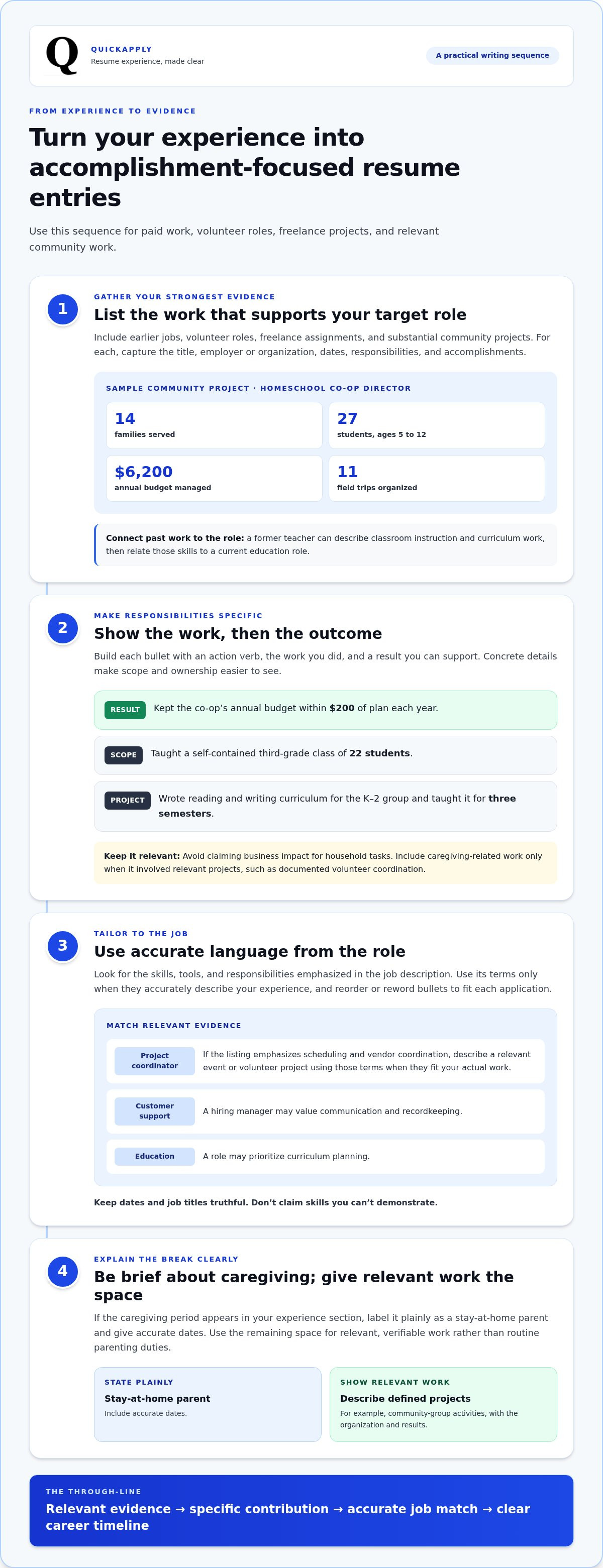
- Start with your strongest evidence. List earlier jobs, volunteer roles, freelance assignments, and substantial community projects. Include job titles, employers or organizations, dates, responsibilities, and accomplishments. A gap doesn’t erase earlier experience, even if those roles happened years ago. For example, a former teacher can describe classroom instruction and curriculum work, then connect those skills to a current education role.
Keep the details specific. A sample homeschool co-op director served 14 families and 27 students ages 5 to 12, managed an annual budget of $6,200, and organized 11 field trips. Those facts show scope more clearly than “helped run a group.”
- Turn responsibilities into outcomes. Use an action verb, name the work, and include a result when you can support it. The co-op director kept the annual budget within $200 of plan each year. A sample teacher taught a self-contained third-grade class of 22 students. These examples show scale, ownership, and results without inflated language.
Review each bullet for a concrete detail: a budget managed, a process completed, a curriculum created, or a group coordinated. The sample co-op director wrote reading and writing curriculum for the K-2 group and taught it for three semesters. Avoid claiming business impact for household tasks. Include caregiving-related work only when it involved relevant projects, such as documented volunteer coordination.
- Match resume language to the job description. Identify the role’s repeated skills, tools, and responsibilities, then use accurate terms from the posting. If a project coordinator listing emphasizes scheduling and vendor coordination, describe a relevant event or volunteer project using those terms only when they fit your actual work. Don’t claim skills you can’t demonstrate.
Check the description against your experience, education, and certifications. A manager hiring for customer support may value communication and recordkeeping; a role in education may prioritize curriculum planning. Tailor the order and wording of your bullets for each application, while keeping dates and job titles truthful. Tailor resume wording to a job description as you prepare each version.
- Describe the caregiving period clearly and briefly. If you include it in experience, label it plainly as a stay-at-home parent and give accurate dates. Use the remaining space for relevant, verifiable work rather than routine parenting duties. If you led a community group, organized its activities, or managed a defined project, describe that work separately, with the organization and results.
For every bullet, ask whether a hiring manager can see the skill and evidence quickly. Replace broad claims like “excellent organizer” with an example, such as coordinating 11 field trips for a homeschool co-op. Keep each application focused on the employer’s stated needs.
Identifying full-time, part-time, or freelance work goals
Include volunteer and freelance work as experience when it demonstrates skills relevant to your target role. Label caregiving clearly, and focus its entry on relevant projects rather than routine parenting duties.
- Choose the work arrangement you’re targeting. Decide whether you’re pursuing full-time, part-time, or freelance roles before editing your resume. Then compare your preferred arrangement with the job description’s schedule, responsibilities, and employment type. A full-time operations role may call for examples of ongoing coordination, while a part-time role may prioritize specific skills and availability.
Make your target visible in your summary and the experience you emphasize. If you’re open to more than one arrangement, prepare tailored versions rather than combining unrelated goals in one document. For example, a resume for a freelance writing project can foreground writing assignments, while one for a part-time administrative role can feature scheduling and recordkeeping.
- Add contract, temporary, and freelance work. List each relevant assignment with its role or service, client or organization, dates, and results. Present contract and temporary positions as work experience, not unexplained gaps between permanent jobs. A freelance bookkeeper, for instance, can describe the records maintained and reports delivered, using accurate details from the work.
Group short assignments under a freelance heading when that makes the timeline easier to scan. Keep client names or project descriptions clear, and distinguish paid work from volunteer activity. Include courses or training when they directly support the type of contract you want, such as a relevant software course for a virtual administrative project.
- Give volunteer work its own evidence. Name the organization, role, dates, and relevant work, just as you would for a paid position. Quantify scope when you can support it. For example, a sample stay-at-home parent resume describes creating a local parenting group on Facebook with over 60 members. That detail shows community-building more clearly than “helped parents connect.”
Connect volunteer duties to the target role without overstating them. Event coordination can demonstrate planning; donation records can show careful recordkeeping. If you organized a fundraiser, describe the actual tasks and results. Don’t present volunteer work as paid employment or claim outcomes you can’t substantiate.
- Separate caregiving from professional accomplishments. If you include full-time parenting in experience, label it plainly and use accurate dates. Keep routine childcare details off the resume. Instead, give relevant volunteer, freelance, or community projects their own entries, with specific responsibilities and outcomes. For example, list a volunteer committee role separately from the caregiving period if you coordinated its schedule.
Review each entry against the role you want. A full-time project coordinator application may benefit from relevant volunteer planning work; a freelance role may call for client assignments and samples of completed work. Keep your strongest evidence visible, and remove details that don’t support that specific goal.
What should your stay-at-home mom resume include?
Include the career break clearly, then use your summary and supporting sections to focus attention on your next role. Keep the explanation brief and give more space to relevant experience, education, skills, and training.
-
Include a Career Break on the Resume
List the caregiving period in your experience section if it helps clarify your timeline. Use a straightforward title, such as “Stay-at-Home Parent,” and accurate dates. Add relevant, specific work only when it involved a project, volunteer role, or community responsibility. Don’t present routine parenting tasks as professional qualifications or leave the timeline unclear to conceal the break.
A parent who ran a community group, for example, can list that role separately, with its organization and relevant responsibilities. Keep the caregiving entry distinct from paid employment. This acknowledges the transition without making it the focus of the resume. If you prefer, mention the break briefly in your objective or explain it in your cover letter instead.
-
Write a Professional Summary After a Break
Open with your professional identity and the value you bring to the target role. A former marketing associate might lead with research, communications, and problem-solving experience, then mention a relevant recent course or certification. Keep the summary focused on evidence, not an apology for time away. Avoid vague claims like “hardworking parent” that don’t show job-related capability.
Tailor the summary to each posting. For an administrative position, emphasize relevant scheduling, coordination, or recordkeeping experience. For a teaching role, foreground classroom experience, education, or recent training. Use the employer’s language when it accurately describes your background, and make sure every skill in the summary has supporting evidence elsewhere.
- Use a Cover Letter to Explain the Transition
Write a cover letter when your employment gap needs more context, particularly after a few years away from paid work. Briefly say that you took time away to care for family, then pivot to your readiness and relevant qualifications. For example: “After a career break to care for my family, I’m prepared to bring my prior customer service experience and recent training to this role.”
Keep the explanation direct. Don’t disclose private family details or devote the letter to defending the gap. Use the remaining space to connect a previous accomplishment, relevant volunteer work, or recent education to the employer’s needs. A focused explanation gives the reader context while keeping your application centered on your fit.
Resume examples for returning to work
Use examples as templates, not scripts. Keep every detail accurate, then adjust the format and evidence to match your target role.
- Build a teacher resume around classroom evidence. Start with a clear target, such as “Elementary teacher returning to classroom instruction.” A sample teacher resume describes a return after eight years at home with three children. It also reports teaching a second-grade class of 20 students. Those details make the career path and classroom experience easy to scan.
Structure the entry with the title, school or organization, dates, and relevant responsibilities. Add teaching methods, curriculum work, or recent training only when they reflect your actual background. Keep the career break concise, then provide evidence of teaching experience. This example works best for education roles because classroom experience directly supports the target.
- Translate earlier experience into a focused summary. A sample objective describes a marketing associate with four years of research, communications, and problem-solving experience. Use that model to lead with your prior professional identity, then connect it to the role you want now. For example, name the function and your strongest relevant skills before mentioning a career transition.
Keep the summary specific to the posting. A marketing application could foreground research and communications; a school role should emphasize classroom or curriculum experience. Don’t use a generic objective that could fit any job. Follow the summary with matching experience, education, and relevant certifications so every claim has supporting evidence elsewhere on the page.
- Show recent projects with clear scope. A sample stay-at-home parent resume describes overseeing remote schooling for three children ages five to 11. That example can help identify relevant project work, but it shouldn’t be presented as paid teaching experience. If you apply for an education role, label the activity accurately and emphasize relevant planning or learning support without implying employment at a school.
Use a similar approach for community or volunteer work. State the organization or project, your role, and the work completed. Keep it separate from paid jobs so a hiring manager can understand the context. Include only details that demonstrate skills the target role needs, and leave routine caregiving duties off the resume.
- Adapt the example to your own evidence. Replace sample details with your real job titles, employers, dates, accomplishments, and training. A resume example can show how to format a transition, but it can’t supply your results. Check each line for accuracy, relevance, and clear context. Then compare the finished version with the job description and move the strongest matching evidence higher.
Build a tailored version for each distinct target, such as classroom teaching or marketing. Tailor your resume to a specific job and align its strongest examples with the role’s requirements.
QuickApply: Resume Tailoring
QuickApply tailors resumes and generates cover letters for specific job descriptions. Use it when adapting a strong base resume to different roles and you want each application to reflect the posting. Its match score can help identify opportunities that align with your experience, while the application tracker keeps your search organized. You can also use Interview Practice to prepare for conversations about your career break, transferable skills, and return-to-work goals.
Keep your details accurate, then review each tailored document before submitting. Make sure it represents your real experience and the role you’re pursuing. Visit QuickApply to tailor your next application.
Turn Your Next Application Into a Starting Point
A resume for returning to work after being a stay-at-home parent can mark a new professional chapter, not just explain time away. Treat each application as a focused step: choose a role that fits your goals, submit materials that represent your experience, and use each interview to sharpen how you describe your strengths.
QuickApply supports that process with Resume Tailoring, Cover Letter Generation, and Interview Practice. Use these tools to prepare application materials and practice communicating your value in your own words. Keep your choices grounded in the work you want next, and make each step reflect your direction.
Contact QuickApply for resume help and take the next step toward work that fits your goals. You’re ready to move forward with purpose.
Frequently Asked Questions
How do you write a resume after a career gap for stay-at-home parents?
Start with the role you want, then build your resume around relevant evidence. Include previous jobs, education, training, and community or freelance projects that support your application. Make the career break clear rather than leaving unexplained dates. For instance, a candidate pursuing office administration can prioritize relevant records, scheduling, or customer service experience, then use the cover letter to briefly explain time away.
Should stay-at-home parenting be listed as work experience on a resume?
You can include a stay-at-home parenting period to make your timeline understandable, but don’t present it as paid employment. Use a plain label and accurate dates. List substantial volunteer or community work separately, with its own organization and role. For example, if you coordinated a school fundraiser, describe that project under the school or volunteer group, not as a job title for parenting.
How do you explain a parenting career gap on a resume and in interviews?
Keep the explanation brief, factual, and focused on your return. On a resume, a clear label can establish the timeline; in a cover letter or interview, say you took time away to care for family and are now pursuing the role. Then shift to your fit. For example, connect a prior customer service role to the communication needs in the job posting.
What is the best resume format for returning to work after years at home?
The best format depends on whether your dated work history or relevant skills make the stronger case. Use reverse-chronological order if recent roles support your target. Choose a combination format if you need to foreground capabilities while showing employment history. For example, a career changer with related volunteer projects may lead with relevant skills, then show those projects and earlier paid work.
How can you highlight transferable skills from parenting on a resume?
Use skills only when you can connect them to a specific, relevant activity. Routine caregiving alone isn’t a substitute for professional evidence. Instead, identify a volunteer project, course, or community responsibility that demonstrates the skill. For example, describe maintaining event records when applying for administrative work. This gives employers a concrete example instead of asking them to infer job qualifications from parenting.
Where can you find resume examples for parents returning to work after a career break?
Use examples as layout guides, then replace their content with your own verified experience. Look for samples that match your target field, such as education, administration, or marketing, and notice how they organize experience and training. A sample volunteer entry might show the role, organization, and project. Don’t copy another candidate’s dates, results, or accomplishments; those details must reflect your own work.
How do you tailor a resume to a job description after a long career gap?
Compare the posting with your experience before editing. Identify its core responsibilities, tools, and qualifications, then select truthful examples that show the closest match. If a role emphasizes recordkeeping, feature a relevant project involving accurate records rather than unrelated volunteer work. Adjust the summary and skills section for that opportunity, but keep job titles, dates, and credentials consistent with your actual history.
Should a resume include dates or use a skills-based format after a career gap?
Include dates for jobs and relevant projects so employers can follow your work history. A skills-based layout can emphasize capabilities while still giving employers a clear picture of your experience. For example, group skills near the top, then support each with a dated role, course, or volunteer project. Use consistent date formatting throughout, and show the career break clearly if it helps explain the timeline.


