

Around 70% of employees in the United States feel undervalued, underused, or stuck at work. If you’re wondering what to do when you feel stuck in your tech career, start by identifying what’s stalled: your growth, your day-to-day work, or your direction. Then choose one practical move, such as discussing your goals with your manager, applying your skills in a new context, or exploring a different role.
Feeling stuck doesn’t automatically mean you need to leave tech. It may mean your current role isn’t using your strengths or moving you toward the work you want. That’s frustrating, but it gives you a clear place to start.
Use this guide to spot signs of career stagnation, assess whether your role supports your growth, and choose a next step that fits your situation. You’ll also find practical ways to refresh your skills, explore new paths, and show employers how your experience can transfer.
Key Takeaways
- Separate a temporary dip in motivation from a pattern of stalled responsibilities or missed opportunities.
- Map your strongest skills to roles and projects where you can use them in a new way.
- Explore emerging areas of tech by identifying the skills they require and choosing one to build next.
- Talk with people doing work that interests you to get a clearer picture of the day-to-day reality before making a pivot.
- Make your experience stand out by showing the judgment, ownership, and results you bring beyond technical skills alone.
What to do when you feel stuck in your tech career
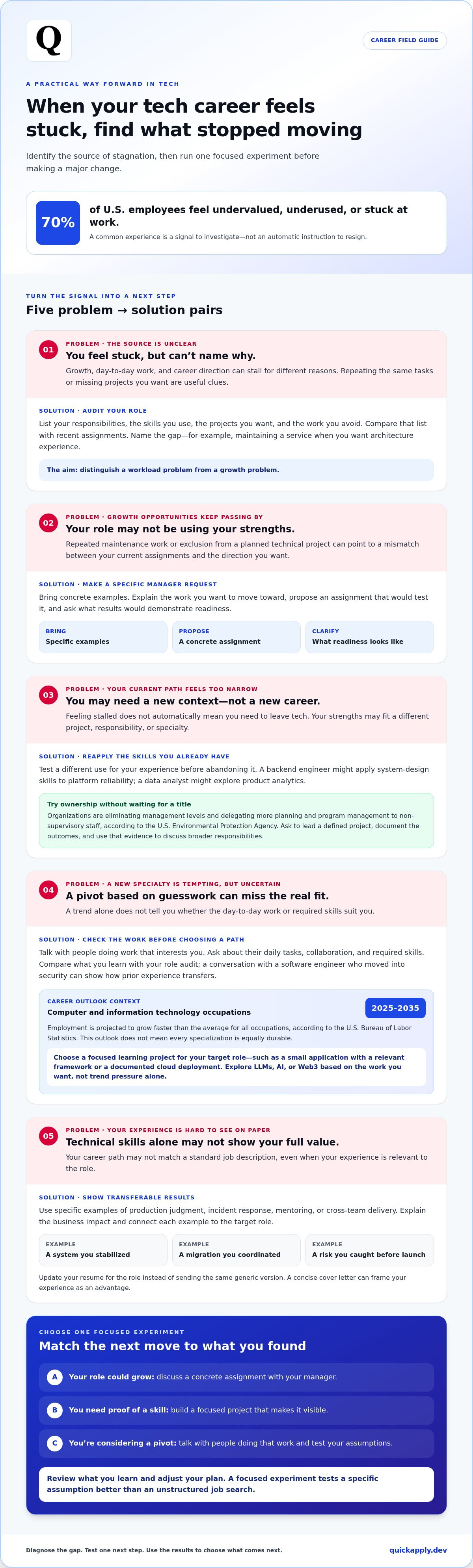
Around 70% of employees in the United States feel undervalued, underused, or stuck at work. In tech, stagnation can look like repeating the same tasks for years after promised growth. It can also mean missing technical projects that match your goals. Treat these patterns as evidence to examine, not an automatic instruction to resign. A practical answer to what to do when you feel stuck in your tech career starts with identifying what has stopped moving.
Before making a major change, audit your role. List your responsibilities, the skills you use, the projects you want, and the work you avoid. Then compare that list with your recent assignments. If you maintain the same service but want architecture experience, for example, name the gap. Ask whether your role is building relevant skills or preventing you from using them. This helps distinguish a workload problem from a growth problem, so your next step addresses the real cause.
Then discuss the pattern directly with your manager. Patty McCord, Netflix’s Chief Talent Officer for 12 years, advises people to raise career concerns openly with their boss. Bring specific examples, such as repeated maintenance work or exclusion from a planned technical project. Explain the direction you want and propose a concrete assignment that would test it. Ask what results would demonstrate readiness for that work. McCord described an employee who wanted six months away to build sod houses, and said people wanting six months or longer away probably want to quit. Use that idea as a prompt to assess your motivation, not as a rigid decision rule.
If your role offers limited room to grow, test a different use for your existing skills before abandoning them. A backend engineer might apply system-design experience to platform reliability; a data analyst might explore product analytics. According to the United States Environmental Protection Agency, organizations are eliminating management levels and delegating more planning and program management to non-supervisory staff. That shift may create opportunities to demonstrate ownership without waiting for a manager title. Ask to lead a defined project, document its outcomes, and use that evidence to discuss broader responsibilities.
Keep your technical skills current while you assess options. Employment in computer and information technology occupations is projected to grow faster than the average for all occupations from 2025 to 2035, according to the U.S. Bureau of Labor Statistics. That outlook does not make every specialization equally durable. Review the tools and systems used in your target roles, then choose a focused learning project that produces visible work. You could build a small application using a relevant framework or document a cloud deployment. Explore emerging areas such as LLMs, AI, or Web3 based on the work you want, not trend pressure alone.
If you’re considering a career change, replace guesswork with conversations. Talk with people doing work that interests you about their day-to-day tasks, collaboration, and required skills. For example, ask a software engineer who moved into security how their previous experience applies. Compare what you learn with your role audit. This can help you decide whether you want a new specialty, a different company environment, or a broader change. Update your resume to show transferable results, and tailor each application to the role instead of sending the same generic version.
Make your value clear, especially if you’re mid-career. A recent graduate may bring current coursework; you may bring production judgment, incident response, mentoring, or cross-team delivery. Give specific examples: a system you stabilized, a migration you coordinated, or a risk you identified before launch. Explain the business impact and connect each example to the target role. A concise cover letter can frame your experience as an advantage when your career path doesn’t match a standard job description.
Choose one next step based on what you’ve learned. If your role could grow, talk with your manager. If you need proof of a new skill, pursue a project. If you’re considering a pivot, interview people doing that work. Review what you learn and adjust your plan. A focused experiment beats an unstructured job search because it tests a specific assumption about your career.
A useful next step is to keep skills fresh and explore emerging fields such as LLMs, AI, or Web3. If growth remains limited, apply existing skills in a different environment or context.
QuickApply: Resume Tailoring
Once you’ve identified a role or specialty to pursue, QuickApply can tailor your resume to its job description. Use the tailored version to connect your experience with the posting’s requirements. Highlight relevant projects, technical strengths, and measurable outcomes instead of sending the same resume for every opportunity.
QuickApply also provides cover letter generation, interview practice, and an application tracker. Use them to prepare for each stage and keep your search organized as you explore a new direction. These tools support your application process, while the career decision remains yours. Start with QuickApply to prepare your next application.
Turn Your Next Move Into Momentum
Deciding what to do when you feel stuck in your tech career gets easier when you treat your next move as a deliberate test, not a verdict on your abilities. Choose a direction that interests you, then make your experience visible to employers hiring for it. Each application can clarify how your skills fit and what you want to build next.
QuickApply helps you prepare with Resume Tailoring, Cover Letter Generation, and Interview Practice. Use these tools to present your experience clearly and get ready to explain why you’re pursuing a new opportunity. Focus on what you bring and the problems you can solve.
Contact QuickApply for support as you prepare for your next application. You don’t need a perfect plan to make progress. Start with one intentional step, learn from it, and keep moving toward work that fits.


