

The traditional job search is dead. If you're still manually editing every bullet point for every application, you've already lost the race. You likely feel the weight of an endless backlog, watching your spreadsheet grow while your response rate stays flat. It's exhausting to fight an automated system with manual labor. Learning how to organize a high-volume job search is no longer about working harder; it's about building a better machine.
You know the frustration of being ghosted by an anonymous ATS and the burnout that comes with repetitive tailoring. We're going to turn your search into a streamlined, high-output pipeline. This 2026 playbook promises to help you master the AI tools and systems required to manage 50+ high-quality applications per week without the burnout. You'll move from manual entry to automated execution. We'll cover how to deploy AI-powered resume tailoring and build a unified application tracker that does the heavy lifting for you. It's time to stop chasing opportunities and start processing them.
Key Takeaways
- Shift your strategy from manual tracking to a system-led pipeline to master how to organize a high-volume job search effectively.
- Replace outdated spreadsheets with an automated tracker to centralize application data and eliminate repetitive manual entry.
- Scale your application volume while maintaining high quality by deploying AI-ready resumes that pass modern ATS filters.
- Optimize your daily schedule with time-blocking techniques designed to manage sourcing, tailoring, and interview follow-ups.
- Use Match Scores to prioritize the most relevant opportunities and drive higher interview conversion rates with less active effort.
The High-Volume Mindset: Why Manual Tracking Fails in 2026
The traditional job hunt is dead. Mastering how to organize a high-volume job search requires a fundamental shift in perspective. You aren't just an applicant; you're a systems engineer managing a lead pipeline. In the 2026 market, volume isn't about spamming resumes. It's about strategic, high-frequency deployment. If you treat every application as a unique manual project, you'll never achieve the scale necessary to beat the odds.
Most candidates fall into the "Black Hole" because they move too slowly. While you're hand-crafting a single cover letter, automated systems have already filled the interview slots. While the fundamentals of job hunting still involve networking and skill alignment, the execution has become entirely digital. Manual applications are statistically likely to fail because they lack the speed and keyword density required to trigger modern response triggers. If you want to know how to organize a high-volume job search that actually yields results, you must treat your career like a high-growth sales funnel.
The Math of the 2026 Job Market
Tech roles are more saturated than ever. Recruiters now receive hundreds of qualified applications within minutes of a posting. Applicant Tracking Systems (ATS) have evolved to filter for hyper-specific, real-time keyword matches that change based on current project trends. You cannot guess these variables manually. You need a system that identifies these patterns at scale.
Systemic job searching is the strategic use of automation and integrated software to bypass manual filtering and maintain high-output application cycles. By the time a human recruiter looks at a pile, the AI has already ranked the top 5% based on Match Scores. If you aren't in that top tier instantly, your application effectively doesn't exist.
Why Your Current Spreadsheet is a Liability
Excel is a graveyard for career goals. Legacy tools like spreadsheets require constant manual data entry that steals hours from your day. Every minute spent updating a row is a minute lost to networking or interviewing. Spreadsheets also create "version hell." When you're managing dozens of resume iterations, a manual log makes it nearly impossible to remember which version went to which company.
- Data Latency: Manual logs are always out of date by the time you finish typing.
- Cognitive Load: Tracking 50+ stages in your head leads to immediate psychological burnout.
- Zero Integration: Spreadsheets don't talk to your resume or your calendar.
The mental tax of repetitive manual tasks is the primary cause of job search fatigue. You don't need a better list; you need a central nervous system. Transitioning to an automated Application Tracker removes the friction and lets you focus on the only metric that matters: interview conversion.
Building Your 2026 Tech Stack: Automation over Spreadsheets
Ditch the spreadsheet. It's a relic of a slower era that actively sabotages your productivity. If you want to know how to organize a high-volume job search, you need a modern, integrated tech stack that moves at the speed of the 2026 market. Your stack should consist of three core components: a browser extension for instant job saving, an AI-powered tailoring engine, and a centralized dashboard.
Speed is your edge. Without it, you're just another data point in a recruiter's archive. You need tools that eliminate manual data entry so you can focus on the interview stage. A high-performance search requires a system that works while you sleep, scanning opportunities and preparing your data for immediate deployment.
The Centralized Application Tracker
A unified dashboard is the central nervous system of your search. While Columbia University's guide to job search organization provides a solid foundation for basic tracking, high-volume searches require real-time automation. An automated job application tracker does more than just list company names; it pulls in status updates, deadline reminders, and critical company data automatically.
The most important feature of a modern tracker is the Match Score. This metric uses AI to compare your profile against the job description instantly. By using Match Scores as your primary organizational metric, you can prioritize high-probability roles and ignore the noise. This ensures your time is spent where it has the highest ROI. You shouldn't waste energy on roles where your score is low; instead, let the system flag the "perfect fit" opportunities for immediate action.
AI Tailoring Engines
Generic resume builders are obsolete. Modern ATS filters are too sophisticated for a one-size-fits-all approach. You need a system that supports unlimited resume versions, allowing you to generate a hyper-specific document for every single lead in seconds. This eliminates the bottleneck of manual editing.
This engine should sync directly with your tracker. When you save a job using a browser extension, the AI should immediately analyze the requirements and prepare your tailored materials. This loop creates a seamless workflow where "applying" becomes a one-click action rather than a multi-hour chore. If you're ready to stop managing files and start winning offers, it's time to upgrade your search infrastructure with a professional automation suite. This level of integration is the only way to maintain a high-volume pipeline without burning out before the first round of interviews.
Quality at Scale: Tailoring Applications Without the Burnout
The biggest lie in career advice is that you must choose between quantity and quality. Traditionalists argue that a high-volume search leads to generic, low-effort applications. They're wrong. In 2026, the best way to maintain quality is through algorithmic precision. Learning how to organize a high-volume job search means shifting from manual editing to algorithmic alignment. You don't need two hours to prep a single application; you need a system that does it in sixty seconds.
AI-Ready resumes are the new standard. These documents aren't just lists of your history; they're dynamic data sets designed to interface with modern hiring software. By automating the process of tailoring a resume to a job description, you ensure every submission hits the specific technical requirements of the role without draining your mental energy. This isn't about cutting corners. It's about using superior technology to achieve a level of customization that manual writing cannot match.
The 2026 ATS Landscape
Modern Applicant Tracking Systems (ATS) no longer rely on simple keyword matching. They use semantic search to understand the context of your experience. They look for the relationship between your skills and the company's needs. Keyword stuffing is dead; it's now about conceptual relevance. Your primary KPI for application quality is your Match Score. This score determines whether a human ever sees your profile. If you aren't hitting a high Match Score through automated tailoring, you're effectively invisible to the recruiter.
Automating the Cover Letter
Cover letters are often the biggest bottleneck in a high-volume search. You don't have time to write from scratch, but a generic template is an immediate rejection. AI solves this by analyzing the job description to highlight your most relevant experience automatically. It identifies the "pain points" in the posting and positions your skills as the solution. High-converting tech cover letters follow a specific logic: problem, solution, and proof. Your AI engine should generate this narrative in under a minute. Before you hit send, run through this quick checklist to ensure consistency:
- Technical Accuracy: Does it correctly reference the stack mentioned in the JD?
- Tone Alignment: Does the language match the company's culture and level of formality?
- Evidence Check: Are your metrics and achievements linked directly to the role's requirements?
This automated approach preserves your brand voice while operating at a scale that manual writing can't touch. You're not just applying; you're deploying a precision-engineered message to every hiring manager in your pipeline. This is how you win in a crowded market.
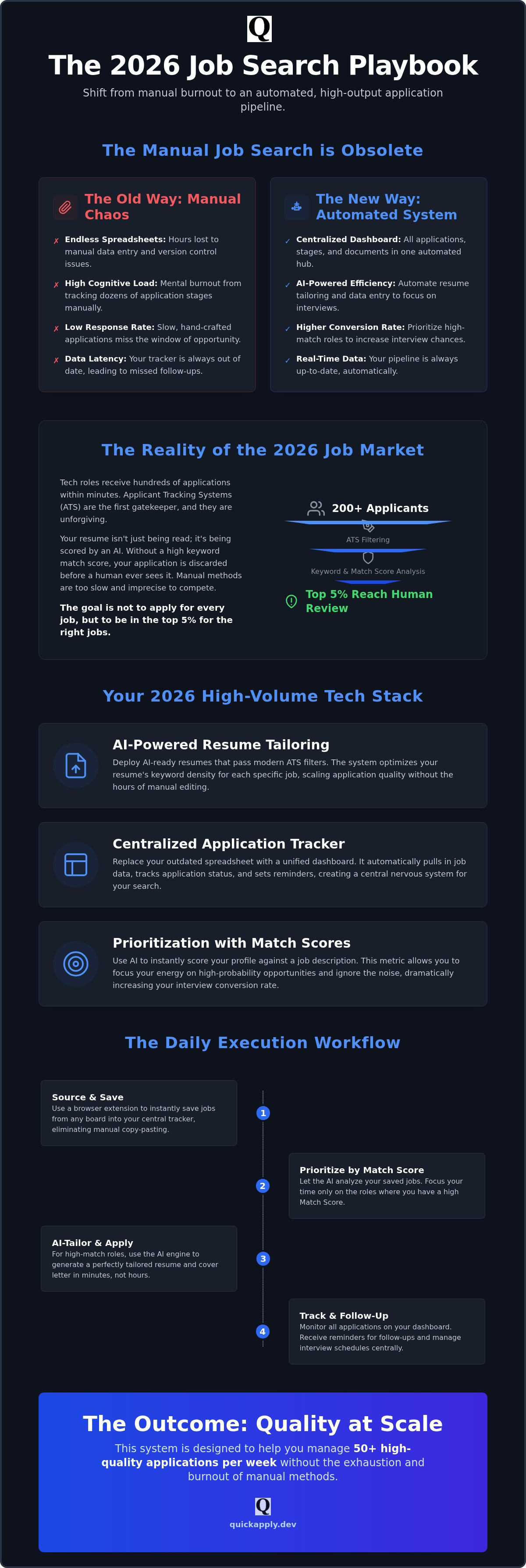
The Daily Execution Workflow: Managing Your Pipeline
Structure is the foundation of scale. If you're trying to figure out how to organize a high-volume job search, stop treating it like a casual activity. You need a rigid daily execution workflow that treats your search like a high-performance sales operation. Success in the 2026 market isn't about working more hours; it's about allocating your energy to high-impact activities while automating the rest.
Time blocking is your primary tool for maintaining momentum. Divide your day into dedicated sprints for sourcing, tailoring, and follow-up. This prevents the cognitive drain of context switching and ensures you hit your volume targets every single day. If you aren't moving through these blocks with mechanical precision, you're leaving offers on the table. A disciplined schedule turns a chaotic search into a predictable pipeline.
Sourcing and Batching Roles
Don't apply to jobs as you find them. This is the most inefficient way to work. Instead, set up AI-driven alerts and filters to aggregate leads while you sleep. Spend your first block of the day sourcing and batching 10-15 roles that meet your criteria. This allows you to process them as a single unit of work rather than a series of disjointed tasks.
- Quick Apply: Use this for roles where speed is the primary factor and the company is in your secondary tier.
- Deep Apply: Reserve this for top-tier targets that require more strategic alignment and personalized networking.
Batching roles allows you to enter a flow state for tailoring, which significantly increases your speed without sacrificing the precision of your Match Scores. It's the difference between a manual workshop and an assembly line.
Status Management and Interview Prep
Your search is a pipeline, not a list. Move every job through clear stages: Applied, Screening, Interview, and Offer. If a lead stalls, automate your follow-up triggers to keep the conversation warm without manual intervention. This ensures no opportunity falls through the cracks while you're busy interviewing. Managing these stages effectively is the core of how to organize a high-volume job search successfully.
Incorporate AI interview practice tools into your daily routine to stay sharp. Treat interview prep as a recurring calendar event, not a last-minute scramble. Monitor your application-to-interview conversion rate as your primary health metric. If this number drops, it's a signal to refine your tailoring engine. To take control of your search and eliminate manual data entry, automate your job search pipeline today. This systematic approach is the only way to manage 50+ applications per week while maintaining peak interview performance.
Scaling Your Search with QuickApply: The Ultimate Optimizer
Efficiency isn't just a goal; it's a requirement for survival in the 2026 tech market. QuickApply serves as the central nervous system for your professional transition. It's built specifically for tech professionals who demand optimization at every stage of their career. When you're figuring out how to organize a high-volume job search, you need a tool that bridges the gap between talent and opportunity without the manual friction. We provide a high-tech solution that turns a tedious process into a streamlined, high-speed operation.
The core of our platform is the Match Score. This metric provides an instant assessment of your alignment with any role. In a competitive national market, you can't afford to guess. By using AI-powered scores, you prioritize the roles that offer the highest probability of success. This data-driven approach ensures your time is spent on high-impact applications rather than statistical long shots. It's the ultimate competitive advantage for the modern professional who values their time.
From Application to Offer
The transition from a job posting to a submitted application should be instantaneous. QuickApply integrates Resume Tailoring directly with a unified Application Tracker. This loop creates a seamless flow that reduces manual data entry and repetitive editing by up to 90%. You save a job using our browser extension, the AI tailors your resume in seconds, and the tracker logs the status automatically. There's no need for fragmented tools or manual logs that slow you down.
Our focus remains strictly on the technical landscape. We understand the specific requirements and stack nuances that hiring managers look for today. This technical precision ensures your materials pass through semantic ATS filters with ease. You aren't just applying; you're deploying a high-conversion lead generation system that works at scale. This level of integration is what allows you to handle 50+ applications per week while maintaining peak quality.
Long-Term Career Management
Your professional growth doesn't stop once you sign the offer letter. QuickApply is designed for continuous career optimization. Once you've mastered how to organize a high-volume job search and secured your new role, our tools help you maximize your lifetime earnings. We offer a comprehensive Salary Negotiation Guide to ensure you're paid your full market value. After you start, the Promotion Roadmap provides a clear path to your next milestone, keeping you ahead of the curve.
Stop fighting the system and start mastering it. You deserve a career search that respects your time and maximizes your output. It's time to replace manual labor with systemic automation. Start optimizing your search today with QuickApply and join the ranks of high-efficiency professionals winning the 2026 job market. Focus on the interviews while we handle the pipeline.
Take Control of Your Career Pipeline
The 2026 job market doesn't reward manual effort; it rewards systems. You've learned why legacy tools are a liability and how AI tailoring preserves quality at a scale once thought impossible. Mastering how to organize a high-volume job search requires shifting from a passive applicant to a proactive pipeline manager. By deploying a tech stack that centralizes your data and automates your materials, you eliminate the friction that causes burnout.
It's time to stop fighting the numbers and start engineering your success. You can process 50+ applications per week while maintaining peak precision. With AI-powered Match Scores for every job, unlimited resume tailoring, and an integrated tracker designed for 2026 tech roles, the advantage is yours. Automate your high-volume job search with QuickApply today. You have the tools to bypass the noise and land the offer you deserve. Build your machine and let it work for you.
Frequently Asked Questions
How many jobs should I apply for per week in a high-volume search?
Target at least 50 high-quality applications per week to overcome the statistical challenges of the 2026 market. This volume ensures your pipeline stays full even when certain roles stall or close. High volume doesn't mean sacrificing quality. By using AI-powered tailoring, you can maintain high Match Scores while hitting these throughput targets. This strategic approach turns your search into a numbers game you're designed to win.
Is high-volume job searching considered "spamming" by recruiters?
Recruiters only consider applications "spam" when they're generic and irrelevant to the job description. If you use a system that aligns your skills with the specific requirements of the role, you're a legitimate candidate. High-volume searching is about strategic coverage, not mindless clicking. As long as your Match Score remains high, you're providing exactly what the recruiter needs to see to move you forward.
How do I organize my job search if I am applying on multiple platforms?
Centralize everything into a single, unified Application Tracker. Fragmented searches across LinkedIn, Indeed, and company portals lead to missed deadlines and data loss. Use a browser extension to save roles from any site directly into your dashboard. This is the most efficient way to master how to organize a high-volume job search without the manual friction of switching between tabs and spreadsheets.
What is the best way to track different versions of my resume?
Stop managing individual PDF files on your desktop. Use an integrated tailoring engine that automatically links every resume version to its corresponding job entry in your tracker. Manual folders lead to version hell, making it impossible to remember which skills you highlighted for which role. An automated system manages these iterations for you, ensuring you always have the right document ready for the interview round.
Can I use AI to tailor my resume without getting flagged by ATS?
Yes, because modern ATS platforms focus on semantic relevance rather than AI detection. These systems look for the relationship between your experience and the job's technical requirements. AI tailoring ensures your resume uses the correct lexicon and context to trigger a high Match Score. As long as your achievements are accurate, using AI is simply a more efficient way to communicate your value to the hiring software.
How much time should I spend on each application in a high-volume search?
Limit your manual effort to under 60 seconds per application. Your AI engine should handle the tailoring of your resume and cover letter instantly. Spend your human energy on sourcing high-quality leads and preparing for technical interviews. If you spend 30 minutes on a single application, you're using an outdated manual process that sabotages your ability to reach the volume required for success.
What are the most important metrics to track in my job search?
Monitor your application-to-interview conversion rate and your average Match Score. These metrics are the health indicators of your search pipeline. You should also track your weekly application volume to ensure you're hitting your targets. If your conversion rate drops, it's a signal to refine your tailoring engine. Tracking these data points allows you to optimize your search based on performance rather than guesswork.
How do I stay organized when managing multiple interview requests?
Move every role into the "Interview" stage of your tracker as soon as you receive a request. Integrate your tracker with your calendar to prevent scheduling conflicts and set automated reminders for follow-ups. High-volume searches lead to high interview counts, which require a systematic approach to logistics. Use interview practice tools as part of your daily routine to stay sharp while the system manages your schedule.


