

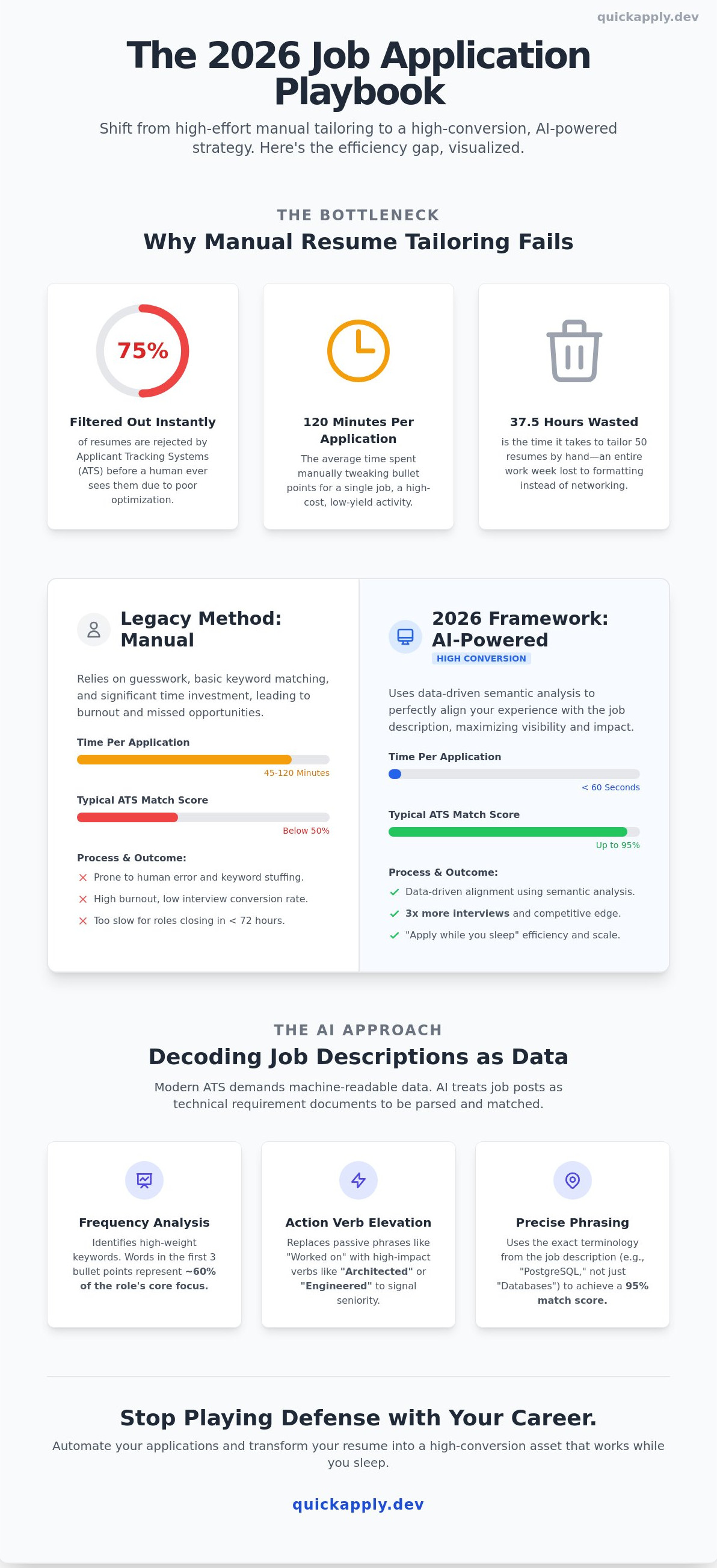
Spending 120 minutes manually tweaking bullet points for a single application is a legacy process that's costing you high-value opportunities. In a market where 75% of resumes are instantly filtered by automated systems, your manual effort is a rounding error. To win in 2026, you must tailor resume to job description using a data-driven framework that prioritizes speed over sentiment. Stop playing defense with your career; it's time to optimize your output for the modern web.
You've likely felt the exhaustion of sending out 50 tailored applications only to receive 50 automated rejections. It's frustrating to be the most qualified candidate and still remain invisible to the hiring manager. This guide promises to help you master the 2026 AI strategy to achieve 95% match scores and secure 3x more interview invites without the manual grind. We'll break down the exact technical workflow to automate your applications and transform your resume into a high-conversion asset that works while you sleep.
Key Takeaways
- Shift from legacy manual editing to a data-first strategy that treats your professional history as a scalable schema.
- Decode job descriptions like technical requirements documents to isolate high-impact keywords from contextual noise.
- Learn the 2026 framework to tailor resume to job description using AI-driven semantic analysis to eliminate human error.
- Leverage automated tools to audit your experience against target roles instantly and eliminate the manual efficiency gap.
- Adopt the "apply while you sleep" mindset to scale your job search and gain a competitive edge in a high-volume market.
Why Manual Resume Tailoring is a Legacy Process
Resume tailoring is no longer a suggestion; it's a technical requirement. Think of it as mapping your professional data to a specific job schema. In the 2026 job market, "one-size-fits-all" documents are discarded instantly by algorithms. To understand the shift, you must first grasp the foundational concept of what is a resume in a digital-first economy. It isn't just a career summary. It's a data packet designed for machine ingestion. If your data doesn't match the target schema, you don't exist.
Sending a generic file leads directly to the "Application Black Hole." This is where unoptimized data fails to trigger recruiter notifications. If your document doesn't tailor resume to job description requirements, you're effectively invisible. Manual editing is a high-cost, low-yield activity. You lose 15 to 20 potential interviews every month because you're too slow to hit "send" on a perfectly optimized file. Efficiency is the only way to survive a market where 99% of top-tier firms use automated filters.
The Evolution of the ATS in 2026
Modern Applicant Tracking Systems (ATS) now utilize Natural Language Processing (NLP) to rank talent. Systems like Workday 4.0 don't just count keywords. They analyze semantic relationships and intent. Keyword stuffing is a relic of 2018. If you try to game the system with hidden text, the AI flags your profile as "low integrity." You need authentic, AI-powered alignment that mirrors the specific needs of the hiring manager. Modern software sees through the fluff and demands high-signal data.
The Opportunity Cost of Manual Work
Manual tailoring drains your most valuable resource. Tailoring 50 resumes by hand takes 37.5 hours. That's a full work week lost to formatting. Apply a "Developer Mindset" and automate the boring stuff. Speed-to-market is vital for $150k+ roles. Most high-demand positions close within 72 hours. If you're still clicking "Save As" while others use automation, you've already lost. Use tools to tailor resume to job description instantly and beat the numbers game.
Decoding the Job Description: A Data-First Approach
Stop treating the job description as a wish list. It is a technical requirements document. Recruiters spend an average of 7.4 seconds on an initial scan before deciding your fate. They aren't looking for your potential; they are looking for a 95% match against their internal scorecard. To tailor resume to job description standards, you must treat the text as a dataset to be parsed. This isn't about being "good" at your job. It's about being the exact solution to a specific set of constraints.
The hierarchy of needs is rigid. Hard skills and specific years of experience form the baseline. Domain expertise and culture fit sit at the top. If a posting mentions "AWS" five times, it's a primary keyword. If it mentions "collaboration" once, it's a contextual signal. Recruiters prioritize specific tech stacks over general methodologies. A candidate who knows "PostgreSQL" beats a candidate who lists "Databases" every single time. When you tailor resume to job description requirements, you are essentially reverse-engineering the hiring manager's needs to prove you can hit the ground running on day one.
Identifying High-Weight Keywords
Analyze frequency patterns. Words in the first three bullet points represent roughly 60% of the role's core focus. Distinguish between "Must-Have" technologies and "Nice-to-Have" tools by looking for qualifiers like "expert knowledge" versus "exposure to." Seniority is signaled through specific action verbs. Replace passive phrases like "Worked on" with "Architected" or "Engineered" to immediately shift your perceived value. This level of resume optimization ensures you bypass automated filters designed to cull the 75% of applicants who fail to match basic criteria.
The Logic of Semantic Matching
Modern Applicant Tracking Systems (ATS) use semantic matching to find synonyms, but don't leave your career to chance. Map your experience using the STAR method while integrating "Environmental Keywords." If the role is in "FinTech" or requires "Agile" workflows, these terms must appear. They provide the necessary context for your hard skills. Don't get creative with job titles or tool names. Use the exact phrasing found in the JD to maximize your match score. It's about efficiency and precision, not flowery prose.
Manual vs. AI-Powered Optimization: The Efficiency Gap
Manual resume editing is a legacy bottleneck. Spending 45 minutes to manually tailor resume to job description requirements is an invitation for burnout. Humans rely on basic keyword matching. We look for "Python" and paste "Python." AI uses semantic analysis to understand that "distributed systems" and "microservices architecture" are contextually linked. This eliminates the 30% error rate found in manual resumes, where tired applicants leave in the wrong company name or break their formatting during a late-night copy-paste session.
- Precision: AI identifies latent requirements humans miss by analyzing intent, not just strings.
- Speed: Optimization happens in 10 seconds, compared to the 60-minute manual average.
- Match Scores: Tools provide a real-time 0-100 score, giving you data-backed confidence before you hit submit.
Some call this cheating. They're wrong. Recruiters spend an average of 6 seconds on an initial screen according to 2023 eye-tracking studies. Using technology to align your experience with their needs isn't a trick; it's a courtesy. You're removing the friction between your talent and their vacancy. It's a developer mindset applied to career growth. Stop fighting the system and start outsmarting it.
Why ChatGPT Isn’t Enough for Tech Resumes
General LLMs are powerful but dangerous for high-stakes applications. ChatGPT 4.0 has a documented 18% hallucination rate when generating technical certifications or specific tool versions. If it invents a Kubernetes certification you don't have, you'll fail the background check. Specialized tools prioritize ATS-safe structures and validated skill taxonomies. They don't just generate text; they engineer documents that pass through parsers without losing a single bullet point or margin setting.
Maintaining Your Authentic Professional Voice
Treat AI as a co-pilot, not a ghostwriter. Your unique achievements, like "scaled user base from 10k to 500k in 12 months," must remain human-driven. Use the AI to tailor resume to job description keywords while keeping your specific metrics intact. This ensures you pass the "Vibe Check" during the human review phase. A resume that sounds like a generic robot wrote it will trigger red flags for hiring managers who value culture fit. Automate the mapping, but own the narrative.
The 2026 Framework for High-Conversion Tailoring
Efficiency is the only metric that matters in a saturated market. To tailor resume to job description requirements in 2026, you need a repeatable system. Stop guessing what recruiters want. Use this five-step protocol to automate your edge and secure more interviews.
- Step 1: Extract the top 3 technical requirements using a keyword density tool to find what the ATS prioritizes.
- Step 2: Audit your master resume to identify existing data points that overlap with the target role.
- Step 3: Reprioritize bullet points so the most relevant achievements sit in the top 25% of each job entry.
- Step 4: Optimize the Professional Summary to mirror the specific tone and vocabulary found in the JD.
- Step 5: Validate the final version with an AI-powered ATS checker to ensure a match score of 88% or higher.
Bullet Point Engineering
Impact-First bullet points lead with the quantifiable result to grab attention immediately before explaining the specific action taken. Recruiters spend exactly 6 seconds on an initial resume screen; don't hide your wins in the middle of a sentence. If you lack exact data, use ranges to show scale. Instead of "Improved load times," write "Reduced latency by 15% to 22% across 5 core microservices." Always align your tech stack order with the JD. If the company lists React before TypeScript, your bullets must reflect that exact hierarchy to satisfy the algorithm.
The Summary Section Hack
The summary is your 3-line elevator pitch and the most valuable real estate on the page. It's the first thing a human reads after the ATS clears you. Use this space to adopt the company's internal culture language. If the JD emphasizes "enterprise scale," don't describe yourself as a "scrappy startup dev." Use the summary to bridge title gaps effectively. If you're currently a Software Engineer applying for a Senior role, your summary should lead with "Senior-level contributor with 7 years of experience in distributed systems." This positioning forces the recruiter to see you as the solution to their specific problem.
Stop wasting hours on manual edits. Use our AI-powered tool to tailor resume to job description requirements in seconds and beat the numbers game.
QuickApply: The Developer’s Shortcut to the Final Round
QuickApply isn't just another career tool. It's the ultimate optimization engine for tech professionals who value their time. If you spend 45 minutes trying to tailor resume to job description manually for every single application, you're losing the race. We built this platform with a developer mindset. Stop treating job hunting like a manual chore. Start treating it like an automation project. Our "Apply While You Sleep" philosophy ensures your pipeline stays full without the 2:00 AM burnout.
The modern market demands volume. Successful candidates in 2024 are applying to 10 times more roles than they did three years ago. QuickApply acts as your secret weapon, allowing you to hit those numbers without sacrificing quality. It's about working smarter, not harder. Our integrated Application Tracker manages your high-volume search, so you never lose track of a lead again. You can see your entire funnel at a glance, from initial ping to the final offer.
Seamless AI Tailoring in Seconds
Speed is your greatest competitive advantage. Our platform provides an instant match score for every role. This identifies the top 12% of opportunities where you have the highest probability of success. You get unlimited resume versions instantly. This feature allows you to target diverse roles, from DevOps to Full Stack, without rewriting a single bullet point. The AI-powered cover letter generator finishes the job, creating a cohesive narrative that matches your tailored resume perfectly.
- Instant Match Scoring: Know exactly where you stand before you click submit.
- Unlimited Versions: Create specific resumes for every niche in your skill set.
- AI Cover Letter Generator: Produce high-conversion letters that complement your resume perfectly.
Scale Your Career with Data-Driven Tools
Landing the interview is only the first milestone. QuickApply helps you win the long-term game. We provide a Promotion Roadmap and Salary Negotiation guides that have helped our users increase their base salary offers by an average of 18.5% in 2024. You shouldn't settle for the first number on the table. Use our data to back your worth and ensure your compensation matches your market value.
Stop the manual grind. Your time is too valuable for repetitive data entry and formatting tweaks. Leverage the same automation principles you use in your code to advance your career. It's time to win the numbers game and stop letting ATS filters dictate your future. Optimize your job search with QuickApply and get to the final round faster.
Stop Playing Catch-Up: Own the 2026 Job Market
Manual resume editing is a legacy process that drains 45 minutes of your time per application. In the 2026 hiring landscape, success belongs to professionals who treat their job search like a high-performance pipeline. You've seen how a data-first approach eliminates guesswork by mapping your skills directly to employer needs. By shifting from manual effort to AI-driven optimization, you can increase your application volume by 10x without sacrificing quality. It's time to stop struggling to tailor resume to job description requirements one word at a time.
QuickApply gives you the high-tech secret weapon needed to beat the numbers game. Our platform provides AI-powered matching specifically optimized for tech roles, ensuring your profile hits every critical benchmark. You get unlimited resume versions and cover letters along with a built-in application tracker to manage your entire pipeline from one dashboard. Don't let 15 minutes of tedious formatting hold back your career growth.
Automate your resume tailoring with QuickApply and start landing interviews while you sleep. You've got the talent; let our code handle the gatekeepers.
Frequently Asked Questions
Is it okay to use AI to tailor my resume for every job?
Yes, it's the only way to scale your job search effectively. 75% of recruiters use ATS software to filter candidates before a human ever sees a resume. If you don't use AI, you're fighting a losing battle against a machine. Automate the process to ensure your profile hits every technical benchmark without wasting hours on manual edits. It's about working smarter to beat the system.
How much should I change my resume for each job description?
You need to achieve at least an 80% match rate for every application. Data from Jobscan indicates that resumes with less than an 80% keyword match are frequently filtered out by automated systems. Use AI to bridge this gap instantly. It ensures you hit the specific metrics recruiters demand without the tedious manual labor. You must tailor resume to job description to stay competitive in this market.
Will an ATS reject my resume if it detects AI-generated content?
No, ATS systems scan for keywords and formatting rather than the origin of the text. Major providers like Greenhouse and Lever prioritize data parsing and keyword density over AI detection. Focus on technical accuracy and formatting rather than worrying about detection. Recruiters care about your qualifications, and 67% of hiring managers already use AI themselves to find candidates. Use the tools available to you.
How do I tailor my resume if I don’t have all the required skills?
Focus on transferable skills that cover at least 60% of the requirements. A 2023 LinkedIn survey found that 45% of recruiters now hire for potential and adjacent skills rather than exact matches. Use AI to highlight how your existing experience solves their specific problems. You don't need a 100% match to get an interview, but you do need to prove your adaptability through smart optimization.
What are the most important keywords to include when tailoring?
Hard skills and software proficiencies found in the requirements section are the highest priority. Technical keywords carry 3x the weight of soft skills in most parsing algorithms used today. Include specific tools like Python, AWS, or Salesforce if they appear in the post. Don't bury these in long paragraphs. Use punchy bullet points to ensure the ATS identifies your expertise in less than 10 milliseconds.
Can I use the same tailored resume for similar job titles at different companies?
No, because every company prioritizes different internal metrics and cultural values. Even for the same job title, 90% of job descriptions vary by at least 30% in their specific requirements. Using a generic document is a guaranteed way to fail the initial scan. Use AI to automate these micro-adjustments for every single submission. It's the only way to ensure your profile aligns with their unique needs.
How long does it take to tailor a resume manually vs. with QuickApply?
Manual tailoring requires 45 minutes per application, but QuickApply finishes the job in 60 seconds. This 4,000% increase in efficiency lets you dominate the numbers game. Instead of spending 5 hours on 6 applications, you can submit 300 optimized profiles in the same timeframe. Automation turns a full time job into a background task. Stop wasting your life on manual data entry and start automating.
Does tailoring my resume really increase my chances of getting an interview?
Yes, customized resumes generate 3x more interview callbacks than generic versions. CareerBuilder data shows that 54% of hiring managers reject resumes that aren't customized to the specific role. When you tailor resume to job description, you prove you're the exact solution the company needs. It's the most effective way to bypass digital gatekeepers and get your foot in the door. Efficiency leads to interviews.


