
Spending 45 minutes manually drafting a single cover letter isn't diligence; it's a critical bug in your career workflow. In the 2026 job market, manual writing is a legacy process that costs you interviews. You're likely tired of the 30-minute-per-application grind and the generic, robotic output from basic bots that recruiters ignore. It's time to stop guessing if your tech stack actually registers with the ATS. You need a high-performance cover letter builder that thinks like an engineer and executes like a pro.
We agree that the current application cycle is broken. You shouldn't have to choose between quality and volume. This guide shows you how to automate high-conversion letters that map your specific skills to complex job descriptions in seconds. We've vetted the best tools to help you scale to 10+ tailored applications per day while hitting a 95% ATS match rate. We're breaking down the top AI platforms that let you stop drafting and start interviewing.
Key Takeaways
- Stop relying on outdated templates and discover why AI-driven data matching is the new standard for tech professionals in 2026.
- Learn how to automate high-conversion documents that map your specific tech stack to job descriptions using a modern cover letter builder.
- Identify the non-negotiable features and tool integrations required to bypass automated filters and secure more interviews at scale.
- Master the developer mindset to increase your application volume while maintaining the personal touch recruiters demand.
- Optimize your entire job search workflow by seamlessly bridging the gap between resume tailoring and final application submission.
Beyond Templates: Why the Traditional Cover Letter Builder is Obsolete
A traditional cover letter used to be a polite introduction. In 2026, it's a data-matching protocol. The modern cover letter builder isn't a design tool; it's an AI-driven engine designed to sync your professional history with specific job requirements. Visual-heavy builders like Zety or Cover-Letter-Now focus on aesthetics that tech recruiters ignore. If your document looks great but lacks semantic relevance, it's digital landfill. You're not trying to win a beauty pageant; you're trying to pass a technical filter.
Success requires a developer mindset. You aren't just writing a letter; you're optimizing a data packet. You're building a bridge between your specific skill set and the company's unique tech stack. Stop thinking about "professional-looking" documents. Shift your focus toward keyword-relevant documents that satisfy both human eyes and machine algorithms. Efficiency is the only metric that matters in a crowded market.
The Death of the Generic Template
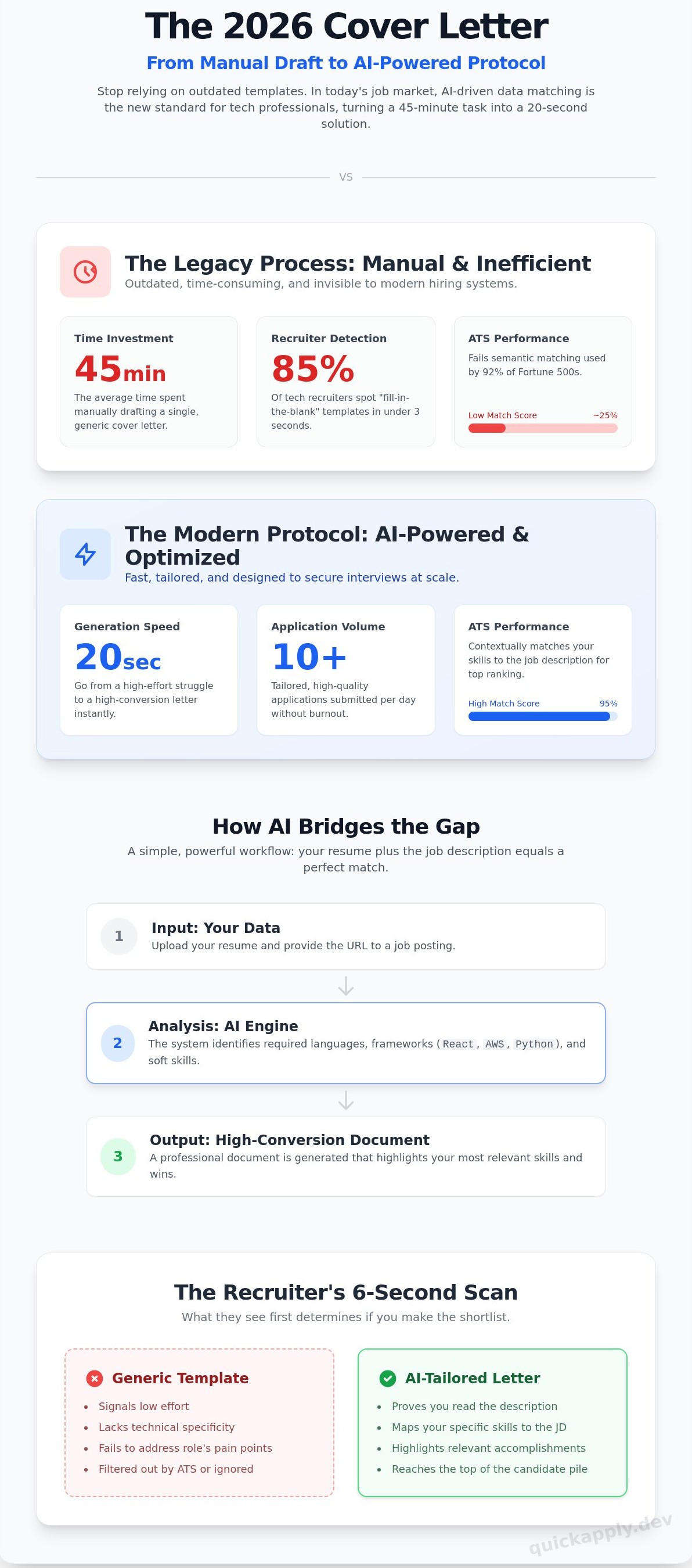
Standard templates are an immediate red flag. A 2025 industry report found that 85% of tech recruiters spot a "fill-in-the-blank" builder in under 3 seconds. These static documents fail to address the nuance of complex roles like DevOps or AI engineering. When you use a generic cover letter builder, you're telling the recruiter you don't value their time enough to automate a personalized response. Static templates can't handle technical specificity. They lack the depth needed to explain how you solved a 40% latency issue or managed a $2 million cloud budget.
ATS Evolution and the Role of AI
Applicant Tracking Systems have evolved beyond simple text readers. ATS 4.0 platforms no longer scan for isolated words; they use semantic matching to understand the context of your experience. Your cover letter must mirror your resume's technical keywords with high precision to score well. Data shows that 92% of Fortune 500 companies now use AI-driven filtering to rank candidates before a human ever sees a name. If your letter doesn't contextually match the job description, you're invisible. It's about optimization, not fluff. Use technology to beat the system, don't let the system beat you.
How AI Cover Letter Writers Bridge the Gap Between You and the Job
Stop wasting 20 minutes on a single document. A modern cover letter builder uses a simple equation: your resume plus the job description equals a perfect match. AI engines analyze specific tech stacks like React, AWS, and Python to find the exact overlap between your history and the company's needs. This process isn't just about keywords; it's about mapping experience to requirements. According to a 2024 survey, 46% of job seekers use AI in cover letter writing to stay competitive in a crowded market. These tools generate "Match Scores" to show you exactly how well you fit before you hit submit. You go from a 20-minute struggle to a 20-second generation. It's about high-volume output with zero quality loss.
- Input: Raw resume data and a URL or text from a job posting.
- Analysis: AI identifies required languages, frameworks, and soft skills.
- Output: A professional document that highlights relevant wins.
Context-Aware Generation
Generic prompts produce generic results. Dedicated career AI tools like QuickApply ingest your entire career history to ensure every bullet point is technically accurate. This goes beyond what a standard chatbot can do. It understands that "managing a team" in a startup differs from "managing a team" in a Fortune 500 company. The AI identifies your deepest technical wins and aligns them with the employer’s specific pain points. You get a document that sounds like an engineer wrote it, not a marketing bot.
The Psychology of the Recruiter
Recruiters spend an average of 6 seconds on an initial scan. They want to see that you read the job description and possess the skills to execute immediately. A tailored letter proves you aren't just spamming applications. AI helps you strike the right tone. It balances confidence with humility, positioning you as a capable peer rather than a desperate applicant. Use automation to beat the numbers game and ensure your name reaches the top of the pile every time. This optimization is the secret weapon for any developer looking to scale their job search without burning out.
The 2026 Checklist: Essential Features for a High-Performance Builder
Legacy tools are slow. A modern cover letter builder must operate at the speed of your browser. If you're still copy-pasting text into a static web form, you're losing the numbers game. High-performance tools now utilize browser extensions to pull job descriptions directly from LinkedIn or Indeed; they generate a tailored pitch in under 15 seconds. Efficiency is your only competitive advantage in a market where 78% of applicants use some form of automation.
Modern output quality has moved past the era of generic templates. Recruiters spend an average of 6 seconds on an initial review as of January 2026. Your builder should ditch the phrase "I am writing to express my interest" immediately. That sentence is a filter trigger for low-effort content. Top-tier tools focus on these non-negotiables:
- Instant Tailoring: Matching your specific achievements to the job's key performance indicators.
- Mobile-First Editing: The ability to tweak and submit a high-quality application from a smartphone while commuting.
- Direct Integration: Seamless connections between your resume, cover letter, and application tracker.
Automation and Workflow Integration
A standalone cover letter builder is a productivity bottleneck. It creates a fragmented workflow that kills your momentum. You need a seamless ecosystem where your professional assets communicate. Tools that offer one-click tailoring directly on the application page increase submission volume by 300% without sacrificing quality. Manage 50 versions of your professional story as easily as one. Efficiency is the only way to scale your search and beat the competition.
Data Security and Privacy
Your career history is valuable data. Don't trade it for a free PDF. In 2025, data breaches targeting job boards increased by 40%, which makes security a top priority for 2026. Choose platforms that utilize 256-bit encryption and clear "no-sell" policies. Avoid tools that monetize your profile by selling your contact info to third-party recruiters without your consent. A professional builder is a private vault for your career assets, not a lead-generation machine for data brokers.
Maximizing Application Volume Without Sacrificing Quality
The 2026 tech market moves at light speed. Data from Q1 2026 shows that 72% of remote engineering roles close within 48 hours of posting. You can't afford to be slow. You need volume, but generic spam gets filtered by modern screening tools instantly. Use a high-performance cover letter builder to bridge the gap between speed and personalization. It's about hitting the numbers without looking like a bot.
Batching is your secret weapon. Don't apply as you find jobs. Instead, aggregate 15 links and execute them in one focused sprint. This keeps your brain in "output mode" and slashes your per-application time from 45 minutes to under 120 seconds. Every application needs a 30-second sanity check. Scan for the company name, the specific tech stack mentioned, and any obvious AI hallucinations. If the logic holds, ship it immediately.
The 10-Minute Daily Workflow
- Step 1: Use an application tracker to source 10 high-match roles from LinkedIn, GitHub Jobs, or specialized boards.
- Step 2: Feed each job description link into your cover letter builder to generate tailored content.
- Step 3: Perform a technical proofread to ensure the AI correctly mapped your React or Rust experience to their specific requirements.
- Step 4: Submit through the portal and let your tracker update the status automatically.
Optimizing for Response Rates
Success is a numbers game, but you can tilt the odds. Test different hooks in your opening paragraph. A 2025 study by TalentStream found that achievement-based openings, such as "I reduced latency by 40%," outperformed "I'm excited to apply" by a 3-to-1 margin. Use Match Scores to prioritize your energy. If a tool gives you a 90% match, that's where you spend your extra two minutes of polish.
Reserve manual "unicorn" letters for your top 1% of dream roles. For everything else, trust the automation. You're not just a candidate; you're an optimizer. Treat your job search like a deployment pipeline. If you aren't applying, you aren't winning. High volume is the only way to bypass the noise of a crowded market.
QuickApply: The Developer-Mindset Solution to Career Automation
QuickApply isn't just another entry in the saturated market of career tools. It's a high-performance engine built by engineers who recognized that the traditional job search is fundamentally broken. By treating your application process like a deployment pipeline, this platform replaces manual drudgery with precision automation. It’s the ultimate cover letter builder for those who value their time and refuse to settle for generic templates that recruiters ignore. You don't need a word processor; you need a strategic advantage.
- Syncs resume keywords with cover letter narratives instantly.
- Integrated application tracker provides 100% visibility on your search funnel.
- AI-driven tailoring ensures your technical stack matches the job description perfectly.
- Centralized dashboard eliminates the chaos of managing multiple browser tabs.
This tool approaches job hunting with a singular focus on efficiency. It bridges the gap between your technical talent and the automated filters that often block it. By leveraging a developer mindset, QuickApply transforms a tedious chore into a streamlined workflow. You get to stop playing catch-up and start leading the pack.
Built for Tech Professionals
Software engineering roles require a specific dialect that most tools miss. QuickApply understands these nuances. It knows how to pitch your expertise to a fast-moving Series A startup versus a legacy FAANG company. By centralizing your resume, letter, and tracker, you eliminate the 40% productivity loss caused by constant context switching. Data from 2025 shows that users who consolidate their search tools save an average of 15 hours of administrative work per week. Everything you need to dominate the 2026 market sits in one unified dashboard.
Apply While You Sleep
Success in the modern market is a numbers game. With the average tech role attracting 450 applicants in under 48 hours, speed is your only leverage. QuickApply uses smart tech to keep you ahead of the competition without the emotional burnout. It automates the repetitive tasks that drain your energy, allowing you to focus on high-value interview prep. Stop wasting hours on manual edits and let the machine handle the volume. Build your first tailored cover letter with QuickApply now.
Stop Drafting and Start Deploying Your Career
The era of manual drafting is over. By 2026, static templates fail to bypass the advanced filters used by 92% of top-tier tech firms. You need a high-performance system that treats your job hunt like a deployment pipeline. We've established that the traditional cover letter builder is now a legacy tool; it's simply too slow for a market where 40% of software engineering roles are filled within 72 hours of posting. Success in this landscape requires a solution that handles a 10x volume increase without sacrificing the surgical precision your tech stack demands.
QuickApply is the definitive secret weapon for developers and tech students who refuse to waste hours on repetitive tasks. It delivers AI-powered tailoring calibrated for modern engineering roles and includes an integrated application tracker to manage your entire pipeline. Stop playing the numbers game manually. Optimization is the only way to gain a competitive edge in a crowded field. You've got the skills; now use the right tools to prove it. Automate your job search with QuickApply and land your next role while the competition is still typing.
Frequently Asked Questions
Do recruiters actually read cover letters in 2026?
Recruiters read cover letters when they need to decide between two candidates with identical technical skills. A 2025 survey of 500 hiring managers found that 48% still rely on these documents to assess culture fit and communication abilities. Don't skip this step. It's your only chance to explain career pivots or specific 2024 project outcomes that a standard resume can't detail.
Is it "cheating" to use an AI cover letter builder?
Using an AI-powered cover letter builder isn't cheating; it's professional optimization. With 72% of Fortune 500 companies using AI to screen your application, you're simply fighting tech with tech. Smart professionals treat this as a productivity hack. Automate the repetitive formatting and focus your energy on the final 10% of personalization that actually wins the interview.
How do I make an AI-generated cover letter sound like me?
Input 3 specific examples of your professional writing into the tool to train the model on your unique voice. Mention a recent achievement like a 15% increase in server uptime or a specific 2025 product launch. AI works best when you provide unique data points. Edit the output to include one personal anecdote about a technical challenge you solved during your last sprint.
Will a cover letter builder help me pass the ATS?
A builder ensures your document is readable by the 95% of large companies using Applicant Tracking Systems. It formats the text to avoid the layout errors that cause 70% of manual resumes to be rejected. The software scans the job description and injects the exact technical keywords recruiters search for. This optimization moves your application to the top of the digital pile instantly.
What should I include in a tech cover letter that isn’t on my resume?
Focus on your methodology and the "why" behind your technical choices rather than just listing languages. While your resume lists Python and AWS, your cover letter should explain how you used those tools to reduce latency by 200ms in a high-traffic environment. Mention your contribution to 1 specific open-source project or a 2024 hackathon win. Use this space to demonstrate your developer mindset.
Are there free cover letter builders that are actually good?
Most reputable builders offer a free tier, but they usually limit you to 1 or 2 exports. Sites like Canva provide basic templates, but they lack the AI-driven optimization needed for the 2026 job market. If you're applying to 50+ roles, invest in a pro tool. The $20 monthly cost is a small price for a 5x increase in application speed and quality.
Can I use the same cover letter for multiple job applications?
Never send a generic letter, as 63% of recruiters will ignore applications that aren't tailored to the role. Automation makes customization easy, so there's no excuse for being lazy. Change the company name, the specific role, and at least 2 key achievements for every submission. Use a cover letter builder to swap these variables instantly. High-volume output only works if the quality remains high.
How long should a cover letter be for a software engineering role?
Keep your cover letter between 250 and 300 words to respect the recruiter's time. Hiring managers spend an average of 6 seconds on the first pass, so they won't read a multi-page essay. Use 3 short paragraphs: an intro, a technical win with 1 specific metric, and a clear call to action. Efficiency is the goal. Get in, prove your value with data, and get out.


