

Choosing a software engineering role is not a career move; it is a high-stakes capital allocation problem where you are the primary asset. Learning how to compare multiple job offers for software engineer positions in 2026 requires more than a gut feeling about the team's culture. With the median total compensation now reaching $191,000, the margin for error is thin. You've fought through the technical rounds, yet you're likely facing analysis paralysis over complex equity packages and the fear of inheriting a legacy codebase.
It's normal to feel overwhelmed when your future depends on variables like 2026 tax brackets or the new wage-weighted H-1B lottery system. This article delivers a quantitative, tech-first framework to evaluate salary, equity, and growth potential so you can accept the right offer with zero regret. You'll learn to calculate the 67% premium commanded by AI specialists and use our Salary Negotiation Guide to maximize your leverage. We'll transform your pile of offers into a clear, data-backed winner that secures your long-term career trajectory.
Key Takeaways
- Replace gut feelings with a Weighted Decision Matrix to treat your career as a high-yield investment.
- Deploy the 2026 TC Formula to master how to compare multiple job offers for software engineer positions, accounting for RSUs and vesting schedules.
- Quantify "Career Tech Debt" to ensure you choose stacks that accelerate your growth rather than maintaining legacy systems.
- Calculate your True Hourly Rate to expose the hidden costs of hybrid commutes and synchronous meeting cultures.
- Use the Bridge Technique and our Salary Negotiation Guide to turn competing offers into maximum compensation leverage.
The Software Engineer’s Decision Matrix: Turning Vibes into Data
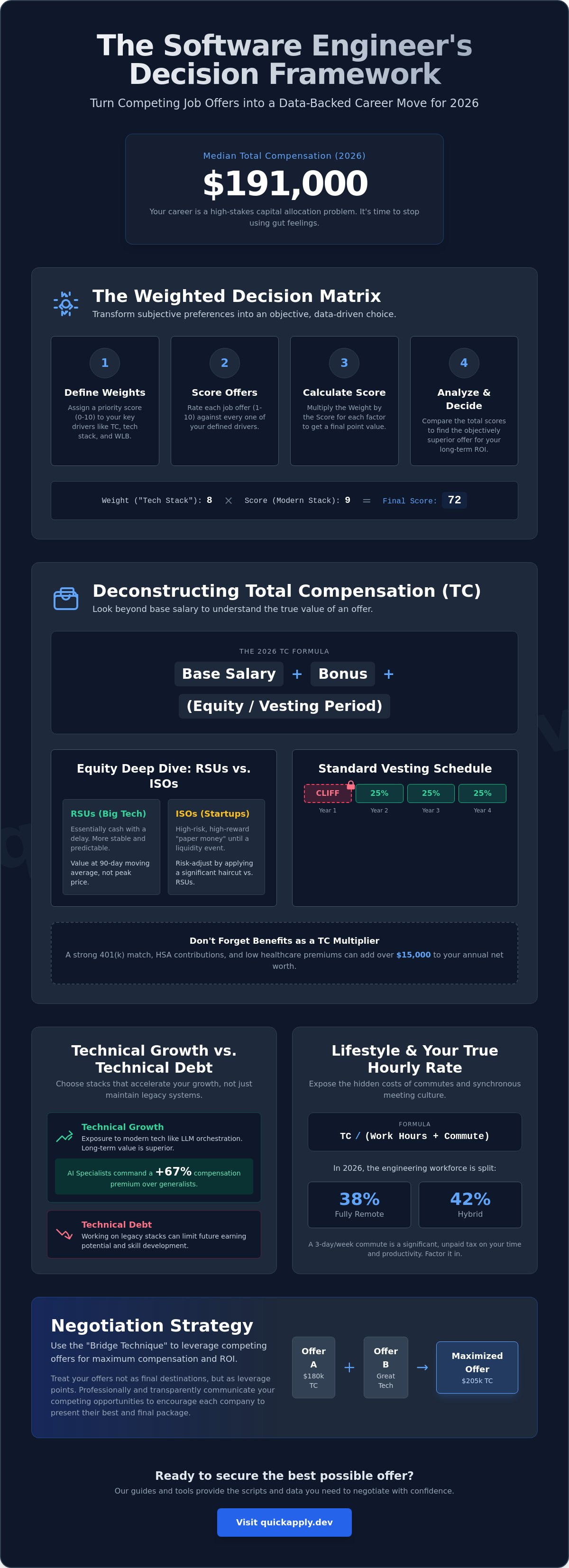
Stop relying on gut feelings. You wouldn't push code to production based on a "vibe," so don't choose your next role that way. Most engineers fail because they prioritize the most recent positive interview or a flashy office over long-term ROI. To master how to compare multiple job offers for software engineer roles, you need an objective system. The Weighted Decision Matrix is that system. It transforms subjective preferences into hard data that you can actually analyze.
Start by defining your non-negotiables. These are binary constraints. If an offer does not hit your minimum base salary or specific remote requirements, discard it immediately. Once you have a shortlist, assign weights from 0 to 10 to your key drivers. A 10 means the factor is critical; a 1 means it is a minor preference. This process ensures you are understanding compensation and benefits beyond the surface level and aligning them with your personal output goals.
Identifying Your High-Impact Variables
Balance immediate cash against technical growth. In 2026, Machine Learning engineers earn about 67% more than generalists. If Offer A provides a higher base but Offer B gives you exposure to LLM orchestration, the long-term value of Offer B is likely superior. Consider the "remote multiplier." With 42% of engineers working hybrid and 38% fully remote, the cost of a three-day commute is a significant tax on your productivity. Finally, weigh the company stage. Seed-stage startups offer high-risk equity, while Big Tech provides the stability of RSUs and established systems.
Building the Scoring System
Normalize your scores to create a fair comparison. Rate each offer from 1 to 10 on every variable, then multiply that rating by your assigned weight. If "Tech Stack" has a weight of 8 and an offer uses a legacy stack, it gets a 2, resulting in 16 points. If a modern stack gets a 9, that is 72 points. This gap reveals the true cost of technical debt. If two offers are within a 5% score range, apply the "Regret Minimization" framework. Ask yourself which offer you would regret turning down more in two years. The Decision Matrix is an optimization algorithm designed to maximize your career's long-term ROI by weighting competing variables against your specific professional goals.
- Define Weights: Assign 0-10 based on personal priority.
- Score Offers: Rate each category 1-10.
- Calculate: Multiply Weight x Score for the final tally.
- Analyze: Compare the totals to find the objective winner.
Total Compensation (TC) Analysis: RSUs, Bonuses, and 2026 Realities
Base salary is a trap. It's the most stable part of your offer but also the least scalable. In 2026, the median total compensation for software engineers has reached $191,000, yet many candidates still fixate on the monthly paycheck. When learning how to compare multiple job offers for software engineer roles, you must shift your focus to the TC Formula: Base + Bonus + (Equity / Vesting Period). This calculation reveals the true value of your time. Guaranteed sign-on bonuses provide immediate liquidity. Performance bonuses are variable risks. You need to vet the company's recent hit rate on targets before counting that money as part of your net worth.
Equity Deep Dive: RSUs vs. ISOs
RSUs are essentially cash with a delay timer. In the volatile 2026 market, you should value them based on the current 90 day moving average rather than the peak price. ISOs are different. They are high risk instruments common in startups. Treat startup equity as "paper money" until a liquidity event occurs. Risk-adjust these by applying a significant haircut when comparing them against public company RSUs. Check the vesting schedule carefully. A standard four-year vest with a one-year cliff is typical. However, back-loaded grants are becoming more common in Big Tech to reduce early churn. If you're struggling to value these complex packages, our Salary Negotiation Guide provides the specific scripts needed to extract better terms during the final stages.
Benefits as a Total Comp Multiplier
Don't ignore the "free" money that doesn't show up in your base. A 401(k) match and HSA contributions can add over $15,000 to your annual net worth. Healthcare premiums also vary wildly between firms. A "gold" plan with zero premiums saves you thousands in post-tax dollars compared to a high-deductible plan. When negotiating a job offer, these line items are often more flexible than the base salary. Factor in professional development budgets. A company that invests $5,000 annually in your skills is subsidizing your future market value. Perks like free lunches or gym memberships are convenient, but they don't buy assets. Focus on the benefits that directly impact your balance sheet.
- 401(k) Matching: Instant 100% ROI on your contributions.
- HSA Contributions: Triple tax-advantaged wealth building.
- Vesting Schedules: Understand the difference between monthly and quarterly vesting.
- Tax Implications: Consider how the 37% tax bracket for high earners (over $640,600) affects your take-home pay.
Technical Growth vs. Technical Debt: Evaluating the Work
Choosing a role is choosing a codebase. Every line of code you write either adds to your market value or depreciates it. Career Tech Debt is the invisible cost of staying too long in a legacy environment. If you spend forty hours a week patching a 15 year old monolith, you're not just working; you're falling behind. When you determine how to compare multiple job offers for software engineer positions, you must audit the technical health of the organization. A modern tech stack acts as a force multiplier for an engineer's market value by ensuring their skills remain compatible with high paying, cloud native roles.
Prioritize greenfield projects over pure maintenance. Building a new system from scratch often accelerates your internal Promotion Roadmap compared to simply keeping the lights on. Maintenance roles offer stability, but they often lack the high impact visibility required for rapid advancement. Evaluate the engineering culture by asking about PR review quality and CI/CD maturity. A team that lacks automated testing or has a slow deployment pipeline will actively hinder your productivity and professional satisfaction. Use the "Resume Driven Development" check. Ask yourself if this role will make you more hireable next year or if it will trap you in a niche that the market is moving away from.
Assessing the Tech Stack ROI
Specialization has an opportunity cost. Niche languages can offer high pay in the short term, but industry standards like Rust or Go provide broader market liquidity. In 2026, targeting roles that utilize AI and machine learning is a strategic move. These specialized skills command a 20-30% salary premium over generalist software engineering roles. Evaluate the infrastructure. Cloud native environments are the standard. If a company is still heavily reliant on on-premise hardware without a clear migration path, they are likely struggling with significant technical debt that will eventually become your problem.
Mentorship and Engineering Excellence
The senior to junior ratio is a critical metric for your growth. If you are the most senior person on the team, you aren't learning; you're just teaching. You need a boss who has mastered complex systems and can provide actionable feedback. Back channel management styles before you sign. Use an application tracker to keep detailed notes on your technical interviewers. Did they ask insightful questions? Did they explain the architecture clearly? These interactions are the best data points you have for predicting the quality of your future mentorship. High energy teams with rigorous standards will push you to perform at a higher level, securing your long term career trajectory.
- Tech Stack: Prioritize modern, scalable technologies.
- Project Type: Seek greenfield opportunities for faster promotion.
- Team Ratio: Ensure there are enough seniors to facilitate your learning.
- Deployment: Demand mature CI/CD and high PR standards.
Lifestyle Design: Remote, Hybrid, and the WLB Myth
Salary numbers are vanity metrics if they require sixty hour weeks and a soul crushing commute. To truly master how to compare multiple job offers for software engineer positions, you must calculate your True Hourly Rate. Factor in the door to door travel time and the "voluntary" overtime expected by high pressure teams. A survey from May 2024 indicated that 42% of software engineers worked in a hybrid model, while 38% were fully remote. By 2026, hybrid work has become the default for large tech firms, typically requiring 2 to 3 days in the office. This shift means your "remote" offer might actually be a "hybrid" offer in disguise. Check the fine print on on-call rotations. Frequent pages are an invisible tax that depreciates your quality of life regardless of your base pay.
Assessing work life balance requires looking beyond the recruiter's pitch. Use Glassdoor and LinkedIn to check the average tenure of current engineers. If the median tenure is under eighteen months, you are likely looking at a "burn and churn" culture. High turnover usually signals a lack of psychological safety or an unsustainable pace. Use our Application Tracker to log these cultural red flags during the interview process so you can compare them objectively against other offers.
The Remote vs. Office Trade-off
Remote work offers flexibility, but it often comes with a networking cost. The "out of sight, out of mind" promotion penalty is real in 2026. If the leadership team is primarily in office, remote engineers may find it harder to secure high visibility projects. Evaluate the financial value of a home office stipend against the convenience of free catered lunches. While a $1,000 stipend is a one time gain, daily meals can save you thousands in post tax income annually. Many engineers find that hybrid models offer the worst of both worlds: the commute of an office job with the fragmented communication of a remote one. Choose the model that protects your deep work hours.
Management and Team Dynamics
Your immediate manager has more impact on your daily happiness than the CEO. Does the team allow for failure and iteration, or is every bug treated as a catastrophe? Meeting culture is the primary thief of engineering productivity. Ask if the company prioritizes asynchronous communication or if your day is fragmented by constant "syncs." A team that respects "Maker's Schedule" will protect your afternoons for coding. Assessing the "Sunday Scaries" probability for each offer is essential. If the thought of their Monday morning standup already feels draining, the extra $10,000 in base salary won't compensate for the mental toll. Build your Promotion Roadmap today to ensure your next move aligns with your long term lifestyle goals.
- True Hourly Rate: Divide TC by (Hours Worked + Commute Time).
- Async Maturity: Look for well documented processes over constant meetings.
- On-Call: Negotiate for rotation compensation or "comp time" after incidents.
- Tenure: Aim for teams where engineers stay at least 2 years.
Negotiation Strategy: Leveraging Multiple Offers for Maximum ROI
Multiple offers are the ultimate output of a successful technical pipeline. This isn't just luck; it's the ROI of your rigorous Interview Practice. Having options changes the power dynamic from applicant to vendor. To master how to compare multiple job offers for software engineer roles, you must view negotiation as a data-driven protocol. Use the Bridge technique to optimize your final package. If Company A offers a higher base salary but Company B has the superior tech stack, use Company A’s cash as a benchmark. Tell Company B you prefer their technical challenges but need them to close the compensation gap with additional equity. This turns their weakness into your long-term wealth.
Professional transparency is your best defense against the exploding offer trap. Recruiters in 2026 often use artificial 48 hour deadlines to force a decision. Don't panic. State clearly that you're finalizing your evaluation of multiple competing offers and require a specific date to finish your due diligence. High-value talent is never rushed. When you finally choose, decline other offers gracefully. The tech world is small; a polite, data-backed rejection keeps the door open for future high-level opportunities.
The Art of the Counter-Offer
Negotiation isn't just about the base salary. If a firm can't budge on cash, pivot to non-monetary terms that increase your career velocity. Ask for a more senior title, a specific professional development budget, or a flexible start date. Use our salary negotiation guide to script these high-stakes calls. Having the exact phrasing ready eliminates the emotional friction of the conversation. Remember that every $5,000 you secure now compounds over your entire career. Don't leave money on the table because of a lack of preparation.
Using QuickApply to Secure Your Future
Your next job search starts the day you accept your current offer. Use our promotion roadmap to set performance expectations during your first week. Don't wait for a performance review to find out you're off track. Document your wins, system architecture contributions, and PR reviews from day one. This continuous tracking ensures you have the data ready for your next transition or internal promotion. By treating your career as a series of optimized sprints, you ensure that you're always moving toward higher compensation and better technical challenges.
- Leverage: Always mention you have competing offers without naming the specific companies.
- Specificity: Ask for exact numbers rather than vague ranges.
- Timeline: Control the decision schedule to avoid high-pressure tactics.
- Documentation: Use a roadmap to ensure your new role leads directly to the next level.
Execute Your High-Yield Career Pivot
Stop treating your career like a series of random events. You've now mastered the quantitative framework required to turn subjective "vibes" into objective data. From auditing technical debt to risk-adjusting RSU packages in a volatile market, you have the tools to win. Mastering how to compare multiple job offers for software engineer roles is about more than just the next paycheck; it's about maximizing your long-term market value and technical trajectory.
Use our high-tech solutions to finalize your decision with total confidence. Optimize your career with QuickApply's AI Career Tools today. Leverage AI-powered salary negotiation scripts to secure the compensation you deserve. Build customized promotion roadmaps for tech pros that turn every new role into a strategic stepping stone. Our automated application tracking for high-volume searches ensures you never lose momentum during your transition. Your career is your most valuable codebase. Refactor it for maximum performance and ship your next move with zero regret.
Frequently Asked Questions
How do I compare a startup offer with a Big Tech offer?
Startups offer high-risk ISOs while Big Tech provides liquid RSUs. Base your choice on your current risk tolerance and immediate liquidity needs. Big Tech offers stability and standardized benefits that are easy to quantify. Startups offer higher potential upside but often come with more technical debt and longer hours. Use the 2026 median TC of $191,000 as your baseline for total compensation when evaluating the risk-adjusted value of startup equity.
Should I ever tell a recruiter exactly what my other offers are?
Don't reveal exact numbers until you're ready to close. Share the specific components you want matched instead of the raw data. If you're learning how to compare multiple job offers for software engineer roles, keep your specific leverage points private. Only provide a specific number if you're using it as a "hard floor" for a counter-offer. This strategy prevents the recruiter from "price matching" your lowest acceptable number.
What is a 'good' equity package for a Senior Software Engineer in 2026?
A competitive equity package for a Senior Software Engineer in 2026 typically ranges from $100,000 to $250,000 in annual RSU value. AI and Machine Learning specialists should expect a 20-30% premium on these figures due to high market demand. Remember that high earners with taxable income over $640,600 will hit the 37% federal tax bracket. Always calculate your post-tax take-home pay before signing any equity agreement.
How do I calculate the real value of stock options at a private company?
Calculate the value by subtracting your strike price from the most recent preferred share price. Then, apply a significant risk haircut of at least 50% to account for the lack of liquidity. Private stock is "paper money" until a secondary sale or IPO occurs. Don't let a recruiter convince you that unvested options are equivalent to cash. Treat them as a high-risk bonus rather than guaranteed compensation.
Is it risky to negotiate if I already have a great offer?
Negotiation is rarely risky if you remain professional and data-driven. Most tech firms expect a counter-offer and budget for it accordingly. It only becomes a liability if you act in bad faith or make demands that exceed the market rate for your specific tech stack. Use a structured approach to understand how to compare multiple job offers for software engineer positions and justify your request with clear market benchmarks.
What are the red flags to look for in a software engineering job offer?
Look for low engineering maturity and high turnover rates as primary red flags. If the median tenure is under 18 months, the culture is likely unsustainable. Ask about their CI/CD pipeline and PR review standards during the final stages. A lack of automated testing or a heavy reliance on legacy monoliths suggests you'll inherit massive technical debt that will eventually stall your future career growth.
How long should I take to decide between multiple job offers?
Take 48 to 72 hours for a standard decision. You can request an extension if you're waiting on a final round from another high-priority firm. Transparency is key to maintaining professional relationships. Tell the recruiter you're finishing your due diligence to ensure a long-term fit. Professional firms respect candidates who treat their career moves with analytical rigor rather than rushing into a high-stakes commitment.
Can I accept an offer and then change my mind if a better one comes in?
You can legally change your mind, but reneging carries significant reputational risk. Most engineering roles are "at-will," meaning you can withdraw before your start date without legal penalty. However, doing so often blacklists you from that specific firm for several years. Only renege if the new offer significantly accelerates your promotion roadmap or provides a massive leap in total compensation that outweighs the social cost.


