

99% of Fortune 500 companies aren't even looking at your resume. Their software is. If you're still wondering how to make resume ats friendly by manually adjusting margins, you're playing a losing game. The 2026 hiring landscape is dominated by agentic AI and complex data parsing that filters out talent before a human ever sees it. You've likely felt the sting of being ghosted after hours of work. It's a systemic problem that requires a technical solution.
We're here to bridge that gap. This guide promises to turn your resume into a high-performance execution engine that ranks in the top 1% of any ATS pool. You'll learn to navigate the latest updates from platforms like Greenhouse and iCIMS while automating your path past the digital gatekeepers. We'll show you how to master modern formatting standards and use smart technology to secure more interview callbacks with significantly less effort. It's time to stop guessing and start optimizing for the bots that run the market.
Key Takeaways
- Understand the 2026 "Black Hole" effect and why AI is now the primary filter for AI-generated applications.
- Master the technical compliance checklist, including why DOCX often outperforms PDF in modern parsing systems.
- Discover how to make resume ats friendly by shifting from basic keyword stuffing to advanced semantic search strategies.
- Balance the Human-Centric AI paradox by aligning your technical data points with the specific strategic goals of hiring managers.
- Leverage QuickApply to automate your success, tailoring resumes for dozens of high-tier opportunities in a single afternoon.
The 2026 Job Market: Why Traditional Resumes Fail the ATS
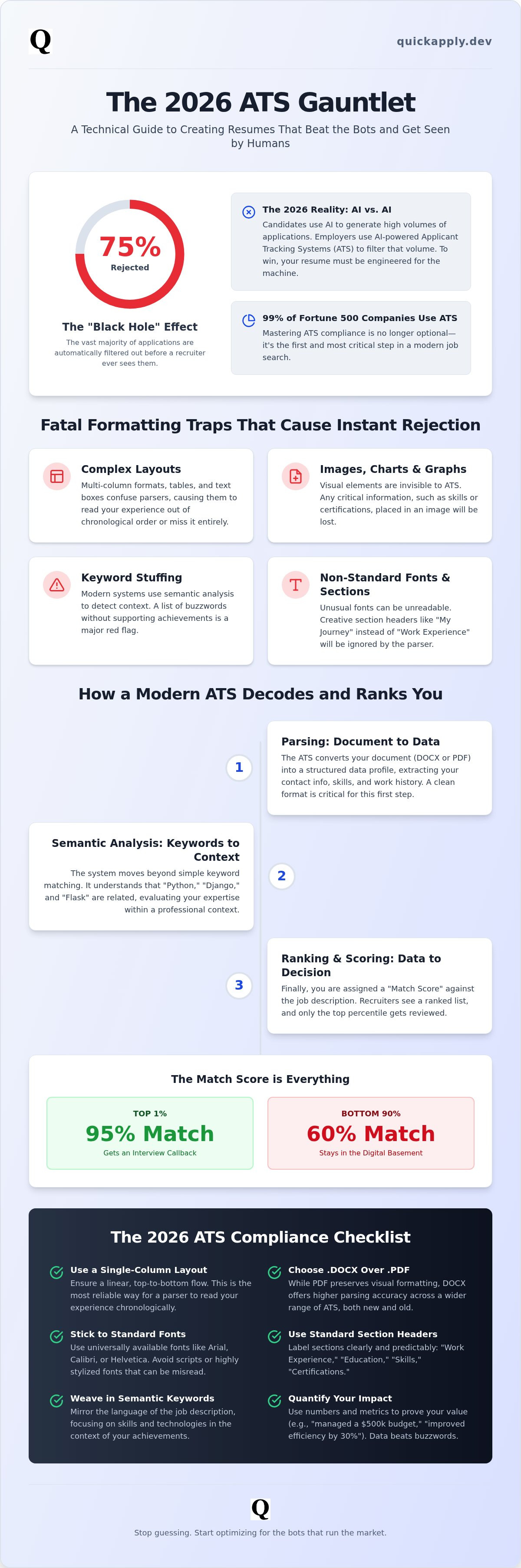
75% of applications disappear into the digital void. This is the Black Hole effect. It's not a glitch; it's the system working as intended. In 2026, the hiring process is an automated gauntlet. If you don't understand what an Applicant Tracking System is, you're essentially shouting into a vacuum. Recruiters no longer sift through stacks of paper. They manage ranking algorithms that prioritize efficiency over sentiment. Mastering how to make resume ats friendly is no longer optional; it's a prerequisite for visibility.
The 2026 reality is a machine-to-machine conflict. Candidates use AI to generate volume. Employers use AI to filter that volume. This creates a paradox where your perfect PDF might be unreadable to a legacy parser. Systems have shifted from basic keyword matching to sophisticated candidate ranking. They don't just scan for words; they evaluate your career trajectory and technical relevance against thousands of competitors in milliseconds. If your data isn't structured for speed, you're already out of the running.
The High-Volume Application Crisis
Ease of access has broken the traditional hiring model. With one-click applications, recruiters are flooded with thousands of resumes for every open role. This creates massive application fatigue. The ATS isn't just a tool; it's a gatekeeper designed to eliminate 90% of the pool instantly. Manual tailoring is a losing strategy. It's too slow. In a high-speed market, you need a technical edge to stay relevant. If you aren't automating your optimization, you're falling behind the curve. Efficiency is the only currency that matters in this volume-heavy environment.
The Cost of Invisible Errors
Formatting traps are the silent killers of a job search. Many applicants focus on aesthetics, adding images, charts, or non-standard fonts. These elements are fatal. They confuse the parser and lead to garbled data. Learning how to make resume ats friendly involves prioritizing structure over style. When a bot can't read your contact info or job titles, it assigns a zero value to your profile.
- Parsing Failures: Multi-column layouts often cause systems to read your experience out of chronological order, destroying your professional narrative.
- Semantic Analysis: Modern bots detect keyword stuffing. They look for contextual relevance, not just a list of buzzwords.
- Match Scores: A low match score triggers an automatic rejection. If the system can't index your skills effectively, you won't even rank in the search results.
A low match score isn't a suggestion. It's a hard stop. You need to align your achievements with specific company goals to satisfy the ranking algorithm. Stop guessing and start engineering your data for the systems that actually control the hiring process.
Decoding the Algorithm: How Modern ATS Resume Checkers Actually Work
The ATS has evolved. It's no longer a simple filter. It's a ranking engine that determines your professional worth in seconds. To win, you must understand the mechanics of the machine. Most advice focuses on the surface. We're going deeper into the code. The system doesn't "read" your resume like a person. It processes it as a data object.
Resume Parsing is the process of converting unstructured document data into a structured candidate profile. This is the first point of contact. The system extracts your name, contact info, and experience into a database. If the parser fails, your application dies. This is why ATS-friendly resume formatting is the bedrock of your strategy. Without a clean technical foundation, your content is invisible.
Modern systems have moved beyond basic keyword indexing. In 2026, semantic search is the standard. Older systems looked for exact matches of the word "Python." Newer systems understand that "Python," "Django," and "Flask" belong to the same ecosystem. They evaluate your skills based on intent and context. If you want to know how to make resume ats friendly, stop focusing on word frequency. Focus on professional relevance. The bot is looking for a cohesive narrative, not a list of buzzwords.
The Match Score is the final output. Recruiters see a dashboard of candidates ranked by percentage. A 95% match gets an interview. A 60% match stays in the digital basement. This score is a calculation of how well your parsed data aligns with the job's specific requirements. You can optimize this instantly with automated resume tailoring to ensure you're always in the top tier of the recruiter's view.
The Role of NLP in 2026 Recruitment
Natural Language Processing (NLP) allows the ATS to read like a human but at a massive scale. It analyzes the relationship between words. It understands that "Managed a team of 10" is more valuable than just having the word "Management" in a skills list. Context is the new keyword. The system identifies career progression and quantifies your impact. It's looking for the "why" and "how," not just the "what."
Parsing Accuracy: The Technical Foundation
Technical errors are avoidable. Many legacy systems still struggle with OCR (Optical Character Recognition), which tries to "read" text from an image. This is why you should never use images or complex graphics. Text parsing is the goal. It's the direct extraction of digital text. Standardized headings help the bot navigate your career history without confusion. Use "Work Experience" instead of "My Professional Journey." Clarity drives ranking. Understanding how to make resume ats friendly starts with these technical non-negotiables.
The 2026 ATS Compliance Checklist: Non-Negotiable Standards
Aesthetics don't get you hired; data structure does. Stop overcomplicating your design. If you want to know how to make resume ats friendly, you must start with the technical baseline. While modern systems claim full PDF compatibility, DOCX remains the gold standard for universal parsing reliability. Legacy systems still struggle with complex PDF layers. According to MIT's guide to ATS-friendly resumes, simple layouts are the most effective way to ensure your data reaches the recruiter without corruption.
Your contact information is the primary index key. The ATS needs essential fields to categorize you correctly. Include your full name, phone number, professional email, and general location. Don't hide this data in headers or footers; many parsers ignore these sections entirely. Use standard section titles like "Work Experience" and "Education." Creative headings like "My Professional Journey" might look unique to a human, but they confuse the bot and lead to empty profile fields.
Formatting for Digital Extraction
The "No Graphics" rule is absolute. Your headshot is an ATS red flag. It can break the parser and trigger bias filters in compliance-heavy industries. Stick to web-safe, standard typography like Arial, Calibri, or Georgia. These fonts are easily indexed. Avoid tables, columns, and text boxes. They disrupt the reading order of the bot. The chronological approach is the bot's favorite. It provides a clear, linear timeline that ranking algorithms can easily quantify. Functional resumes often hide gaps, but they also hide the data points the ATS needs to rank you effectively.
Optimization for Semantic Ranking
AI models look for measurable impact. Use the Action + Task + Result formula to provide a clear data path for the bot to quantify your value. For example: "Increased lead conversion (Result) by implementing a new CRM workflow (Task) using Python (Action)." This structure satisfies both the semantic search for tools and the contextual ranking for achievements. AI prioritizes hard skills for initial ranking, so ensure your technical stack is prominent. Learning how to make resume ats friendly involves more than just deleting images. It requires specific alignment. Knowing how to tailor resume to job description requirements is the fastest way to boost your ranking score and move from the digital basement to the recruiter's shortlist. Build authority by using industry-standard terminology that mirrors the job posting exactly.
Beyond Keyword Stuffing: Mastering Contextual Relevance with AI
Keywords are the floor, not the ceiling. In 2026, the real challenge is the Human-Centric AI paradox. You must satisfy the ranking algorithm while remaining compelling to the human manager. If your document sounds like a bot wrote it for another bot, you'll fall into the "uncanny valley" of AI text. This leads to immediate rejection during the human review phase. High-performance applicants understand that how to make resume ats friendly involves more than just word frequency. It requires deep contextual alignment between your past execution and the company's future goals.
Over-optimization is a trap. When you strip away personality for the sake of a match score, you lose your competitive edge. The goal is to find the right balance. Use good resume examples to see how top-tier tech professionals integrate technical requirements without sacrificing their professional voice. Your resume should be a data-rich narrative that proves you can solve specific problems, not just that you know the terminology.
The Automated Tailoring Advantage
Efficiency is your greatest asset. Manual resume editing is a legacy process that creates unnecessary latency. It typically takes 45 minutes to adjust a single application. AI does it in 15 seconds. This speed allows you to maintain high accuracy while drastically increasing your application volume. The Match Score serves as a critical feedback loop. It tells you exactly where your career strategy aligns with market demand. Don't waste time on manual tweaks. Use automation to ensure every submission hits the top of the pile. High-volume output with low-effort input is the only way to win in a crowded market.
Beating the Hidden ATS Filters
The ranking algorithm isn't the only gatekeeper. Hidden filters, like knock-out questions, can end your candidacy before it begins. These are the automated prompts regarding years of experience, specific certifications, or sponsorship needs. If your parsed data doesn't provide a clear "yes" to these requirements, the system discards your profile. Location and availability fields are equally vital. Many systems prioritize local candidates or those ready to start immediately. To achieve 100% alignment, leverage tailor resume to job description ai tools. These systems scan for these hidden triggers and ensure your profile is optimized for every possible filter. You can automate your resume tailoring now to bypass these digital barriers and secure your next interview.
Success in 2026 requires a technical mindset. You've mastered the basics of how to make resume ats friendly; now you must master the execution. Stop treating your job search as a manual chore. Treat it as an optimization problem that requires the right software to solve.
Optimizing your search also means managing how you appear to recruiters once you've cleared the automated filters. You can discover LYNKP to build a professional digital career identity that showcases your full value beyond a static document.
Stop Checking, Start Applying: Automating Your Success with QuickApply
Knowing how to make resume ats friendly is a diagnostic step. Fixing it manually for every application is a productivity leak. Most tools identify errors but leave the labor to you. QuickApply is an execution engine. It outpaces screening bots by automating the entire optimization cycle. You don't just find out what's wrong; you generate the solution instantly. This is the shift from passive checking to active applying. It's about moving at the speed of the software that's trying to filter you out.
Efficiency defines the 2026 market. You can now generate custom resumes for 50 jobs in a single afternoon. This isn't just about volume; it's about precision. Our match score identifies the best-fitting opportunities so you can focus your energy where it yields results. Data indicates that tech professionals using these automated systems secure 3x more interviews compared to those using manual methods. By removing the friction of manual editing, you maintain a consistent competitive edge. You're no longer fighting the bots; you're using a superior one to win the statistical game of high-volume hiring.
Integrated tracking ensures you never lose sight of an application again. Traditional spreadsheets are slow and prone to error. Our platform manages the entire search cycle, providing a real-time dashboard of your funnel performance. You can see exactly which versions of your resume are performing and where you are in the recruitment lifecycle. This level of data-driven oversight is essential for navigating the complex ecosystems of modern enterprise hiring.
The QuickApply Workflow for Tech Pros
Start by uploading your master resume. The AI handles the heavy lifting of data extraction and structural alignment. Once your profile is ready, use our ai cover letter generator to create responses that mirror your tailored resume. This ensures a unified professional narrative across all documents. This consistency is vital for semantic search ranking. Manage the entire search cycle with the integrated Application Tracker. It eliminates the redundancy of manual data entry and keeps your pipeline moving without active effort.
Winning the Interview and Beyond
Getting past the ATS is only the first stage of the gauntlet. Once the digital gatekeepers grant you access, leverage our interview practice tools to refine your delivery. We provide a full-stack career platform that supports your long-term trajectory. From salary negotiation guides to promotion roadmaps, the goal is continuous growth. Stop wasting hours on manual formatting and outdated advice. It's time to Stop building, start tailoring with QuickApply to dominate your field. Mastering how to make resume ats friendly is just the beginning of your automated success story. Take control of your career data and let the machine work for you.
Master the Algorithm and Secure Your Next Role
The 2026 job market is an algorithmic battleground where speed and precision are the only metrics that matter. You now understand that how to make resume ats friendly involves a shift from basic keyword stuffing to advanced semantic alignment. By prioritizing structural integrity and technical compliance, you ensure your data remains readable to even the most complex legacy parsers. The digital gatekeepers are no longer a barrier; they're a system you can navigate with the right technical edge.
Don't let manual editing slow your career trajectory. Leverage a platform that moves as fast as the hiring software it targets. QuickApply offers AI-powered tailoring in seconds, an integrated application tracker to manage your funnel, and built-in interview practice tools to help you close the deal. It's time to stop guessing and start executing with a tool built for the modern tech professional.
Optimize your resume and beat the ATS with QuickApply today. Your next opportunity is waiting on the other side of the screen. You've got the talent; now you have the technology to prove it.
Frequently Asked Questions
Do ATS resume checkers actually work?
Yes, they function as diagnostic simulators for the recruitment process. These tools mirror how parsers extract data and rank candidates. They help you understand how to make resume ats friendly by identifying structural failures and keyword gaps before you submit. Using a checker ensures your data is visible to the algorithm rather than being discarded by the system.
What is a good ATS score for a resume?
Aim for a match score of 80% or higher to reach the recruiter's shortlist. Achieving a 100% score is rarely possible because every company configures its ranking parameters differently. Focus on hitting the top tier of the applicant pool. This high-ranking position ensures the system flags your profile as a priority match for the human hiring team.
Is it better to use a PDF or Word document for ATS?
Use a DOCX file for the highest technical compatibility. While modern systems are improving their PDF processing, legacy parsers still struggle with complex document layers. A Word document provides a clean, flat text structure that is easy for any system to index. This simple choice prevents parsing errors that could make your experience invisible to the bot.
Can an ATS read resume columns or tables?
No, columns and tables frequently scramble the reading order of the parser. Most systems read text from left to right across the entire page. When you use multi-column layouts, the bot merges unrelated sections of your experience into a garbled mess. Stick to a single-column, linear structure to ensure your career timeline remains logical and searchable.
How do I know if a company uses an ATS?
Assume every company uses one. 99% of Fortune 500 companies and 93% of organizations overall rely on an ATS in 2026. You can verify this by looking at the application URL. If you see names like Workday, Greenhouse, or iCIMS, you are interacting with an automated gatekeeper. Tailoring your resume is the only way to navigate these systems effectively.
How often should I tailor my resume for the ATS?
Tailor your resume for every single application. Each job description contains specific semantic requirements that the ranking algorithm uses to score your profile. Manual editing is a productivity leak. Use automation to align your skills with the job requirements in seconds. This ensures you maintain a high match score for every role without wasting hours on manual updates.
Will using an AI resume builder get me banned from job boards?
No, recruiters prioritize the quality of the data over the tool used to create it. AI resume builders, such as Rezumi, are standard productivity tools for tech professionals in 2026. These platforms ensure your information is structured for the very systems recruiters use to find talent. Using smart technology gives you a competitive edge and helps you secure interviews faster than manual applicants.
What are the most important keywords for a tech resume?
Hard skills and specific technical stacks are the primary drivers of your rank. Focus on the exact languages, frameworks, and tools mentioned in the job description. Modern systems use semantic search to understand the relationship between these terms. Learning how to make resume ats friendly involves placing these technical markers within the context of measurable professional achievements.


