
79% of job seekers are already using AI tools to gain a competitive edge, yet many still struggle with the very first line. If you are still agonizing over how to start a cover letter for every single project or repository you have managed, you are losing the race. In 2026, manual drafting is a legacy process that belongs in a museum. Spending 30 minutes on a single application only to get ghosted by an ATS is a total failure of optimization.
It is exhausting to narrate complex technical skills while worrying about match scores and automated filters. You deserve a workflow that respects your time. This guide provides a high-performance framework to replace your static templates with AI-driven automation. You will learn to generate tailored documents that bypass detection and land more interviews. We are breaking down the exact system to accelerate your submission speed and maximize your career ROI. Stop wasting hours; start deploying applications with precision.
Key Takeaways
- Stop using static files; transition to dynamic frameworks built for the 2026 tech market.
- Master how to start a cover letter by mapping your opening hook to the specific technical challenges in the job description.
- Identify the structural "anchor points" where you must inject personal insight to bypass AI filters without losing efficiency.
- Avoid the "Canva Trap" by choosing ATS-optimized formats that ensure your data reaches the hiring manager.
- Utilize automated JD analysis to replace manual drafting and secure higher match scores instantly.
What is a Cover Letter Template in the AI Era?
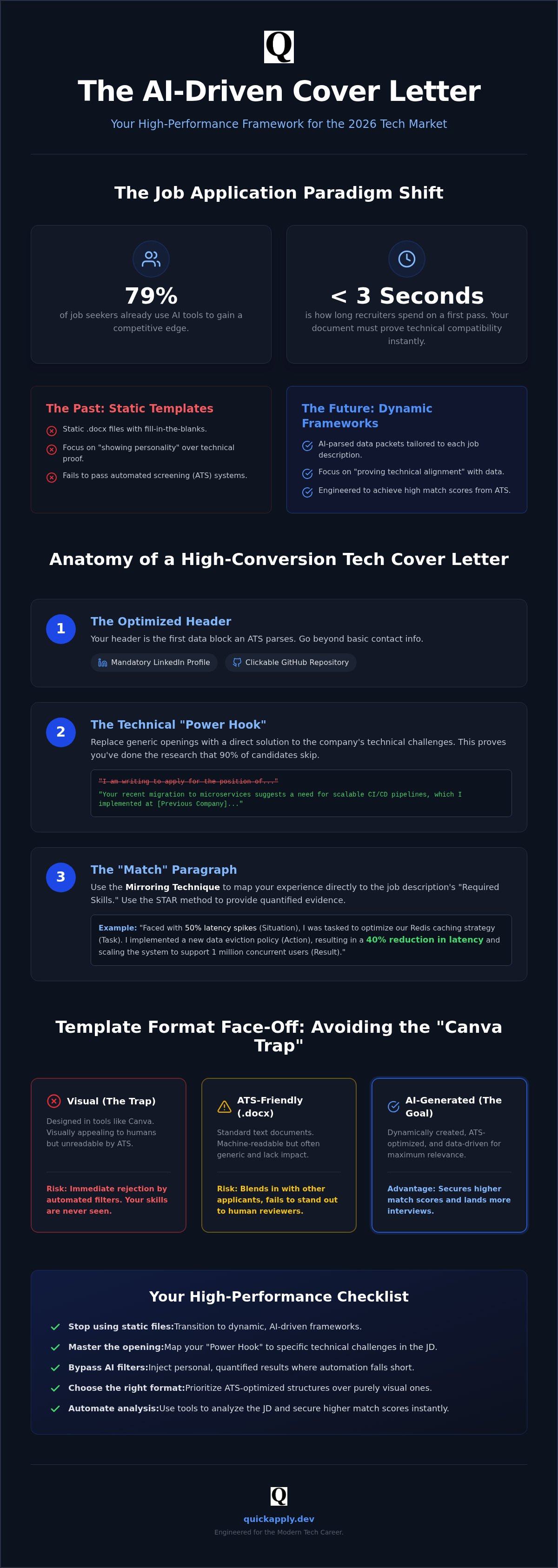
In 2026, a cover letter template isn't just a static .docx file you swap names into. It's a dynamic structural framework designed to feed data to an algorithm. While traditional definitions describe what a cover letter is as a simple introduction, the tech sector has moved beyond that. Now, it's about architectural alignment. If you're still using a "one-size-fits-all" template, you're signaling to recruiters that you lack the optimization mindset required for modern software roles. These generic documents are the primary reason for immediate rejection because they fail to hit the specific match scores required by automated screening systems.
The tech industry demands a high-speed, data-driven approach. Your template must function as a bridge between your raw talent and the company's specific technical debt. In an era where 66% of hiring managers use AI-detection software to screen candidates, your document needs to be both machine-readable and high-impact. It's no longer about filling in blanks; it's about configuring a system that outputs success. A template that doesn't adapt to the specific tech stack of the role is a liability, not an asset.
The Evolution of the Job Application
Applications have shifted from physical letters to digital PDFs, and now into AI-parsed data packets. In this environment, recruiters spend less than 3 seconds on a first pass. They aren't looking for "personality" in the traditional sense. They are scanning for technical compatibility. Your cover letter must prove you can solve their specific engineering bottlenecks before a human ever sees it. Knowing how to start a cover letter in this era means leading with a high-impact solution rather than a polite greeting. The shift from "showing personality" to "proving technical alignment" is absolute.
Why Tech Professionals Need Specialized Templates
Software engineering is too complex for a standard corporate template. You need a structure that accommodates GitHub repositories and project portfolios natively. Traditional templates bury your stack proficiency in blocks of text; modern frameworks highlight it. Instead of listing responsibilities, your template should focus on "Impact Metrics." Understanding how to start a cover letter with a focus on stack-specific impact is the difference between an interview and a 404 on your application status.
- Highlight specific stack proficiency such as Rust, Kubernetes, or AWS early.
- Embed links to live repositories or architectural diagrams within the header.
- Quantify results by showing how you reduced latency by 40% or scaled a system to 1 million users.
These specialized frameworks ensure your technical narrative isn't lost in translation. They prioritize the information that actually moves the needle in a hiring decision. When you optimize your template for these specific tech requirements, you aren't just applying. You're demonstrating your ability to engineer a solution for your own career growth.
The Anatomy of a High-Conversion Tech Cover Letter
Your header is the first data block an ATS parses. It must go beyond basic contact info. In 2026, including your LinkedIn profile and a link to your GitHub repository or technical portfolio is mandatory. If these aren't clickable and properly formatted, you're creating friction for the recruiter. You need to structure your cover letter so the most relevant technical links are indexed immediately. This metadata is the foundation of your professional identity in a digital-first market.
Mastering how to start a cover letter requires a shift from self-introduction to problem-solving. While 79% of job seekers use AI, most use it to generate generic fluff. You should use it to identify the company's pain points. Look at their recent engineering blog or public repo updates. Your opening line should address their current challenges directly. This creates instant alignment between your skills and their technical debt.
The Technical Hook: Grabbing Attention in 2026
Stop using "I am writing to apply for the position of..." as your entry point. It's redundant and wastes space. Instead, try: "Your recent migration to a microservices architecture suggests a need for scalable CI/CD pipelines, which I successfully implemented at my previous role." This is a Power Hook. It defines a specific technical achievement that aligns with their current roadmap. By referencing a company's recent engineering updates, you prove you've done the research that 90% of candidates skip.
The "Match" Paragraph: Bridging the Skill Gap
The body of your letter must use the Mirroring Technique. Map your experience directly to the "Required Skills" in the job description. If they ask for Kubernetes, AWS, or React, those keywords must appear in your narrative. Use the STAR method to provide evidence: Situation, Task, Action, Result. For example: "Faced with 50% latency spikes, I optimized our React state management, resulting in a 20% improvement in load times." This provides the concrete data points recruiters need to verify your proficiency.
Close with a confident call to action. Don't hope for a call. Invite a technical discussion about their specific stack. "I'm eager to discuss how my experience with Go could accelerate your backend refactoring." To ensure your document hits these high-performance markers every time, you can use automated cover letter generation to match every job description perfectly. This system ensures your close is as punchy as your opening, driving the reader toward an immediate interview request.
Comparing Template Formats: Visual vs. ATS-Friendly vs. AI-Generated
Choosing the wrong format is the fastest way to kill your application before a human ever sees it. You might think a stylized, multi-column layout makes you look like a visionary, but most ATS parsers see it as unreadable noise. This is the "Canva Trap." High-resolution graphics and complex grid systems often end up in the digital trash because they break the logic of modern hiring platforms. In 2026, your document is data first and a document second. If the parser can't find your contact info or your technical stack, you don't exist.
The "Word Standard" remains a safe harbor for many, but it lacks the edge required for innovative tech startups. It's functional but often too boring to capture attention in a high-volume environment. When you're figuring out how to start a cover letter that actually converts, a static Word file doesn't offer the dynamic flexibility needed to match specific job descriptions at scale. It forces you into manual editing, which is a massive drain on your most valuable resource: time. You can't afford to spend 30 minutes on a document that only has a 2% chance of being read.
The new gold standard is the AI-Tailored Dynamic Template. This isn't just about filling in blanks. It's a structural framework that adapts its content density and keyword weighting based on the job description. To ensure your template is readable, run a simple "plain text" test. Copy and paste your content into a basic text editor. If the order is scrambled or characters are missing, an ATS will likely reject it. A clean, single-column layout is your best bet for passing the 66% of hiring managers who now use AI-detection and screening software.
Visual Templates: Use with Caution
Creative layouts have their place, specifically for design roles or early-stage startups where a human might be the first to open the file. However, for the vast majority of tech roles, these are a risk. Multi-column layouts are notoriously difficult for automated tracking systems to parse correctly. Recruiters in 2026 prefer clean, single-column scans for rapid review. This format allows for rapid review and ensures that your technical stack is indexed without errors. Don't let a "pretty" design stop you from getting an interview.
The Rise of the AI-Tailored Framework
Manual drafting is an obsolete strategy. Modern ai cover letter generator technology has replaced the slow process of manual tailoring. There is a critical difference between a generic "prompt" and a "tailored output." A tailored framework analyzes the job description to determine exactly how to start a cover letter with maximum impact. Efficiency is your ultimate competitive advantage. In a market where 71% of placements come from candidates already in a firm's database, you need to submit high-quality, high-match applications faster than the competition.
How to Use a Template Without Looking Like a Bot
Automation is your engine, but you are the driver. In 2026, the most successful tech professionals use a "Human-in-the-Loop" strategy. This means you automate the structural framework while personalizing the critical insights. If you're struggling with how to start a cover letter that feels authentic, you need to identify "Anchor Points" within your template. These are specific zones where you must inject unique context about a company's recent project or a specific technical hurdle you've cleared. A template provides the speed; your insight provides the conversion.
The key is using technology to enhance, not replace, the human element. Just as The Songai by Songai Media uses AI to help individuals transform their unique life stories and memories into custom musical gifts, you should use AI to help package your professional journey in a way that resonates with hiring managers.
Your narrative should remain consistent across your entire application packet. Reviewing good resume examples helps you see how to carry technical threads from your bullet points into your cover letter prose. Don't just repeat your resume. Expand on the "why" behind your most significant architectural decisions. Be vigilant about AI hallucinations. Automated tools can occasionally misinterpret your experience or invent project details. Always verify every technical claim before hitting submit. A single fabricated detail can ruin your credibility instantly.
Keyword Optimization: The 2026 Secret Sauce
Recruiters use algorithms to weigh your relevance before they ever read a word. Identify "High-Weight" keywords by looking at the first three requirements in the job description. These are the company's non-negotiables. Place these terms naturally within your opening and body paragraphs. You should be tailoring your resume to a job description and your cover letter simultaneously. If these two documents don't sync up on key technical proficiencies, your match score will suffer. Consistency is the key to bypassing automated gatekeepers.
Tone Check: Striking the Tech Balance
The "Formal Corporate" tone is dead. It feels stiff, dated, and robotic. In the modern tech landscape, you want to sound like a "Pragmatic Tech-Ally." This means being direct and results-oriented. Use punchy, active verbs like "Architected," "Scaled," and "Optimized." Avoid long-winded stories that bury your impact. The 2026 trend favors short, high-impact paragraphs that respect the reader's time. Each sentence should prove you understand the stack and the business goals behind it.
Stop guessing and start optimizing your outreach. Generate tailored cover letters in seconds to ensure your tone and keywords are always on point for every application.
QuickApply: Moving Beyond Static Templates
Legacy templates are a bottleneck in your career progression. Relying on a static file is a high-risk strategy that ignores the realities of 2026 hiring algorithms. QuickApply marks the definitive end of the "Copy-Paste" era. Instead of manual drafting, our system leverages advanced JD analysis to select the optimal structural framework for your specific target role. It ensures your document isn't just a letter, but a precision-engineered data packet designed for maximum impact.
When you use our platform, you no longer have to guess how to start a cover letter to grab a recruiter's attention. The AI identifies the core technical pain points in the job description and drafts a Power Hook that aligns with your verified experience. This removes the mental fatigue of staring at a blank cursor. You move from drafting to deploying in seconds. It is about working smarter, not harder, to secure your next technical lead or senior engineering role.
The Match Score feature provides the ultimate sanity check. It evaluates your cover letter against the job description to ensure you hit the specific keyword weighting required by modern parsers. You know exactly if your document hits the mark before you ever hit send. This data-driven feedback loop eliminates the anxiety of the "black hole" application process. You aren't just sending out resumes; you are submitting optimized solutions with a high probability of conversion.
The 30-Second Tailoring Workflow
Speed is your greatest asset in a competitive market. Simply upload your base resume and paste the target job URL. Our AI analyzes the intersection of your skills and the company’s needs to produce a high-conversion document. You get one-click edits and an instant PDF export, allowing for a mastered job application process that takes less time than brewing a cup of coffee. This workflow is built for professionals who value their time and expect their tools to do the same.
Scaling Your Search with Precision
Applying to 10 or more high-quality roles daily used to be a recipe for burnout. With our automation, it becomes a routine task. You can maintain high standards across every single submission without sacrificing your evenings. By leveraging the application tracker, you avoid duplicate efforts and keep your search organized in a single command center. This transition from a "Job Seeker" to a "Career Manager" is the final step in optimizing your professional trajectory. Stop wasting hours on manual labor and start managing your career like the high-level system it is.
Optimize Your Application Pipeline Today
The transition from static files to dynamic frameworks is the single most important upgrade you can make to your job search. You've learned that success in 2026 requires more than just a clean layout; it demands technical alignment and algorithmic readiness. By moving past the "Canva Trap" and focusing on impact metrics, you position yourself as a high-value asset. You now know exactly how to start a cover letter by addressing specific engineering pain points that generic templates always miss.
Don't let manual drafting slow your momentum. QuickApply provides the infrastructure you need to scale your search with precision. Our platform delivers AI-powered tailoring in seconds and utilizes ATS-optimized frameworks to ensure your technical stack is indexed correctly. By using our integrated application tracking, you transform from a passive seeker into a proactive career manager. It's time to leverage smart technology to secure your competitive advantage in a crowded market.
Stop manual drafting and start tailoring with QuickApply to accelerate your path to more interviews. Your next technical breakthrough is waiting for a perfectly engineered application.
Frequently Asked Questions
Do I really need a cover letter in 2026?
Yes, you need one to bridge the gap between your resume and the specific technical debt of a company. While 79% of job seekers use AI, those who succeed use cover letters to prove architectural alignment. It is your best tool for explaining the "why" behind your engineering decisions. Without it, you miss a critical chance to influence your match score and address specific pain points mentioned in the job description.
How do I make my cover letter template ATS-friendly?
Use a clean, single-column layout with standard fonts like Roboto or Arial. Avoid complex graphics, tables, or multi-column grids that break the parsing logic of modern tracking systems. These visual elements often render your data unreadable to algorithms. Focus on a clear hierarchy of information. Ensure your technical keywords are placed naturally within the text for optimal indexing by the recruiter's screening software.
Should I use a different template for every job application?
Tailor every document to maintain a high match score and prove your relevance. A static template is a liability in a competitive market. Each job has unique technical requirements and specific bottlenecks. By adjusting your framework to mirror the job description, you prove you understand the company’s stack. This strategy is critical when deciding how to start a cover letter that actually converts into an interview.
Can recruiters tell if I used an AI cover letter generator?
Recruiters spot generic, low-effort AI outputs, but they value high-quality, tailored documents. 66% of hiring managers use AI-detection software, so the "Human-in-the-Loop" strategy is vital. Use AI to build the structural framework and identify keywords; then inject your specific project insights. This ensures your narrative feels authentic while benefiting from the speed of automation. It is about optimization, not just copy-pasting raw outputs.
How long should a tech cover letter be in 2026?
Limit your letter to between 200 and 300 words. Recruiters in 2026 value brevity and impact over long-winded narratives. Focus on three high-impact paragraphs: a strong hook, a technical match section, and a confident close. Every sentence must serve a purpose. If a word does not prove your proficiency or solve a problem, delete it. Efficiency is the ultimate signal of a professional who respects the reader's time.
Is it okay to use a creative Canva template for a software engineer role?
Skip the Canva templates for software engineering roles. While they look visually appealing to humans, they often fail the ATS parsing test. Multi-column layouts and non-standard font encoding can scramble your data. For tech roles, a clean, single-column Word or PDF document is the gold standard. It ensures your GitHub links and technical stack are indexed correctly without any digital friction or formatting errors.
What are the best fonts for a professional cover letter?
Select modern, sans-serif fonts like Roboto, Open Sans, or Lato. These fonts are highly readable on digital screens and are easily parsed by automated systems. Avoid decorative or serif fonts that feel dated or create visual clutter. Consistency in font choice across your resume and cover letter projects a polished, professional image. Stick to a size between 10 and 12 points to ensure readability without wasting space.
How do I mention my GitHub or portfolio in a cover letter template?
Embed clickable links to your GitHub and portfolio in the header alongside your contact information. When deciding how to start a cover letter, you can also reference a specific repository that demonstrates your proficiency in the company’s tech stack. Mentioning a live project or an open-source contribution provides concrete proof of your skills. This moves the conversation from theoretical knowledge to practical, architectural impact that recruiters can verify instantly.


