

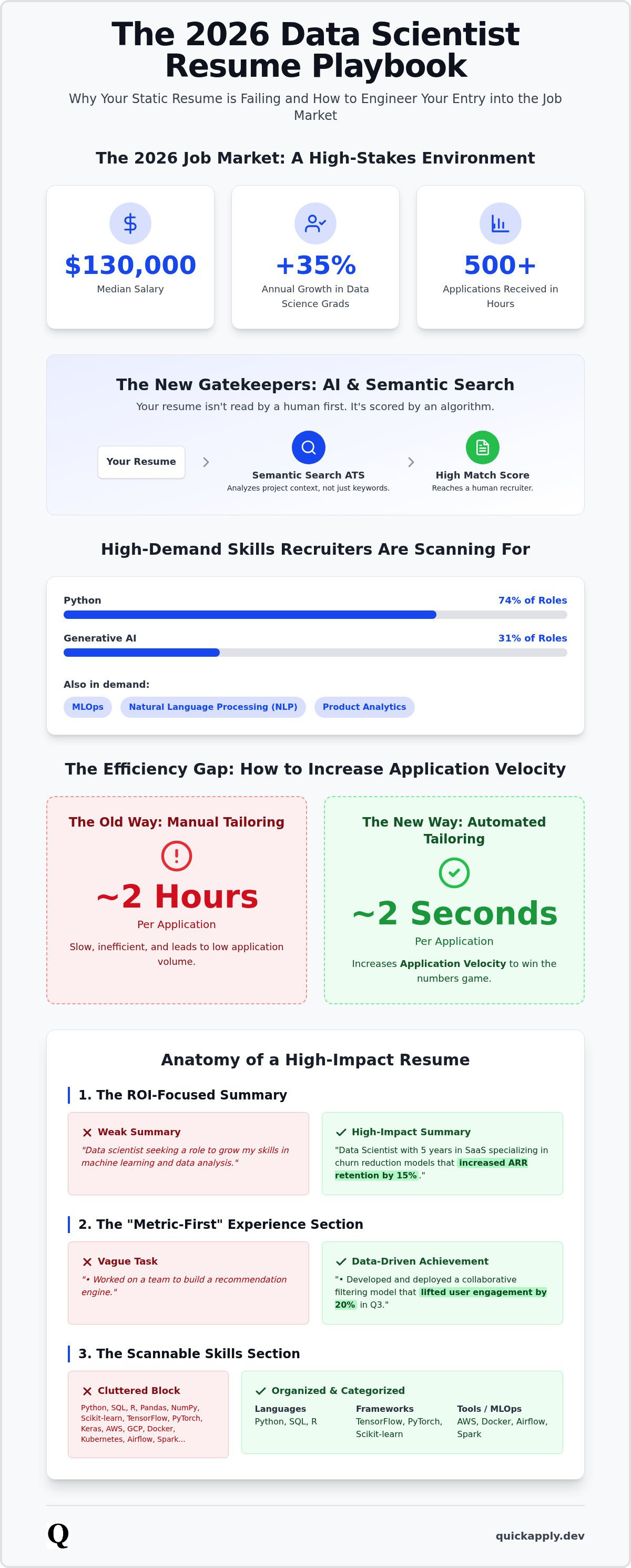
In 2026, a static resume is a statistical guarantee of rejection. With data science graduates increasing by over 35% annually, the competition for that $130,000 median salary is brutal. You need more than a list of libraries; you need a data scientist resume example that functions as a high-performance base model. Employers now filter for specific signals, with 74% of roles demanding Python and 31% requiring Generative AI expertise. If your application isn't optimized for these precise benchmarks, it won't even reach a human recruiter.
You're likely tired of sending hundreds of applications into the void with zero response. It's difficult to quantify business impact when you're focused on technical architecture, but that's where most candidates lose the lead. This guide teaches you the anatomy of an AI-ready application and shows you how to use automated tailoring to beat the market noise. We'll provide a clear template that works and a strategy to prioritize high-demand skills like MLOps and NLP, ensuring your interview conversion rates finally move in the right direction.
Key Takeaways
- Understand how 2026 ATS systems use semantic search to filter candidates and how to bypass these digital gatekeepers instantly.
- Deconstruct a high-performance data scientist resume example to master the technical header and ROI-focused summary that recruiters demand.
- Eliminate the "generalist trap" by learning to tailor your profile for specific specializations like ML Engineering or Product Analytics.
- Adopt a "Metric-First" mindset to quantify your business impact, replacing vague task lists with concrete data-driven achievements.
- Build a high-volume application pipeline using automated tracking to manage your career growth with maximum efficiency and zero wasted effort.
The 2026 Data Science Job Market: Why Your Static Resume is Failing
The data science job market in 2026 is a high-frequency trading floor for talent. When a top-tier firm posts a role, they receive 500+ applications within hours. If you're still using a static PDF, you're mathematically invisible. Modern Applicant Tracking Systems (ATS) have moved beyond simple keyword matching to sophisticated semantic search. They don't just look for "Python"; they analyze the context of your projects to determine if your experience aligns with their specific business goals. You aren't competing against other people; you're competing against a scoring algorithm.
Understanding What is Data Science? involves more than just knowing algorithms; it requires the ability to signal your value to these automated gatekeepers. A standard data scientist resume example is a useful base model, but it's not a final product. Every role is a unique dataset. If you don't adjust your parameters for each specific job description, your match score will plummet. Stop writing documents. Start engineering your entry. Tailoring is the only way to survive the noise.
How AI Recruitment Algorithms Screen Your Data Science Skills
Recruiters now use LLM-based screening tools that parse your project descriptions for technical nuance. These systems identify the difference between a casual user of PyTorch and someone who has deployed production-level models. Keyword stuffing is officially dead. If you load your skills section with irrelevant terms, the algorithm identifies the low signal-to-noise ratio and flags your profile as a mismatch. You must match the specific tech stack of the job description with surgical precision. The AI evaluates how your previous stack experience solves their current technical debt. If the job asks for MLOps and you only talk about Jupyter Notebooks, you're out.
The Efficiency Gap: Manual vs. Automated Tailoring
The traditional approach to job hunting is a productivity leak. Manually adjusting your data scientist resume example for every application takes approximately two hours per role. In a market where speed is a competitive advantage, this is unacceptable. Automated tailoring reduces that time to two seconds. This shift allows you to increase your "Application Velocity", which is the number of high-quality, tailored applications you can submit per week. Resume Tailoring is the process of aligning experience with specific job requirements using data-driven precision. It's the difference between guessing and winning. High-velocity candidates win because they out-calculate the competition.
Anatomy of a High-Impact Data Scientist Resume Example
A high-impact data scientist resume example starts with a technical header. Links to your GitHub, Kaggle, and a live Portfolio aren't optional extras. They're proof of work. Recruiters in 2026 check these repositories to verify code cleanliness and documentation style before they ever pick up the phone. If your GitHub is a graveyard of "Untitled.ipynb" files, you've already lost. Your header should be a clean, hyperlinked row that directs attention to your best deployments.
Beyond the header, the structure must prioritize readability. Don't just list your tech stack in a massive block of text. Categorize your skills into Languages, Frameworks, and Tools. This allows both the ATS and the human reader to scan your profile in seconds. When you align these data scientist resume elements correctly, you demonstrate an understanding of technical hierarchy. It shows you know which tools are primary drivers and which are secondary support systems.
The 'Professional Summary' That Hooks Recruiters in 6 Seconds
A weak summary is a list of tools. A high-impact summary is a business case. Stop saying you're "seeking a role to grow your skills." Instead, deliver a three-line elevator pitch focused on ROI. Mention your specific domain expertise, whether it's FinTech, SaaS, or Healthcare. If you've mastered a specific niche, lead with it. For example, "Data Scientist with 5 years in SaaS specializing in churn reduction models that increased ARR retention by 15%." This tells the recruiter exactly what problem you solve. It also aligns with the "Match Score" logic used by modern screening tools. If your summary doesn't mirror the job's core KPIs, you're just another applicant in the pile. You can check your current match score to see how your summary stacks up against 2026 benchmarks.
Structuring the Experience Section for Maximum Clarity
The experience section is where most candidates fail by listing tasks instead of results. Use the Action-Context-Result (ACR) framework for every bullet point. "Built a model" is a task. "Deployed a Gradient Boosting model to optimize supply chain logistics, reducing shipping delays by 22%," is a result. This shift from "what I did" to "what I solved" is what separates mid-level talent from senior engineers. When reviewing good resume examples, you'll notice that the most successful profiles use hard data to anchor their claims. If you're dealing with NDA-protected projects or stealth startups, focus on the architecture and the scale. Describe the data volume and the percentage of improvement without naming the specific client. This maintains professional ethics while proving your technical capability. When you use this data scientist resume example structure, you transform your resume from a static history into a roadmap for future business success.
Strategic Tailoring: Why One Resume is No Longer Enough
Generalist resumes are mathematically destined for the trash folder in 2026. Companies no longer hire "Data Scientists" in the broad sense; they hire specific solutions to specific technical bottlenecks. A data scientist resume example for a Machine Learning Engineer must lead with model deployment, latency optimization, and infrastructure. In contrast, a Product Analyst role requires a heavy emphasis on experimentation, SQL optimization, and business metrics. If you submit the same document for both, you're signaling a lack of domain awareness. You're just a candidate with a Python compiler, not a strategic hire.
Mapping the job description to your experience is the only way to identify high-priority content gaps. If a posting emphasizes MLOps and your current draft focuses on exploratory data analysis, you have a structural mismatch. You can't rely on a recruiter to "read between the lines" when an algorithm is doing the first pass. Use AI resume tailoring to bridge these gaps instantly. This isn't about fabricating experience. It's about re-weighting your existing technical wins to match the employer's immediate pain points.
The 'Base Resume' vs. The 'Tailored Version' Workflow
Maintain a master document. This is your comprehensive data lake containing every project, certification, and technical achievement you've ever recorded. When a high-value role appears, extract the "Winning 3" projects that align closest with that specific JD. If the target is a FinTech firm, lead with your fraud detection models. If it's a SaaS company, prioritize your churn prediction work. Ensure your LinkedIn remains a broad professional overview while your data scientist resume example becomes a laser-focused strike. Consistency across platforms prevents red flags during the vetting process.
Beating the ATS Without Losing the Human Touch
Optimization doesn't have to strip your professional personality. AI tailoring works best when it maintains your authentic voice while satisfying the semantic search requirements of modern ATS. Avoid the "AI-generated" look by reviewing the output for technical nuance and precise action verbs. Refine the descriptions to match your actual level of contribution. tailoring your resume to a job description is the highest-ROI activity in a 2026 job search because it guarantees your profile reaches the top of the pile without requiring hours of manual editing. Efficiency is your only leverage in a high-volume market.
Quantifying Impact: How to Showcase Data Science Value
Technical specifications are just the baseline. In a high-performance data scientist resume example, your value isn't measured by the complexity of your stack, but by the ROI of your deployments. Saying you "built a model" is a zero-value statement. Recruiters in 2026 look for the delta you created in the business. If your XGBoost model improved conversion by 12%, lead with that percentage. Technical accuracy metrics like F1 scores or RMSE are internal checkpoints; business KPIs like Revenue, Churn, and Customer Acquisition Cost (CAC) are the external results that get you hired.
Many candidates struggle because their previous companies didn't track exact dollar amounts for every project. If you lack direct financial data, use proxies. Quantify the time saved for internal teams, the reduction in manual data entry hours, or the increase in data pipeline reliability. For instance, reducing model latency by 200ms might not have a direct price tag, but it significantly improves user experience and system throughput. Highlighting cost-saving initiatives is just as powerful as revenue generation. Optimizing cloud compute costs shows you understand the bottom line, making you a strategic asset rather than just a technical cost center.
Understanding these efficiencies is critical; for example, you can discover Switch My Books to learn how automated financial data migration replaces hundreds of manual entry hours with a streamlined, technical solution.
The 'Impact Formula' for Data Scientists
Stop writing bullet points that read like a job description. Use a three-step formula to engineer high-impact statements. First, identify the specific business problem, such as high customer churn or inefficient lead scoring. Second, state your technical solution, like an XGBoost churn prediction model or a custom NLP pipeline. Third, quantify the outcome with a hard number. A winning bullet point looks like this: "Reduced customer churn by 15% ($200k ARR retained) by deploying an XGBoost prediction model to trigger targeted retention offers." This structure proves you can translate code into capital. To ensure your bullets hit these benchmarks, use an AI tailor to optimize your impact statements instantly.
Showcasing 'Soft' Impact: Leadership and Cross-Functional Collaboration
Data science doesn't happen in a vacuum. You must document your "data storytelling" and stakeholder management skills. Ownership and initiative are best demonstrated through active verbs. Don't say you "were responsible for" a pipeline; say you "architected" it. Quantify your soft impact by mentioning the number of junior scientists you mentored or the number of cross-functional departments that now rely on your dashboards. If you improved data literacy across a 50-person marketing team, that's a massive win. It shows you can bridge the gap between technical complexity and business execution. This level of detail in your data scientist resume example signals that you're ready for senior-level responsibility.
Automated Career Growth: Building Your Data Science Pipeline
Your resume isn't a final destination; it's the raw data input for your career pipeline. In a market where application volume acts as a primary filter, managing your job search like a production-level data project is the only way to scale. Once you've engineered a high-performance data scientist resume example as your base, you need a system to deploy it. This means moving beyond manual spreadsheets and gut feelings. Leverage Match Scores to identify which roles are worth your technical energy. By focusing on high-probability opportunities where your specific stack aligns with the company's immediate needs, you maximize your interview conversion rate while minimizing wasted effort.
The goal is to move from a defensive "apply and pray" mindset to an offensive, data-driven strategy. Your resume should be one part of a larger automation stack that handles the heavy lifting of discovery and tailoring. This allows you to treat your career search as an optimization problem. When you treat the application process as a pipeline, you can identify exactly where the bottlenecks are occurring. If you're getting views but no calls, your summary might need work. If you're not getting views, your ATS optimization is the failure point. Use the data to iterate and win.
Integrating Your Resume with an Application Tracker
Tracking which version of your resume was sent to which company is critical for professional consistency. If you get a callback for an ML Engineering role, you must know exactly which projects and ROI metrics you highlighted in that specific version. Using an automated application tracker allows you to manage this metadata without manual entry. Over time, this data reveals which project descriptions or tech stack configurations trigger the highest response rates. You can use these insights to refine your master document continually. Transitioning from the initial application to interview practice becomes a logical next step when you can review the tailored insights that resonated with the recruiter. This feedback loop turns your job search into a self-optimizing system.
The QuickApply Advantage: Stop Building, Start Applying
QuickApply bridges the gap between your technical talent and the final interview room. It eliminates the friction of manual document editing and the administrative overhead that slows down your career progression. By utilizing automated systems, you stop functioning as a document editor and start acting as a strategic candidate. Your time is a finite resource. It's better spent mastering system design or refining your coding skills than reformatting bullet points for the fiftieth time. Focus on the final offer and the salary negotiation. Using a data scientist resume example that's already optimized for 2026 standards gives you the lead. Start tailoring your data science resume with QuickApply today and turn your application process into a high-speed engine for career growth.
Deploy Your 2026 Career Strategy
The 2026 job market demands a shift from manual editing to systemic optimization. You've learned how to transform a basic data scientist resume example into a high-impact business case that speaks the language of ROI. By moving beyond simple task lists and embracing a "Metric-First" mindset, you position yourself as a strategic asset. Efficiency is your ultimate competitive advantage. Don't let your technical talent get buried under the noise of 500 competing applications.
It's time to stop reformatting bullet points and start focusing on the final offer. Your career search is a pipeline that requires the right tools to scale. With AI-powered tailoring for tech roles and real-time match scores, you can prioritize high-probability opportunities instantly. Manage your entire growth strategy with an integrated job application tracker that keeps your master document refined and ready for deployment. This is how you out-calculate the competition and secure the salary you deserve.
Optimize your Data Science Resume in seconds with QuickApply. You have the technical skills; now use the right career stack to ensure the market sees them. Your next breakthrough role is just one optimized application away.
Frequently Asked Questions
What is the best resume format for a data scientist in 2026?
The reverse-chronological format remains the gold standard for data scientists. It's the most readable structure for modern ATS algorithms and human recruiters alike. Focus on a single-column layout to ensure your technical skills and ROI metrics parse correctly. Avoid complex graphics or multi-column sidebars that break semantic search. A high-performance data scientist resume example always prioritizes a clear hierarchy of experience and technical proficiency.
Should I include my GitHub profile on my data science resume?
Yes, a GitHub profile is non-negotiable for technical validation in 2026. Recruiters use it to verify your code quality, documentation habits, and project consistency. Ensure your repositories have clear README files and aren't just empty folders. A live portfolio or Kaggle link serves as additional proof of work. If you don't provide these links, you're asking the hiring team to take your skills on faith. They won't do it.
How do I list machine learning projects if I have no professional experience?
Create a dedicated "Technical Projects" section that mirrors a professional experience block. Treat each project as a job, detailing the specific problem, your technical stack, and the final result. Focus on the full data lifecycle, from wrangling and EDA to model deployment and monitoring. Mentioning that you deployed an API via FastAPI or AWS shows you understand production environments. This is critical for entry-level roles.
For those looking to demonstrate advanced skills, analyzing sensor data from professional-grade hardware like Apevie Simulators offers a unique opportunity to showcase expertise in high-frequency telemetry and real-time data processing.
For example, building a case study around a digital guest photo sharing platform like Bestever.pics allows you to demonstrate how you would handle real-time image data and user engagement metrics in a live event setting.
Alternatively, you could model a recommendation engine for a global smart car marketplace like AutoDream, which showcases your ability to work with large-scale transactional data across multiple countries.
If you are interested in modeling international trade flows, you can find out more about how Global Exclusive Trading (GET) facilitates the connection between domestic and international markets as a service-oriented export company.
How long should a data scientist resume be?
Keep your resume to one page if you have fewer than ten years of experience. Senior data scientists with extensive publication records or complex project histories can extend to two pages. Efficiency is key. If a detail doesn't directly support your candidacy for a specific role, delete it. Recruiters spend less than six seconds on the initial screen. Every line must earn its place on the page.
Do I really need to tailor my resume for every single data science job?
Yes, tailoring is mandatory to survive the high volume of 2026 applications. A generic data scientist resume example will fail to trigger the semantic match scores required by modern ATS. You don't need to rewrite the entire document from scratch. Instead, re-weight your project bullets and technical summary to align with the specific tech stack and business KPIs mentioned in the job description. Automation makes this process instant.
What technical skills are most in-demand for data scientists in 2026?
Python, SQL, and Machine Learning remain the core requirements for most roles. However, current market data shows a massive shift toward Generative AI, LLM fine-tuning, and MLOps. Knowledge of cloud platforms like AWS or Azure is now a baseline expectation. Specializing in NLP or computer vision can also differentiate you in a crowded market. Prioritize these specialized skills to command the highest salary tiers.
How can I tell if my resume is ATS-friendly?
Your resume is ATS-friendly if it uses standard fonts and a simple layout without tables, images, or headers that hide text. Test your document by copying the text into a plain text editor to see if the reading order remains logical. Most modern systems use semantic search. The best way to check is by using a match score tool. If your skills don't align with the job description's context, the ATS will deprioritize you.
Should I include soft skills on a technical data science resume?
Don't just list soft skills like "communication" in a vacuum. Instead, demonstrate them through your project descriptions by mentioning stakeholder management or data storytelling. Explain how you translated complex technical findings into actionable business insights for non-technical leadership. This proves you can bridge the gap between engineering and executive decision-making. Quantifiable leadership impact is a major differentiator for senior-level roles.


