

Stop treating your career like a guessing game. In a market where 2026 hiring trends favor candidates who demonstrate immediate technical ROI, winging your next round is a recipe for rejection. You likely know the feeling of staring at a blank screen, struggling to translate complex engineering wins into a concise STAR method response. It's exhausting to waste hours on generic prep that fails to align with the specific role you actually want.
You deserve a competitive advantage that scales with your ambition. By integrating a high-performance ai interview practice tool into your workflow, you can transform unpredictable interviews into a repeatable execution process. This article explores how to leverage automated simulations to predict recruiter questions, refine your delivery for maximum impact, and build the muscle memory required to secure your next role. We'll break down the systems you need to move from interview anxiety to total technical mastery with data-driven confidence.
Key Takeaways
- Shift from manual preparation to AI-augmented career management to stay ahead of 2026 hiring trends and stop wasting time on generic question lists.
- Identify latent job requirements by using an ai interview practice tool to analyze job descriptions and simulate realistic recruiter interactions before the actual call.
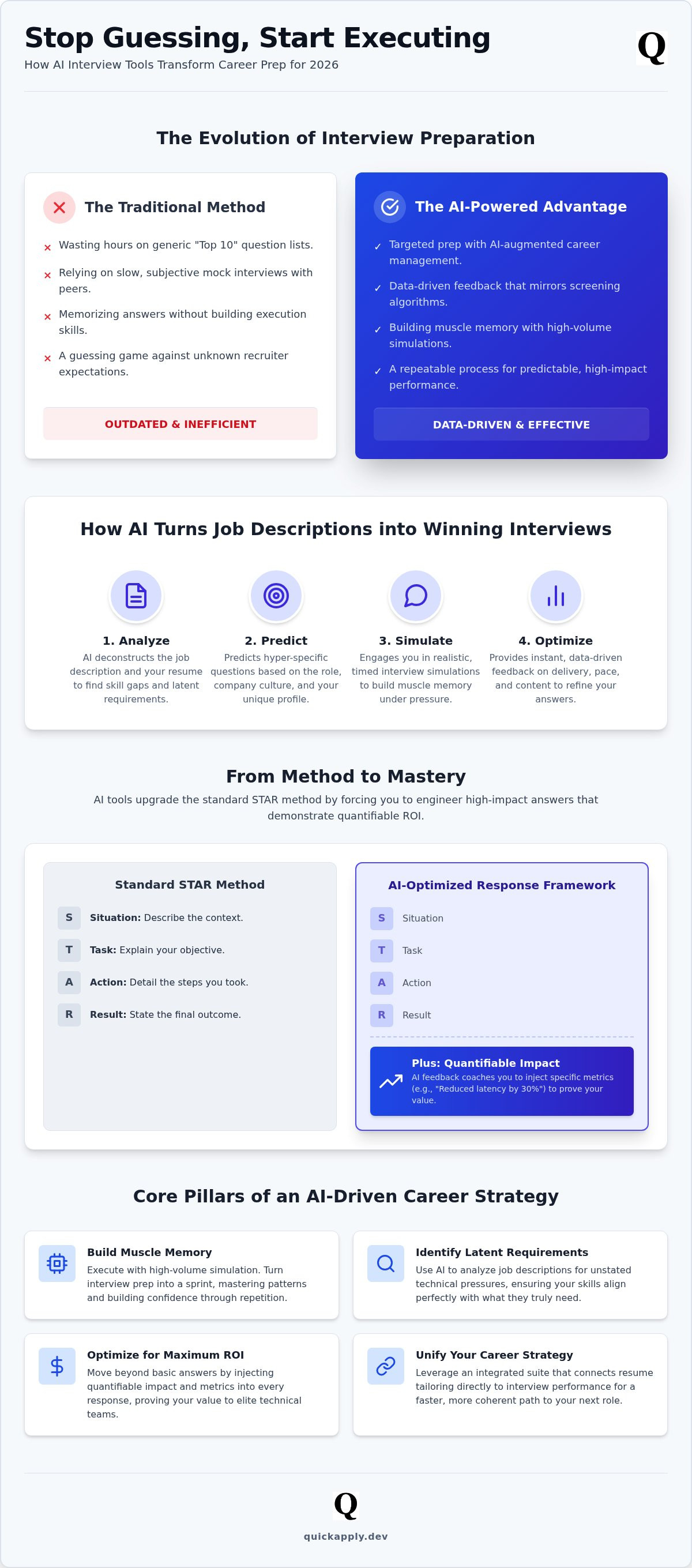
- Optimize your responses for maximum ROI by injecting quantifiable impact into every answer, moving beyond basic STAR methods to meet elite technical expectations.
- Execute with high-volume simulation to build muscle memory, treating interview prep like a sprint and prioritizing rounds through an automated application tracker.
- Unify your career strategy by leveraging an integrated suite that connects resume tailoring directly to interview performance for a faster path to your next role.
The 2026 Tech Interview: Why Traditional Prep is Obsolete
The old ways of prepping for an interview are dead. Stop relying on outdated strategies that worked five years ago. In the 2026 hiring market, manual preparation is a liability. Generic lists of "top 10 interview questions" are obsolete because they fail to account for the hyper-specialized requirements of modern engineering roles. Companies now use data-driven evaluation to determine technical and cultural fit long before you ever speak to a human recruiter.
Recruiters are no longer relying on gut feeling; they use data to predict candidate performance. Understanding how AI is used in hiring is essential for anyone entering the current tech sector. AI-led first-round screenings are now the standard. These systems don't just look for keywords. They analyze your logic, your delivery, and your ability to quantify impact in real-time. If you aren't practicing against the same technology that's screening you, you're at a massive disadvantage.
The AI vs. AI Hiring Landscape
Hiring has become a technical arms race. Recruiters use sophisticated algorithms to screen for hyper-specific impact markers. Your interview prep must match the precision of your tailored resume. If there's a gap between what your resume promises and how you perform in a simulation, the system flags it immediately.
Manual mock interviews with friends or peers are too slow. They're subjective and limited by the other person's knowledge. They can't provide the objective, data-driven feedback needed to beat a screening algorithm. To win in this environment, you need an ai interview practice tool that mirrors the speed and complexity of the actual process. It's about fighting technology with technology to ensure your profile stands out.
From Memorization to Simulation
Thinking on your feet is a dangerous myth. In high-stakes technical rounds, success is a byproduct of pattern recognition. You don't need more time; you need more volume. Transitioning from passive reading to active, AI-driven feedback loops is the only way to build the necessary muscle memory.
An ai interview practice tool provides the frequency of simulation required to master complex scenarios. It forces you to articulate technical impact under pressure, turning abstract knowledge into repeatable execution. This process moves you away from memorizing answers and toward mastering the underlying patterns of high-impact communication. By the time you reach the final round, you aren't guessing. You're executing a proven strategy based on hundreds of successful simulations.
Decoding the Algorithm: How an AI Interview Practice Tool Works
An ai interview practice tool isn't a simple question generator. It's a high-fidelity simulator. It uses Natural Language Processing (NLP) to dismantle job descriptions (JDs) and recreate the recruiter's mindset. Most candidates read a JD and see bullet points; a high-performance LLM sees "latent" requirements. It identifies the unstated technical pressures and soft skills required for the role. This allows the system to generate questions that match the actual difficulty level of a 2026 technical round.
The real power lies in the alignment between your resume and the job requirements. When you use an integrated suite for interview practice, the algorithm analyzes your specific career history against the company's needs. It doesn't just ask generic questions. It targets the gaps in your profile and forces you to defend your technical choices. This data-driven approach ensures your preparation isn't just broad; it's surgical.
JD Analysis and Question Prediction
Modern tools don't just scrape keywords. They extract the underlying architecture of a role. If a position requires managing legacy codebases, the AI predicts scenarios involving technical debt and refactoring. It automatically generates role-specific prompts like "Describe a time you optimized a query that was bottlenecking production." By integrating current company culture data, an ai interview practice tool simulates the specific values of the organization, ensuring your soft skills align with their internal standards.
Instant Feedback and Scoring
Execution requires measurement. As you respond, the tool analyzes your delivery using sentiment analysis and pace tracking. It evaluates whether you're hitting the STAR method (Situation, Task, Action, Result) effectively. If your "Action" phase is too thin, the AI flags it immediately. You get specific coaching on phrasing to maximize tech impact. The result is a "Match Score" for your interview performance. This metric quantifies your readiness, telling you exactly where you stand before the first real call. It eliminates the guesswork and replaces it with objective data.
Beyond the STAR Method: Engineering High-Impact Answers
Everyone knows the STAR method. In a 2026 FAANG-level interview, using a basic STAR framework just makes you average. Recruiters at top-tier firms are looking for more than a chronological story. They want to see your technical logic and decision-making under pressure. An ai interview practice tool allows you to move beyond the script. It pushes you to defend your "why" instead of just listing your "what." This is where you separate yourself from the thousands of other applicants who simply followed a template.
Curveball questions are designed to break your prepared stories. When a hiring manager asks why you chose a specific microservices architecture over a monolith, they're testing your technical depth. AI simulations prepare you for these pivots. They force you to refine your explanations for different stakeholders. You'll learn to speak in high-level business impact for recruiters and deep-dive system architecture for lead engineers. This adaptability is the hallmark of a senior-level candidate.
The 'Action' Phase: Highlighting Technical Ownership
The "Action" part of your story is where most candidates fail. They focus on what the team did, not what they personally owned. AI analysis identifies the specific technical details in your history that carry the most weight. It helps you frame individual contributions within team successes without losing your personal impact. Technical Ownership is the ability to articulate specific architectural decisions and their direct consequences on system performance and business goals. By isolating these moments, you demonstrate that you aren't just a passenger on a project; you're a driver of results.
Quantifying Results with AI Precision
Vague wins are worthless. Saying you "improved performance" won't cut it in a data-driven hiring landscape. You need hard numbers. An ai interview practice tool prompts you to recall specific metrics like a 40% latency reduction or a 15% increase in infrastructure ROI that you've likely overlooked. It acts as a cognitive bridge to your past data, ensuring every story ends with a punch.
You can even A/B test your answers by comparing two versions of the same story. The AI scores each for impact, showing you exactly which phrasing resonates with technical decision-makers. This iterative process turns your career history into a library of high-impact narratives. You'll enter the room knowing exactly which data points will secure the offer. Don't leave your results to chance when you can engineer them with precision.
High-Volume Simulation: The Path to Interview Execution
Interviewing is an execution problem. You don't get hired for what you know; you get hired for how you communicate it under high pressure. Reading blogs or documentation for ten hours is passive and ineffective. It won't save you when a CTO challenges your system design logic. You need high-volume simulation. Treat your prep like an engineering sprint. By using an ai interview practice tool, you move from abstract theory to repeatable muscle memory. Ten focused mock sessions will always outperform ten hours of reading because they force you to hit "The Wall" and climb over it before the real call happens.
Efficiency requires a structured pipeline. Use an automated job application tracker to prioritize your prep. Focus your simulation energy on high-value roles first. Don't waste your peak performance on roles that don't align with your long-term career goals. The 3-stage simulation cycle of "Draft, Simulate, Refine" ensures that every minute spent practicing yields a measurable improvement in your delivery.
Setting Up Your AI Simulation Lab
To maximize your output, you need a controlled environment. Follow this protocol to turn your ai interview practice tool into a high-performance lab:
- Step 1: Link your tailored resume directly to the target job description to ensure the AI generates role-specific technical prompts.
- Step 2: Run a 30-minute "blind" simulation. Don't use notes. Don't pause. Force yourself to articulate technical impact in real-time.
- Step 3: Analyze the automated feedback. Look for filler words that dilute your authority and identify technical gaps where your logic faltered.
Iterative Refinement for Tech Roles
Execution isn't a one-time event. It's a series of refinements. Re-run specific questions until your "Match Score" hits 90%. This isn't about memorization; it's about mastering the pattern of a high-impact response. Practice for different interviewer personas. A recruiter needs to hear about your collaboration and high-level wins, while a CTO requires a deep dive into your architectural choices. This process builds a "Confidence Buffer." When you've already answered a difficult question twenty times in simulation, the real interview feels like a formality. You aren't guessing; you're executing a proven script. Start your first high-volume simulation today and stop leaving your career to chance.
QuickApply: The Integrated Suite for Career Dominance
Efficiency is the only metric that matters in a high-velocity job search. QuickApply replaces fragmented workflows with a single, high-velocity engine. Most candidates struggle because their data is scattered across spreadsheets, browser tabs, and generic documents. By centralizing your data within our ai interview practice tool, you eliminate the friction between applying and interviewing. Our platform treats your career as a continuous optimization loop, ensuring that every action you take informs the next stage of the process.
The system leverages AI resume tailoring to fuel your preparation. It doesn't just match keywords; it identifies the specific technical pillars you need to defend during a live round. When your resume is perfectly aligned with the JD, the interview becomes a predictable execution of that data. You stop guessing what they might ask and start mastering the specific talking points that got you through the door.
From Resume Tailoring to Final Round
Consistency is your greatest asset in a competitive market. QuickApply ensures your narrative remains unbreakable from the first click to the final offer. By linking insights from our AI cover letter generator directly to your interview talking points, you project an image of total technical authority. This ecosystem prevents the "narrative drift" that often disqualifies candidates during deep-dive rounds. You aren't just practicing; you're synchronizing your entire professional identity for maximum impact.
Your 2026 Career Roadmap
The volatility of the 2026 tech landscape demands an "always-ready" state. QuickApply provides the infrastructure for continuous career management. Beyond the initial hire, our suite includes salary negotiation guides and promotion roadmaps to ensure your growth never plateaus. You can manage your entire interview pipeline with our built-in application tracker, prioritizing high-ROI opportunities without sacrificing the quality of your prep.
This is more than a tool; it is a bridge between your current talent and your next major opportunity. Stop prepping and start executing. Use a dedicated ai interview practice tool to automate the manual labor of career growth. The system is built for those who value their time and expect their technology to do the same. Secure your next role with the confidence of a candidate who has already won the simulation.
Master the Technical Execution Loop
The 2026 hiring landscape doesn't reward effort; it rewards execution. You've seen how manual preparation creates a bottleneck in your career progression. Transitioning to a high-performance ai interview practice tool is the only way to match the speed of modern technical screening. By moving from passive reading to active simulation, you build the muscle memory required to handle high-stakes rounds with ease. It's about replacing anxiety with a repeatable, data-driven system.
QuickApply offers the only integrated suite designed for total career dominance. Our platform ensures perfect resume-to-interview alignment while our application tracker keeps your pipeline moving without manual friction. It's time to replace guesswork with results-driven career automation. Optimize your interview execution with QuickApply's AI tools and take control of your professional trajectory. The next level of your career is waiting for those ready to execute. Start your journey toward technical mastery today.
Frequently Asked Questions
Is an AI interview practice tool better than a human mock interview?
Yes, for high-volume execution and objective feedback. Humans are limited by their own schedules and personal biases. An ai interview practice tool provides infinite repetitions and data-driven scoring that a human peer cannot match. It allows you to fail safely and iterate rapidly before stepping into a high-stakes environment.
How does QuickApply's interview tool differ from basic ChatGPT prompts?
QuickApply integrates your specific resume data and the target job description to create a surgical simulation. Basic ChatGPT prompts lack this context and often produce generic, surface-level responses. Our system focuses on the technical pillars of your specific role. This ensures your practice isn't just broad; it's highly relevant to the actual vacancy.
Can AI tools help with coding interviews or just behavioral questions?
Our tool excels at both. While it focuses heavily on the verbal defense of technical choices, it also helps you articulate your logic during system design and coding challenges. It forces you to explain your architectural "why." This is often more important to hiring managers than the syntax of the code itself.
Will recruiters know if I used an AI tool to prepare my answers?
No. Recruiters will only see a candidate who is articulate, confident, and well-prepared. Using an ai interview practice tool isn't about cheating. It's about refining your real experiences into high-impact narratives. It helps you sound like the best version of yourself rather than a scripted robot.
How many mock sessions do I need to feel confident for a tech interview?
Aim for 10 to 15 focused simulations per role. This volume builds the muscle memory needed to handle curveball questions without hesitation. The goal is to reach a consistent "Match Score" of 90% or higher within the tool. Once you hit this metric, you're ready to execute in a live environment.
Does the tool provide feedback on my tone and body language?
Yes. The system analyzes your delivery metrics, including sentiment, pace, and verbal clarity. It flags filler words and shifts in tone that might signal a lack of confidence. By refining these technical communication markers, you project a sense of authority that resonates with both recruiters and CTOs.
Can I use the tool for remote interview practice specifically?
Absolutely. The tool is built to simulate the exact environment of a remote technical round. Practicing through a screen helps you master eye contact with the camera and maintain a strong digital presence. It's the most efficient way to prepare for the reality of the current remote-first tech hiring landscape.
How much does a professional AI interview practice tool cost in 2026?
Costs vary across the industry based on the level of integration and features provided. Professional-grade tools are typically priced as part of a comprehensive career management suite. You should evaluate the investment against the potential ROI of securing a higher salary through better negotiation and superior interview performance.


