

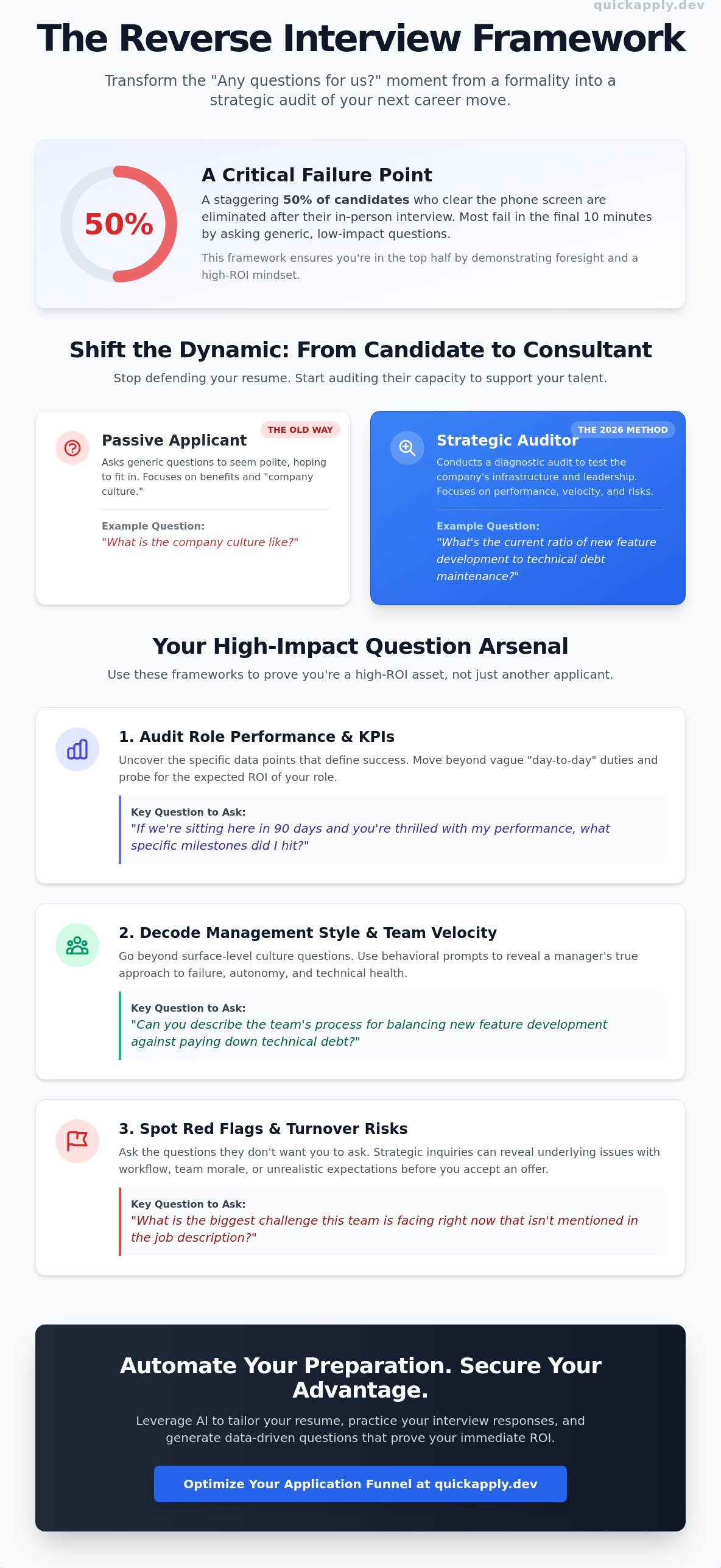
Fifty percent of candidates who clear the phone screening are eliminated immediately after an average in-person performance. It's a brutal statistic that highlights a systemic failure. Most applicants treat the final ten percent of the meeting as a polite formality. You've felt that tension when the manager asks if you have questions. You don't want to ask something generic that bores them or fails to uncover a toxic culture. Knowing exactly what to ask in an interview hiring manager is the difference between being a safe candidate and the high-ROI hire they've been searching for.
Stop answering questions and start auditing the opportunity. This 2026 high-impact guide gives you the framework to transition from answering mode to strategic peer mode instantly. Use these insights to probe for AI-driven efficiency, evaluate leadership styles, and demonstrate industry foresight that commands respect. We're breaking down the specific questions that prove you're ahead of the curve and ready to deliver immediate results. If you're ready to optimize your entire application funnel, our Interview Practice and Resume Tailoring tools are built to secure your competitive advantage.
Key Takeaways
- Transform the "any questions" segment into a diagnostic audit to ensure the role matches your technical standards and career trajectory.
- Identify the specific KPIs that define success by learning exactly what to ask in an interview hiring manager regarding 90-day performance roadmaps.
- Decode team velocity and leadership styles using behavioral prompts that reveal a manager's true approach to failure and autonomy.
- Spot cultural red flags and turnover risks through strategic inquiry techniques that maintain your status as a high-performance candidate.
- Streamline your preparation by leveraging automation to generate data-driven questions that prove your immediate ROI to the organization.
The Strategic Power of the Reverse Interview
The final segment of a job interview process is often treated like a courtesy lap. This is a critical error. High-performers view this window as a diagnostic audit. You aren't just there to be evaluated. You're there to stress-test the company's infrastructure. We call this the Reverse Interview. It's a strategic pivot where you stop defending your resume and start analyzing the employer's capacity to support your talent. You're shifting the power dynamic from a passive applicant to an active consultant.
The goal isn't just to prove you can do the job. You've already done that by getting through the door. Now, you must determine if this environment will accelerate your growth or stifle your output. This requires Strategic Curiosity. It’s a mindset that treats the hiring manager as a future peer rather than a gatekeeper. When you master what to ask in an interview hiring manager, you signal that you're a high-ROI asset. You show you understand the complexities of the 2026 market. You demonstrate that you're looking for a partnership, not just a paycheck.
Recruiter vs. Hiring Manager: Knowing the Difference
Recruiters are filters. They screen for basic alignment, salary expectations, and high-level culture fit. Their metrics are based on volume and retention. Hiring managers are different. They're looking for a solution to a specific pain point. They care about team velocity, technical debt, and how you'll impact their next quarterly review. Your questions must reflect this shift in stakes. If you're still asking about benefits or office hours, you've missed the target. You need to probe for the friction points that keep them up at night. Use this time to audit their leadership style and the tools they provide to ensure your success.
Why Generic Questions Kill Your Momentum
Boring questions signal a low-effort mindset. Asking "What is the company culture like?" provides zero data. It invites a scripted HR response that doesn't reflect reality. High-impact candidates ask questions that force the manager to speak candidly about challenges. If you want to stand out, your inquiries must demonstrate industry foresight. Knowing what to ask in an interview hiring manager means digging into their AI adoption—such as their use of Chatterbots for automated customer service—or their approach to technical failure. Use our Interview Practice tools to refine these prompts and build your confidence. You need to uncover the reality of the role before you sign, not three months into a toxic contract. Generic questions lead to generic roles; strategic questions lead to high-impact careers.
Questions to Ask About Role Performance and KPIs
Performance metrics have evolved. In 2026, hiring managers don't care about a list of duties; they care about how quickly you can integrate into their existing systems and start shipping code. Knowing what to ask in an interview hiring manager regarding performance targets separates the contributors from the leaders. You need to uncover the hard data points that determine whether you'll be considered a success or a failure six months from now. Standard Interview preparation tips often suggest asking about the 'day-to-day,' but that's too vague for a high-stakes environment. You need to probe for the specific ROI they expect from your seat.
Start by analyzing the job description for missing variables. Use the match score logic to identify where your skills don't perfectly align with the JD. These gaps are your best opportunities for strategic questions. If the JD emphasizes "rapid scaling" but ignores "technical debt," ask how they balance speed with stability. This shows you're thinking about the long-term health of their systems, not just checking boxes. It proves you understand the underlying mechanics of a functional team.
Defining Success: The First 90 Days
Hiring managers want to see a roadmap. Don't ask what they want you to do; ask what they want you to achieve. A high-impact question sounds like this: "If we're sitting here in 90 days and you're thrilled with my performance, what specific milestones did I hit?" This forces them to define their KPIs. It reveals if their expectations are realistic or if they're looking for a miracle worker. Listen for mentions of specific software releases, team integration, or efficiency gains. If they can't define success, they can't lead you toward it.
The Team Roadmap and Technical Debt
Every team has a skeleton in the closet. It's usually technical debt or a bloated roadmap. Ask about the current balance between maintenance and new feature development. In a healthy 2026 organization, this is a deliberate 80/20 or 70/30 split. If the manager admits they spend 90% of their time on "firefighting," you've just identified a red flag. Inquire about the biggest technical hurdle the team currently faces. This demonstrates your willingness to tackle the hard problems while helping you decide if you actually want to solve them. Use our Interview Practice tool to rehearse these high-pressure inquiries before you're in the hot seat.
Decoding Management Style and Team Velocity
Management is an operating system. If the OS is buggy, your career will crash. Most candidates ask generic questions that invite polished, HR-approved scripts. You need to bypass the filter. Knowing what to ask in an interview hiring manager means digging for behavioral evidence of how they actually lead. Don't ask if they value autonomy. Ask how they handled the last major system outage or a failed product launch. Their response reveals if they prioritize blameless post-mortems or if they look for a scapegoat. High-performers need a manager who acts as a force multiplier, not a bottleneck.
Evaluate the feedback loops. In a high-velocity team, feedback is continuous and data-driven. Ask the manager how they deliver performance critiques and how often. If the answer is "at the annual review," the team is moving too slowly for the 2026 market. You're looking for a culture of radical candor and technical excellence. Use our Interview Practice module to simulate these high-pressure reversals. You must be comfortable auditing your boss before they become your boss. This isn't just about survival. It's about finding an environment where your efficiency is rewarded, not hindered by manual bureaucracy.
Questions That Reveal the Real Culture
Culture isn't found in the mission statement. It's found in how decisions are made when the stakes are high. Ask: "Tell me about a time a team member disagreed with your technical direction. How was it resolved?" This question targets the manager's ego and their commitment to the best idea. You want to hear about a collaborative resolution, not a top-down mandate. Inquire about how the team handles conflict between product requirements and technical debt. If they can't give you a concrete example, the culture is likely avoidant or oppressive. You need a transparent environment to maintain your peak productivity.
Professional Growth and Promotion Pathways
Your trajectory shouldn't be a mystery. In 2026, the best managers act as career accelerators. Ask about the internal promotion process for the last person who held this role. If they can't name a clear path or a success story, you're looking at a dead-end. Inquire about the specific budget and time allocated for professional development. A manager who values your future will have a system for tracking your growth metrics. We provide a Promotion Roadmap to help you visualize your next steps, but you need the manager's buy-in first. If they don't have a plan for your advancement, they're just looking for a temporary patch, not a long-term asset.
Spotting Red Flags: The Questions They Don’t Want You to Ask
Protecting your career trajectory requires more than just technical skill. It requires the courage to ask uncomfortable questions. Many candidates fear looking "difficult" or "high-maintenance" during the final stages of a meeting. This is a mistake. High-performers aren't difficult; they're discerning. If a manager is defensive when you probe for operational reality, you've already found your first red flag. Knowing what to ask in an interview hiring manager involves identifying systemic friction before you're trapped in it. You aren't just looking for a job. You're looking for an environment where your efficiency isn't sabotaged by poor leadership.
Start with the vacancy itself. Ask why the position is open without dancing around the topic. Is this new headcount due to growth, or is it a backfill? If it's a backfill, ask what the previous person moved on to do. A manager who celebrates a former employee's promotion or successful transition is a mentor. A manager who remains vague or critical of their predecessor is a warning sign. Your goal is to separate growth opportunities from revolving doors. To ensure your initial application set the right tone for this high-level dialogue, learn how to tailor your resume using 2026 AI strategies.
The Turnover and Growth Audit
Turnover data is a direct reflection of management health. Don't ask "Is turnover high?" because you'll get a sanitized answer. Instead, ask about the average tenure on the immediate team and the frequency of internal promotions. If the team is entirely new but the company isn't scaling, ask what happened to the previous cohort. In 2026, you should also use AI tools to cross-reference these answers with Glassdoor sentiment and LinkedIn employee movement data in real-time. If the manager’s narrative doesn't match the digital footprint, trust the data. You need a role that offers a Promotion Roadmap, not a dead-end seat.
Work-Life Integration in a Remote-First World
Stop asking about "work-life balance." It sounds passive. Instead, ask about "work-life integration" and "asynchronous communication protocols." Inquire about how the team handles deep work blocks and after-hours emergencies. A high-impact question sounds like this: "What are the team's expectations for response times outside of core synchronous hours?" This reveals if the company respects your time or expects 24/7 availability. You're looking for a system that optimizes for output, not performative presence. If they can't define their communication stack or boundaries, expect burnout. Protect your productivity by using our Interview Practice tools to master these high-stakes inquiries before your next meeting.
Automating Your Interview Preparation with AI
Efficiency is the bedrock of a modern career. Manual research is a legacy process that wastes your most valuable resource: time. In 2026, high-performers use systemic automation to prepare for high-stakes meetings. For legal professionals looking to understand how these tools are applied in specialized industries, check out freelegalquote.com. You can now feed a job description and company news into an AI to identify the exact technical gaps in their current infrastructure. This data-driven approach tells you exactly what to ask in an interview hiring manager to prove you're the solution they've been searching for. You aren't just guessing. You're using algorithmic insights to dominate the conversation and position yourself as a high-ROI hire.
Confidence in the room comes from knowing your delivery is surgical. Our Interview Practice tools allow you to refine your responses and questions until they feel natural and authoritative. You've already used Resume Tailoring to get the interview. Don't fail at the final ten percent by relying on generic preparation. This level of optimization isn't just about securing the offer. It's about setting the stage for a powerful salary negotiation. When you show up as a strategic peer who has already diagnosed their problems, your market value skyrockets.
Using AI to Research the Hiring Manager
Manual LinkedIn stalking is inefficient. Use AI to synthesize the hiring manager's digital footprint into a brief you can consume in sixty seconds. Look for recent technical blog posts, conference talks, or open-source contributions. This allows you to tailor what to ask in an interview hiring manager to their specific interests and expertise. If they recently spoke about migrating to a new architecture, ask about the friction points they encountered. This level of personalization proves you've done the work that 99% of other candidates ignored. It moves the conversation from a standard Q&A to a high-level technical consultation.
Closing the Deal: The Follow-Up Strategy
Most follow-up emails are polite fluff. They provide no value and are quickly archived. Your follow-up should be an extension of the interview itself. Use the notes you gathered during your "Reverse Interview" to draft a value-add response. If the manager mentioned a specific challenge with team velocity, send a brief thought on a tool or framework that addresses it. Use our Cover Letter Generation logic to adapt your communication style to their corporate tone instantly. This keeps the momentum high and reinforces your image as a proactive problem-solver. You're not just waiting for a decision. You're continuing to prove your ROI until the contract is signed.
Optimize Your Career Trajectory
The final ten percent of your meeting isn't a courtesy. It's a high-stakes audit of your future environment. You now have the framework to bypass generic scripts and uncover the technical reality of any role. Mastering what to ask in an interview hiring manager ensures you don't just land a job; you secure a partnership built for growth. You've learned to probe for KPI clarity, decode management operating systems, and spot systemic red flags before they compromise your productivity.
Manual preparation is a liability in a high-speed market. Success requires a modern technical stack. Stop guessing and start preparing with QuickApply’s AI Interview Suite. Leverage our AI-powered match scoring for tech roles and refine your delivery with automated interview practice and real-time feedback. From the initial screen to your final Promotion Roadmap and Salary Negotiation Guide, we provide the tools to maximize your market value. Take control of the narrative and walk into the room with absolute technical confidence. Your next high-impact role is within reach.
Frequently Asked Questions
How many questions should I ask a hiring manager?
Aim for three to five strategic questions. You need to prove your engagement without exhausting the manager's schedule. Focus on high-ROI inquiries that audit the team's technical roadmap or performance expectations. Prioritize depth over a long list of surface-level queries to maintain your status as a high-value candidate.
Is it okay to ask about salary in the first interview with a manager?
Avoid salary discussions in the initial technical screen with a hiring manager. They prioritize output and team fit rather than budget administration. Wait for the final stages or use our Salary Negotiation Guide to time your move perfectly. Your goal with the manager is to establish your value before you discuss the cost of your talent.
What questions show that I have done my research?
Ask about specific technical decisions or recent company milestones mentioned in the news. Mentioning a specific software migration or a recent quarterly report proves you've analyzed their current state. Knowing what to ask in an interview hiring manager regarding their 2026 AI adoption strategy signals that you're already thinking like an internal stakeholder.
What is the best question to ask a hiring manager at the end of an interview?
The most effective closing question targets immediate success metrics. Ask: "If we meet in six months and I've exceeded your expectations, what specific milestones did I hit?" This forces the manager to define their KPIs. It also allows you to address any lingering doubts they have about your technical fit before the meeting ends.
Can I bring a list of questions to the interview?
Bring a digital or physical list to demonstrate your organizational rigor. It signals that you value the manager's time and your own career trajectory. Referencing a prepared list helps you maintain strategic peer mode. It ensures you don't miss critical diagnostic points during high-pressure transitions.
How do I ask about the company’s financial health without being rude?
Frame the question around growth and resource allocation. Ask about the team's budget for new initiatives or how the company prioritizes technical debt versus new feature development. This reveals financial stability without sounding like an auditor. It proves you're looking for a sustainable environment where your efficiency can thrive.
What should I do if the manager already answered all my questions?
Pivot to a deeper layer of a previous topic. If they've covered the roadmap, ask about the specific friction points they encountered during the last sprint. Knowing what to ask in an interview hiring manager when the basics are covered means digging into their personal leadership philosophy. Ask what they find most challenging about managing this specific team.
How do I follow up after asking my questions?
Send a concise follow-up that adds value to a point discussed. If they mentioned a technical hurdle, include a brief insight or a link to a relevant framework in your note. This reinforces your status as a problem-solver. Use our Application Tracker to manage your follow-up cadence and ensure you never miss a critical touchpoint.


