

Did you know that 75% of resumes are rejected by an ATS before a human recruiter even glances at them? In the 2026 job market, traditional resume tailoring for software engineers is no longer just a chore; it's a losing game if you're still doing it manually. You spend hours tweaking bullet points only to receive an automated rejection email minutes later. It's exhausting to be the most qualified candidate in the stack and still get ghosted by a machine that doesn't understand your technical depth.
We agree that the current hiring system feels rigged against even the best talent. You deserve a workflow that works as hard as your code does. This article teaches you how to achieve a perfect match score using AI-driven semantic alignment to bypass modern filters. We'll break down the 2026 strategy to automate your job search and secure more interview invites with significantly less effort. It's time to stop guessing and start outsmarting the systems standing in your way.
Key Takeaways
- Navigate the shift from basic keyword searching to AI-driven semantic alignment in 2026 Applicant Tracking Systems.
- Identify the three essential layers of a perfect match: keywords, hard skills, and quantifiable impact.
- Master resume tailoring for software engineers to bypass spam filters and avoid the pitfalls of manual over-optimization.
- Apply a strategic framework to audit your tech stack against job requirements and close critical semantic gaps.
- Leverage the QuickApply Match Score to prioritize high-impact opportunities and automate your application search lifecycle.
The Evolution of Resume and Job Description Matching in 2026
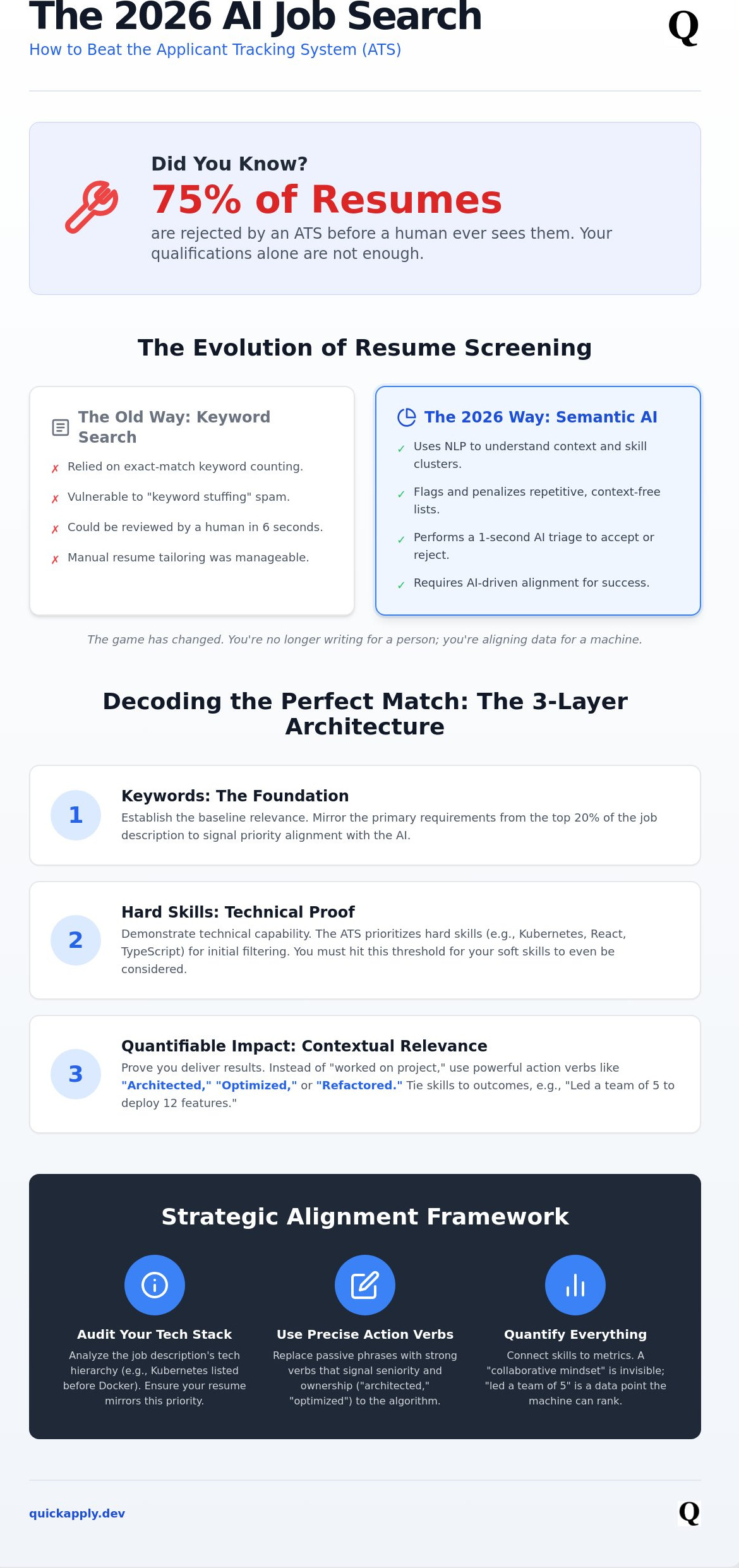
Resume and job description matching is the critical bridge between your raw data and a recruiter's specific needs. In 2026, this bridge is no longer built by human hands. It's constructed by algorithms. The old '6-second rule' where a human scanned your header is dead. It has been replaced by a 1-second AI triage. If your data doesn't align instantly, you're deleted. Statistics show that 98% of Fortune 500 companies now rely on an Applicant Tracking System (ATS) to perform this initial filter. For technical roles, a high match score isn't just a bonus; it's the only ticket to a human review. You're effectively writing for a machine first and a person second.
The 2026 shift from 'Keyword Search' to 'Semantic Understanding' has changed the fundamental requirements of the job search. Modern systems don't just count words. They analyze relationships between concepts. This evolution means that resume tailoring for software engineers has moved from a simple editing task to a complex data alignment problem. If you aren't optimizing for the way an AI reads your experience, you're essentially invisible to the hiring team.
This challenge is part of a broader shift in digital visibility; much like how brands use mustacheaeo.com to optimize for AI-driven answer engines, software engineers must now treat their resumes as structured data for AI consumption.
Beyond Keywords: The Rise of Semantic ATS
Modern screening algorithms use Natural Language Processing (NLP) to identify skill clusters. If a job description asks for 'Frontend expertise,' the AI knows to look for React, Vue, or TypeScript, even if those specific words aren't the primary focus of the JD. Exact-match strings are no longer enough for 2026 screening. The danger of keyword stuffing is higher than ever; modern systems flag repetitive, context-free lists as spam. You must demonstrate how your skills interact. Effective resume tailoring for software engineers now requires proving impact within a specific tech stack, ensuring that every bullet point reinforces the semantic relevance of your profile.
The 2026 Reality: AI vs. AI in the Job Market
Recruiters are using high-speed AI to filter thousands of applications in seconds. If you aren't using AI to align your profile, you're at a massive disadvantage. Applications per job have risen by 30% recently, making manual tailoring a mathematical impossibility for the serious seeker. Strategic tailoring has replaced the generic resume. It's about finding the most efficient path through systemic automation. You need to speak the machine's language to reach the person behind it. This isn't about tricking the system. It's about ensuring your actual talent isn't lost in a sea of unoptimized data. Efficiency is your only competitive edge in this high-volume market.
Decoding the Match: Keywords, Skills, and Contextual Relevance
A perfect match isn't a single score; it's a three-layered architecture. First, keywords establish the baseline. Second, hard skills demonstrate technical capability. Third, impact proves you can deliver results. You can find high-quality software engineer resume examples that demonstrate this structure, but 2026 systems require even deeper alignment. You aren't just checking boxes. You're building a data-driven case for your candidacy.
Tech job descriptions follow a hidden hierarchy. Primary requirements usually occupy the top 20% of the list. These are non-negotiable. Secondary requirements are often flexible. If a JD lists Kubernetes before Docker, your resume must mirror that order. This hierarchy signals to the AI that your priorities align with theirs. Mastering this specific hierarchy is a vital part of resume tailoring for software engineers. It ensures the most critical data points hit the screener first.
Action verbs signal seniority to modern algorithms. Don't say you "worked on" a project. Say you "architected," "refactored," or "optimized" it. These verbs indicate ownership and technical maturity. They tell the screening algorithm that you aren't just a contributor; you're a driver. Precision in language is the core of effective resume tailoring for software engineers. Every word must earn its place on the page.
Hard Skills vs. Soft Skills: The Weighting Game
In 2026, ATS prioritize technical proficiency for initial filtering. If you don't hit the hard skill threshold, your soft skills won't even be read. However, leadership and communication must still be present. The secret is mapping them to specific outcomes. Your skills and qualifications must be quantified to survive the triage. A "collaborative mindset" is invisible; "led a team of 5 to deploy 12 features" is a data point the machine can rank.
Contextual Matching: Proving Impact, Not Just Presence
Contextual matching is the alignment of results with expectations. It goes beyond listing a tool. You must use the 'XYZ Formula' for every bullet point. Accomplished [X] as measured by [Y], by doing [Z]. For example, "Reduced latency by 40% through implementing a Redis caching layer." This creates a narrative that AI can parse and recruiters can trust. Generic experience is noise. AI translates your specific achievements into the language of the JD. If you want to see how your current profile stacks up, checking your match score is the fastest way to identify gaps before you hit send.
The Invisible Barrier: Why High-Quality Candidates Fail the Match Test
Being qualified isn't enough. You can have a decade of Java experience and still get rejected for a Senior Java Developer role. Why? Because your resume didn't signal the right seniority level to the AI. This is the "Experience Gap." Machines in 2026 look for specific markers of leadership and architectural decision-making. If your document just lists tasks instead of outcomes, you're failing the match test. Effective resume tailoring for software engineers bridges this gap by aligning your actual seniority with the job description's expectations. It's about proving you can do the job, not just that you know the tools.
Then there is the "Over-Optimization" paradox. Many candidates try to game the system by stuffing every possible tech keyword into their footer. In 2026, this triggers spam filters. Modern Applicant Tracking Systems use semantic analysis to detect unnatural word density. If your keyword-to-content ratio is too high, the system flags you as a bot or a low-quality applicant. You need a balance. You need precision, not volume. Strategic resume tailoring for software engineers requires you to weave requirements into your experience naturally, ensuring the machine sees context alongside the keywords.
This level of contextual awareness is a hallmark of sophisticated AI; for those exploring how agents manage such information, novacortex.dev offers a privacy-focused memory layer designed specifically for AI agent data retention.
Formatting Traps that Break AI Scanners
Sophisticated algorithms still struggle with bad design. Creative resumes with multi-column layouts, graphics, and non-standard fonts often result in "parsing errors." If the machine can't read your contact info or tech stack, your match score drops to zero instantly. This is why good resume examples for 2026 prioritize clean, single-column layouts. Your PDF must be machine-readable and parsable. Avoid "invisible text" tricks or complex tables that confuse the screeners. As per advice from a hiring manager, clarity always beats cleverness. Stick to standard layouts that ensure every bullet point is accessible to modern screeners.
The Myth of the 'Perfect' Resume
A "perfect" resume is a fairy tale. It doesn't exist. There is only a perfectly matched resume for a specific role. Many engineers fall into the trap of using a chatgpt resume based on generic prompts. These fail because they lack the specific contextual alignment required for high-level tech roles. Generic AI output sounds like everyone else. It lacks your unique voice and specific project impact. You shouldn't let a bot write your life story. Instead, use technology to refine your professional identity. You provide the substance; the technology provides the alignment. This is how you maintain authenticity while optimizing for the algorithm.
Strategic Alignment: A Step-by-Step Framework for the Perfect Match
Manual tailoring is a relic of the past. In the 2026 market, you need a high-speed pipeline to stay competitive. Success requires a systematic approach that moves from raw job data to a finished application in minutes, not hours. This framework ensures your resume tailoring for software engineers is both mathematically precise and narratively compelling. Stop guessing what the machine wants. Start executing a proven sequence that guarantees visibility.
- Step 1: Extraction. Identify the core tech stack and non-negotiable requirements. Distinguish between the primary language and the supporting ecosystem.
- Step 2: Semantic Audit. Compare your current profile against the extracted data. Look for conceptual gaps where your experience exists but isn't described in the JD's specific dialect.
- Step 3: Re-prioritization. Move your most relevant projects to the top. If the role emphasizes microservices, your Kubernetes and Docker achievements must lead your experience section.
- Step 4: Reinforcement. Generate a tailored cover letter. Use this document to connect the dots between your technical skills and the company's specific business challenges.
- Step 5: Validation. Verify the alignment using an AI-powered match score. Never hit submit until you know the machine will rank you in the top tier.
Analyzing the Job Description for Hidden Intent
Job descriptions are often poorly written, but they always hide a specific pain point. You must read between the lines to identify what the company is actually struggling with. If the JD mentions "optimizing legacy code," they have technical debt. If they focus on "rapid scaling," they have infrastructure bottlenecks. You should tailor resume to job description requirements by phase, addressing these specific problems in your professional summary. Position yourself as the solution to their immediate crisis, not just another developer with a list of languages.
The Power of the 80% Match Rule
A 100% match often looks suspicious or unrealistic to modern recruiters. It can signal that you've over-optimized or potentially fabricated experience to fit the mold. Aim for the "Goldilocks zone" of an 80% match. Focus on the core 80% that matters: the primary stack and essential responsibilities. If you have missing skills, use a transferable skills approach. Show how your expertise in one framework allows you to master their specific toolset rapidly. This creates a profile that is both optimized for the algorithm and believable to a human. To see exactly where your profile sits in this range, you can get your match score instantly and adjust your strategy before applying.
Automating the Match with QuickApply: Precision at Scale
Manual frameworks provide the logic, but automation provides the speed. QuickApply is the engine that drives your career forward by handling the heavy lifting of resume tailoring for software engineers in seconds. In a market where applications per job have risen by 30% recently, speed isn't just a luxury. It's a survival requirement. You need to move faster than the competition while maintaining a precision that satisfies both the AI screener and the human hiring manager. With 129,200 annual openings projected in the field, you can't afford to be slow.
The QuickApply Match Score identifies your best-fit opportunities instantly. Stop applying blindly to every generic job title in your feed. This tool acts as a high-speed filter, allowing you to prioritize roles where you have a 75% or higher semantic alignment. This focus ensures your time is spent on high-probability leads rather than low-yield applications. It's about working smarter, not harder, to navigate a system where 98% of Fortune 500 companies already use an ATS to gatekeep their roles.
Using the Match Score to Prioritize Your Search
Efficiency is the core of a successful 2026 job search. The Match Score doesn't just tell you how well you fit; it tells you where to put your energy. By filtering out low-probability jobs, you save hours of wasted effort. The integrated Application Tracker then manages your entire search lifecycle. It keeps every tailored resume version organized and easily accessible. This solves the massive disconnect between the initial application and the interview stage. You'll always know exactly which version of your experience a recruiter is looking at.
Scaling Your Search Without Sacrificing Quality
Applying to 10 tailored roles in minutes gives you a disruptive advantage. You can maintain high-volume output with low-effort input, ensuring your "Success DNA" is perfectly translated for every different tech stack you encounter. This semantic data even informs your final round ai prep. By understanding exactly how you matched with the role during the resume tailoring for software engineers phase, you can walk into the interview with a clear map of your own value proposition. Stop building static, generic resumes. Start tailoring with QuickApply to secure your next role with total precision.
Scale Your Success with AI-Driven Precision
The hiring landscape has shifted permanently. You can't rely on generic documents or manual edits to survive the 1-second AI triage. Success in 2026 requires a technical mindset that treats your application as a data alignment problem. By mastering semantic matching and avoiding formatting traps, you position yourself at the top of the stack. Modern resume tailoring for software engineers isn't about working harder; it's about using superior systems to outpace the competition.
You now have the framework for strategic alignment. It's time to execute. Stop wasting hours on manual tweaks that don't produce interviews. Leverage technology that moves as fast as the market. With an AI-powered Match Score and automated cover letter generation, you can apply with total confidence. You will even get tech-focused interview practice to seal the deal. Your next role is waiting for a seeker who knows how to navigate the system.
Tailor your resume in seconds with QuickApply and start landing the interviews you deserve. You have the talent. Let us provide the optimization. You are ready to win.
Frequently Asked Questions
What is a good resume and job description match score for software engineers?
Aim for a match score between 80% and 90% to land in the top tier of applicants. A perfect 100% score often looks suspicious or over-optimized to modern recruiters, while scores below 70% typically fail the initial AI triage. Focus on aligning your core tech stack and primary responsibilities to hit this target range effectively.
Does the ATS look for exact word matches or synonyms in 2026?
Modern systems use semantic understanding to identify synonyms and related skill clusters. While 2026 screeners recognize that "React" implies "Frontend development," you should still prioritize the specific terminology used in the job description. Using the employer's preferred dialect ensures the highest possible relevance score during the automated screening phase.
How do I match my resume to a job description without lying?
Use semantic alignment to rephrase your genuine experience using the employer's specific language. If you have "cloud experience" and the job description asks for "AWS infrastructure," describe your cloud work through the lens of the AWS tools you actually utilized. It is about highlighting the most relevant parts of your history, not inventing new skills.
Can I use AI to match my resume for FAANG companies safely?
Yes, but you must avoid generic, bot-like output that lacks specific context. FAANG companies use highly sophisticated internal systems that flag low-quality generated content. Use AI for resume tailoring for software engineers to align your quantifiable achievements with their specific architectural goals while maintaining your unique professional voice.
How many keywords should I include for a 90% match?
Focus on the top five to seven technical requirements rather than a specific word count. Quality and context matter more than volume in 2026. Weave these high-priority requirements into your impact statements to show the AI that you have applied these skills in real-world scenarios, which carries more weight than a simple list.
Why is my resume match score low even though I have the right experience?
Your score is likely low because of formatting errors or a lack of seniority markers. If your resume uses multi-column layouts or non-standard fonts, the AI might fail to parse your data correctly. Additionally, if you don't use the specific action verbs that signal leadership, the system may categorize your experience at a lower level than you deserve.
Is it better to have a high match score or a visually appealing resume?
A high match score is your primary ticket to a human review. A visually appealing resume is useless if the ATS rejects it before a recruiter ever sees it. Optimize for machine readability first by using a clean, single-column layout. Once you pass the AI filter, a professional and simple design will satisfy the human hiring manager.
How does QuickApply’s match score differ from other resume checkers?
QuickApply provides a disruptive, integrated solution that connects your match score to an application tracker and interview practice tools. Unlike standalone scanners that only count keywords, our system uses semantic analysis to predict recruiter interest. It is a comprehensive tool built for the high-speed resume tailoring for software engineers required in the current market.


