

71% of engineering leaders now report that technical skills are becoming harder to assess due to AI integration. In 2026, clean code is the baseline. Narrative engineering is the differentiator. You've likely felt the frustration of being too technical for a recruiter or too vague for a hiring manager. It's difficult to quantify your value in a non-sales role, but failing to do so leaves senior-level offers on the table. You need high-impact star method examples for software developers that translate your technical wins into career capital.
We agree that your time is better spent shipping features than rehearsing scripts. You'll master the STAR method with developer-specific examples and learn to engineer narratives that land senior-level offers. This guide delivers a bank of ready-to-use stories and a framework to automate your interview preparation. It's time to stop guessing and start optimizing your behavioral rounds with the same precision you apply to your codebase. We'll show you how to navigate ambiguity and leverage the STAR-L framework to prove your worth to any hiring committee.
Key Takeaways
- Convert your technical history into a logic-based framework designed to pass both recruiter screens and deep-dive architectural rounds.
- Study high-impact star method examples for software developers focused on resolving critical production outages and managing complex legacy migrations.
- Eliminate the "Nerd Snipe" by translating engineering bottlenecks into quantified business impact that justifies senior-level compensation.
- Avoid the "We Trap" by using our 4-step framework to claim individual ownership of architectural decisions and execution.
- Streamline your preparation using AI-driven interview practice to extract high-value narratives directly from your existing project history.
What is the STAR Method for Software Engineers?
The STAR method is a narrative framework that maps technical actions to business value. For developers, it functions as a logic-based framework to debug your career history for recruiters. It stands for Situation, Task, Action, and Result. While it's the industry standard for behavioral questions, most engineers treat it like a chore rather than a tool for optimization. Using What is the STAR Method? as your structural foundation allows you to present complex technical achievements in a format that hiring managers can parse instantly. It provides a structured syntax for your professional wins, ensuring you don't get lost in the weeds of a specific pull request or a minor bug fix.
High-impact star method examples for software developers prevent the common mistake of rambling. Instead of a chronological list of tasks, you deliver a focused story that highlights your decision-making process. This framework forces you to quantify your output, moving your narrative from "I wrote code" to "I reduced system latency by 40%." In a market where 71% of engineering leaders find technical skills harder to assess due to AI, your ability to articulate your impact is your most valuable asset.
Why Tech Giants Use Behavioral Interviews
Engineering leaders at top-tier firms look for more than just syntax proficiency. They need to identify Force Multipliers. These are the engineers who improve the whole team's velocity through mentorship and system optimization. Behavioral rounds signal how you handle technical debt or interpersonal friction within a high-pressure sprint. They move beyond LeetCode to assess how you solve real-world, messy system problems that don't have a single "correct" answer. Companies use these questions to see if you can navigate ambiguity when requirements shift and the legacy codebase is failing.
The Anatomy of a Senior-Level Technical Story
Senior engineers don't just talk about how they wrote a function; they focus on the why behind architectural decisions. A strong story highlights the trade-offs made during the Software Development Life Cycle (SDLC). You must demonstrate that you understand the business impact of your technical choices. Effective star method examples for software developers connect code-level changes to high-level KPIs like cloud cost savings or user retention. You should clearly explain why you prioritized consistency over availability or why a specific microservice was the right choice for the scale. This level of reflection proves you aren't just a coder, but a system architect who thinks about the bottom line.
Engineering Your STAR Response: The 4-Step Framework
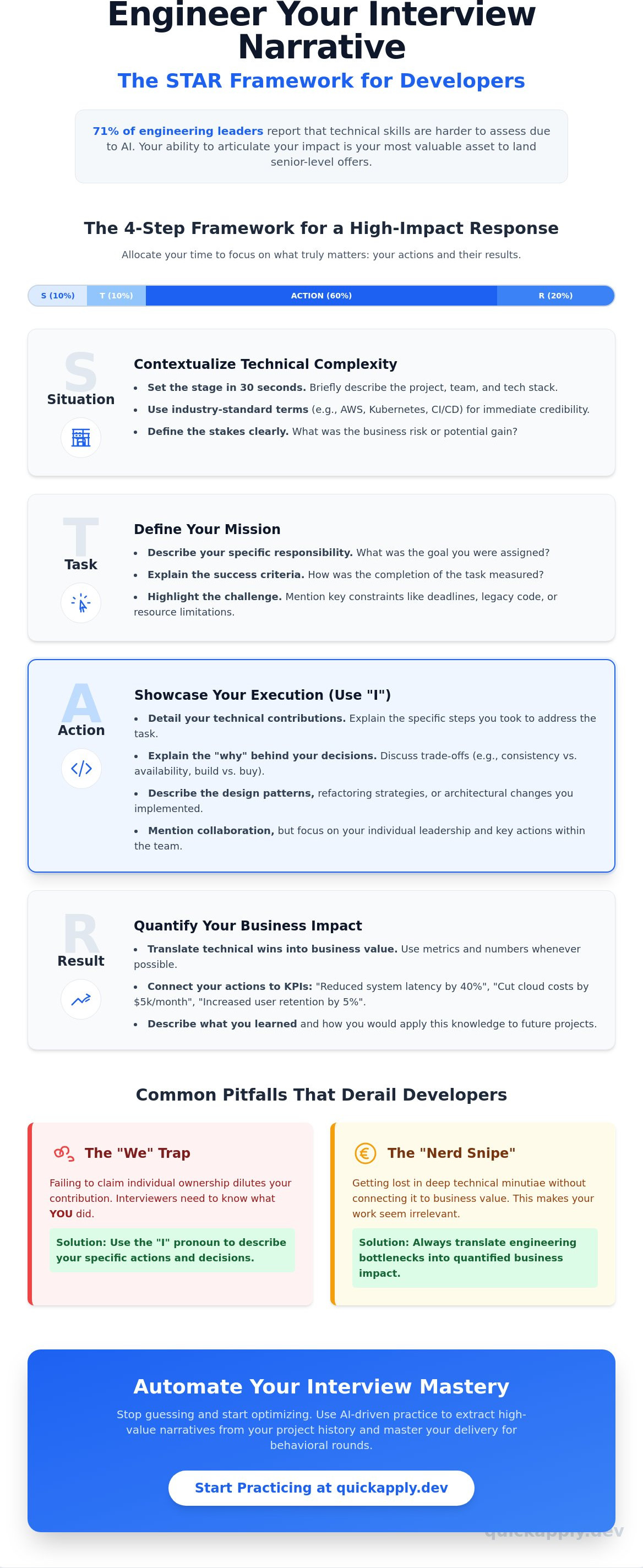
Master the STAR interview method by treating it like a technical specification. You have a limited time budget. Spend 10% on the Situation, 10% on the Task, 60% on the Action, and 20% on the Result. This specific ratio ensures you don't bore the interviewer with context while starving them of implementation details. High-impact star method examples for software developers require this balance to prove both architectural oversight and hands-on capability.
Precision is your greatest asset here. If you spend three minutes describing a bug but only thirty seconds on the fix, you've failed the interview. You must drive the narrative toward your individual contribution. Think of this as debugging your professional history to remove the fluff and highlight the logic. If you find yourself struggling to recall these details during prep, you can use interview practice tools to simulate these high-pressure deep dives and refine your delivery.
Situation & Task: Contextualizing Technical Complexity
Set the stage in 30 seconds or less. Avoid deep-diving into obscure internal tools that require ten minutes of explanation. Use industry-standard terms like AWS infrastructure, Kubernetes clusters, or CI/CD pipelines to build immediate credibility. Define the stakes clearly. What would have happened if the bottleneck wasn't cleared? Mentioning that a failure would lead to a 15% drop in checkout conversions provides the urgency needed to make your story memorable. You're setting the baseline for the value you're about to deliver.
Action: The Implementation Deep Dive
This is the core of your response and should take up the majority of your time. Use "I" instead of "we" to ensure you get credit for the implementation. Describe the specific design patterns or refactoring strategies you employed. Did you implement a Strategy pattern to handle multiple payment gateways? Did you move to an asynchronous event-driven architecture to decouple services? Explain how you collaborated with cross-functional teams like Product or DevOps. Show the interviewer you understand the trade-offs involved in your technical choices.
Result: Hard Data and Business Impact
End with a punch. Use the X-Y-Z formula: Accomplished [X] as measured by [Y], by doing [Z]. For example: "Reduced CPU usage by 25% as measured by CloudWatch metrics by optimizing the database indexing strategy." Include soft results too. Reducing on-call fatigue or improving team velocity are powerful indicators of a senior-level mindset. If you don't have access to exact dashboard data, quantify the result by comparing the "before" and "after" states based on engineering feedback or system stability reports.
3 High-Impact STAR Method Examples for Developers
Stop theorizing. Start executing. In 2026, hiring managers look for system-level reasoning over simple syntax proficiency. They want to see how you handle high-concurrency failures and architectural debt. These star method examples for software developers demonstrate the shift from writing code to engineering high-availability solutions. Each scenario proves you can think beyond the immediate task to consider long-term system health and team velocity.
Precision in your storytelling is just as critical as precision in your codebase. These examples are engineered to bypass recruiter filters and resonate with technical leads who value data over anecdotes. Mastering these narratives is the fastest way to navigate behavioral interviews for software engineers and secure senior-level compensation.
Example 1: The Critical Production Bug
Situation: A memory leak was causing recurring 500 errors during peak traffic periods. This wasn't just a technical glitch; it was a direct threat to our 99.9% uptime SLA and customer trust.
Action: I didn't just restart the pods. I used profiling tools to isolate the leak within a specific middleware layer that handled session persistence. I identified that the garbage collector couldn't reclaim memory due to circular references in the caching logic. I refactored the resource management to use weak references and optimized the cleanup intervals. I then collaborated with the DevOps team to update our monitoring stack for better visibility into heap usage.
Result: We achieved zero downtime during the next high-traffic event. I also implemented automated regression tests to ensure this specific failure mode never returns to production. This fix saved an estimated 12 hours of on-call troubleshooting per month.
Example 2: The Architectural Migration
Situation: Our monolithic architecture was blocking deployment velocity. The team was stuck in a rigid bi-weekly release cycle, and a single bug in one module could crash the entire application.
Action: I spearheaded the transition to microservices using the strangler fig pattern. This allowed us to migrate functionality incrementally without the risk of a "big bang" failure. I started with the most volatile service, decoupling it from the main database and implementing an asynchronous event-driven architecture using Kafka. I created a standardized service template to ensure consistency across the new infrastructure.
Result: Deployment frequency increased from bi-weekly to multiple times per day. System resilience improved, as service failures were now isolated. This migration reduced our mean time to recovery (MTTR) by 60% across the board.
Example 3: Navigating Team Conflict
Situation: During a high-stakes code review, a senior peer disagreed with my proposed database schema change for our new analytics engine.
Action: Instead of arguing semantics or relying on seniority, I created a data-driven proof of concept. I ran performance benchmarks comparing both approaches using a production-sized dataset. I focused on read-heavy workloads that mirrored our actual user behavior. I then presented the results in a neutral, technical walkthrough, highlighting the trade-offs in write latency versus read throughput for both designs.
Result: We reached a consensus based on evidence rather than ego. The team adopted my schema, which resulted in 40% faster read queries for our most hit endpoints. This approach established a new team standard for resolving technical disagreements through empirical testing.
Common Pitfalls: Why Most Developers Fail Behavioral Rounds
Elite coding skills won't save you if your narrative is low-fidelity. Behavioral rounds are designed to filter out engineers who can't map code to capital. In 2026, where 71% of engineering leaders say AI makes technical skills harder to assess, your story is your only verifiable proof of impact. Most developers treat these rounds as a formality; they "wing it" and wonder why they're passed over for senior roles. High-impact star method examples for software developers require more than just technical accuracy. They require narrative precision.
The most common failure is the "We Trap." Developers are conditioned to be team players, but in an interview, "we" is a bug. If you don't claim individual ownership of technical actions, recruiters assume you were just a spectator. You must also avoid the "No Result" finish. A story without a quantified metric is just a rambling anecdote. If you can't prove your fix reduced latency or saved costs, you haven't finished the task. Don't let a lack of preparation become a bottleneck in your career progression. Optimize your delivery with Interview Practice before you step into the room.
How to Avoid the 'Nerd Snipe'
Recruiters aren't compilers. Getting bogged down in the minutiae of a specific memory leak or a niche library is a "Nerd Snipe" that kills your momentum. Use the 80/20 rule: spend 80% of your time on high-level logic and business impact, and only 20% on specific technical terminology. Periodically check in with the interviewer. Ask, "Would you like me to go deeper into the implementation details?" This demonstrates high emotional intelligence and ensures you're keeping your audience engaged. Practice translating complex refactoring strategies into "business-value" language that highlights ROI.
Preparing Your Story Bank
Manual story creation is a high-latency strategy. You need a pre-cached bank of narratives ready for immediate execution. Maintain a running log of "Wins" and "Fires" throughout your career. Map each story to common behavioral themes like Leadership, Failure, Conflict, and Innovation. This ensures you aren't searching for a memory while the clock is ticking. Finally, ensure your stories align with the good resume examples you used to get the interview. Inconsistency between your written history and your verbal narrative is a major red flag for hiring managers.
Automate Your Interview Mastery with QuickApply
Manual interview prep is a legacy process. In 2026, engineers don't have hours to manually map their history to behavioral frameworks. It's a bottleneck that kills your momentum and keeps you stuck in mid-level roles. You need a system that functions like an IDE for your career, optimizing every step from the initial application to the final negotiation. QuickApply bridges the gap between your raw technical contributions and the high-impact star method examples for software developers that hiring managers demand.
You've already learned how to tailor your resume to a job description using our AI-driven strategy. Now, you can seamlessly transition that same data into behavioral mastery. QuickApply uses AI to extract STAR stories directly from your project history, commit logs, and technical documentation. It identifies the architectural decisions and conflict resolutions you've already lived through, transforming them into structured narratives that resonate with senior leadership. This isn't just about saving time; it's about ensuring your narrative is as optimized as your code.
AI-Powered Interview Practice
Use the interview practice module to simulate high-pressure technical rounds. This isn't just a static mock interview. It's a real-time copilot that evaluates your STAR structure and technical clarity as you speak. You'll receive instant feedback on where you're "Nerd Sniping" or where you've fallen into the "We Trap." The system generates custom STAR templates based on specific job descriptions in seconds. This ensures your examples are always relevant to the specific tech stack and leadership principles of the company you're targeting.
Closing the Loop: From Application to Offer
Efficiency doesn't stop once the interview starts. QuickApply’s application tracker keeps your story bank organized by role. You'll never repeat the same anecdote to the same hiring team or lose track of which technical win you highlighted for which firm. While you prepare for today's offer, the Promotion Roadmap helps you build your future STAR stories by identifying the technical leadership gaps in your current trajectory. You aren't just looking for a job. You're building a system for continuous career optimization. Optimize your interview performance with QuickApply’s AI tools today.
Engineer Your Career Breakthrough
Narrative engineering is no longer optional for senior roles. You've learned how to debug your professional history and avoid the "Nerd Snipe" by focusing on business impact. By utilizing high-impact star method examples for software developers, you move from a line-item contributor to a strategic system architect. The 2026 market demands precision and speed. Manual preparation is a bottleneck you can't afford when high-stakes offers are on the line. Every story you tell must demonstrate your ability to navigate ambiguity and deliver measurable ROI.
QuickApply streamlines this process through its AI-powered STAR story generator and real-time interview feedback loop. Trusted by thousands of tech professionals in 2026, our platform ensures your delivery is as optimized as your codebase. You don't have to guess what recruiters want to hear. Instead, you can rely on data-driven insights to refine your pitch and claim your seat at the table. Stop stressing and start practicing with QuickApply’s AI Interview Assistant. You have the talent; now use the right tools to prove it. Your next senior-level offer is just one well-engineered story away.
Frequently Asked Questions
What is the best way to use the STAR method for a junior developer with no experience?
Leverage academic projects, open-source contributions, or bootcamp capstones to build your narrative. Focus on the specific logic you used to solve a technical bottleneck or how you managed a merge conflict in a group repository. Even without a corporate history, you can demonstrate system thinking by explaining why you chose a specific library or how you optimized a local database schema.
How long should a STAR method response be in a technical interview?
Aim for a duration of two to three minutes. Allocate 10% of your time to the Situation and Task, 60% to the Action, and 20% to the Result. This ratio ensures you provide enough implementation detail without losing the interviewer's attention. If you exceed three minutes, you risk being "Nerd Sniped" by irrelevant details that don't move the narrative forward.
Can I use the STAR method for coding questions or only behavioral ones?
You should use the STAR framework to explain the reasoning behind your algorithmic choices and system design decisions. Map the "Action" to the trade-offs you made, such as prioritizing time complexity over space complexity. This approach transforms a standard coding solution into a high-impact narrative that proves your architectural oversight.
What should I do if I can't remember a specific result or metric for my story?
Use comparative metrics or qualitative feedback to anchor your result. If you don't have access to an exact dashboard percentage, describe the "before and after" state of the system. Stating that you "halved the build time" or "eliminated recurring session timeouts" provides enough technical weight to validate your star method examples for software developers.
How do I talk about a failure using the STAR method without looking incompetent?
Utilize the STAR-L framework by adding a "Learnings" section to your response. Focus on the technical post-mortem and the automated safeguards you implemented to prevent a recurrence. Showing that you built a new regression test suite after a production failure demonstrates a senior-level mindset and a commitment to system stability.
Is the STAR method still relevant in 2026 with AI-driven hiring?
It is more critical than ever because 71% of engineering leaders now find technical skills difficult to assess due to AI. The STAR method is the only way to prove your individual agency and decision-making process in an AI-assisted workflow. You must use it to demonstrate that you are a system architect who can validate and integrate AI-generated code rather than just a prompt engineer.
How many STAR stories should I have prepared before a big tech interview?
Prepare five to seven versatile stories that can be adapted to different themes. Your story bank should include narratives focused on technical conflict, architectural innovation, and high-pressure debugging. Having a pre-cached set of star method examples for software developers allows you to respond with zero latency when the interviewer shifts topics.


