

The safest move isn’t always to rule out a company after layoffs. Applying for a job at a company that just had layoffs can still make sense when the role is new and the team is receiving investment. Treat repeated cuts, a role that appears to replace eliminated work, and evasive answers about the position’s future as reasons to pause.
It’s reasonable to wonder whether a new job could put you in the path of another restructure. But a layoff announcement alone doesn’t show whether a particular team is shrinking, shifting priorities, or hiring for growth. This guide covers signs to weigh before you apply, including what the job posting reveals, whether hiring has resumed in your function, and how the company handled the cuts.
You’ll also find a clear way to discuss layoffs in interviews and practical questions that can reveal how the role fits the company’s plans. Weigh the signals together, then decide based on the work, the team, and the answers you hear, not the headline alone.
Key Takeaways
- Judge the specific role and team, not just the company’s layoff headline; repeated cuts or a quietly reappearing position deserve closer scrutiny.
- Explain your job search honestly and briefly in interviews, then turn the conversation toward how you can contribute.
- Look for signs that the company is investing in the function you’d join, rather than assuming all hiring signals overall growth.
- Ask how the role supports the company’s long-term vision and meet the prospective team to understand its current environment.
- Apply when the position’s purpose and outlook make sense to you, then tailor your application materials to the role.
1. Limits of assessing an individual employer and application odds
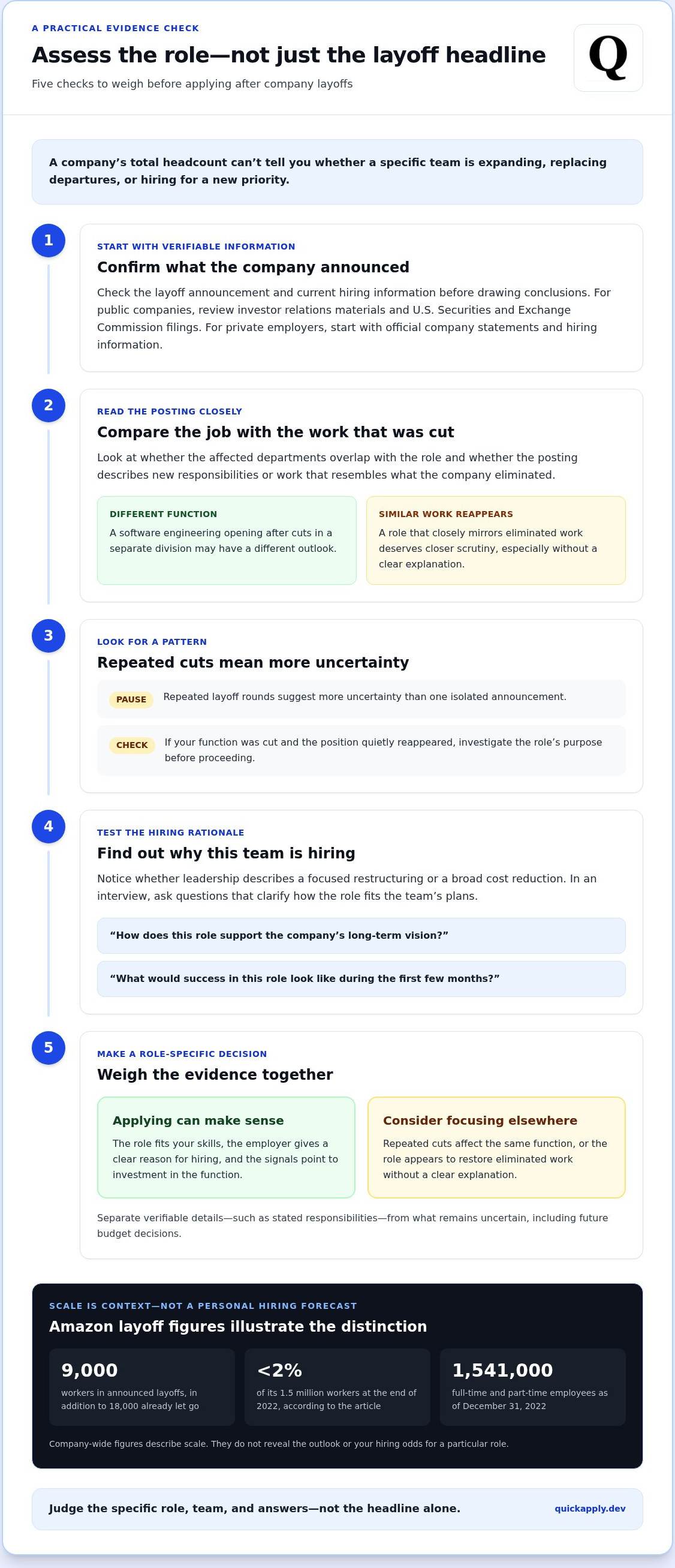
Applying after layoffs calls for a role-specific decision, not a prediction about the whole company. Verify the cuts through company announcements and filings, then compare those details with current job postings and recent financial updates. For public companies, review investor relations materials and filings with the U.S. Securities and Exchange Commission. For private employers, start with official company statements and hiring information.
Even strong evidence has limits. A company’s total headcount cannot tell you whether your prospective team is expanding, replacing departures, or hiring for a new priority. Amazon, for example, announced layoffs of 9,000 workers in addition to 18,000 employees it had already let go. Those announcements represented less than 2% of its 1.5 million workers at the end of 2022. According to Amazon, it employed approximately 1,541,000 full-time and part-time employees as of December 31, 2022. The figures describe company scale, not your odds of landing a particular role.
Build a simple evidence check before you apply. Compare the job description with the company’s layoff announcement, if available. Check whether the affected departments overlap with the role, whether the posting describes new responsibilities, and whether the position has appeared repeatedly. A software engineering opening after cuts in a separate division may signal a different outlook from a role that closely mirrors work the company just eliminated.
- Check the pattern: repeated layoff rounds suggest more uncertainty than one isolated announcement.
- Check the function: consider skipping a role if your function was cut and the position quietly reappeared.
- Check the explanation: note whether leadership describes a focused restructuring or broad cost reduction.
These signals can help you assess risk, but they can’t calculate your personal chances of getting hired. Decisions also depend on the role’s requirements, the candidate pool, and how closely your experience matches the team’s needs. Separate what you can verify, such as the job’s stated responsibilities, from what remains uncertain, such as future budget decisions.
Use that distinction to make a practical decision. If the role fits your skills and the employer gives a clear reason for hiring, applying can be reasonable despite layoffs elsewhere. If repeated cuts affect the same function or the job seems to restore eliminated work without a clear explanation, focus your effort elsewhere. Track what you learn and your application status to make each decision more informed.
2. Preparing to discuss a layoff in interviews
Prepare a short, honest explanation before your next interview. If your position ended in a broader reduction, say so plainly: “My role was eliminated as part of a company-wide layoff. I’m now looking for a position where I can use my experience in product analytics.” Keep it factual, then connect your search to the role you want. A concise answer gives the interviewer context without letting the layoff define your candidacy.
Don’t criticize your former employer, even if the process felt unfair. Avoid blaming a manager, sharing internal disputes, or speculating about leadership decisions in interviews, networking conversations, or social media posts. These details can distract from your skills and make your answer sound focused on conflict. Instead, share what you learned or the work you want to do next. For example, explain that you’re seeking a team with a clear need for your specialty.
After your brief explanation, redirect the conversation with a question about the position. If the interviewer asks why you left, answer directly, then ask, “What would success in this role look like during the first few months?” This keeps the discussion useful and gives you a clearer sense of expectations. Prepare another role-related question in case the interviewer follows up, such as asking which projects need immediate support.
- State the situation: Say your position was eliminated in a broader layoff, if that accurately describes what happened.
- Keep the tone neutral: Leave out criticism, speculation, and details about workplace drama.
- Return to the role: Connect your experience to the job, then ask a question about its priorities.
If you were laid off, you can request a letter from human resources stating that your departure was part of a broader layoff, rather than a dismissal for personal performance problems. Keep it available in case an interviewer needs clarification. Not every employer will ask for one, so use it as supporting documentation when relevant. Your spoken explanation should still be clear on its own.
Rehearse aloud so your answer stays steady and concise. A practice interview can help you refine the wording, handle follow-ups, and pivot toward your qualifications. Try answering the question, “Why are you looking for a new role?” without adding unnecessary detail. Then practice connecting your response to one skill or result that matches the job description. Practice layoff interview answers before your next conversation.
Keep your approach calm and factual in interviews, networking conversations, and on social media. Avoid criticizing your former employer in any of these settings, even if you feel frustrated by how the layoff was handled. If someone asks for more detail, give a simple, honest explanation of why you’re seeking a job instead of adding criticism or speculation. Then shift the conversation toward the position by asking about its priorities or the team’s needs. This helps you move forward without dwelling on your departure and keeps the focus on the role and the contribution you hope to make.
4. Whether hiring resumed broadly or in specific areas
Yes. A company can lay off employees in one function while hiring in another. It may be shifting investment rather than contracting across the entire business. For example, a firm could reduce a legacy product team while hiring engineers for a new platform. The key is to identify where the open role sits and what work it supports.
Start with the job description. Separate core responsibilities from general requirements, then compare them with the company’s stated priorities. A role building a new product differs from one maintaining a function that recently lost staff. Look for concrete signals, such as ownership of a new project, a named product area, or responsibilities tied to a changed business strategy. These details can show whether the team is gaining resources or simply replacing capacity.
Next, map hiring activity by function. Review current openings across the company and group them by team or skill set. If postings cluster around one business area, hiring may be targeted rather than broad. For instance, several cloud infrastructure openings alongside fewer customer support roles could indicate a shift in investment. Job listings show demand, but not the full budget or future staffing plan.
- Compare teams: Note which functions have open roles and which appear in the layoff announcement.
- Read role language: Look for new ownership, project launch work, or a clear business need.
- Check consistency: Compare the job description with company statements and recent product updates.
Use the interview to test your interpretation. Ask how the role’s priorities have changed and which teams it works with most closely. A hiring manager who can explain the problem this position will solve gives you a clearer picture than a generic statement about growth. For example, ask whether the role supports a newly funded product, fills a critical capability gap, or takes over work after a reorganization.
Applying makes the most sense when the function is receiving investment and the position is genuinely new. A new role with defined goals may have a different outlook from a replacement opening in a team that recently lost similar positions. Tailor your resume to the responsibilities that reveal the team’s priorities. Then use the interview to confirm how success will be measured and what resources support the work.
Don’t treat company-wide hiring as proof that every role is secure, or layoffs as proof that every team is shrinking. Assess the specific function, the position’s purpose, and the manager’s explanation together. This gives you a sharper basis for deciding than simply counting open jobs.
5. When to apply after company layoffs
In the United States, employment laws can affect how layoffs are carried out and who may be hired. The applicable rules depend on the employer and circumstances, so a layoff announcement alone doesn’t establish a universal waiting period before hiring resumes.
For your decision, prioritize the role’s purpose over the time since the announcement. Apply when the position is clearly needed, the team is investing in that function, and the job description matches your skills. A new role supporting a funded product may be a stronger opportunity than a posting that repeats work recently removed from the same team.
Don’t assume waiting automatically improves your chances. A company may reopen hiring in one area while keeping another function closed. If the role fits your experience and the employer can explain why it exists, applying promptly lets you enter the process while the opening is active. If the explanation is vague or the position closely resembles eliminated work, pause and gather more context before investing your time.
- Apply now: The role is new, relevant to your skills, and tied to a clear team priority.
- Pause: The function was cut, and a similar opening has reappeared without a clear explanation.
- Move on: Repeated layoff rounds affect the same area, with no clear purpose for the vacancy.
Use a focused application routine instead of waiting for broad hiring to return. Choose 2-3 job listings each day and tailor your materials to those openings. For example, if a posting emphasizes stabilizing a product after a reorganization, show relevant experience with launches, reliability, or cross-functional delivery. Match your evidence to the role’s actual priorities.
Timing also depends on how long you can sustain your job search. The average time to find a job after being laid off is about five months. That figure isn’t a deadline for one employer; it’s a reason to maintain a steady pipeline instead of betting your search on a single company. Keep applying to suitable roles while assessing each employer’s signals.
Set a decision rule before emotions or urgency take over. Apply when the role’s purpose, team investment, and your fit align. Pause when those signals conflict, then use the interview to clarify the position’s goals. Skip the opening if repeated cuts target its function and the company can’t explain why the work is returning. This keeps your search active without treating every layoff as either an automatic rejection or a green light.
U.S. employment laws may affect how an employer conducts layoffs and whom it can hire, with the applicable rules varying by employer and circumstances. A layoff by itself does not impose a universal waiting period before hiring resumes.
5. What questions should you ask in an interview after a company has had layoffs?
Use the interview to understand whether the position has a durable purpose, rather than to demand certainty about future staffing. Ask, “How does this role fit into the company’s long-term vision?” Then follow up: “What priorities should this person deliver against?” Specific answers about projects, customers, or team goals reveal more than broad assurances about growth.
LaTrice Huff recommends looking for a role that may last at least two years. That isn’t a guarantee of job security. It’s a prompt to test whether the work has a meaningful place in the company’s plans. Ask what the team expects to accomplish over that period and how this position contributes. A manager can’t guarantee that a role will always exist, so focus on the work’s purpose and current priorities.
Ask how and why the company conducted its layoffs. Keep the wording neutral: “What factors shaped the recent workforce changes, and how did leadership decide which teams were affected?” The answer can show how leaders communicate decisions and explain their values. Listen for a clear account of business priorities, not just polished language. Notice whether the interviewer answers directly or avoids the substance of the question.
Meet prospective teammates during the interview process. Ask how responsibilities have shifted and what collaboration looks like now. For example, “Which projects are the team’s main focus, and how have those priorities changed?” A teammate’s perspective can help you understand how remaining employees feel and whether roles are clearly defined. Compare their answers with the hiring manager’s explanation.
- Role outlook: “How does this position support the company’s long-term vision?”
- Team impact: “How have responsibilities or workflows changed since the layoffs?”
- Decision process: “How did leadership determine which teams were affected?”
- Success measures: “What outcomes would show that this hire is succeeding?”
Evaluate the pattern, not one imperfect answer. A manager may not know every future staffing decision, but should be able to explain the role’s current purpose, priorities, and connection to team goals. If answers conflict across interviewers, ask a concise follow-up about the discrepancy. Clear, consistent details give you a stronger basis for deciding than promises of permanent security.
Prepare your questions before the interview and practice asking them in a calm, direct way. Practice your layoff interview questions so you can keep the conversation focused on the role, the team, and the work ahead.
Use the same calm, open tone with prospective teammates, and ask what day-to-day collaboration feels like after the changes. Their views can add context about company culture and how remaining employees feel. Questions about the role’s long-term vision and the layoffs can also help you assess leadership’s priorities.
QuickApply: Resume Tailoring
QuickApply helps you turn a carefully chosen role into a focused application. Use Resume Tailoring to align your experience with the job description, then use Cover Letter Generation to highlight why your background fits the team’s priorities. These tools are useful once you’ve assessed the company’s hiring outlook and are ready to apply, rather than sending generic materials to every opening.
Keep your search organized with the Application Tracker, and use Interview Practice to prepare for questions about your layoff and the role. The goal is a clear, consistent process: target suitable openings, tailor each application, and prepare to explain your fit. Visit quickapply.dev to explore QuickApply.
Turn your decision into a focused next move
Make your next application a deliberate test of fit, not a reaction to a headline. Before applying, write down what you need from the role: meaningful work, a team whose priorities make sense, and clear expectations for success. Use those criteria consistently. They can help you decide with less second-guessing and keep your search moving.
Applying for a job at a company that just had layoffs can still be a smart move when the opportunity fits your goals. Make each application specific. QuickApply’s Resume Tailoring and Cover Letter Generation help align your materials with the role, while Interview Practice helps you discuss your experience clearly. Choose the support that matches your next step, then keep building momentum.
Contact QuickApply for job search help and put your next application in motion. You’re equipped to make a thoughtful choice and move forward with confidence.
Frequently Asked Questions
Should I apply to a company that just had layoffs?
Yes, if the opening is active and your experience fits the work. Applying for a job at a company that just had layoffs can still be a practical choice when the role aligns with your skills and priorities. Save the job description and note its key requirements, since postings can change. Make sure your resume highlights relevant accomplishments, not just matching job titles, and keep other applications moving.
Is it a good idea to apply for a job at a company that just had layoffs?
It can be. Whether applying for a job at a company that just had layoffs is a good idea depends on your priorities and the opportunity’s fit. Consider how you weigh stability, compensation, and growth. For example, someone who needs predictable income may assess a reorganized team differently from someone pursuing a specific project. Make your decision around your needs and goals, not the headline alone.
How should you negotiate salary and job security after company layoffs?
Ask how the role fits into the company’s long-term vision and whether it is expected to last at least two years. Managers cannot guarantee that a role will always exist.


