

A public listing is a milestone, not a guarantee of stability. To learn how to get a job at a post-IPO startup, target roles that match your skills, then assess the company’s finances, culture, and growth prospects before applying. An IPO can give a company access to public investors, while a direct listing can move shares to public exchanges without raising capital.
The appeal is clear: you may find the pace and ownership of a startup alongside the visibility of a public company. But the IPO headline alone won’t tell you whether the role is a smart move. Look beyond it.
This guide shows you how to evaluate stability, work-life balance, career growth, and professional relationships, then compare salary with the potential upside and limits of equity. You’ll also learn how companies become publicly listed and what to focus on in your application and interviews. Use these details to make a sharper decision before committing time to the process.
Key Takeaways
- Assess financial health through revenue growth, profitability or a clear path to it, and cash flow, not the IPO headline alone.
- Compare the role’s scope, culture, work-life balance, and career growth with what you want next.
- Weigh salary against equity by considering vesting, trading limits, and the terms that affect what you can keep or sell.
- Look beyond traditional IPOs: direct listings and SPACs can also take companies public.
- Focus your application on the role’s needs, then tailor your resume and prepare examples that show relevant impact.
Evaluating company stability, culture, and work-life balance
Assess a post-IPO employer through its finances, size, products, and day-to-day expectations, not its listing alone. The interview process typically includes conversations with a recruiter and hiring manager, role-specific discussions, and time to assess how the team works.
Assessing Company Stability and Scale
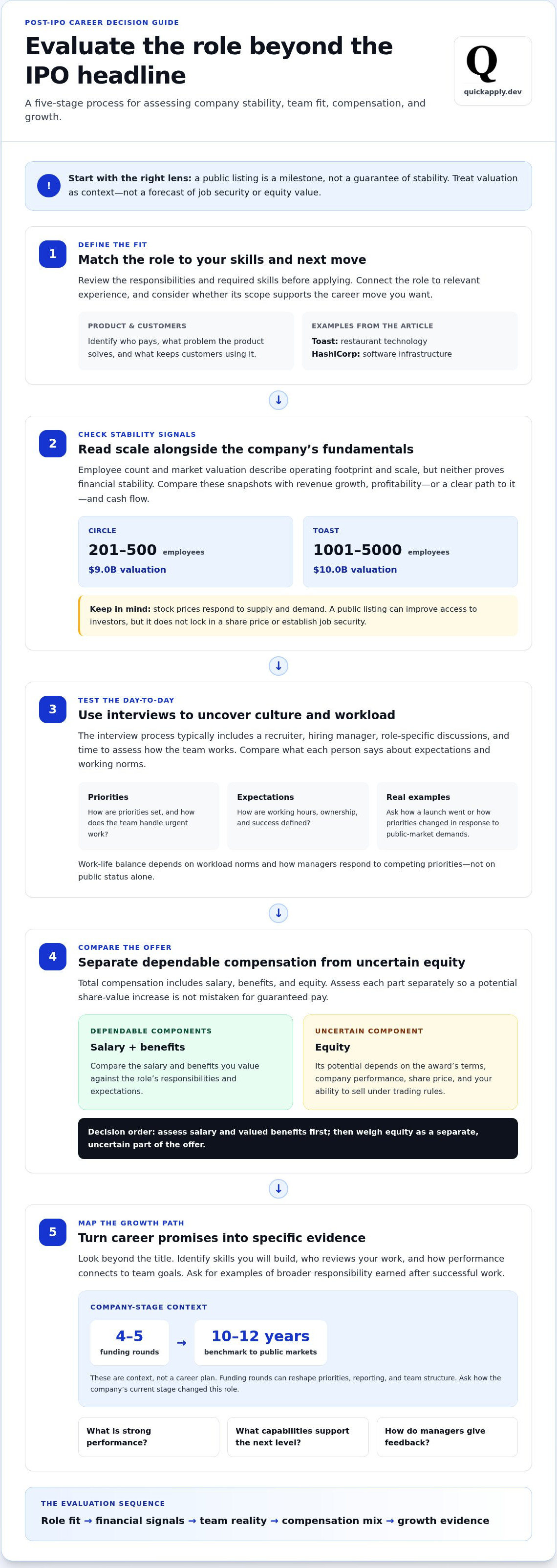
Company scale combines employee count and market valuation, but neither figure proves financial stability. These measures matter because they help you understand an employer’s operating footprint and the environment you may join. For example, Circle is listed with 201-500 employees and a $9.0B valuation, while Toast is listed with 1001-5000 employees and a $10.0B valuation.
Compare these snapshots with the company’s fundamentals. Revenue growth, profitability or a clear path to profitability, and cash flow offer useful signals about financial health. A public listing can improve access to investors, but stock prices still respond to supply and demand. Treat valuation as context, not a forecast of job security or equity value.
Comparing Compensation, Benefits, and Equity
Total compensation combines salary, benefits, and equity. Comparing each component shows what the offer actually provides. Consider salary alongside the benefits you value, then assess equity separately rather than treating it as guaranteed pay. Its potential depends on the award’s terms, the share price, and your ability to sell shares under company trading rules.
Ask how the role’s responsibilities connect to business goals, then compare those expectations with the compensation structure. A larger equity award can look attractive, but its value depends on company performance and grant terms. Base your decision on dependable salary and benefits first, then weigh equity as a separate, uncertain element.
Consider the company’s finances and workplace signals together. Valuation can fluctuate, while workload, manager expectations, and operating habits shape your daily experience. During interviews, ask how priorities are set, how teams handle urgent work, and how success is measured. Request concrete examples, such as how the team handled a launch or shifted priorities in response to public-market demands.
Culture shows up in how employees describe collaboration and decision-making. Compare answers from the recruiter, hiring manager, and prospective teammates. If they describe different expectations for working hours or ownership, ask how those differences play out on the team. A company’s public status doesn’t determine work-life balance; workload norms and how managers respond to competing priorities matter more.
Evaluate the company’s industry and products by identifying who pays, what problem the product solves, and what keeps customers using it. Toast, for example, operates in restaurant technology, while HashiCorp focuses on software infrastructure. Then review the employer’s official careers page and current job listings. Before applying, match each role’s responsibilities and required skills to your experience.
Career development and professional relationships
A post-IPO role can broaden your scope, but public-company processes may change how decisions are made. Evaluate the learning curve alongside the job title: identify which skills you’ll build, who will review your work, and how performance connects to team goals. In interviews, ask for a concrete example of an employee taking on broader responsibility after a successful project.
Use the company’s growth history as context, not as a career plan. Startups often move through four or five funding rounds before an IPO, and a 10-12-year timeline can serve as a benchmark for reaching public markets. Each funding round can reshape priorities, reporting, and team structure. Ask how the company’s current stage changed this role and what outcomes would signal readiness for greater responsibility.
Turn vague promotion language into specifics. Ask what strong performance looks like, which capabilities distinguish the next level, and how managers give feedback. A useful discussion names the work, not just the title: for example, owning a launch, improving a workflow, or coordinating across product and finance. Compare these examples with the job description before deciding whether the role supports your next career move.
Professional relationships matter during hiring and after you join. The example shows why consistent communication and a record of delivered work can support career progress. Build trust by sharing concise updates, documenting decisions, and giving colleagues clear ownership of shared tasks.
Relationships also shape what happens when your path changes. If you leave, communicate directly with your manager, complete agreed handoffs, and thank colleagues for specific contributions. Maintaining professional communication can help preserve working relationships as you leave a startup. In a post-IPO environment, former teammates may later become collaborators, references, or connections to new roles, so close projects cleanly rather than disappearing during a transition.
Use interviews to test the company’s development culture. Ask how managers discuss growth, how cross-functional work is assigned, and how teams handle changing priorities. Compare answers across the recruiter, hiring manager, and prospective teammates. A focused cover letter draft can also connect your past achievements to the responsibilities and growth path described in the role.
Salary versus potential IPO-related upside
Compare dependable salary with equity as separate parts of an offer. A public listing gives employees access to shares, but it doesn’t lock in a share price or payout. Stock prices move with supply and demand in the market. The company’s purpose, financial performance, and share value all affect potential upside. Treat equity as an opportunity, not a substitute for salary you need to meet regular expenses.
Tableau Software illustrates the contrast between cash compensation and later share value. That outcome shows what can happen when a company’s shares rise, but it isn’t a template for another employee’s grant. Your role, grant terms, timing, and company performance shape your own outcome.
Timing matters after a listing. The average first-day return from the IPO price has historically been about 19%, but that doesn’t tell you what your shares will be worth later. A startup’s IPO lockup period typically lasts around six months from the date of the initial listing, although it can vary. Tableau Software employees couldn’t sell their shares for 6 months After the IPO. Account for that delay when weighing equity against cash you can use now.
Read the equity agreement before assigning a value to options or shares. Unvested startup equity is generally forfeited when an employee leaves, subject to the equity agreement’s terms. Vested options may remain exercisable for a limited period after departure, depending on that agreement. Some startups give departing employees a 90-day period to exercise vested options, but the period varies by company. Exercise can also trigger tax consequences based on option type and your tax situation.
Compare offers using a simple framework: salary and bonus, benefits, equity type, vesting schedule, and restrictions on selling. Ask how the grant works and what happens if you leave before all equity vests. Consider whether the company could raise more capital, become established, or pursue an acquisition, since each path can affect the value and timing of equity differently. Don’t count projected share value as current pay. Use salary to assess immediate compensation, then weigh equity according to its specific terms.
How do I identify startups that recently went public?
Start with the company’s investor-relations page and look for an announcement confirming its public listing. If you’re learning how to get a job at a post-IPO startup, confirming the listing route helps establish whether the employer is publicly traded. Check whether it used a traditional IPO, a direct listing, or a SPAC transaction. These routes differ. A direct listing can move shares from private markets to public exchanges without raising capital, while a SPAC is another route to a public listing. The route provides context, but doesn’t establish whether a specific role fits your goals.
Search the company name with terms such as “investor relations,” “public listing,” and “careers.” Compare the announcement with the company’s filings and public-market profile. A company seeking an IPO files an S-1 registration form with the SEC, but filing alone doesn’t mean the IPO will happen. A filing may be updated, but that alone does not confirm that a planned listing will proceed. Treat the completed listing, not an early filing, as evidence that the company is publicly traded.
Use this sequence to build a reliable shortlist:
- Find the listing route. Confirm whether the company completed a traditional IPO, direct listing, or SPAC transaction. Each route can shape how shares entered public markets.
- Confirm the event. Match the company’s announcement with its public-market profile. A planned listing or S-1 filing is not the same as a completed listing.
- Review the business. Read investor-relations materials for products, customers, financial direction, and stated priorities. Connect those details to the team and job description.
- Open the careers page. Compare active roles with current priorities. Note responsibilities, required skills, and application instructions before tailoring your materials.
Don’t rely on “post-IPO” in a job title or article. Verify the company’s listing status, then use its official job listings to confirm that the role is open. Public companies may still adjust teams and processes after listing. Look for descriptions that explain ownership, reporting lines, and how the team supports its product. These details help distinguish a clearly scoped opportunity from a headline with little relevance to your work.
A practical search for how to get a job at a post-IPO startup starts with a simple tracking record: listing route, confirmation source, careers-page address, target role, and application status. This helps prevent confusing a filing with a completed listing. For example, both direct listings and traditional IPOs lead to public trading, but a direct listing itself doesn’t raise capital for the company. Record that distinction so you can discuss the business context accurately during interviews.
What roles are most in demand at post-IPO companies?
There isn’t one universal list of high-demand roles across public startups. Hiring priorities follow the company’s product, customers, and operating needs. A software infrastructure business such as HashiCorp has different requirements from restaurant technology company Toast. Use job listings to identify which teams are hiring, then match your skills to the work described.
Start with these role groups and connect each one to a business need:
- Engineering and product: Software engineers, product managers, and designers build, maintain, and improve the core product. For HashiCorp, infrastructure expertise may align with products serving technical teams.
- Security and IT: Security engineers and IT specialists help protect systems, manage access, and support internal operations. Look for descriptions focused on risk controls, infrastructure, or enterprise customers.
- Finance and accounting: Accountants, financial analysts, and finance systems specialists support planning, reporting, and business decisions. Match your experience to the specific tools, processes, or analysis named in the listing.
- Legal and compliance: Counsel and compliance professionals help teams manage contracts, policies, and industry requirements. A healthcare company, for example, may need expertise relevant to its regulated business.
- Sales and customer success: Account executives, sales engineers, and customer success managers connect products with buyers and help customers use them. At Toast, restaurant-sector knowledge can make customer needs easier to understand.
- People operations: Recruiters and HR specialists help teams hire, onboard, and support employees. Compare the role’s scope with the company’s hiring plans and internal processes.
Read each job description for clues about the team’s current priorities. Repeated references to platform reliability, customer onboarding, or enterprise sales can signal where the company is investing effort. Then map your experience to those needs. Use a concise example that shows the problem, your contribution, and the result, such as improving a deployment process or reducing friction during customer onboarding.
Interview conversations can clarify how success is measured. Ask the hiring manager what the role should accomplish, which teams it works with, and what challenges need attention first. For a product role, discuss a launch or roadmap decision. For finance, explain how your analysis informed a business choice. Specific examples help interviewers connect your skills to the team’s work.
Build your application around the exact role, not a generic public-company pitch. Tailor your resume to the stated requirements and use a focused application materials workflow to prepare for relevant openings.
QuickApply: Resume Tailoring
QuickApply helps turn your research into application materials tailored to each post-IPO role. Use Resume Tailoring to align your experience with the job description, then generate a focused cover letter that connects your skills to the company’s needs. Interview Practice helps you prepare examples for role-specific conversations, while the Application Tracker keeps target roles and application progress organized.
It’s a practical next step once you’ve identified a role and want to move from evaluating the opportunity to applying with relevant materials. Keep your examples specific to the team’s priorities and the work you can contribute.
Explore QuickApply at quickapply.dev.
Turn Your Research Into Your Next Move
Your next move in learning how to get a job at a post-IPO startup is to turn your target role into a focused application. Choose an opening that fits your strengths, then make each line of your materials show how your experience matches its needs. Specific examples help employers see the value you can bring.
QuickApply supports the process with Resume Tailoring, Cover Letter Generation, and Interview Practice. Use these tools to shape your application around the role, communicate your impact clearly, and prepare for conversations with the hiring team. A deliberate, role-specific approach keeps your effort focused and makes your next steps easier to manage.
Ready to prepare your next application? Explore QuickApply for job search support and move forward with confidence.
Frequently Asked Questions
🏦 First, what is an IPO and why do companies do it?
An initial public offering, or IPO, is a process through which a company offers shares to public investors and becomes publicly traded. Companies may pursue an IPO to raise capital, increase visibility, or give existing shareholders a route to sell shares. Not every public listing is a traditional IPO: direct listings and SPAC transactions are other routes. Check which path the company used before interpreting its public-market status.
Where can I find job openings at post-IPO startups?
Start with the company’s official careers page, where you can filter openings by team, location policy, and experience level. Search the company’s investor-relations announcements for listing information, then match the confirmed company name to its current vacancies. Set alerts for role titles and skill terms, and revisit saved listings before applying. Job descriptions can change as teams update priorities, so use the live posting rather than an older search result.
How should I tailor my resume for a post-IPO startup job?
Build each version around the role’s required skills and the team’s stated goals. For a product operations role, emphasize process improvements and cross-team launches; for engineering, foreground relevant systems and technical ownership. Use the employer’s wording when it accurately describes your experience, and support claims with specific outcomes from past work. Remove unrelated details that obscure your fit, then proofread dates, titles, and links before submitting.
How can I get a referral or network with employees at a public startup?
Find employees whose teams overlap with your target role, then send a short, personalized message. Mention the specific opening and a relevant project, and ask for perspective on the work rather than demanding a referral. If someone responds, prepare focused questions about team priorities and the interview process. After the conversation, send a brief thank-you and share an update if you apply. Keep your outreach professional and respect a lack of response.
How do post-IPO startup salaries and equity compensation compare with private startups and established companies?
Compare the full offer, not the employer category. A private startup may emphasize equity with uncertain liquidity, while an established company may offer a different balance of salary, benefits, and stock. A public startup’s shares have a market price, but access to cash depends on award terms and trading restrictions. Compare role scope, benefits, bonus structure, vesting, and company rules for selling shares before judging total compensation.
What financial and business metrics should I research before applying to a post-IPO startup?
Review revenue growth, profitability or a clear path to profitability, and cash flow. Then connect those figures to the business: identify the product, its customers, and the stated priorities for future growth. Consider whether the company explains how it plans to use capital and whether its business model depends on a narrow set of products or customers. Use your findings to prepare informed questions about the team’s goals and resources.
What risks should I consider when joining a company soon after its IPO?
Consider share-price volatility, restrictions on selling equity, and what happens to unvested awards if you leave. Exercising options can also have tax consequences that depend on the option type and your circumstances. Beyond compensation, public-market demands may shift company priorities or team workflows. Assess the job based on its responsibilities and dependable compensation, and treat potential equity value as uncertain rather than money available for current expenses.
How can I evaluate a post-IPO startup's culture, job stability, and growth prospects?
Use interviews to assess how the team operates, not just how the company describes itself. Ask the hiring manager how priorities are set, how success is assessed, and what the role should accomplish first. Compare those answers with employees’ descriptions of collaboration and workload. To assess growth prospects, connect the role to the product and business priorities. Clear responsibilities and consistent answers provide stronger signals than a public listing alone.


