

Your cover letter doesn’t need to become a medical history. When explaining a resume gap due to mental health, keep it brief and honest: say you took time away for personal health, then focus on your readiness and fit for the role. You don’t need to disclose a diagnosis to explain the gap.
It’s reasonable to protect your privacy while addressing a gap directly. The goal isn’t to justify every month away; it’s to give the employer enough context, then refocus on what you can contribute. This guide explains how to phrase the gap in a cover letter, highlight relevant skills or learning from your time away, and prepare a concise interview response. Adapt the wording to your circumstances, share only what you choose, and make your next step clear.
Key Takeaways
- Keep your explanation brief and honest while sharing only the personal details you’re comfortable disclosing.
- Connect relevant training, volunteering, or other experience from your time away to the role’s needs.
- Prepare a concise interview response that states your readiness and redirects attention to your strengths.
- Use your cover letter to acknowledge the gap briefly, then focus on why your skills fit the position.
1. Briefly and honestly explaining time away from work
Start with the dates, then give a short, accurate description of your time away. For example: “2023-2024: Took time away for personal health and recovery; now prepared to return to work.” Use dates that match your actual employment history. Keep the explanation focused on the break, not medical details. The World Health Organization estimates that roughly 1 in 7 people globally experience a mental health condition, but your resume doesn’t need to explain a diagnosis to make a gap understandable.
In most United States situations, applicants can keep a mental health condition private and don’t have to name a diagnosis when explaining a career gap. A brief reference to personal health can provide context without disclosing treatment, symptoms, or other private information. Choose wording you’re comfortable repeating in an interview. Don’t claim the break was for caregiving or another reason if that isn’t true. Honest, limited context sets a clear boundary and keeps your explanation consistent.
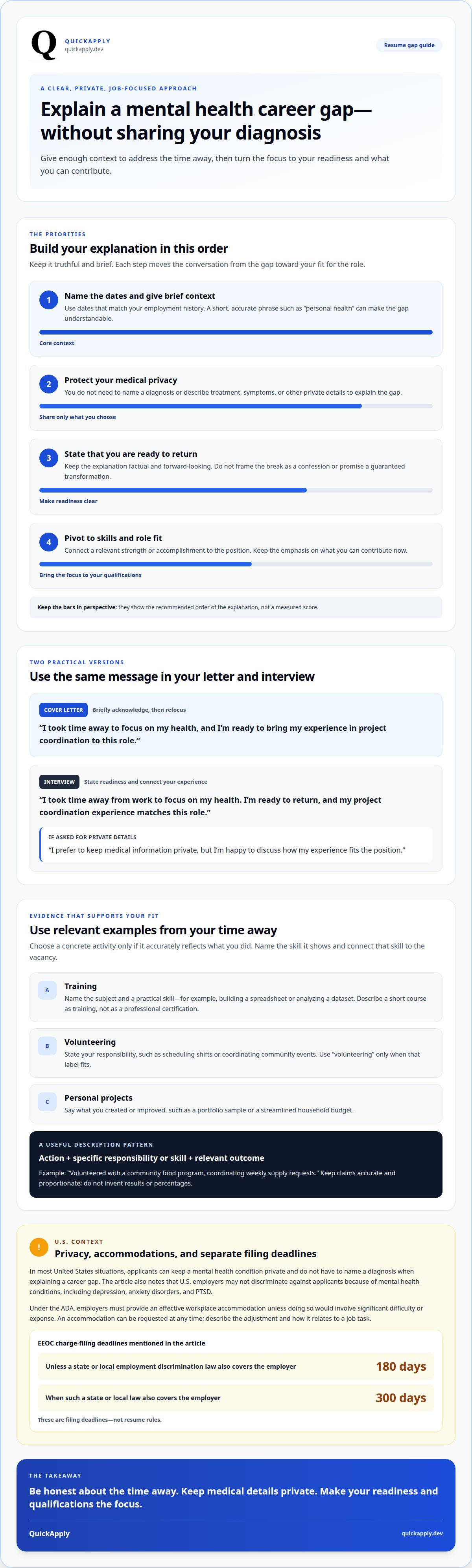
Frame the break as time when you focused on your well-being, not as a confession or apology. For example: “I took time away to focus on my health, and I’m ready to bring my experience in project coordination to this role.” Mention a specific skill only if it connects to the job. Avoid presenting recovery as a guaranteed transformation. Keep the explanation factual: why you took the break, what you can contribute now, and why the position fits.
If the gap connects to possible workplace discrimination, note the separate EEOC filing deadlines. According to the U.S. Equal Employment Opportunity Commission, the deadline to file an EEOC charge is 180 days from the alleged violation unless a state or local employment discrimination law also covers the employer. According to the U.S. Equal Employment Opportunity Commission, that charge-filing deadline extends to 300 days when such a law also covers the employer. These are filing deadlines, not resume rules. For your resume, use a brief, truthful label such as “Personal health leave” and keep the focus on your qualifications.
2. Highlighting skills, learning, and volunteering during a break
Use the break section to show relevant activity, not to present it as a full-time role. Start with one concrete example, such as a completed course, a volunteer task, or a personal project. Name the skill it demonstrates and connect that skill to the vacancy. For example, completing an online data course can support an application for a role requiring spreadsheet analysis. If recovery left little room for formal activities, don’t imply otherwise. Your earlier work accomplishments can still demonstrate your skills.
Describe each activity with an action and an outcome. “Volunteered with a community food program, coordinating weekly supply requests” shows organization and communication. “Completed a project management course and used its planning framework for a personal project” makes learning tangible. Keep each description accurate and proportionate. A short course is training, not a professional certification; call informal help volunteering only when that label fits. Choose examples that match the job description instead of listing everything you did.
- Training: Name the subject and a practical skill, such as building a spreadsheet or analyzing a dataset.
- Volunteering: Describe your responsibility, such as scheduling shifts or coordinating community events.
- Personal projects: State what you created or improved, such as a portfolio sample or a streamlined household budget.
For accomplishments before the break, describe the action, scope, and result. “Created a client onboarding guide that reduced repeated questions” is stronger than “helped with onboarding.” Keep claims verifiable and don’t invent results or percentages. If the work involved a team, be specific about your contribution. A former supervisor, volunteer coordinator, instructor, or mentor may be able to speak to your skills and reliability when references are requested.
Finally, prioritize evidence that maps to the target role. A cover letter can connect a course or volunteer task to a requirement without turning the break into a long explanation. Use focused cover letter drafting to organize those examples around the position’s needs.
3. Preparing a concise explanation for an employment gap
Prepare a response with the dates, a brief explanation, and a pivot to your qualifications. For example: “I took time away from work to focus on my health. I’m ready to return, and my project coordination experience matches this role.” If you’re deciding how to explain a resume gap due to mental health, practice the wording aloud with someone supportive. Rehearsing can help you stay concise when interview nerves make you want to overexplain.
In an interview, say that you’re ready to work, then connect your experience to a role requirement. You don’t need to name a diagnosis. If asked for private details, try: “I prefer to keep medical information private, but I’m happy to discuss how my experience fits the position.”
In the United States, employers may not discriminate against applicants because of mental health conditions, including depression, anxiety disorders, and PTSD. Under the ADA, employers must provide an effective workplace accommodation unless doing so would involve significant difficulty or expense. These protections don’t mean you have to share a diagnosis to explain a resume gap.
You can request a workplace accommodation at any time. If you need one, describe the adjustment and how it relates to a job task. For example, explain what change would help you perform a specific responsibility. Keep the request focused on the work need instead of sharing more medical history than necessary.
Look for employers whose hiring materials explicitly support people with disabilities or mental health conditions. A clear nondiscrimination statement describes the employer’s stated approach, though it can’t tell you everything about the workplace. Consider it alongside the role description and your own priorities.
Practice how to explain a resume gap due to mental health with a short answer and a boundary for follow-up questions. Then rehearse a transition to a relevant strength, such as meeting deadlines or coordinating project handoffs. This helps keep your response direct and interview-ready.
4. Explaining a gap in a cover letter
A cover letter gives you room to connect a brief note about the gap to your qualifications. Don’t turn it into a timeline of treatment or a detailed account of recovery. Use one concise sentence for the break, then spend the remaining space showing how your experience matches the role. For example: “After taking time away to focus on my health, I’m ready to return and bring my customer support experience to your team.”
Place the explanation where it won’t overshadow your opening. A practical sequence is to introduce the role, briefly address the gap if needed, then connect a specific strength to a listed job requirement. If your resume already labels the break clearly, the letter can focus more on your fit. If the dates might prompt questions, a short sentence can provide context without naming a diagnosis.
Make the next sentence specific to the employer. Refer to a responsibility in the posting, then connect it to evidence from your work history. For example: “In my previous role, I documented recurring customer issues and shared fixes with the product team. I’m interested in applying that approach to your support operations.” This keeps the focus on your contribution rather than asking the reader to interpret the gap.
Check the final draft against three points: the explanation is truthful, you share only the personal details you choose, and the rest of the letter addresses the position. Remove repeated apologies and claims about personal growth that don’t connect clearly to the role. Keep the resume dates and cover letter wording consistent, then read both together to catch mismatches.
For a focused draft, generate a role-specific cover letter and shape the gap sentence around your preferred level of disclosure. Keep the final version in your own voice, and make sure each example reflects your actual experience.
QuickApply: Resume Tailoring
QuickApply tailors your resume to a specific job description, helping relevant experience stand out. Use Resume Tailoring when you’re ready to apply and want your skills, accomplishments, and career-break wording aligned with the role. Keep the explanation honest and concise, and let your qualifications carry the rest.
For a consistent application, pair your resume with Cover Letter Generation, then use Interview Practice to prepare for questions about your work history. The Application Tracker helps you manage applications in one place as your search progresses. Choose the tools that fit your next step.
If you’d like support with your applications, contact QuickApply.
Carry your message into your next application
Knowing how to explain a resume gap due to mental health gives you a starting point, not a script you have to use unchanged. Keep a short version of your explanation, then adjust the emphasis for each role. One employer may need context for your dates; another may be more interested in a project, skill, or qualification you bring. Your privacy boundary can stay consistent while your examples reflect the job.
QuickApply supports your next step with Resume Tailoring, Cover Letter Generation, and Interview Practice. Use these tools to align your application materials and prepare to discuss your experience in your own words. The goal is a clear, credible message that lets your experience take center stage.
Contact QuickApply to get support with your job search. Move forward at your pace, with a message that feels honest and right for you.
Frequently Asked Questions
Do you have to disclose a mental health condition or reason for a resume gap to employers in the United States?
Generally, you don’t have to name a diagnosis or share personal medical details just to explain a resume gap. You can give a brief reason, such as taking time away for personal health, or simply provide the dates and focus on your qualifications. Keep any explanation truthful and consistent across your resume, application, and interview.
How can you answer questions about a career gap without sharing private medical details?
Set a clear boundary, then redirect to your ability to do the job. For example: “I keep personal health details private. I’m ready to discuss how my experience with customer accounts fits this role.” If the interviewer follows up, calmly repeat the boundary and offer a job-related example, such as managing competing deadlines or communicating with clients.
What are examples of honest, professional explanations for a mental health-related employment gap?
Use wording that reflects your actual circumstances. Examples include “Career break for personal health,” “Time away from work focused on recovery,” or “Personal leave, now ready to return to my field.” Follow with a relevant qualification or skill rather than claiming the break produced a specific benefit. Avoid labels like “sabbatical” unless they accurately describe your time away.
Can employers ask about mental health or medical history during a job interview in the United States?
Interview questions should focus on the job, and employers may not discriminate against applicants because of mental health conditions. According to the U.S. Equal Employment Opportunity Commission, after a job offer but before work begins, an employer may ask about a mental health condition only if it asks everyone entering the same job category the same questions. Keep your response centered on the role’s requirements.
How can you address concerns about readiness to return to work after a mental health leave?
Answer in terms of your ability to meet the role’s stated requirements, not with a promise about your future health. For example: “I’m prepared to meet the schedule and core responsibilities described for this position.” Support your answer with a relevant work example, such as handling a regular reporting cycle or coordinating handoffs across a team.
Should you use a functional resume or include volunteer work and training to cover an employment gap?
Choose a format that makes your relevant experience easy to understand. A functional resume can foreground skills, while a clear work-history timeline helps readers follow the dates. Include volunteer work or training when it demonstrates a skill the role needs, and label it accurately. For example, list a completed course under training rather than presenting it as employment.


