

A system design interview tests how you turn an open-ended problem into a workable system, explain your choices, and adapt when requirements change. Most interviews give you 45-60 minutes to design a product or infrastructure system. Practicing system design interview questions helps you build a clear approach instead of relying on memorized answers.
The open-ended format can feel demanding, especially when there’s no single correct design. You’ll make progress by clarifying the goal, setting priorities, and explaining trade-offs as you go. This guide covers what interviewers assess, how to gather requirements, and how the interview typically unfolds. It also offers prompts to practice, from designing a news feed to building a web crawler, and a practical approach for tackling each one.
Key Takeaways
- Separate high-level architecture decisions from low-level code details and machine learning model design.
- Clarify the system’s goals, users, and constraints before choosing components or estimating scale.
- Show how each component fits together, explain trade-offs, and adapt your design when requirements shift.
- Use familiar prompts such as designing a news feed or web crawler to practice turning requirements into a coherent architecture.
1. What are system design interviews?
A system design interview asks you to turn a product or infrastructure problem into a workable design. You may need to explain database choices, APIs, data flow, and how components interact. For a photo-sharing service, for example, describe how uploads reach storage and how users retrieve images. The aim is a coherent system, not a list of technologies.
High-level architecture maps the system’s major components and how they connect. API design explains how those components or external clients exchange requests and responses. You might outline an upload API, an image-processing service, and a database for image metadata. Tie each choice to a requirement, such as whether users need to retrieve their own photos.
Low-level design focuses on implementation inside a component, including classes, methods, and object relationships. Operating systems questions instead examine processes, threads, memory, and file systems. A system design interview may touch on these topics, but its main task is broader: explain how a complete service works. Start with the architecture and move into component details when the interviewer asks.
Machine learning system design focuses on how data, model training, inference, and evaluation fit into a product. A recommendation feature, for instance, needs a path from user activity to model output. General system design may also cover its APIs, storage, and scaling, while the ML-specific discussion adds decisions about models and data.
The expected scope varies by career level. Most entry-level software engineering roles don’t include this interview, though exceptions exist. System design becomes more common at mid-level and is the norm for senior roles. Interviewers commonly assess problem navigation, solution design, technical excellence, communication, and collaboration. Start by breaking high-level requirements into key user actions. Then sketch the components and show how requests flow between them.
2. Problem navigation and requirements gathering
Start by converting the prompt into decisions, not components. For a news feed, ask who can publish, who can view posts, and whether updates must appear immediately. Clarify the actual product goal before drawing a database or service. In a 45-minute interview, spend 3-10 minutes understanding the problem and setting scope. Use that time to identify the particular user actions the design must support.
Next, separate functional requirements from constraints. Functional requirements describe what users can do, such as posting a message or following an account. Constraints describe system qualities, such as availability, privacy, latency, or expected growth. Ask which requirements matter most, whether the system is read-heavy or write-heavy, and what data must persist. These answers should shape the design before you choose technologies.
Estimate traffic, storage, and bandwidth by stating assumptions and showing your calculations. For traffic, relate active users and their actions to requests over time, then distinguish average load from peak demand. For storage, estimate the records created, average record size, and retention needs. For bandwidth, connect request volume to the size of data sent or received. Explain which assumptions drive each estimate rather than presenting unsupported figures as facts.
Summarize the scope on the whiteboard: users, core actions, data, and constraints. Then rank the requirements. A chat service, for example, may prioritize message delivery and conversation history, while an analytics dashboard may prioritize efficient queries. This framing keeps the design tied to user needs and makes trade-offs easier to explain.
Build the architecture only after the scope is clear. Sketch the client, API, services, database, and external dependencies, then trace one actual request through them. If a requirement changes, explain which component or resource must change and why. Rehearsing this structured conversation with interview practice can help you make assumptions and reasoning clear under interview pressure.
3. System design interview format and preparation
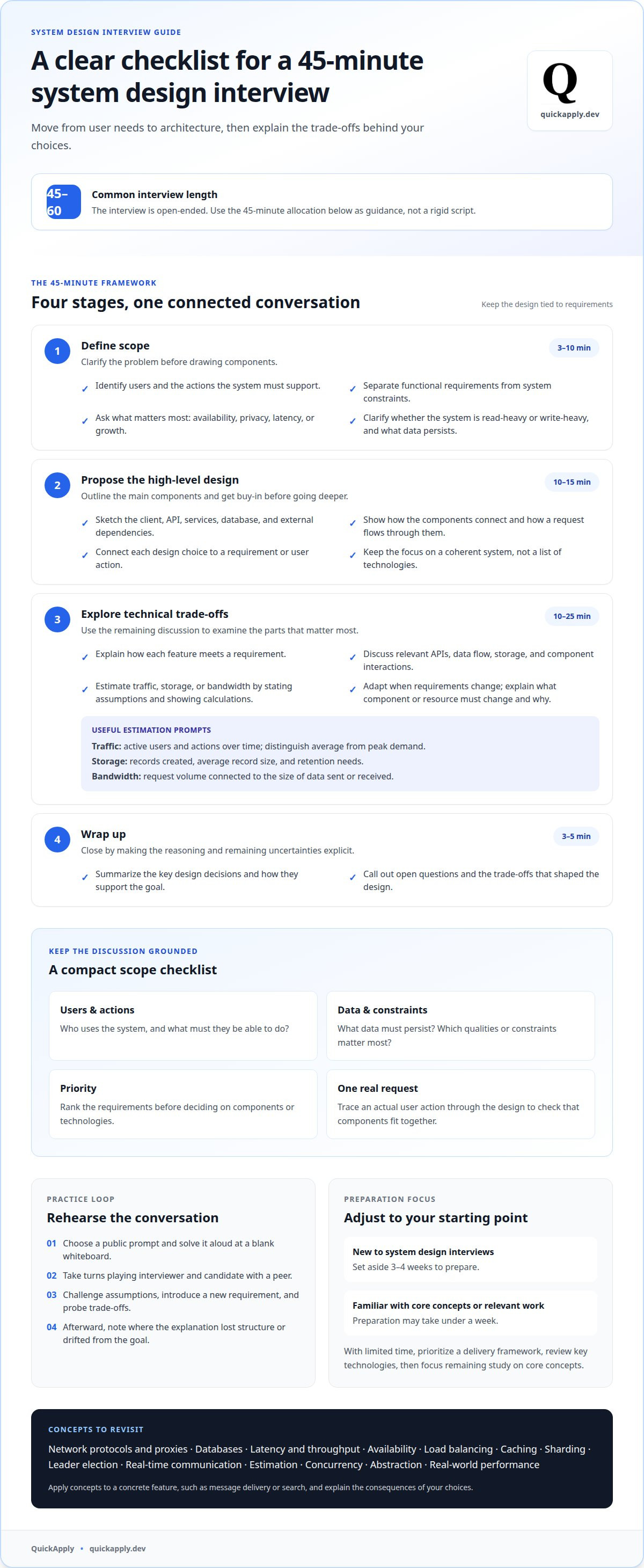
System design interviews commonly run 45-60 minutes and center on an open-ended design prompt. A useful framework has four steps: define scope, propose a high-level design, explore technical tradeoffs, and wrap up. Treat the design as a conversation. Explain how each feature meets a requirement, then adapt when the interviewer adds a constraint.
For a 45-minute session, allocate 3-10 minutes to understand the problem and set scope. Spend 10-15 minutes proposing the high-level design and getting buy-in, then use 10-25 minutes for a deeper technical discussion. Reserve 3-5 minutes to summarize decisions and open questions. These ranges are guidance, not a rigid script; move time toward the area the interviewer probes.
Start practicing with public system design prompts, a blank whiteboard, and a peer to play interviewer. Solve one prompt aloud, then switch roles. Ask each other to challenge assumptions, introduce a new requirement, and probe trade-offs. Afterwards, identify where the explanation lost structure or the design drifted from the original goal. Repeating this cycle builds practical problem-solving skills better than passive reading alone.
Review the core concepts behind complex systems: network protocols and proxies, databases, latency, throughput, availability, load balancing, caching, sharding, leader election, and real-time communication. Also practice estimation, concurrency, abstraction, and reasoning about real-world performance. Apply each concept to a concrete feature, such as message delivery or search, and explain the consequences of your choices.
Plan preparation time around your starting point. Candidates new to these interviews are advised to set aside 3-4 weeks; people familiar with core concepts or relevant work may prepare in under a week. With limited time, prioritize a delivery framework, review key technologies, then focus remaining study on core concepts. Practicing system design interview questions under timed conditions reveals gaps faster than memorizing polished designs.
Over 30 days, prioritize applying knowledge, since candidates may struggle to use material they have only consumed. Explain how components fit together and discuss the pros and cons of design choices.
4. Common system design interview questions
Choose practice prompts that require different architectural decisions. A URL shortener tests key generation, redirects, and storage. A file-sharing service tests permissions, metadata, and large-file transfer. A ride-sharing platform brings together location updates, matching, and trip state. Don’t memorize a finished diagram. Identify the core user actions and build the design around them.
For a video-streaming service, explain how content moves from upload to playback. Treat encoding, storage, delivery, and search as separate responsibilities. Describe where a request goes when someone selects a video, and how the system responds if a dependency fails. Interviewers assess how you connect decisions to requirements, not how many components you can name.
A notification system presents a different challenge. Start with event sources, delivery channels, user preferences, and retry behavior. Then explain how the design handles duplicate events or a temporarily unavailable destination. For a collaborative document editor, focus instead on concurrent edits, conflict handling, and how users see saved changes. Each prompt calls for clear reasoning about its specific workload.
Common mistakes include designing before clarifying the goal, adding infrastructure without explaining its purpose, and overlooking trade-offs. Another is treating the first proposal as final instead of adapting when the interviewer changes a requirement. State your assumptions as you work, and connect each component to a user need or system constraint.
Turn each prompt into a repeatable drill: state the scope, sketch the main data flow, examine failure cases, and defend one tradeoff. Then practice explaining your decisions aloud with interview practice, so your reasoning stays clear when the interviewer probes deeper.
QuickApply: Interview Practice
QuickApply’s Interview Practice gives you a way to prepare after learning the structure and common prompts. Turn to it when you’re ready to rehearse explaining design choices, discussing tradeoffs, and responding to follow-up questions. Use the practice to focus on clear reasoning, not memorized diagrams. Pair that preparation with Resume Tailoring or Cover Letter Generation when you’re applying for roles and want your application materials aligned with specific opportunities. The goal is a more organized job search, with interview preparation connected to the rest of your application workflow. Contact QuickApply to explore the next step.
Make your next practice session count
Turn preparation into a repeatable habit. Choose a prompt, explain your assumptions aloud, and note where your reasoning becomes hard to follow. In the next session, focus on that specific gap instead of repeating a polished answer. This makes each practice round more useful and helps you explain your decisions clearly.
Practicing system design interview questions is most valuable when you treat each attempt as a chance to improve your process, not memorize a diagram. Adapt your approach to new constraints and interviewer feedback. Then bring the same clarity to the rest of your job search, from presenting your experience to preparing for interviews.
Explore interview support with QuickApply and take your next step with a focused plan. You’re ready to keep building momentum.
Frequently Asked Questions
What are system design interviews?
System design interviews ask you to plan how a software system should work and explain the choices behind your design. A prompt might ask you to design a shared calendar. You could describe event creation, invitations, and how users see updates across devices. The interviewer may then explore how your design handles changed requirements, competing priorities, or a component failure.
How much time do I need to prepare?
Preparation may take 3-4 weeks if system design concepts are new to you; candidates with relevant experience or familiarity may prepare in under a week. Use your available time to practise applying concepts, not just reading about them. For example, reserve a session to work through a prompt aloud, then use another to revisit weak areas and explain your decisions more clearly.
What system design interview questions are most commonly asked?
Practice prompts often ask you to design a product or infrastructure system. Try an autocomplete service, a rate limiter, or a ticket-booking platform. Each brings different decisions: autocomplete raises questions about search results and data updates, while a rate limiter focuses on controlling request flow. Treat these as scenarios, not fixed templates, and adapt your design to the requirements.
What topics should you study for system design interviews?
Study the concepts that help explain how a design behaves under real conditions. Focus on data modeling, API contracts, consistency, fault tolerance, and capacity estimation. For a booking system, for example, consider how the design prevents conflicting reservations and handles a failed payment request. Connect each technical choice to a user need, then explain the trade-off in plain language.
What are the best free system design interview practice resources?
Use public system design prompts, a blank whiteboard, and a peer to play interviewer. Solve a prompt aloud, then switch roles. Challenge each other’s assumptions and probe the trade-offs.
How do system design interview questions differ for junior, mid-level, and senior engineers?
Most entry-level software engineering roles do not include system design interviews, though exceptions exist. These interviews become more common at mid-level and are the norm for senior roles.


