

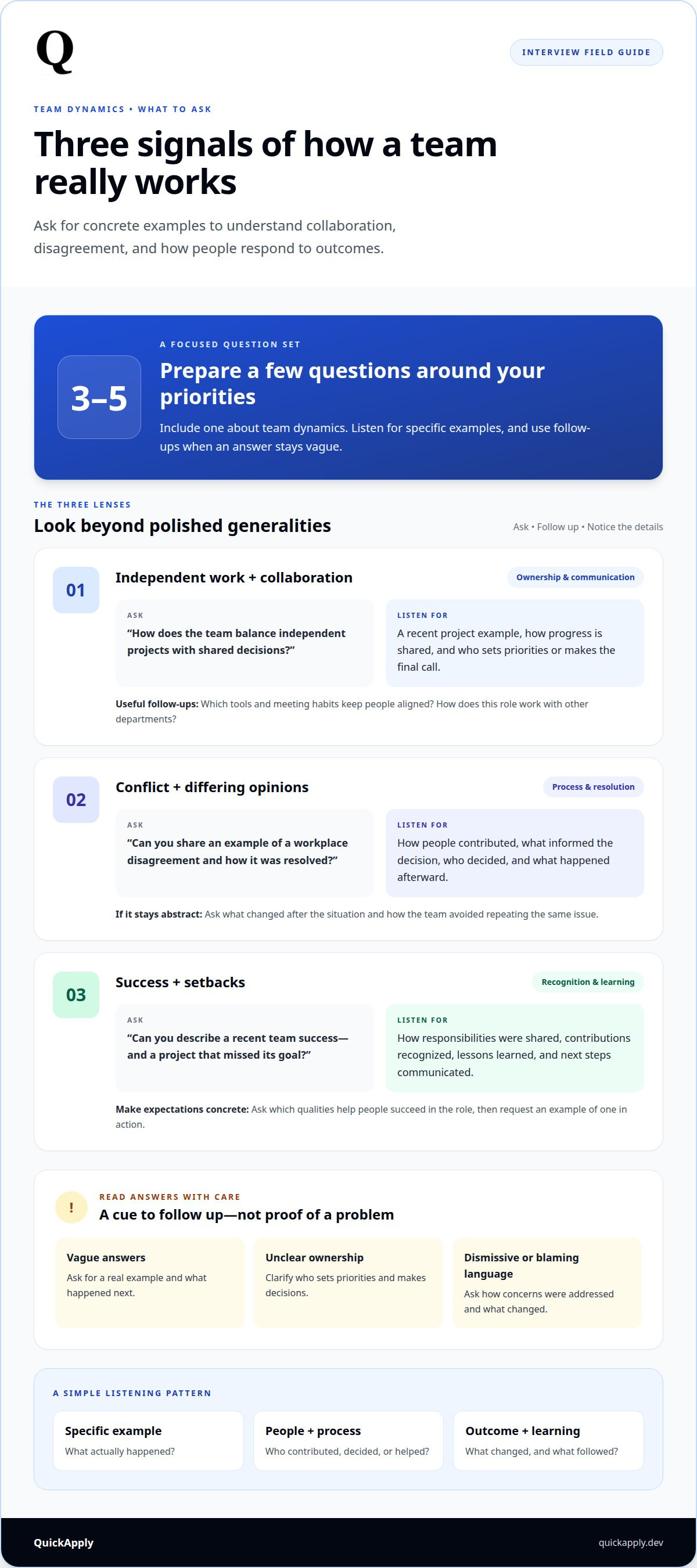
A polished interview answer won’t tell you how a team works day to day. The best questions to ask an interviewer about team dynamics are specific to the role and the working style you want. Prepare 3-5 thoughtful questions, then use the answers to understand how the team collaborates, handles disagreement, and responds to success or setbacks.
It makes sense to look beyond the job description: your day-to-day experience also depends on communication, shared expectations, and how colleagues handle challenges together. This guide helps you choose questions that reflect your priorities rather than relying on generic prompts. You’ll find ways to ask about independent work and collaboration, conflict resolution, team successes and setbacks, and the details that matter most to you. Listen for specific examples and use follow-ups to understand how the team works in practice. That gives you a clearer basis for deciding whether the role and team are a good fit.
Key Takeaways
- Ask how the team balances focused individual work with collaboration, and request a concrete example of how people work together.
- Learn how the team handles disagreement by asking about its approach to conflict and how a past issue was resolved.
- Ask how the team recognizes successes and responds to setbacks to understand what its working culture looks like in practice.
- Choose questions around your own priorities, then use Interview Practice to rehearse asking them clearly and confidently.
1. Balancing independence with collaboration
Strong teams make room for focused work as well as useful collaboration. Ask, “How does the team balance independent projects with shared decisions?” Then request an example, such as how a recent project moved from individual research to a group decision. The answer can show how colleagues share ownership and communicate progress.
Clarify roles and decision-making directly: “Who sets priorities, and who makes the final call when opinions differ?” Ask how this role works with other departments, too. For example, a software developer might coordinate with product and design teams before a feature launches. These questions reveal how teams across the organization work together and where responsibilities sit.
Communication habits shape the daily workflow. Ask which tools and processes the team uses to share updates and how often it meets. For a clearer picture, ask the interviewer to describe the last team meeting: what it covered, who contributed, and what decisions followed. You can also ask how company values show up in everyday collaboration.
To understand leadership and support, ask, “How do you give feedback and help the team remove blockers?” Follow up with, “What does onboarding look like, and how do new hires build working relationships?” These questions connect the manager’s style to practical support, such as clear priorities or introductions to colleagues in other teams.
Ask directly about workload: “How does the team set priorities when several requests arrive at once?” You can also ask how staffing and deadlines affect the balance between focused work and collaboration. These prompts help clarify how the team handles competing demands without assuming its workload is predictable.
Watch for vague answers that avoid examples, unclear ownership, or dismissive comments about collaboration. Treat these as reasons to ask a focused follow-up, not as proof of a problem. Prepare 3-5 questions, including one about team dynamics, and listen for specifics that show how people actually work together.
2. Conflict resolution and differing opinions
Ask, “How does the team handle conflict or differing opinions?” Then follow up with, “Can you share an example of a workplace disagreement and how it was resolved?” A specific account can show whether people address problems directly, consider the evidence, and agree on next steps. It also reveals whether the team treats disagreement as a work issue or a personal failure.
Listen for the process, not just the outcome. An interviewer might explain that two colleagues disagreed about a product deadline, reviewed customer needs, and adjusted the plan together. That answer gives you details to assess: whether both people could contribute, who made the final decision, and how the team communicated afterward. If the response stays abstract, ask what happened after the disagreement.
Interpersonal conflict can involve more than competing ideas. Ask, “How would a team member raise a concern about a colleague’s communication or follow-through?” The answer may clarify whether concerns are raised directly with that person, through a manager, or in a team discussion. You can also ask how managers support employees when a disagreement affects shared work. These prompts help you understand the culture without assuming every conflict follows the same path.
Notice how the interviewer talks about people involved in past conflicts. Blaming one person, dismissing concerns, or describing unresolved tension without mentioning next steps may warrant a follow-up. Ask, “What changed after that situation, and how did the team prevent the same issue from repeating?” A clear response can reveal whether the team learns from friction or simply moves on.
Keep your own examples ready, too. If asked about a disagreement, explain the issue, your action, and the outcome without attacking a former colleague. To make that account relevant in writing, tailor a cover letter to the role by emphasizing the experience and skills that match its needs.
3. How teams celebrate success and handle setbacks
Ask, “Can you describe a recent team success and what made it work?” A concrete example can reveal how colleagues divide responsibilities, share information, and respond under pressure. For instance, a product launch might depend on engineering, design, and customer support coordinating their work. Listen for the actions behind the result, not just the achievement.
Follow up with, “How did the team recognize the people involved?” Recognition may happen in a team meeting, through a manager’s feedback, or by sharing credit among contributors. The details show what the organization values and whether employees’ contributions are visible. If the interviewer mentions only one person, ask how the rest of the group supported the outcome.
To clarify expectations, ask, “What qualities have helped previous team members succeed in this role?” The interviewer might point to clear communication, ownership, or adaptability. Ask for an example of one quality in action, such as a teammate flagging a delivery risk early. That connects abstract expectations to observable behavior you can assess.
Setbacks reveal another side of team culture. Ask, “Can you share an example of a project that missed its goal and how the team responded?” A useful answer describes what changed, how people shared responsibility, and what the group learned. For example, a delayed launch might prompt the team to revise handoffs or clarify who owns decisions.
Then ask, “How does the team handle setbacks while keeping people informed?” Notice whether the response includes practical steps, such as reviewing what happened, assigning follow-up actions, and communicating progress. A team that discusses both success and setbacks gives you a clearer picture of how work unfolds. Compare the interviewer’s examples with your priorities: public recognition may matter to you, while you may value candid feedback and lessons learned. These questions help you understand what success means beyond completing a project.
4. Tailoring interview questions to personal priorities
Don’t use every question available. Choose a few that explore what matters most in your next role. If autonomy matters, ask how the manager sets direction while leaving room for independent decisions. If connection with colleagues matters, ask how they share feedback and build trust. Your priorities turn broad questions into useful ways to assess fit.
Make each prompt specific to the role. For a product role, ask, “How does this team work with design and engineering when priorities shift?” For a customer-facing role, ask how employees share customer feedback with other teams. Questions to ask an interviewer about team dynamics should reflect the work you’d actually do, not just sound impressive.
Culture questions can reveal more than formal policies. Ask, “What do you enjoy most about working with this team?” Then ask, “What would you change about the team’s culture?” A detailed answer may show what the interviewer values and where the team is still evolving. Pay attention to examples, not just polished phrases.
Connect your questions to the role’s immediate context. Ask, “What’s the biggest challenge this team needs the new hire to help address?” Then follow up by asking how the manager supports employees facing that challenge. This connects the team’s needs to your potential contribution without assuming what success requires.
Listen actively and adapt your follow-ups. If an answer mentions frequent handoffs, ask how the team keeps ownership clear. If the interviewer describes open feedback, ask how managers act on it. These follow-ups often reveal more than moving on to another prepared question. Compare the answers with your priorities, then note where they align or conflict.
Before the interview, rehearse concise questions and follow-ups so they sound natural, not scripted. Practice questions to ask an interviewer about team dynamics and sharpen your delivery with Interview Practice.
QuickApply: Interview Practice
QuickApply’s Interview Practice helps you rehearse answers and prepare to ask about collaboration, conflict, and team culture. Use it when you’ve chosen questions that match your priorities but want to deliver them clearly and confidently.
Practice asking a concise follow-up, too. If an interviewer describes how the team handles setbacks, you can ask what the group learned and changed. Rehearsing can help you stay focused while leaving room to listen and respond naturally. The goal is a focused conversation, not a memorized script.
For support with interview preparation, contact QuickApply.
Turn your next interview into a two-way decision
The right questions to ask an interviewer about team dynamics can help you decide whether the role suits how you work best. Treat the conversation as a chance to test your priorities, not just make a strong impression. Afterward, note which answers included clear examples and which left important points unresolved. That record can help you compare opportunities with more confidence.
Prepare for your next step with focused support. QuickApply offers Resume Tailoring, Cover Letter Generation, and Interview Practice to help you prepare application materials and rehearse your approach. Use Interview Practice to sharpen your questions about the team and your responses to follow-up questions.
Contact QuickApply for interview support, and move into your next conversation prepared to make an informed choice.
Frequently Asked Questions
What are good questions to ask in an interview?
Good interview questions uncover how the role works in practice and what the team needs from you. Ask, “What would you want the person in this role to take ownership of first?” or “How does the team decide when a task is ready for review?” These prompts connect the job description to real work and give you details to weigh against your strengths and priorities.
What questions reveal how a team collaborates day to day?
Ask the interviewer to trace a typical assignment from start to finish. For example: “How does a project move from an initial request to a finished deliverable?” Listen for how tasks are assigned, how colleagues hand work off, and how they document decisions. This walkthrough can reveal daily collaboration patterns more clearly than broad descriptions of the team’s style.
How should I ask about communication styles and meeting norms on a team?
Ask how teammates share urgent updates, routine progress, and decisions that affect others. You might say, “How does the team make sure a decision reaches people who weren’t part of the discussion?” You can also ask what makes a meeting useful and whether key decisions are documented afterward. These questions clarify communication expectations without assuming every team uses the same process.
How can I ask about team culture and psychological safety in an interview?
Ask how employees can raise uncertainty or admit a mistake without being dismissed. For example: “Can you describe a time someone challenged an assumption, and how the team responded?” The interviewer’s answer may show whether different perspectives are welcomed in practice. Notice whether they describe listening and follow-through, rather than relying only on broad claims about an open culture.
What questions reveal how the team handles disagreements and conflict?
Ask what happens when colleagues disagree about a technical approach or project priority. A useful prompt is, “How does the team decide what to do when two reasonable options have strong supporters?” Follow up by asking who helps resolve a deadlock and how the decision is recorded. The response can clarify whether disagreement leads to a clear decision or lingering uncertainty.
How should I ask about feedback and performance expectations within a team?
Ask how the manager defines strong performance and how employees learn whether their work meets expectations. For example: “What does effective performance look like in this role, and how is progress discussed?” You can also ask how feedback connects to goals or development plans. Specific answers help you understand how success is evaluated, rather than relying on informal impressions.


