

A memorized script can make a strong interview story sound stiff. To improve storytelling for behavioral interviews, choose examples that show strengths relevant to the role, shape each story with Freytag’s pyramid, and practice from a short set of bullet points instead of memorizing every line.
You may already know the facts of your best work. The challenge is choosing details that make your judgment, actions, and impact clear without taking a scenic route. A concise structure helps you stay focused while leaving room to sound like yourself.
This guide shows you how to find job-relevant stories, build a clear arc, trim unnecessary context, and rehearse from turning-point bullets. You’ll develop a repeatable way to adapt examples to different questions, rather than a script that falls apart when the interviewer takes the conversation in a new direction.
Key Takeaways
- Choose examples that match the role’s priorities, and focus on the strengths your actions demonstrate.
- Keep each response centered on one story, with only the context and details that move it forward.
- Use a clear story arc to make the obstacle, your decisions, and the outcome easy to follow.
- Practice from brief turning-point notes so your delivery stays structured without sounding memorized.
Choosing stories that demonstrate job-relevant strengths
A compelling behavioral interview story connects a specific challenge to your choices and the result. It becomes memorable when the interviewer can see your role, impact, and lesson without sorting through unrelated details. If you want to know how to improve storytelling for behavioral interviews, start by selecting evidence that matches the job.
- Start with the role’s priorities. Review the job description and identify the strengths it emphasizes, such as prioritization, collaboration, or analytical judgment. For a product role, resolving competing customer and engineering needs could demonstrate all three. Choose evidence that matches the work, not just your most impressive-sounding achievement.
- Build a story bank from past experience. List projects from work, training, or field experience, then identify at least one possible story from each. Examples might include a launch, a difficult handoff, or a decision made with incomplete information. A key part of how to improve storytelling for behavioral interviews is having relevant examples ready without creating a separate story for every question.
- Choose a clear turning point. Find the moment when your judgment or action changed what happened next. For example, describe a project where a late change threatened the launch, then explain how you clarified priorities and aligned the team. Skip routine updates that show activity but reveal little about your decisions.
- Make your contribution visible. Distinguish your work from the team’s. Name the action you took, why you chose it, and who else contributed. If you coordinated a handoff, explain how you surfaced the blocker and what changed afterward. Specific decisions establish credibility better than broad claims like “I’m a strong communicator.”
- Show impact with evidence. End with an outcome, using a metric when you have one, such as reduced delays or improved completion. Otherwise, state an observable result: the launch proceeded, a decision became clear, or the team adopted your process. Add a genuine reflection about what you learned, then connect the example to the strength the interviewer asked about.
Keeping interview stories concise and natural
Use one story per answer, then adjust its emphasis to fit the question. A short opening and a few relevant details keep your response focused without turning it into a memorized script.
-
Keep Answers Concise and Adaptable
Start with a brief summary that names the challenge and outcome. Then choose a few key points that answer the question directly. For example, a question about collaboration calls for details about how you aligned people, while a question about judgment needs the decision and reasoning. Avoid adding a second story or background that doesn’t support the prompt.
Keep the core events stable, but shift which details you emphasize. This makes one prepared example useful for different questions without forcing the same response every time.
-
Consider Answer Length
A concise behavioral interview story should take 60 to 90 seconds to tell. Time a practice run, then trim repeated context, minor actions, and details the interviewer doesn’t need to understand the result. Keep enough information to explain your role and choices; a response that’s too compressed can leave the interviewer guessing about your contribution.
Use the opening summary to set direction, then spend most of the answer on what you did and what followed. Stop after the outcome and a relevant learning point instead of adding a second conclusion.
-
Keep Delivery Natural
Practice the sequence, not a word-for-word script. Record yourself telling the story, review the playback, and notice where you sound stiff, rush, or repeat a phrase. Revise those moments, then tell it again in your own words. Keep the facts consistent while letting the phrasing vary with the question.
Use brief notes to recall the key beats, not full paragraphs to recite. To rehearse answers and refine your delivery, try interview answer practice.
Structuring a story with Freytag’s pyramid
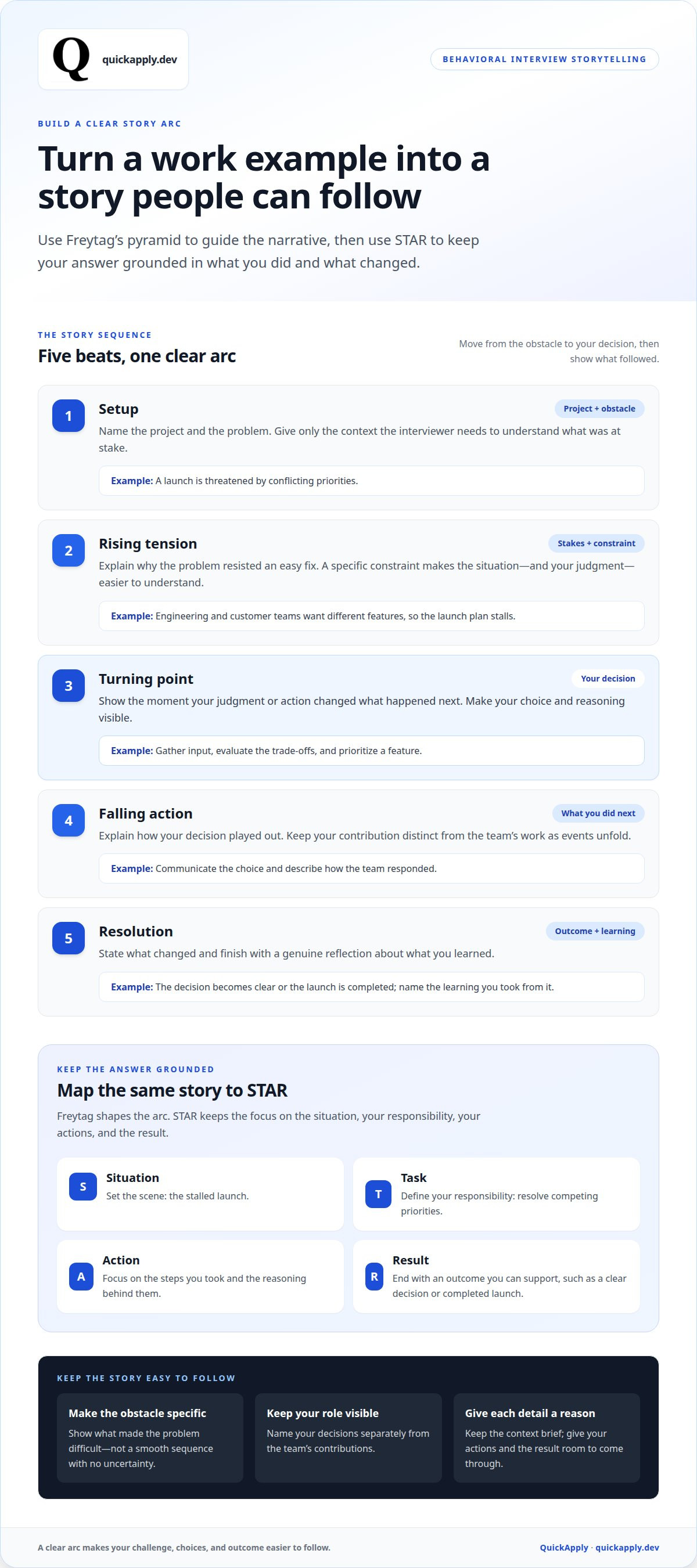
Give your example a clear arc, then use STAR to keep your answer grounded in your actions. The structure helps the interviewer follow the challenge, your response, and what changed.
-
Apply Freytag’s Pyramid
Arrange the story as setup, rising tension, a turning point, falling action, and resolution. Start with the project and the obstacle, such as a launch threatened by conflicting priorities. Build tension by explaining what was at stake and why the problem resisted an easy fix. At the turning point, show the decision you made. Then explain what happened and what you learned.
- Make the obstacle specific. For example, explain that a launch plan stalled because engineering and customer teams wanted different features. Describe when you recognized the conflict, then show how you evaluated the trade-offs. Avoid presenting a smooth sequence with no uncertainty; a real constraint makes your judgment easier to understand.
- Keep your role visible as events unfold. If teammates contributed, briefly name their part, then distinguish your decisions from the group’s work. For the launch example, explain how you gathered input, prioritized a feature, and communicated the choice. This prevents “we delivered” from obscuring what you personally did.
-
Structure Answers with STAR
Map the same example to STAR: Situation, Task, Action, and Result. Set the Situation with the stalled launch, define your Task as resolving competing priorities, and focus the Action on the steps you took. End with the Result, such as a clear decision or completed launch, using evidence you can support. Don’t let background overwhelm your actions.
- Check that every part earns its place. The Situation and Task explain the problem; the Action reveals your reasoning; the Result shows the impact. If the example ends with a team outcome, clarify your contribution. Close with a genuine reflection, such as how you’d surface stakeholder conflicts earlier next time. That insight completes the story without adding a second plot.
Practicing from story-spine bullet points
A five-bullet spine gives you a lightweight practice system: it preserves the story’s logic without locking you into a script. Use it to learn how to improve storytelling for behavioral interviews while keeping each example flexible.
- Find the project’s turning points. Pick a project, then identify its top three moments of change. These might be a key decision, setback, disagreement, launch issue, or surprising feedback. Choose moments that shifted events, not routine updates. For example, customer feedback that challenged your original plan can mark the point where the story changes direction.
- Build the five-bullet spine. Write Situation, Task, Action one, Action two, and Result. For a customer-feedback project, note the initial goal, your responsibility, how you reviewed the feedback, how you changed the plan, and what happened next. Keep each bullet to a cue phrase. Full sentences can turn a useful outline into a script.
- Allocate space to your contribution. Keep Situation and Task to about a third of the answer, then use the rest for Action and Result. If the setup takes half your response, trim the background. The interviewer needs enough context to understand the stakes, but your decisions and outcomes should carry the story’s weight.
- Rehearse in three formats. Type the outline, write it by hand, then say it aloud. Each pass tests sequence, understanding, and delivery. After speaking, check whether the action bullets explain what you did and why. If the result feels disconnected, add the missing link between your action and the outcome.
- Test the spine against varied prompts. In a peer-practice session, answer three or four behavioral questions using the same project where relevant. Shift the emphasis to fit each prompt, but preserve the facts and sequence. Notice which bullet is difficult to explain, then revise that cue. To keep building your skill in how to improve storytelling for behavioral interviews, practice your interview answers with a compact outline.
QuickApply: Interview Practice
QuickApply’s Interview Practice helps you rehearse behavioral answers after building your story spine. Use it when your examples are clear on paper but feel difficult to deliver smoothly aloud. Focus each practice run on explaining your choices, adapting to the question, and keeping the story’s key events intact.
For a product launch example, practice emphasizing collaboration for one prompt and decision-making for another. This tests whether your bullet points support different angles without turning into a fixed script. Pair interview preparation with Resume Tailoring or Cover Letter Generation when you’re also aligning application materials to a specific role.
Contact QuickApply to learn more about Interview Practice.
Turn your next story into practice
Your next interview answer is a chance to make your judgment easier to understand. A practical way to improve storytelling for behavioral interviews is to treat each response as a skill you can refine: notice where your explanation loses focus, then adjust the details that support your point. Keep your story grounded in what you actually did and learned.
QuickApply offers Interview Practice to help you rehearse answers, alongside Resume Tailoring and Cover Letter Generation for your application materials. Use the tools that fit the next step in your job search, and keep refining your examples as you prepare for different roles.
Contact QuickApply to explore interview support. You’ve already built the raw material; now put it to work with a clear, confident delivery.
Frequently Asked Questions
How do you use the STAR method for behavioral interview answers?
Use STAR to make your answer easy to follow: explain the Situation, define your Task, describe the Action you took, then share the Result. Keep the setup brief and give most of your time to your own decisions and actions. For example, explain what caused a project delay, what you were responsible for, how you reset priorities, and what changed afterward.
How do you choose strong stories for behavioral interview questions?
Choose stories with a clear challenge, a visible personal contribution, and an outcome you can explain honestly. Look for moments such as resolving a disagreement, recovering from a missed deadline, or improving a handoff between teams. A strong example doesn't need to be dramatic. It should give the interviewer enough context to understand the stakes and distinguish your work from the team's.
How do you add measurable results and specific details to interview stories?
Anchor the result in evidence you can support, such as a deadline met, a recurring error removed, or a process made easier to use. Include the relevant timeframe, tools, or people involved when you remember them. If you don't have a precise metric, describe the observable change instead. Never invent a percentage or claim credit for an outcome you can't substantiate.
How do you adapt one story to different behavioral interview questions?
Keep the event and its facts consistent, then shift the emphasis to fit the question. A conflict story can focus on listening and alignment for a teamwork question, or on a decision you made for a problem-solving question. Before answering, identify the skill being tested. Don't force a story that doesn't fit; choose another example if the connection feels strained.
How do you prepare behavioral interview stories without sounding rehearsed?
Prepare short prompts, not a word-for-word script: note the situation, your key action, and the outcome. Practice explaining the same event in your own words, then pause and answer follow-up questions without restarting from a memorized opening. QuickApply's Offer Closer includes STAR interview practice with AI scoring, which can help you rehearse and review your answers while keeping your delivery natural.
What common mistakes should you avoid in behavioral interview answers?
Avoid spending most of your answer on background, speaking only as “we,” or describing actions without explaining why you chose them. Don't blame colleagues or make a setback someone else's fault. Skip unrelated details, unsupported accomplishments, and endings that leave the outcome unclear. If the interviewer asks a follow-up, answer that point directly instead of repeating your full story.


