

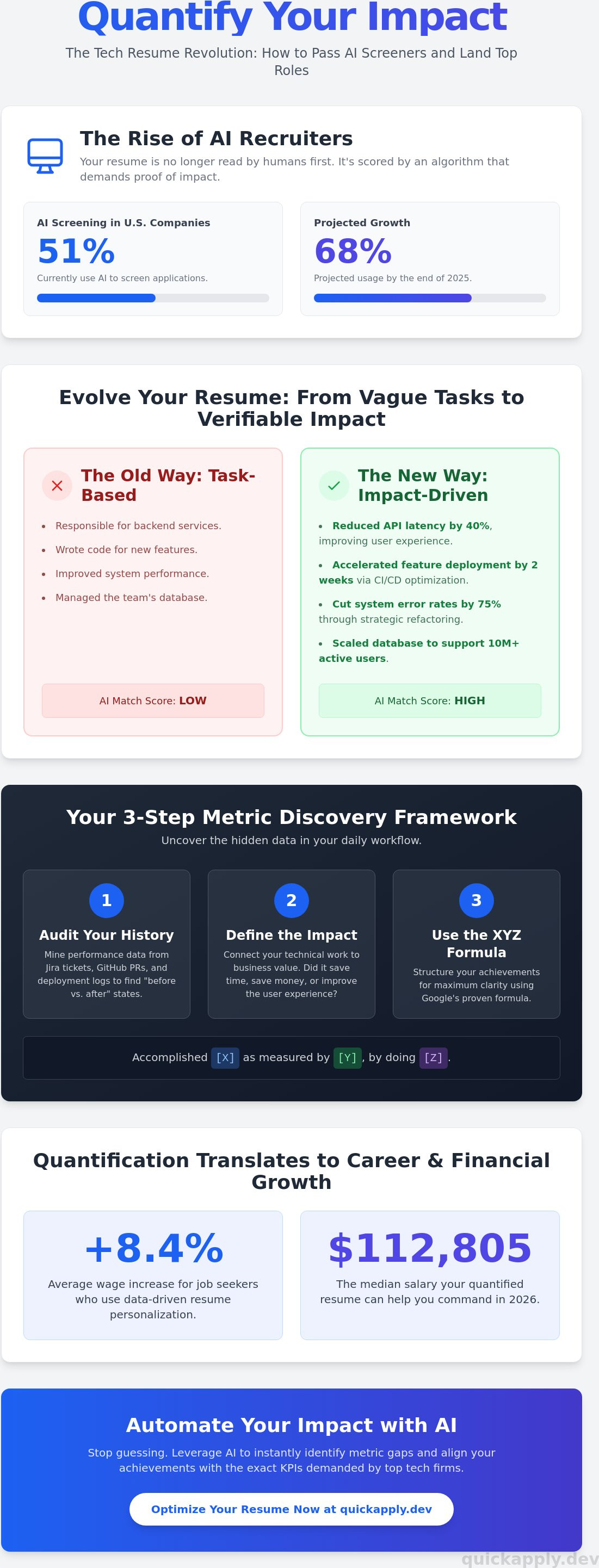
51% of U.S. companies now use AI to screen your application; that figure is projected to reach 68% by the end of 2025. If your resume still reads like a generic list of job duties, you're likely being filtered out before a human ever sees your name. Learning how to quantify achievements on a resume for tech roles is no longer optional. It's the only way to prove you're a high-impact engineer rather than a replaceable task-runner in a market where software developer unemployment sits at 3.1%.
It's frustrating to feel like an average developer because you don't have "saved the company $10M" stories. You have the skills, but translating daily bug fixes into senior-level impact often feels like a dark art. This guide delivers the exact frameworks you need to turn vague technical tasks into high-impact metrics that pass ATS filters and impress engineering managers. We'll break down the specific technical KPIs that recruiters actually care about and show you how to build a resume that commands a 2026 median salary of $112,805. Prepare to optimize your career path with data-driven precision.
Key Takeaways
- Stop listing tasks and start scaling impact by using metrics to verify your seniority level for both AI-driven screening systems and human engineering managers.
- Audit your technical history using a systematic framework to extract performance data directly from Jira tickets, GitHub pull requests, and deployment logs.
- Master how to quantify achievements on a resume for tech roles by applying specific KPIs like latency reduction for software engineers or model accuracy and drift for data scientists.
- Solve the "missing data" problem by utilizing proxy metrics and the "Power of One" strategy to demonstrate value even without access to corporate financial dashboards.
- Leverage AI-powered Resume Tailoring to instantly identify metric gaps and align your technical achievements with the exact KPIs demanded by high-growth tech firms.
Why Technical Recruiters Demand Quantified Achievements in 2026
The tech job market has shifted. In 2026, recruiters don't care what you did; they care what you achieved. Listing your tech stack isn't enough. You need to provide scale. A developer who managed a database for 10 users is not the same as one who scaled a system for 10 million users. Without numbers, you're just another profile in the stack. Your Curriculum vitae (CV) must act as a technical data sheet that proves your capabilities at a glance.
Stop using the phrase "responsible for." It's a dead end. It describes a task assigned to you, not the value you delivered. Modern technical profiles are impact-based. They focus on the delta between the state of the system when you arrived and the state when you left. If you want to know how to quantify achievements on a resume for tech roles, you must start by measuring your output against business objectives. This shift in perspective is the difference between an "average" developer and a senior leader.
The Role of AI Match Scores
Hiring is now an algorithmic game. 51% of U.S. companies use AI in their hiring process, and 82% of those use it to review resumes. These systems don't just look for keywords like "Java" or "Python." They calculate match scores based on seniority indicators found in your bullet points. Specific numbers act as your "proof of work." An AI sees "Reduced latency by 40%" and assigns a higher seniority weight than "Improved system performance." This isn't just about passing a filter. It's about your bottom line. Job seekers who use data-driven personalization see an average wage increase of 8.4%. Numbers translate directly into negotiation leverage because they remove ambiguity. High match scores signal to recruiters that you're a safe, high-ROI hire in a competitive market.
Defining "Impact" in a Technical Context
Activity is not impact. Writing 500 lines of code is activity. Reducing technical debt to accelerate feature deployment by two weeks is impact. You must bridge the gap between engineering effort and business value. Move away from "I wrote code" toward "I optimized systems." Recruiters in 2026 are trained to look for candidates who understand the financial and operational implications of their technical choices. If your work didn't save time, save money, or make the product better for the user, it didn't have impact.
Think about your last major pull request. Did it lower CPU usage? Did it increase throughput? Every line of code exists to serve a business goal. When you learn how to quantify achievements on a resume for tech roles, you show recruiters you understand the "why" behind the "how." This clarity is what separates senior engineers from junior developers. It demonstrates that you don't just build things. You solve problems that matter to the company's P&L.
The Metric Discovery Framework: Finding the Data in Your Daily Workflow
Stop guessing your impact. Most developers fail because they try to recall achievements from memory months after the code is deployed. This leads to vague bullet points that get ignored. To master how to quantify achievements on a resume for tech roles, you must treat your career like a series of post-mortem reports. Audit your Jira, GitHub, and Trello history. Your ticket velocity and pull request volume aren't just work logs; they're the raw data for your seniority. Look for the "Before vs. After" state of every major feature or refactor you led.
If you lack direct access to revenue data, consult your Product Managers. They track the "North Star" metrics that your code influences. Whether it's user retention, conversion rates, or churn, your technical output drives these business outcomes. Following expert guidance for the tech industry, you should transform every task into a metric-driven statement using the Google XYZ formula: Accomplished [X] as measured by [Y], by doing [Z]. Once you've mined this data, use Resume Tailoring to ensure these metrics align perfectly with the specific KPIs in your target job description.
Step 1: Identify the Constraint
Every project starts with a bottleneck. Before you wrote a single line of code, what was the friction point? Was the issue system latency, high cloud costs, poor reliability, or a clunky user experience? Write a single sentence defining the technical problem in numerical terms. For example, "The legacy API had a 500ms response time" or "Manual deployments took 4 hours per week." Identifying the starting point is the only way to prove the scale of your solution.
Step 2: Measure the Delta
Impact is the difference between the old state and the new one. Calculate percentage improvements in latency or throughput. Track "Time Saved" through automation. If you moved from weekly deployments to 5x daily, you didn't just "improve the pipeline." You increased deployment frequency by 2,400%. These frequency metrics signal high velocity to engineering managers. Use hard numbers to show how you optimized the system, reduced overhead, or accelerated the development lifecycle. This data proves you don't just write code; you deliver measurable efficiency.
Don't settle for "fixed bugs." Instead, state that you "reduced production error rates by 15% across 3 microservices." This level of detail passes AI filters and builds immediate credibility during technical interviews. It shows you understand the relationship between your IDE and the company's operational success.
Role-Specific Quantification: From Latency to Lead Conversion
Generic numbers are noise. To stand out, your metrics must align with your specific technical domain. A frontend developer's impact looks nothing like a data scientist's results. Understanding how to quantify achievements on a resume for tech roles requires a deep dive into the specific KPIs that define your engineering branch. If you're a software engineer, your value lives in performance and scale. For DevOps, it's about reliability and cost efficiency. Data scientists must prove accuracy and speed. Product managers need to show growth and ROI. Stop using "increased efficiency" as a catch-all. Use the language of your stack.
Software Engineering Metrics
Scale matters. Engineering managers need to see the volume your code handles. Instead of "optimized the backend," state that you "reduced API response time by 40% for a platform with 1M+ daily active users (DAU)." This provides immediate context for your seniority. Code quality is another vital metric. Don't just say you wrote tests. Prove you "increased test coverage from 60% to 92% across a legacy monolith." If you led a migration, quantify the complexity. "Migrated 50+ microservices to Kubernetes" tells a story of architectural mastery that "worked with cloud tools" never could. These numbers serve as hard evidence of your technical maturity.
This level of precision is particularly critical when applying for roles in high-stakes sectors. For instance, you can discover Gemba and explore how their banking infrastructure layer allows companies to launch branded financial services, a task that demands significant technical scale and reliability.
DevOps and Infrastructure Metrics
In the world of SRE and DevOps, uptime is king. You aren't just maintaining servers; you're protecting revenue. "Maintained 99.99% uptime during peak holiday traffic" is a high-impact statement that resonates with any tech leader. Efficiency is your second pillar. Quantify your cloud cost optimization. "Reduced AWS spend by $15,000 per month" is a concrete win. Speed is your third. Focus on deployment velocity. "Automated CI/CD pipelines, reducing deploy time from 4 hours to 60 minutes" shows you understand the value of engineering time. This level of detail is essential when learning how to quantify achievements on a resume for tech roles because it mirrors the precision required for the job itself.
Data Science and Product roles follow the same logic. A data scientist should highlight how they "reduced model drift by 12%," while a Product Manager should focus on "reducing churn by 5% through A/B testing." Every role has a North Star metric. Find yours. Document it. Use it to build a resume that functions like a high-performance system.
The "Missing Data" Problem: How to Quantify Without Hard Numbers
"I don't have access to the dashboard" is the most common excuse for a weak resume. You don't need a direct line to the CFO to prove your value. Learning how to quantify achievements on a resume for tech roles is possible even in highly siloed environments. You just need to shift your focus from absolute totals to representative samples. Efficiency is your currency. If you can't measure the dollar, measure the time, the volume, or the scope. Data is everywhere in your workflow; you just have to extract it from the noise.
The "Power of One" strategy is your most potent tool. If you optimized a single SQL query that reduced execution time by 2 seconds, and that query runs 5,000 times a day, you didn't just "fix a slow query." You saved the system 2.7 hours of processing time every single day. That is a quantifiable achievement. When the exact number is unknown, use conservative ranges. Stating "Improved performance by 10-15%" is more credible than a vague claim and demonstrates a data-conscious mindset. If you're struggling to identify these hidden wins, use Resume Tailoring to scan your history for untapped metric opportunities.
The Proxy Metric Framework
Proxy metrics act as stand-ins for direct business impact. If you don't know the revenue generated by a feature, look at the user count it serves. Managing a service for 50,000 monthly active users (MAU) provides immediate scale. If user data is restricted, look at your team's internal scope. "Architected a CI/CD pipeline used by 40+ developers" proves influence and leadership. You can also use industry benchmarks as a baseline. If the industry average for model accuracy in your niche is 85% and your team reached 92%, that 7% delta is your proof of excellence. You aren't guessing. You're benchmarking.
Quantifying Maintenance and Support
The "I just fix bugs" objection is a career-killer. Bug fixing is actually system stability management. Reframing your work is essential. Instead of "Resolved tickets," write that you "Maintained 99.9% system availability by resolving 150+ high-priority production issues." Quantify the complexity of your refactors. "Reduced technical debt by refactoring 10,000+ lines of legacy code" sounds senior-level. You can also measure your scale of influence through stakeholder counts. Supporting "4 cross-functional departments" shows you operate at an organizational level, not just a ticket level. This digitalization of tasks is happening in every sector; for instance, Repair-CRM helps field service businesses track every service call as a measurable data point. Every task has a number. Find it.
Automating Resume Impact with QuickApply’s AI Tailoring
Manual resume editing is a legacy process. In a market where 78% of technology leaders plan to increase headcount in the second half of 2026, you can't afford to spend hours on a single application. You need a system that identifies "metric gaps" instantly. QuickApply’s AI analyzes your existing bullet points and detects where you've listed a task without a corresponding result. It forces you to think in data. This is the fastest way to master how to quantify achievements on a resume for tech roles without getting bogged down in manual spreadsheets.
The software doesn't just look at your past; it reverse-engineers your future. By scanning the job description, the AI identifies the specific KPIs the hiring manager values most. If the posting emphasizes cloud cost reduction, the tool prompts you to surface your AWS optimization metrics. Using the Resume Tailoring tool ensures your numbers aren't just impressive. They're relevant. This alignment is what triggers high match scores in AI-driven ATS platforms, positioning you as the optimal solution to the company's specific technical bottlenecks.
Optimizing for the 2026 Job Market
Speed is the ultimate competitive advantage. If you're applying for high-demand AI, ML, or data science roles, you're competing against thousands of applicants. Manual tailoring is a failure point. You need to translate technical tasks into business-aligned achievements at scale. Implementing a proven AI resume tailor for tech jobs strategy allows you to submit high-impact applications in minutes. This isn't just about volume. It's about high-volume output with low-effort input. It allows you to move as fast as the technology you build.
Continuous Improvement via Application Tracking
Data-driven job hunting requires feedback loops. Use the application tracker to monitor which quantified versions of your resume generate the most interview requests. Maybe your "latency reduction" bullet point hits harder at startups, while "cloud cost savings" resonates more with enterprise firms. A/B test your metrics. Analyze the conversion rate of your applications just like you'd analyze a production system. This iterative approach ensures you're always ahead of the curve. Start optimizing your tech resume with QuickApply today and turn your career data into your biggest asset.
Deploy Your High-Impact Resume
The 2026 tech market moves too fast for vague descriptions and generic task lists. You've learned that impact is the only metric that matters to engineering managers and AI screening systems alike. By identifying your constraints, measuring the delta, and using proxy metrics when hard data is missing, you've mastered how to quantify achievements on a resume for tech roles. This data-driven approach turns your technical history into a high-performance system that commands attention and higher salary offers.
Don't let manual editing slow your deployment. QuickApply is built specifically for tech professionals who value their time. Our platform provides AI-powered match scoring to ensure your achievements align with employer KPIs, while the automated application tracking lets you monitor your success in real time. It's time to stop guessing and start optimizing. Tailor your resume for tech roles in seconds with QuickApply and secure your next senior-level position. Your career deserves a high-velocity solution.
Frequently Asked Questions
Is it okay to estimate numbers on a resume if I don’t have exact data?
Yes, conservative estimates are acceptable when exact logs are inaccessible. Use ranges like "15-20%" to show you're being realistic rather than guessing. This demonstrates a data-conscious mindset. If you can explain the logic behind the number in an interview, the estimate holds up. Avoid round, unbelievable numbers like "100% improvement" unless you have the documentation to prove it.
What are the best metrics for an entry-level software engineer with no experience?
Focus on technical efficiency within your personal or academic projects. Measure your code quality through test coverage percentages or the reduction of bundle sizes in your web apps. If you contributed to open source, mention the number of pull requests merged. Even "decreased initial load time by 300ms" shows you understand performance, which is a key part of how to quantify achievements on a resume for tech roles.
How do I quantify my work if I worked on a project that never launched?
Measure your progress against the project roadmap or technical benchmarks. You can quantify the number of microservices built, the percentage of the API finished, or performance wins found during testing. Impact isn't just about the final launch. It's about the engineering hurdles you cleared. State that you "completed 90% of the core backend architecture" to show the scale of your effort.
Will recruiters check the validity of the percentages I put on my resume?
Technical recruiters verify your numbers by asking deep-dive questions during the interview. They look for consistency in your story. If you claim you reduced latency by 40%, they'll ask which specific bottleneck you removed. Honesty is your best policy. A single lie about a metric will disqualify you instantly during a technical screen because it signals a lack of integrity.
How many quantified bullet points should I have per job entry?
Target three to five quantified bullet points for your most recent or relevant roles. This density provides enough data for AI match scores without cluttering the page. For older roles, one or two high-level metrics are sufficient. Prioritize the metrics that align most closely with the job description you're currently targeting to ensure maximum impact.
Does every single bullet point need a number on a tech resume?
Not every bullet point needs a number, but your high-priority achievements should. Some points are better used to describe complex architectural shifts or the specific tech stack used. Balance is key. Aim for a ratio where your most impressive wins are backed by data, while supporting points provide the necessary technical context for your 2026 application.
What is the "Google XYZ formula" for resumes?
The Google XYZ formula is a framework for writing impact-driven bullets. You state that you "Accomplished [X] as measured by [Y], by doing [Z]." This forces you to lead with the result, provide the evidence, and then explain the technical action. It's a standard for top-tier tech resumes because it eliminates fluff and highlights direct business value.
How do I quantify "soft skills" or leadership on a technical resume?
Soft skills are measured by the tangible results they produce for the team. If you improved communication, measure it through a 20% reduction in meeting time or faster sprint completion. If you mentored junior devs, mention the number of successful promotions. Leadership impact is always visible in the increased efficiency or stability of the systems your team manages.


