

In 2026, your LinkedIn profile isn't a digital resume; it's a structured data set designed to feed a 150-billion-parameter AI model. If you aren't optimizing linkedin profile for job search 2026 with a technical mindset, you're effectively invisible to the systems that matter. You've probably noticed that traditional keyword stuffing no longer works. It's frustrating to watch your profile views flatline while irrelevant recruiters clutter your inbox. You deserve a profile that works as hard as your code or your strategy.
We agree that the shift to the 360Brew algorithm feels like a black box designed to keep talent hidden. This systemic change is actually your greatest opportunity to gain a competitive advantage in a market of 1.3 billion users. I promise to show you how to master the Semantic Skill Graph and turn your profile into a high-performance lead magnet for top-tier recruiters. We'll explore the importance of the "saves" metric over simple likes, the impact of the new blue check verification, and how to leverage video introductions to bypass traditional AI filters.
Key Takeaways
- Shift your focus from basic keywords to "Capability Clusters" to align your professional data with modern semantic search engines.
- Engineer your Headline as a high-conversion metadata tag and your About section as an executive summary for both human recruiters and AI filters.
- Master the technical nuances of optimizing linkedin profile for job search 2026 to secure top-tier rankings and increase inbound interview requests.
- Utilize the STAR method in your Experience section to prioritize measurable impact, ensuring your profile perfectly mirrors your tailored resumes.
- Integrate your LinkedIn data with an automated job application tracker to maintain a seamless, high-velocity workflow across your entire application stack.
Understanding the 2026 LinkedIn Algorithm for Job Seekers
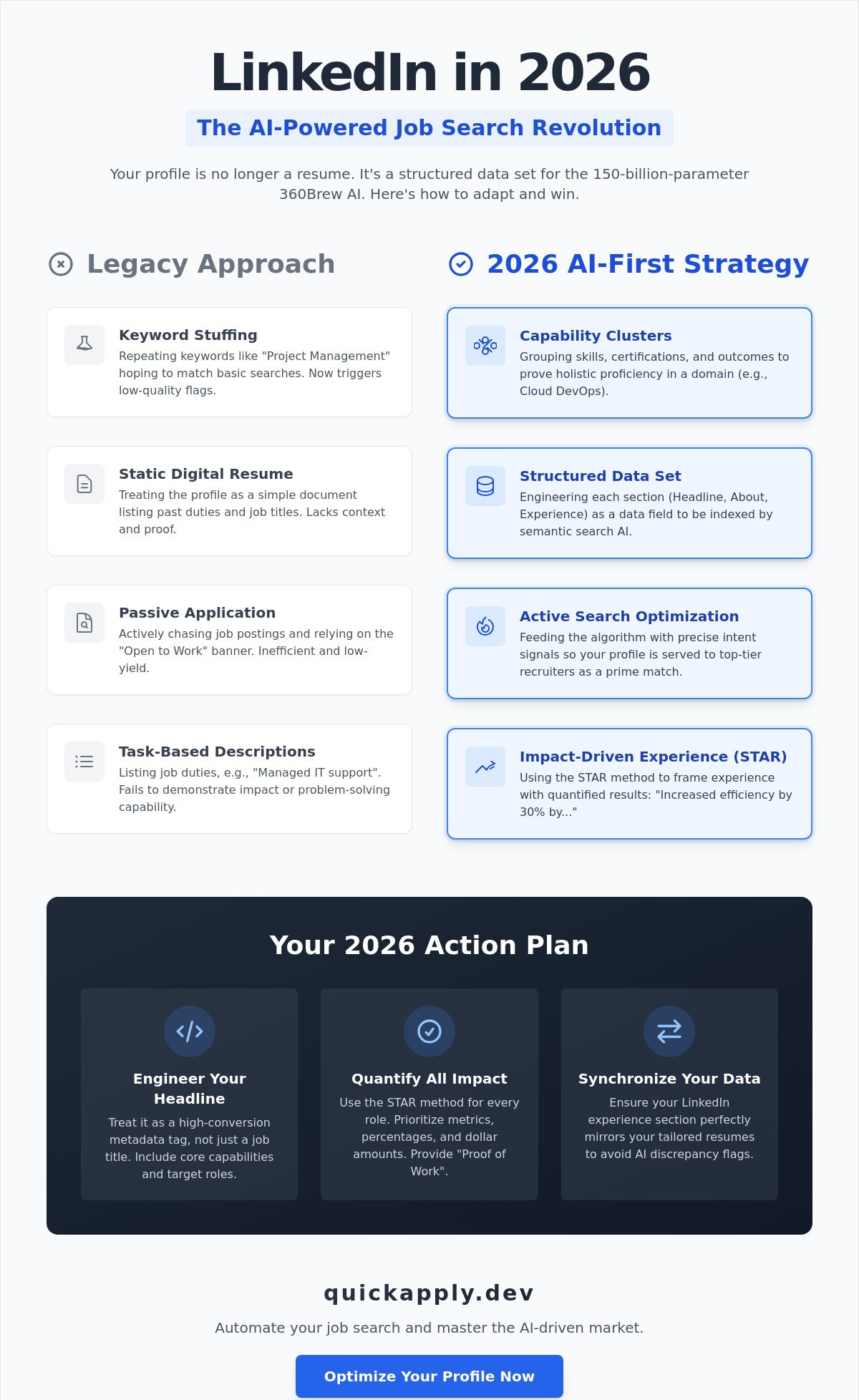
Stop treating your LinkedIn profile like a static document. In 2026, the platform functions as a sophisticated data-alignment engine. The History of LinkedIn shows a clear trajectory from a simple digital rolodex to the current 360Brew AI system. This 150-billion-parameter decoder-only transformer doesn't just read your text; it indexes your professional identity as a structured data set. When you focus on optimizing linkedin profile for job search 2026, you aren't just writing for humans. You're configuring your profile to satisfy high-speed semantic search filters used by top-tier recruiters.
The 2026 shift replaces basic keyword matching with Capability Clusters. Recruiters no longer search for isolated terms like "Project Management." Instead, the AI scans for clusters of related skills, certifications, and verified outcomes that prove expertise. Your goal is to move from "Passive Application," where you chase jobs, to "Active Search," where the algorithm serves your profile to recruiters as a top-tier match. This requires precise data tagging. Simply toggling the "Open to Work" setting is insufficient. You must feed the algorithm specific intent signals that align with current market demands.
Semantic Search and Recruiter AI in 2026
Modern recruiter AI utilizes advanced natural language processing (NLP) to interpret the intent behind your job titles. It knows that a "Growth Lead" at a startup carries different responsibilities than a "Marketing Manager" at a global corporation. The system indexes your profile based on the problems you solve rather than the tasks you perform. Your profile must answer specific questions about your technical depth and leadership scope. If the AI can't map your experience to a specific Capability Cluster, you remain invisible in search results. Context is the new currency of the 2026 job market, and for entrepreneurs or SME teams looking to master these technical shifts, Business With AI Strategist provides expert AI consultancy and strategic implementation services.
The Death of Keyword Stuffing: Moving to Contextual Relevance
Repeating a technical skill dozens of times in your skills section is a legacy tactic that now triggers "low-quality" flags. The 360Brew algorithm prioritizes contextual proof. If you claim expertise in Python, the AI looks for mentions of Python in your experience descriptions, project sections, and even your "saves" or engagement history. You must link every skill to a specific, measurable project outcome to achieve high ranking. Capability Clusters are defined as interconnected groups of skills and experiences that demonstrate a candidate’s holistic proficiency in a specific professional domain. Build these clusters by grouping your accomplishments around core competencies. This technical alignment ensures your profile mirrors the requirements of high-value roles perfectly. Efficiency wins every time.
Engineering a High-Conversion Headline and About Section
Your headline is your primary metadata tag. It functions exactly like an
Aligning Your Experience with Modern Market Demands
LinkedIn is not a digital graveyard for your past duties. In 2026, recruiters use AI to cross-reference your profile against your submitted documents. This means your Experience section must be a living data set. It should directly mirror the strategy used to tailor resume to job description. If your resume claims you led a migration to a new cloud architecture, but your LinkedIn only mentions "IT support," the AI flags a discrepancy. This inconsistency lowers your internal trust score. High-performance optimizing linkedin profile for job search 2026 requires total data synchronization across all platforms.
Focus on impact over activity. Use the STAR (Situation, Task, Action, Result) method for every entry. Don't just list tasks. Show the results. In 2026, "Proof of Work" is the standard for high-value roles. Use the media attachment feature to upload white papers, GitHub repositories, or project screenshots. These are no longer optional extras. They are verified signals that prove your capability to the 360Brew algorithm. Every attachment adds another layer of context that keyword-only profiles lack.
Quantifying Tech Impact in the Experience Section
Data drives the recruiter's "Match Score." Use concrete metrics like percentage increases in efficiency or dollar amounts saved. If you're transitioning from legacy tech stacks to modern tools, explain the transferability of your logic. Using the best ai resume builder 2025 helps you identify which metrics resonate most with current market demands. Ensure these same numbers appear on your profile. The AI calculates your ranking based on the density of these specific data points. Efficiency is measurable. Make sure your profile reflects that.
Skills vs. Endorsements: The New Weighting
The algorithm has evolved significantly. Your top three skills now carry 80% of your profile's ranking weight. Choose them with surgical precision. Don't waste these slots on generic soft skills like "Communication." Focus on the high-demand technical capabilities defined by the Semantic Skill Graph. Skill Assessments are now a critical differentiator. Completing these LinkedIn-verified tests provides a significant boost in search visibility compared to unverified profiles. Get endorsements by providing value first. Endorse your colleagues for their actual strengths. They'll often reciprocate. Quality always beats quantity in a semantic search environment.
Leveraging Social Proof and Engagement for Passive Reach
Engagement on LinkedIn is often misunderstood as a popularity contest. In reality, it serves as a critical data stream for the Recruiter's "Likelihood to Engage" metric. This score predicts how likely you are to respond to an InMail based on your recent platform activity. You don't need to be a full-time content creator to win. Low-effort engagement, such as commenting on posts by industry leaders, keeps your profile active in the eyes of the 360Brew algorithm. Strategically optimizing linkedin profile for job search 2026 means treating every interaction as a signal to the backend search engine. This activity ensures your data remains fresh without requiring hours of manual input.
The "Featured" section is your technical showcase. Move beyond static certificates. Use this space to pin your most relevant project repositories, live portfolios, or high-impact white papers. This section provides immediate "Proof of Work" for recruiters scanning your profile. It bridges the gap between your structured data and your actual output. By curating this section, you control the first technical impression you make on both human reviewers and AI filters. It's the most efficient way to prove you can do the job before a recruiter even reads your experience section.
To truly stand out, your professional narrative must be as sharp as your technical skills. Branding TITANS™ offers a guide to unfolding a path toward market dominance by refining your mission and professional identity.
Strategic Networking in the Age of Automation
Efficient networking requires precision, not volume. Use Boolean search strings to find recruiters at your target companies. A search like (Recruiter OR "Talent Acquisition") AND "Cloud Architecture" identifies the exact gatekeepers you need. When sending connection requests, keep them short and data-driven. Reference a specific project or shared technical interest. Avoid generic templates that sound like bot-generated spam. Implement the "2-2-2 Rule" to maintain your profile without burnout. Spend ten minutes a week making 2 comments, sending 2 connection requests, and following 2 industry leaders. This high-impact, low-effort routine keeps your social signals strong and your profile visible.
Managing Recommendations for Maximum Credibility
Quality beats quantity in the 2026 Recommendation Exchange. Recruiters prioritize recency over volume. A recommendation from three years ago carries little weight compared to one from the last six months. When requesting feedback, guide your recommenders to use specific keywords and Capability Clusters. Ask them to mention the specific tech stack or methodology you mastered during your tenure. This ensures the recommendation serves as qualitative data that reinforces your profile's technical indexing. Recommendations function as verified qualitative data that modern hiring teams use to validate the technical claims made in your experience section.
Ready to turn your social proof into a signed offer? Sync your profile with our application tracker to manage the high-volume leads your optimized profile generates.
Scaling Your Search: Integrating LinkedIn with Your Application Stack
Don't treat your LinkedIn profile as an isolated asset. It is the central nervous system of your professional automation stack. While competitors rely on the high-volume, low-conversion trap of "Easy Apply," you should use your profile as a structured baseline for deeper integration. By optimizing linkedin profile for job search 2026 and syncing it with an automated job application tracker, you create a seamless data flow from search to interview. This integration ensures every touchpoint reinforces your professional narrative without manual data entry errors. Efficiency is the only path to a top-tier role.
Match Scores provide the diagnostic data you need to iterate. If your profile doesn't hit a 90% match for a target role, your Capability Clusters require refinement. This feedback loop allows for real-time optimization. It prevents you from wasting time on applications where you're technically invisible to the 360Brew algorithm. The final check is always consistency. Recruiters cross-reference your LinkedIn data against your tailored resumes to spot discrepancies. Any contradiction in dates, titles, or tech stacks triggers a manual rejection. Build trust through absolute data alignment across every platform you use.
Syncing LinkedIn with Your Resume Tailoring Strategy
QuickApply analyzes job descriptions to identify the exact skills missing from your profile. Treat your LinkedIn as your "Master Profile," the single source of truth for your career data. When you tailor a resume, you're simply creating a specialized view of this core data set. This consistency builds immediate rapport with human recruiters who value transparency and precision. It also ensures that when an AI scans your profile after reading your resume, the match is 100% verified. You're not just applying; you're providing a cohesive technical narrative that the algorithm can't ignore.
Using QuickApply to Track and Optimize Every Touchpoint
Success in 2026 is a numbers game played with technical precision. Monitor which versions of your profile generate the most inbound recruiter interest. Use this data to double down on the keywords and project descriptions that convert. Automation doesn't stop at the application. You can automate the follow-up process after a LinkedIn connection to keep your name at the top of the recruiter's inbox. Stop guessing and start engineering your career path with optimizing linkedin profile for job search 2026 as your foundation. Optimize your entire job search with QuickApply's AI tools to maintain a permanent competitive advantage in a crowded market.
Master Your Professional Data for a 2026 Market
The 360Brew algorithm has fundamentally redefined the rules of professional visibility. You can't rely on legacy tactics like keyword stuffing or static summaries. Success in the current landscape depends on aligning your professional data with the Semantic Skill Graph. By optimizing linkedin profile for job search 2026, you transform a passive profile into a high-performance lead generator. Focus on engineering high-impact headlines and verified Capability Clusters to ensure you rank at the top of recruiter search results every time. Consistency between your profile and your tailored documents is no longer optional; it's a technical requirement for building trust with both AI filters and human hiring teams.
It's time to stop manually managing your career and start automating your success. Use our AI-powered Match Scores to verify your profile's performance against real-world market demands. Our Automated Application Tracker and Instant Resume Tailoring tools provide the technical edge needed to dominate the 2026 job market. Start optimizing your career with QuickApply today. You have the skills. Now, give them the platform they deserve. Your next high-tier role is waiting for the data to align.
Frequently Asked Questions
Is LinkedIn Premium worth it for job seekers in 2026?
Yes, LinkedIn Premium provides a clear competitive advantage through its advanced AI features. Premium Career costs $29.99 per month in 2026, or $19.99 if billed annually. This tier unlocks AI-powered job search tools and smart matching that free users can't access. If you value efficiency and data-driven insights, the investment pays for itself by surfacing high-probability opportunities faster.
How often should I update my LinkedIn profile during a job search?
Update your profile every two weeks to keep your professional data fresh. The 360Brew algorithm prioritizes active profiles that consistently feed it new information. Small tweaks to your skill tags or project descriptions signal that your expertise is evolving. This is a core part of optimizing linkedin profile for job search 2026. Don't let your data stagnate while the market moves forward.
Can recruiters see if I'm looking for a job if I don't use 'Open to Work'?
Yes, recruiters use specialized filters to find "hidden" talent. They track signals like profile updates, new skill endorsements, and engagement with industry leaders. These systemic signals suggest you're ready for a move even without a public badge. Recruiters often prefer candidates who maintain a high-quality profile without appearing desperate. Your activity level is its own signal in the 2026 market.
What is the most important part of a LinkedIn profile for AI ranking?
The Headline is your most critical metadata tag for initial indexing. It's the primary field the AI uses to categorize your professional identity. Following the headline, your Experience section bullets provide the necessary context for Capability Clusters. These two areas must be engineered with precision to ensure you rank in the top tier of search results. Treat them as technical documentation for your career.
Should I include my full resume in my LinkedIn 'About' section?
No, avoid pasting your full resume into your summary. This creates a wall of text that is difficult for AI transformers to parse efficiently. Instead, use the About section for a high-level executive summary and a structured skills matrix. This approach assists in optimizing linkedin profile for job search 2026 by providing readable, indexed data. Keep your tailored resume as a separate document for specific applications.
How do I hide my job search from my current employer on LinkedIn?
Set your "Open to Work" preferences to "Recruiters Only" within your privacy settings. LinkedIn filters out recruiters at your current company, though it's not a perfect guarantee. Avoid making public posts about your search or changing your headline to include "Seeking." Stick to backend data optimization and private networking. This strategy allows you to build your future while protecting your current position.
Does posting content actually help you get hired in tech?
Yes, content creation generates vital social signals that boost your visibility. You don't need to be a full-time creator to see results. Sharing project updates or commenting on technical trends increases your "Likelihood to Engage" score. This metric makes you a more attractive target for recruiter outreach. It proves your active involvement in the tech ecosystem and validates your technical claims through public engagement.
How many skills should I list on my LinkedIn profile for maximum SEO?
List the maximum 50 skills allowed, but focus your energy on the top three. The 2026 algorithm gives significantly more weight to your primary skill slots. Ensure these three skills align perfectly with your target Capability Clusters. Use the remaining 47 slots to build a broad semantic net. This ensures you appear in a wider range of searches without diluting your core professional brand.


