

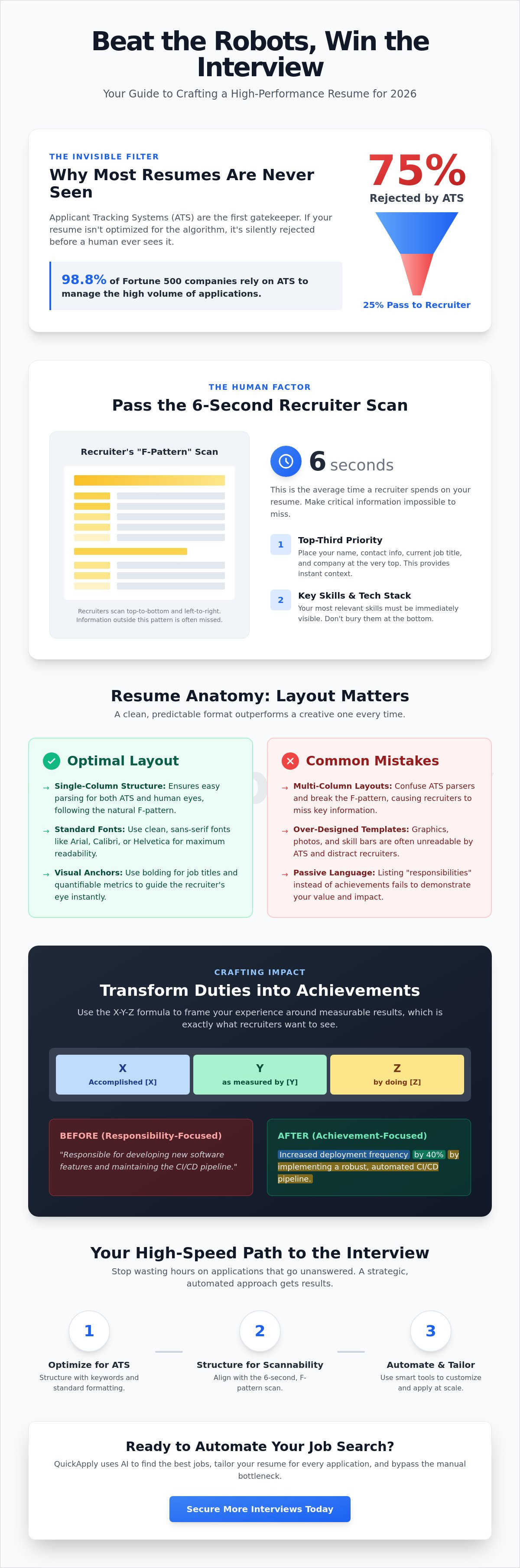
Approximately 75% of resumes are rejected by an Applicant Tracking System before a human recruiter ever sees them. In a market where Fortune 500 companies have reached a 98.8% ATS adoption rate, your career history isn't just a document; it's a data set. Understanding what do recruiters look for in a resume in 2026 requires moving past outdated formatting and focusing on high-density data validation. If you aren't optimizing for the algorithm, you're effectively invisible.
It's exhausting to spend hours tailoring applications only to receive automated rejections or total silence. You know the traditional advice is broken, and you're ready for a strategy that actually works in a tech-driven landscape. This guide promises to help you master the exact criteria recruiters use to scan resumes and show you how to automate your way to the top of the pile. We will break down the 5 to 7 second human scan, the shift toward skills-based hiring, and the specific ways to pass AI filters while staying compliant with new regulations like NYC Local Law 144. It's time to turn your resume into a high-performance tool that secures the interviews you deserve.
Key Takeaways
- Master the 6-second rule by structuring your resume for instant pattern matching rather than deep narrative reading.
- Implement the X-Y-Z formula to transform passive job duties into high-impact, quantifiable achievements.
- Discover exactly what do recruiters look for in a resume by understanding how AI assigns Match Scores based on semantic search.
- Replace the one-size-fits-all approach with high-speed tailoring that mirrors specific job priorities at scale.
- Leverage smart automation to identify best-fitting opportunities and bypass the manual application bottleneck.
The 6-Second Scan: Understanding the Recruiter’s Entry State
Recruiters are overwhelmed. With hundreds of applications flooding in for every open role, deep reading is a luxury they simply don't have. Instead, they utilize a cognitive filter known as the 6-second scan. This isn't a thorough review; it's a high-speed validation process designed to eliminate unqualified candidates instantly. They want to see if you meet the baseline requirements before they ever commit to reading a full paragraph. If you don't pass this initial test, your narrative depth won't matter because no one will ever see it.
At this early stage, your career story is secondary to pattern matching. Recruiters scan for specific signals that align with the job’s core requirements. If those signals aren't immediately visible, your resume is discarded. Understanding what do recruiters look for in a resume starts with recognizing that your document is a user interface, and the recruiter is a user looking for a specific solution. They categorize information into two buckets: Must-Haves and Nice-to-Haves. Must-Haves are the deal-breakers, such as a required degree or a specific software certification. Nice-to-Haves are the differentiators that help you stand out once the basics are confirmed.
Eye-tracking research confirms that recruiters follow an "F-pattern" movement. They start at the top left, move across the header, and then drop down the left margin to scan headers and bullet points. They don't hunt for information; they expect it to be exactly where they've seen it a thousand times before. If you break this flow, you increase the cognitive load on the recruiter, which often leads to a rejection.
The Information Hierarchy of a Winning Resume
Your current job title and company name are the highest priority data points. They provide instant context for your seniority level and industry fit. Use visual anchors like bolded text and clear bullet points to guide the eye toward these facts. Don't bury your tech stack in a bottom footer. Position your most relevant tools and languages in the top third of the page. This ensures they are captured during the initial scan when the recruiter's attention is at its peak.
Visual Cleanliness vs. Over-Designed Templates
Over-designed templates are a significant liability in 2026. Many "creative" layouts use multi-column structures that break the natural F-pattern, confusing the recruiter and slowing down the scan. Stick to common resume formats that prioritize legibility over aesthetics. Standardize your fonts and margins to ensure instant information retrieval. A clean, single-column layout ensures the recruiter stays focused on your value rather than your design choices. Efficiency wins every time.
The Anatomy of Impact: Content That Recruiters Actually Value
Recruiters don't hire you for your potential; they hire you for your proven throughput. In 2026, listing "responsibilities" is a fast track to the rejection pile. You must pivot to an achievement-based model to prove your value instantly. This is the core of what do recruiters look for in a resume. They want to see how you solved specific problems and the measurable results of your actions. If your bullet points look like a job description, you've already lost the reader's interest.
The industry standard for impact is the X-Y-Z formula. Accomplished [X] as measured by [Y], by doing [Z]. This structure forces you to lead with results. Instead of saying you "developed software," say you "increased deployment frequency by 40% as measured by DORA metrics by implementing a robust CI/CD pipeline." This gives the recruiter concrete data to validate your claims. To ensure your achievements are framed correctly for specific roles, you can use automated Resume Tailoring tools to optimize every bullet point for maximum impact.
Context is everything. Listing a hard skill like "Go" or "Rust" in a vacuum is useless. Recruiters need to see how that skill was applied in a real-world scenario to drive efficiency. In 2026, technical relevance decays at an accelerated rate. Your resume must highlight continuous learning and recent certifications to show you're keeping pace with rapid shifts in the tech stack. Stale skills suggest a lack of adaptability, which is a major red flag for modern hiring teams.
Quantifying Tech Contributions Beyond Sales Targets
You don't need to be in sales to provide hard numbers. Technical recruiters look for metrics like "reduced latency by 30%" or "onboarded 500+ users to a new internal tool." If you aren't in a revenue-generating role, focus on scale and efficiency. Mention managing a $2M infrastructure budget or leading a 10-person dev team across multiple time zones. These figures provide a sense of scope that generic adjectives cannot match.
The Skills Section: Hard Skills vs. Soft Skills Balance
Recruiters prioritize specific languages over generic descriptors. They want to see Python, Kubernetes, or AWS, not "Excellent Communication." Demonstrate your soft skills through collaborative project descriptions rather than a bulleted list. You must link your skills and qualifications directly to the job description requirements. This alignment shows you understand the specific technical challenges the company is facing and have the exact tools to solve them.
The Invisible Filter: Navigating ATS and AI Screening in 2026
Before a recruiter ever initiates the 6-second scan mentioned earlier, an algorithm has already decided your fate. Modern Applicant Tracking Systems (ATS) don't just store documents; they rank them. In 2026, 98.8% of Fortune 500 companies use these systems to manage the surge in AI-generated applications. These platforms use AI to generate a "Match Score" that determines your position in the recruiter's queue. If your score is low, you stay at the bottom of a 250-application pile, effectively invisible to human eyes.
Understanding what do recruiters look for in a resume in this digital-first era requires a shift in perspective. They look for high Match Scores driven by "Core Signal" keywords. These are the specific technical requirements and impact markers found in the job description. To identify them, look for terms repeated in the "Requirements" and "Responsibilities" sections. These are the data points the AI is programmed to find. A good resume example for 2026 must be optimized for these parsing algorithms without sacrificing human readability.
Standardizing Formats for Machine Readability
Machine readability is non-negotiable. Run a "Plain Text Test" on your PDF by copying the content and pasting it into a basic notepad. If the text doesn't export cleanly, the ATS won't parse it correctly. Avoid images, charts, and complex icons. They look great to humans but appear as gibberish to extraction tools. Use consistent date formats and standard section headings like "Work Experience" instead of "My Career Journey." AI needs familiar labels to categorize your data accurately into the database.
Semantic Matching: Beyond Exact Keyword Repetition
Modern AI uses semantic search to understand context. It recognizes that "Frontend" and "React" are related terms. You don't need to repeat the same keyword fifty times to rank. Instead, focus on proximity. Keep your skills listed near the specific roles where you applied them. This provides the context AI needs to validate your expertise. Don't try to "hack" the system with invisible text or fake skills. AI is now sophisticated enough to detect these anomalies. Even if you trick the bot, you'll fail the human interview when you can't back up the claims. Optimization is about alignment, not deception. Efficiency comes from being the best match, not the best liar.
Strategic Tailoring: Meeting Recruiter Expectations at Scale
Sending a generic resume is a statistical dead end. In 2026, application volume has surged by 30% per vacancy. Recruiters don't have time to interpret how your experience might fit their needs. They expect an immediate, high-fidelity match. Understanding what do recruiters look for in a resume means recognizing that every application requires a unique data alignment. If your document doesn't mirror the job’s specific priorities, the AI Match Score will bury your profile before a human ever sees it.
Efficiency doesn't mean rewriting your entire history for every job. It means adopting a Match Score mindset. You must identify the core requirements of a role and ensure they are represented in the most visible sections of your resume. This strategic alignment is the only way to break through the noise of hundreds of competing applicants. You can tailor your resume to a job description by focusing on the 20% of content that drives 80% of the recruiter's decision.
The 80/20 Rule of Resume Tailoring
Focus your energy where it matters. The Summary and the top three bullet points of your most recent role are the most critical data points. Adjust your job titles to match industry-standard nomenclature if your internal company title is obscure. Swap out technical skills to highlight the exact stack requested in the posting. These small, high-impact changes significantly increase your perceived relevance without requiring hours of manual work. This ensures you pass the pattern-matching phase with minimal effort.
Leveraging AI for Instant Optimization
Manual tailoring is a legacy process. Tech-savvy professionals are moving away from word processors and toward automated systems. Use AI to instantly identify the gap between your current resume and the job description. These tools generate tailored bullet points that emphasize your most relevant experience while maintaining your unique voice. This isn't about fabricating experience; it's about optimizing the presentation of your existing data. To stay ahead of the curve, you should Automate your Resume Tailoring and focus your time on preparing for the interviews you'll actually get. Efficiency is the ultimate competitive advantage.
The QuickApply Strategy: Automating Your Path to the Interview
Manual application processes are the primary bottleneck in your career progression. If you're still manually tweaking every bullet point for every submission, you're losing the volume game. QuickApply provides the technical infrastructure to bypass this manual labor. By automating the alignment between your data and recruiter expectations, you move from the "applying" phase to the "interviewing" phase with surgical precision. Stop fighting the system and start using it to your advantage.
The Match Score feature is the core of this optimization strategy. It identifies high-probability opportunities by scanning job descriptions and comparing them to your profile instantly. This isn't just about finding jobs; it's about finding the specific roles where your data already satisfies the recruiter's criteria. You can streamline your entire workflow with an automated job application tracker to ensure no opportunity falls through the cracks. This systematic approach replaces hope with data-driven results.
AI-Powered Resume Tailoring in Seconds
QuickApply’s AI performs a deep analysis of job descriptions to determine exactly what do recruiters look for in a resume for that specific vacancy. It highlights your most relevant data points while maintaining strict ATS compatibility. This ensures you pass both the machine filters and the human scan. To provide a complete application package, use the cover letter generator to create a narrative that reinforces your technical achievements. You get a tailored application in seconds, not hours.
Beyond the Application: Tracker and Practice Tools
Submitting the application is just the first step in the pipeline. Managing your funnel requires a centralized Application Tracker to monitor status updates and follow-ups. Once the interview invite arrives, utilize the Interview Practice tool to simulate the specific technical and behavioral questions for that role. This end-to-end approach ensures consistency from your initial tailored resume through to your final salary negotiation. Use the Salary Negotiation Guide to ensure your final offer reflects your true market value. You aren't just looking for a job; you're optimizing your career output.
Optimize Your Career Output for 2026
The hiring landscape in 2026 demands more than just a well-written document. It requires a strategic alignment between your career data and the algorithms designed to filter it. You've learned that what do recruiters look for in a resume is essentially a high-fidelity match for their specific technical needs, validated by quantifiable impact and machine-readable formatting. By mastering the 6-second scan and the 80/20 rule of tailoring, you've already gained a significant competitive advantage over the 75% of applicants currently being rejected by automated filters.
Now it's time to operationalize these insights. Don't waste another hour on manual edits that don't move the needle. Leverage AI-powered Match Score technology and automated ATS-friendly resume tailoring to scale your outreach without sacrificing quality. From comprehensive application tracking to precision interview prep, you have the tools to dominate a crowded market. Stop manual tailoring and start getting hired with QuickApply. The most efficient path to your next role is ready for deployment. Go secure it.
Frequently Asked Questions
How long should a resume be for a tech recruiter in 2026?
Two pages are the modern standard for professionals with over five years of experience. One page remains the limit for entry-level roles or career changers. Recruiters value information density over arbitrary page counts. If your second page is filled with high-impact achievements and relevant tech stacks, keep it. Efficiency means providing exactly enough data to prove your value, nothing more.
Does the order of my skills section actually matter?
Yes, the hierarchy of your skills is critical. Place your most relevant technologies at the top of the list to align with the recruiter's F-pattern scan. Grouping skills by category, such as "Cloud Infrastructure" or "Backend Languages," helps the reader categorize your expertise instantly. This reduces cognitive load and ensures your core competencies are identified within the first few seconds of the review.
Will recruiters know if I used AI to tailor my resume?
Recruiters expect optimization. In 2026, using AI to align your data with a job description is a sign of technical literacy. They won't care if you used a tool as long as the content is accurate and quantifiable. When considering what do recruiters look for in a resume, they prioritize relevance and proof of impact over the method used to format the document. Just ensure you verify every claim before submission.
Should I include a summary or an objective statement?
Always use a professional summary. Objective statements are legacy components that focus on what you want, whereas summaries focus on what you offer. A three-line summary acts as an executive brief for your entire career. It should highlight your years of experience, your primary tech stack, and your most significant achievement. Treat it as the high-impact hook for the rest of your document.
How many keywords is "too many" for an ATS?
There is no magic number, but context is more important than frequency. Modern ATS use semantic search to evaluate the relationship between your skills and your roles. Repeating a keyword twenty times won't help if it isn't linked to a specific achievement. Focus on natural integration. If you mention a skill, back it up with a measurable result in your experience section to satisfy the algorithm.
What is the most common reason recruiters reject qualified candidates?
The most common rejection reason is a lack of quantifiable evidence. Qualified candidates often fail because they describe their duties instead of their results. If a recruiter can't see the scale of your impact within six seconds, they'll move to the next profile. This is a core part of what do recruiters look for in a resume; they need data points like percentages and dollar amounts to validate your seniority.
Do recruiters actually check the links to my GitHub or portfolio?
They check them during the second or third review stage. Your GitHub or portfolio serves as a validation tool once you've already passed the initial scan and the ATS filter. Don't expect a recruiter to click links during their first 6-second review. Ensure your resume can stand on its own, with links serving as deep-dive evidence for the hiring manager later in the process.
Is a 1-page resume still the standard for experienced professionals?
No, the one-page rule is largely obsolete for mid-to-senior level roles. Trying to cram fifteen years of technical leadership into one page usually results in tiny fonts and poor readability. This frustrates recruiters and breaks the scanning flow. Use two pages to provide the metrics and context required for high-level positions. Prioritize clarity and impact over an arbitrary page limit to ensure your value is clear.


