

Only 4% of new job postings in 2026 are for fully remote roles, which means the competition for these high-paying positions is more aggressive than ever. You already know the frustration of spending hours manually editing a document just to be ghosted by a remote-first company. It's exhausting to prove your reliability and remote-ready mindset when you can't walk into a physical office to make an impression. Learning how to write a resume for remote jobs is no longer about listing your past duties. It's about engineering a technical asset that survives the most brutal filters in the current tech market.
Stop wasting hours on manual edits. This guide delivers the technical and structural optimizations you need to dominate the 2026 landscape. You'll learn to clear modern ATS filters and prove your autonomy through a specialized async tech stack. We provide the repeatable system required to apply at scale, increase your interview-to-application ratios, and secure the digital-first career you deserve. This is your blueprint for navigating the high-speed shift toward hybrid and remote-first employment models.
Key Takeaways
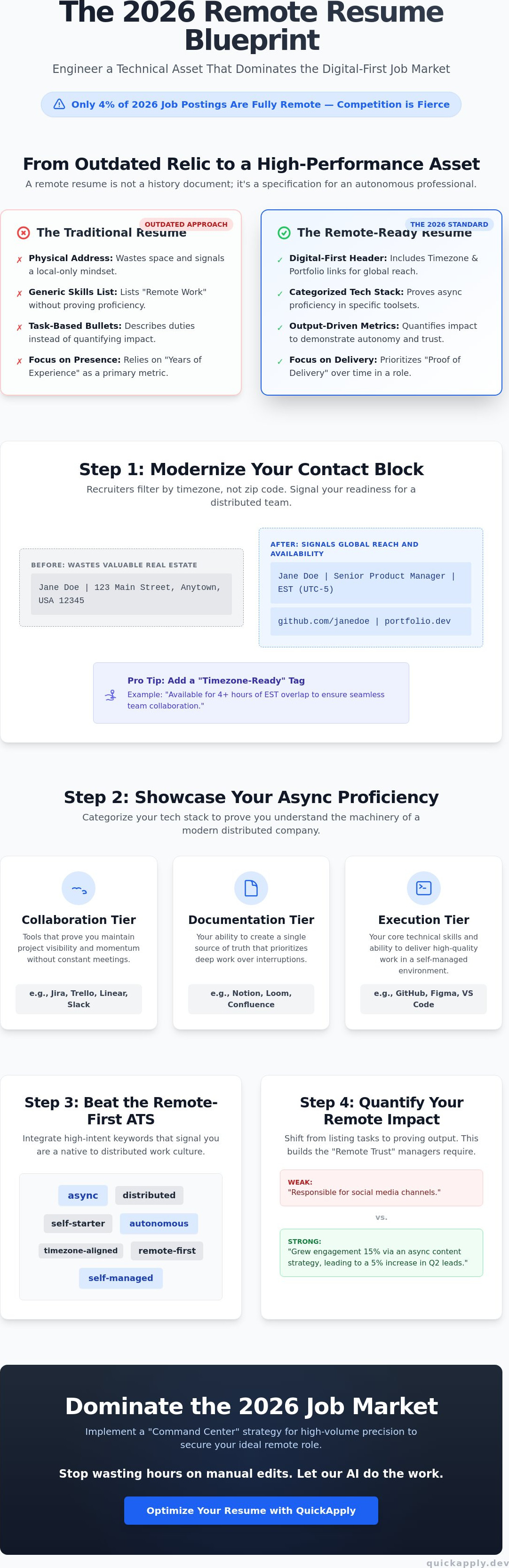
- Replace traditional headers with digital-first contact blocks to signal immediate readiness for distributed environments.
- Showcase async proficiency by categorizing your tech stack into collaboration, documentation, and execution layers.
- Learn how to write a resume for remote jobs that uses the Remote Metric framework to prove impact without direct supervision.
- Bypass remote-first ATS filters by integrating high-intent keywords such as async, distributed, and self-starter.
- Implement a "Command Center" strategy to maintain high-volume precision and dominate the competitive 2026 job market.
The 2026 Remote Resume: Why "Location" is the Least Important Part
In the 2026 tech market, your physical location is a tax variable, not a qualification. A Remote-First resume is a document optimized for trust and autonomy. Traditional resumes focus on chronological history, but remote managers prioritize Proof of Delivery over Years of Experience. They don't care how long you sat in a chair; they care about what you shipped while no one was watching. While the fundamentals of a resume remain grounded in clear communication, the 2026 remote standard requires a radical departure from traditional layouts. You are no longer competing with the person in the next zip code. You are competing with a global talent pool, making speed-to-apply a critical metric for success.
Learning how to write a resume for remote jobs requires a shift in perspective. You must treat your resume as a technical specification for a high-performance asset. If your header still lists a full street address, you're wasting valuable real estate. Remote-first companies operate in the cloud, and your contact block should reflect that digital-first reality. By stripping away legacy formatting, you signal that you are ready to integrate into a distributed team without the friction of outdated corporate habits.
The Death of the Physical Address
Recruiters in 2026 ignore city and state data in favor of timezone availability. With only 4% of new roles being fully remote, hiring managers use timezone alignment as an immediate filter to ensure meeting overlap. Replace your home address with your primary timezone and a link to your digital footprint. Format your header for maximum global reach: [Name] | [Role] | [Timezone/UTC] | [GitHub/Portfolio]. Use the Timezone-Ready tag, such as "Available for 4+ hours of EST overlap," to provide instant clarity for international roles. This simple hack removes the guesswork for recruiters managing distributed teams across multiple continents.
Trust vs. Presence: The Remote Recruiter Mindset
Hiring for remote roles is an exercise in risk management. Managers feel a natural anxiety about professional reliability when they cannot see you working. Your resume must act as a proxy for your presence, proving you can maintain momentum without a physical office. When you master how to write a resume for remote jobs, you address this anxiety head-on by highlighting your ability to self-manage. Remote Trust is the intersection of technical skill and documented autonomy. Every bullet point should reinforce this connection, showing that your output remains consistent regardless of your environment or lack of direct oversight.
Auditing Your Tech Stack: Showcasing Async Proficiency
Listing "remote skills" as a generic bullet point is a 2022 mistake. In 2026, recruiters look for a specific technical ecosystem that proves you can function without a manager hovering over your shoulder. When you master how to write a resume for remote jobs, you must categorize your stack into three distinct layers: Collaboration, Documentation, and Execution. This structure signals that you understand the machinery of a distributed company. Slack is no longer a standout skill; it is a baseline expectation. True async maturity is demonstrated by your proficiency in tools like Loom for video updates and Notion for knowledge management, which prioritize deep work over constant pings.
Your GitHub or Portfolio shouldn't just be a static link. Integrate it as a live work-in-progress feed to show continuous delivery. Remote-first companies value transparency. They want to see your commit history and how you handle pull requests in a collaborative environment. Even when applying for non-engineering roles, a public-facing portfolio acts as a technical proof of concept. Following authoritative resume writing guidance ensures these links are structured to highlight results rather than just existence. If you find this technical audit overwhelming, our Resume Tailoring service can help align your stack with specific job requirements instantly.
The Collaboration Tier: Moving Beyond Email
Remote work fails without project visibility. Highlighting your experience with Jira, Linear, or Trello proves you can maintain momentum within a transparent project management system. It's not just about using the software. You must demonstrate that you understand feedback loops. Prove you can lead meetings in both camera-on and camera-optional cultures, showing you respect the different communication needs of a global team. Emphasize your ability to manage real-time versus delayed feedback loops to show you won't stall when teammates are in different time zones.
Documentation as a Superpower
In a remote environment, writing is the primary interface. It is the most important skill for 2026. Senior remote roles demand "Documentation-First" leaders who can drive decisions without synchronous meetings. List "Technical Writing" or "RFC Creation" to prove you can lead through async channels. This shows you can create a paper trail that benefits the entire organization. You can use good resume examples to see exactly how to structure your documentation experience for maximum impact. This approach turns your resume into a case study of your ability to communicate complex ideas clearly and concisely.
Quantifying Remote Impact: Moving from Tasks to Output
Remote managers live in a state of constant anxiety about "productivity theater." They fear that without a physical office, work stalls and communication breaks down. Your resume must kill this fear instantly. Mastering how to write a resume for remote jobs means shifting from a "tasks completed" mindset to an "output delivered" framework. Traditional bullet points describe what you did; remote-first bullet points describe what happened because you were there, even if no one saw you do it. You need to prove that your presence is felt through your results, not your status icon.
Use the Remote Metric framework to quantify your impact. Focus on metrics like Time-to-Ship and Sprint Velocity. If you're a developer, don't just list languages. Mention your average code review turnaround time. If you're in marketing, highlight how you maintained campaign momentum across staggered timezones. Zero-Management Oversight is the ultimate signal to a recruiter. It tells them you're an autonomous unit capable of hitting targets without a manager hovering in your Slack DMs. This level of self-sufficiency is the gold standard for high-paying 2026 roles.
The Autonomy Formula
Your action verbs must scream independence. Use "initiated," "deployed," and "managed" to show you didn't wait for permission or constant guidance. For example, instead of saying you "worked with a team," state that you "Led a distributed team of 12 across 4 timezones to deliver project X ahead of schedule." This proves you can navigate the complexities of global collaboration without friction. To turn a standard task into a remote-ready achievement, anchor the result to a specific delivery timeline and the absence of direct local supervision.
Proving Reliability with Data
In 2026, availability metrics matter more than hours worked. Remote companies prioritize uptime and resolution speed over the traditional 9-to-5 grind. Use data proxies like ticket resolution speed, documentation accuracy, or pull request frequency to prove you're reliable. If you can show you maintained a 99% uptime on your deliverables while working asynchronously, you've already beaten most of the applicant pool. Organizing these metrics requires a systematic approach. Using a professional application tracker ensures you're documenting your own search with the same precision you'll use once you land the role.
Tailoring at Speed: How to Optimize for Remote-First ATS
Manual tailoring is a relic of the past. In a market where 29% of employees would quit if forced back to the office, the competition for the remaining 4% of remote roles is a statistical war. You cannot win this war with a slow, manual process. Learning how to write a resume for remote jobs in 2026 requires an automated approach to Applicant Tracking Systems (ATS). These systems don't just look for skills; they look for cultural alignment with distributed work. If your document doesn't hit a high Match Score within the first five seconds, it’s deleted before a human ever sees it.
One tailored resume beats 100 generic blasts. However, tailoring doesn't have to take hours. You can leverage the best AI resume builders of 2026 to handle the heavy lifting. These tools scan job descriptions for high-intent keywords like "Async" and "Self-Starter" and inject them into your profile naturally. This ensures your application survives the initial filter while maintaining the integrity of your professional story. To dominate the queue, use our Resume Tailoring tool to sync your experience with job requirements in seconds.
The 2026 Keyword Stack for Remote Tech
Remote-first ATS algorithms prioritize specific technical and operational terms. You must include phrases like Distributed Systems, Cross-functional, Cloud-native, and KPI-driven. However, avoid keyword stuffing. Never use the word "Remote" more than three times. Instead, focus on the substance of the work. You can tailor resume to job description with AI to identify these hidden requirements in under 60 seconds. This allows you to submit high-precision applications at the speed of the modern web.
Beating the "Location Filter"
Many companies use ATS to auto-reject candidates based on specific zip codes or states, even for "fully remote" roles. Bypass these legacy filters by optimizing your digital file metadata. Set your "Work Preferences" to "Remote" in the document properties. Additionally, your PDF filename is a searchable field. Include your target role and the word "Remote" in the filename, such as "Senior_Dev_Remote_John_Doe.pdf". This ensures that even if the system filters by location, your intent is clear and your file is indexed correctly for remote-specific searches.
The Remote Application Engine: High-Volume Precision
Remote job hunting in 2026 isn't a passive activity. It's a high-stakes "Volume x Precision" game. You've already optimized your tech stack and quantified your impact in the previous steps. Now, you need a delivery system. Most candidates fail because they treat applying like a lottery. They blast generic documents and hope for the best. Learning how to write a resume for remote jobs is only half the battle. The other half is deploying that asset with enough frequency to overcome the statistical hurdles of a crowded market. Speed is a feature, not a bug.
Consistency creates momentum. Set up a "Command Center" for your job search to avoid the burnout of manual tracking. A 10-minute daily workflow is more effective than a weekly eight-hour binge. You must identify new listings, tailor your documents, and hit send before the first 100 applications trigger an auto-filter. This systematic approach ensures you're always at the front of the queue. Closing the deal requires addressing "The Remote Question" upfront: how do you maintain high output without a physical office presence? Your application must answer this before the recruiter even asks.
Automating the Outreach Pipeline
Personalization is mandatory, but it shouldn't be slow. Use an AI cover letter generator to personalize your pitch for remote culture. Your cover letter should highlight your async communication skills and your ability to work across timezones. Track your "Remote Response Rate" to iterate on your resume versioning. If your response rate is low, it’s a signal to adjust your keyword strategy. Use a disciplined follow-up strategy for distributed teams. Since remote hiring managers are often overwhelmed by global volume, a polite, well-timed nudge can move your file from the "maybe" pile to the "interview" list.
Scaling Without Losing Quality
Quality usually drops when volume increases. QuickApply solves this by enabling 50+ high-quality, tailored applications per week. You don't have to choose between speed and precision. Manage multiple versions of your resume for hybrid versus full-remote roles. A hybrid role might need a focus on local collaboration, while a full-remote role requires a heavy emphasis on async documentation. You can Optimize your remote resume with QuickApply now to bridge the gap between your talent and these high-paying opportunities. Stop manual editing and start using a system designed for the 2026 tech market.
Deploy Your Remote-First Career Strategy
The 2026 remote market belongs to those who view their resume as a high-performance technical asset. You've learned to swap physical addresses for timezone availability and replace generic tasks with self-managed milestones. Proving your async maturity through a documented tech stack is no longer optional; it is the baseline for survival. Mastering how to write a resume for remote jobs means moving at the speed of the software you use every day. You are competing against a global talent pool, and precision is your only leverage.
Don't let manual editing slow your momentum. Join 50,000+ tech professionals who use our automated ATS optimization to target high-intent keywords instantly. Our system provides an AI-powered Match Score for every remote role to ensure your document survives the first five seconds of scrutiny. Stop manually editing—tailor your remote resume in seconds with QuickApply. You have the technical skills to thrive in a distributed world. Now, use the tools that match your ambition and secure your next high-paying role. The future of work is autonomous; your search should be too. You're ready to win.
Frequently Asked Questions
Do I need to put my home address on a resume for a remote job?
No. Street addresses are legacy data points that create unnecessary clutter. You only need to provide your City, State, and Timezone. Recruiters use this information for tax compliance and meeting scheduling. Providing a full address is a security risk and signals that you haven't updated your application standards for the digital-first era.
How do I show remote work experience if I’ve only worked in an office?
Highlight remote-adjacent skills and async collaboration. If you managed projects across different office floors or coordinated with satellite branches, you were already working in a distributed way. Focus on your proficiency with tools like Slack, Jira, and Zoom. This is a critical part of learning how to write a resume for remote jobs when you're transitioning from a traditional office environment.
What are the best keywords for remote resumes in 2026?
Prioritize high-intent terms like Async Communication, Distributed Systems, and Self-Managed. Include technical markers such as Cloud-native, SDLC, and Sprint Velocity. These keywords signal to ATS filters that you possess the autonomy required for remote success. Avoid generic buzzwords. Stick to the functional language of modern software development and digital productivity.
Should I include my timezone on my resume?
Yes. Timezone availability is the new primary location metric. Recruiters for global teams need to calculate meeting overlap immediately. Listing your timezone, such as EST or UTC+1, removes friction from the hiring process. It shows you're proactive about collaboration logistics. This small detail can be the difference between getting a call and being filtered out for scheduling risks.
How can I prove I am productive when working from home?
Use the Remote Metric framework to quantify your output. Mention specific data like code review turnaround time, ticket resolution speed, or campaign launch frequency. Prove you hit targets without direct supervision. In 2026, data is the only proxy for trust. If you can show consistent delivery while working independently, you eliminate the hiring manager's anxiety about remote productivity theater.
Does ATS auto-reject resumes without a physical location?
Some legacy systems might, but most modern ATS accept City and State as sufficient data. If a job portal requires a zip code, provide it, but keep your resume document focused on your timezone. Ensure your file metadata and filename include the word Remote. This helps you stay in the correct search buckets even if the system has rigid location fields.
Is it okay to use AI to tailor my resume for remote tech roles?
Yes. AI is the industry standard for maintaining high-volume precision. Manual tailoring is too slow for the 2026 tech market, where speed-to-apply is a competitive advantage. Use AI to align your technical skills with the job description in seconds. This allows you to focus your energy on interview preparation and technical assessments rather than repetitive document editing.
How do I list "Remote" for a job that was hybrid?
Label the position as Hybrid/Remote in your experience section. Detail the specific projects or days you handled while working away from the office. Emphasize the async tools and documentation practices you used during those periods. This demonstrates that you have already successfully managed the transition between different work models and can thrive in a fully distributed setting.


