

Over 97% of tech companies in 2026 use automated systems to kill your application before a human ever sees it. You're a data expert, yet you're likely spending hours manually tweaking bullet points only to receive a rejection email four minutes after hitting submit. It's a frustrating, inefficient loop that ignores your actual technical talent. You know that systems should work for you, not against you.
This guide shows you how to master data scientist resume ats optimization to turn the tables on the algorithms. You'll learn to engineer a document that doesn't just pass filters but commands a high match score at FAANG and top-tier startups. We're moving beyond simple keyword stuffing to a high-tech, outcome-driven strategy that leverages AI-driven optimization. This is about building a bridge between your talent and the opportunity you deserve.
We will break down the latest 2026 parsing trends from leaders like Workday and Greenhouse. You will discover exactly which ML and AI keywords actually move the needle and how to quantify your impact to meet the new standard of outcome-driven hiring. It's time to stop guessing and start treating your job search like the optimization problem it is.
Key Takeaways
- Decode how 2026 systems use Natural Language Processing to rank your profile as a searchable database entry rather than a simple static filter.
- Implement the "70% Match Rule" to bypass the need for perfect keyword overlap while still dominating the rankings.
- Apply a precise formula to translate your technical tasks into quantified business ROI, a critical component of successful data scientist resume ats optimization.
- Resolve the PDF vs. DOCX debate once and for all to ensure your formatting never breaks the modern parser.
- Use automated match scores to eliminate manual tailoring and prioritize the high-probability roles that lead to top-tier interviews.
The Data Science Rejection Gap: Understanding the 2026 ATS
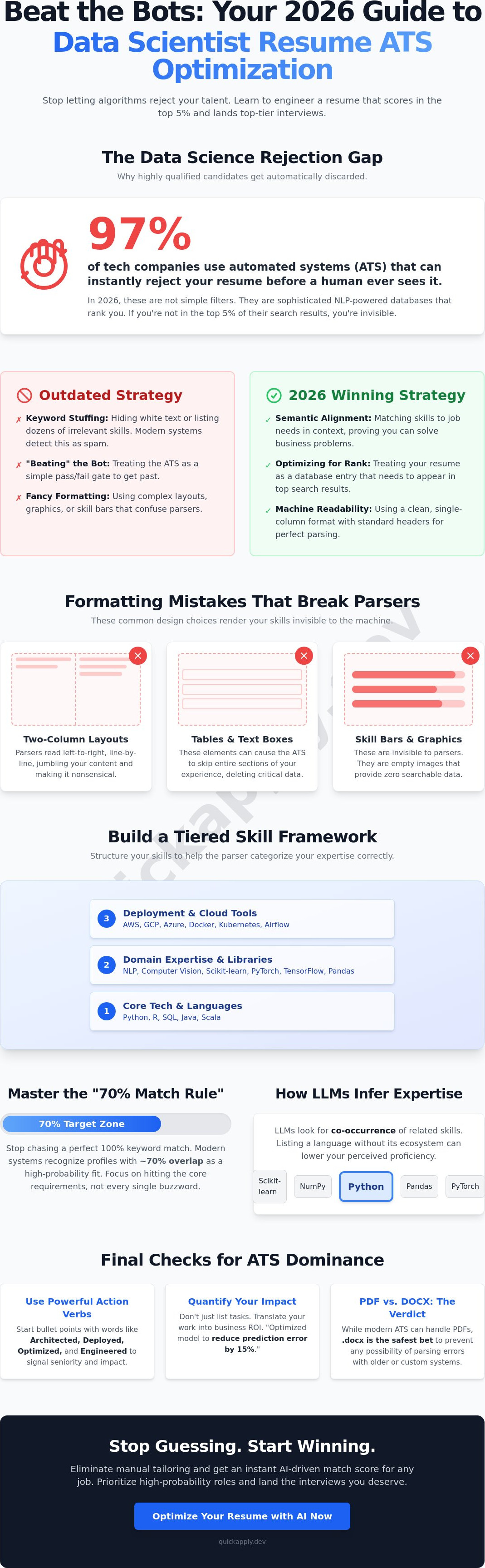
Most data scientists view an Applicant Tracking System (ATS) as a simple pass/fail filter. That's a mistake. In 2026, these platforms function as sophisticated, searchable databases that use Natural Language Processing (NLP) to rank your profile against thousands of others. If you aren't in the top 5% of the search results, you don't exist. This is the Rejection Gap. It's a systemic failure where highly qualified candidates are discarded not for a lack of skill, but because their data structure is unreadable.
Effective data scientist resume ats optimization requires a shift in mindset. You're no longer just trying to "beat" a bot. You're optimizing for semantic alignment. Older tactics like hidden white-text keywords are dead. Modern systems detect that as spam immediately. Instead, you must ensure your resume reflects the contextual relationships between your tools and your outcomes. If the system cannot map your skills to the specific needs of the role, you'll stay stuck in the rejection loop regardless of your actual talent.
Why Standard Parsers Fail on Technical Resumes
Technical resumes are notoriously difficult to parse. You might think a two-column layout looks modern. To a legacy parser, it's a jumbled mess of unrelated text strings. Tables are even worse; they often cause the system to skip entire sections of your experience. Stick to standard headers. If you label your expertise as a "Technical Toolkit" instead of "Skills," the system might fail to categorize those keywords correctly. Data visualizations like skill bars or proficiency charts are equally useless. To a machine, those are just empty images. They take up valuable space without providing any searchable data.
The Shift to LLM-Based Screening
By 2026, top-tier ATS platforms have integrated Large Language Models to infer your level of expertise. They look for co-occurrence. If you list "Python" but don't mention "Pandas," "NumPy," or "Scikit-Learn" nearby, the algorithm may downrank your proficiency score. It understands that a professional data scientist rarely uses one without the others. Your resume must be both machine-readable and human-persuasive. The machine handles the ranking, but a human still makes the final call. If your data scientist resume ats optimization strategy lacks a clear narrative for the recruiter, you'll still lose the interview. Modern screening is about proving you can solve business problems, not just listing libraries.
The Keyword Architecture: Building a Tiered Skill Framework
The architecture of your resume determines your visibility in a crowded market. You can't just dump a list of libraries into a single section and hope for the best. To succeed in data scientist resume ats optimization, you need a tiered framework that maps your expertise to the specific logic of the algorithm. Divide your skills into three distinct layers: Core Tech (languages like Python or SQL), Domain Expertise (NLP, Computer Vision), and Deployment Tools (Docker, AWS). This structure helps the parser categorize you as a specialist rather than a generalist.
Don't stress about hitting a 100% keyword match. The "70% Match Rule" is the baseline for 2026. If you meet the majority of the requirements, modern systems recognize your profile as a high-probability fit. Use action verbs like "Architected," "Deployed," or "Optimized" to signal seniority. These verbs show ownership of the project lifecycle, which is exactly what LLM-based parsers look for when ranking experience. Focus on frequency. Use frequency analysis to identify "hidden keywords", which are terms the recruiter repeated three or more times. These are the weights that drive the ranking algorithm.
Hard Skills vs. Toolsets: Finding the Balance
Distinguish clearly between your foundational languages and the frameworks you use to build. Listing Python is mandatory, but pairing it with Scikit-learn or PyTorch demonstrates operational depth. In 2026, cloud proficiency is no longer an extra skill; it's a core requirement. Whether it's AWS, GCP, or Azure, your resume must signal that you can work in production environments. According to MIT's guide to ATS-friendly resumes, 99% of Fortune 500 companies use these tracking systems, making standard formatting and clear skill categorization essential for survival. To ensure your stack aligns with top-tier requirements, use automated resume tailoring to identify and fill critical skill gaps instantly.
Specialization Overlays: NLP, CV, and MLOps
Generic data science roles are disappearing. Companies now hire for specific outcomes. If you're targeting Machine Learning Engineer roles, your keyword density must shift toward MLOps tools like Kubernetes, MLflow, and Docker. For Generative AI positions, emphasize LLM orchestration and fine-tuning. These high-value keywords signal seniority and the ability to move models from a notebook to a live environment. Specialization keywords act as a secondary filter that elevates your profile above general applicants who lack niche expertise.
The Quantified-Impact Formula: Turning Code into ROI
Companies don't hire you to write Python scripts. They hire you to generate profit, save time, or mitigate risk. If your resume reads like a GitHub README, you're failing both the human review and the algorithmic scoring. Effective data scientist resume ats optimization requires translating every technical task into a business outcome. Use the standard formula: [Action Verb] + [Technical Task] + [Quantified Result]. This turns a passive list of duties into a high-impact narrative of success that machines can easily rank.
Scale is your biggest differentiator in a crowded market. Building a model for a local CSV is a basic project. Deploying a real-time recommendation engine for a 10TB+ data warehouse is a career achievement. Always specify the volume of data you've handled. It signals your ability to work in production-grade environments. High-volume data handling is a top-tier keyword that triggers senior-level rankings in modern systems. According to Columbia's guide to resume optimization, 75% of candidates are rejected by the ATS. To beat these odds, you must align your language with the business goals mentioned in the job description.
Measuring Success in Data Science Bullets
Accuracy is a technical metric, but conversion is a business metric. A 92% model accuracy means nothing if it doesn't solve a core problem. Instead, state that you "Improved model accuracy to 92%, resulting in a 5% lift in checkout conversion." This connects the dots for the recruiter. Translate technical wins like "reduced latency" into "saved $200k in annual cloud compute costs." Use scale as a differentiator by mentioning you "deployed models to 1M+ active users." This is the language of ROI that 2026 systems are programmed to prioritize.
The 'Context-Task-Result' (CTR) Method
Use the Context-Task-Result (CTR) method to avoid the "Laundry List" trap. Every bullet point should explain the "Why" behind the "What." If you used XGBoost, explain why it was the right choice for that specific business context. Don't just list tools; show their application. For example: "Engineered a gradient boosting pipeline to predict customer churn, reducing attrition by 12% and retaining $1.2M in annual recurring revenue." This single sentence defines your most impactful project with a specific ROI stat that demands attention.
Formatting for 2026: Surviving the Modern Parser
The technical sophistication of your model doesn't matter if the parser can't read your file. In 2026, the debate between PDF and DOCX has a clear winner: DOCX is the safest bet for enterprise systems like Workday, while PDF is acceptable for modern startup stacks like Greenhouse. Why? Older enterprise systems still struggle with PDF text extraction layers, often merging words or ignoring line breaks. If you want 100% reliability in data scientist resume ats optimization, stick to a clean DOCX file. It ensures your data remains structured and searchable without any character corruption.
Standard headers are mandatory. Don't get creative with titles like "My Journey" or "Technical Prowess." Use "Professional Experience," "Education," and "Skills." These act as anchor points for the algorithm to categorize your timeline correctly. Avoid the temptation to use graphics, skill bars, or company icons. They add zero value to a machine and often break the parsing logic entirely. If the system encounters an unreadable image where your Python experience should be, you've already lost the ranking battle. Most importantly, ignore the "white fonting" myth. Modern LLM-driven parsers extract the raw text stream regardless of color. If a system catches you stuffing hidden keywords in white text, you'll be flagged for spam and blacklisted from the firm's talent pool instantly.
The Clean Layout Blueprint
A single-column layout is the only safe choice for technical roles. Multi-column designs often cause parsers to read across the page, mixing your 2024 experience with your 2018 education. Use OCR-friendly fonts like Arial, Calibri, or Roboto to ensure every character is recognized correctly by the scanner. Balance your white space to pass the "6-second human scan" that follows the automated filter. A cluttered page is a rejected page. You can find visual inspiration in these good resume examples to see how high-performers structure their technical sections for maximum clarity.
Standardizing Section Headers
Mapping your history correctly is vital for parser alignment. "Professional Experience" is the industry standard that algorithms prioritize. If you have significant academic projects or open-source contributions, place them under a dedicated "Projects" header. This ensures they are indexed as practical experience rather than just personal interests. For those who need to move faster, you can automate your resume formatting to ensure every header and font choice is optimized for 2026 standards. Don't let a formatting error be the reason your technical talent goes unnoticed by top-tier firms.
Automating the Pipeline: Tailoring at Scale with QuickApply
Data science is about finding the most efficient path to a solution. Spending hours manually rewriting bullet points for every application is a massive inefficiency. It's a bottleneck that slows your career momentum and wastes your technical talent. In the 2026 market, speed is just as important as skill. You need a system that handles the heavy lifting of data scientist resume ats optimization while you focus on crushing technical interviews. Automation is the only way to stay ahead of the curve.
QuickApply uses a Match Score to prioritize your application pipeline instantly. Don't waste time on roles where the semantic alignment is low. Instead, focus on the high-probability opportunities where your profile already hits the critical match thresholds discussed in previous sections. With the ability to generate unlimited resume versions, you can tailor your documentation for every specific job description in seconds. This isn't just about keyword matching; it's about systemic automation of your professional brand. Once you've optimized your funnel, use the application tracker to manage the flow and ensure no high-value opportunity falls through the cracks.
From Manual Edits to AI-Driven Precision
Precision shouldn't come at the cost of your time. QuickApply tailors your resume to a job description by identifying the exact technical weights the ATS is looking for. It maintains your technical accuracy while ensuring your phrasing aligns with the specific requirements of the role. This "Apply More, Worry Less" philosophy isn't about spamming the market. It's about increasing your statistical odds of success through high-volume, high-quality output. By automating the tailoring process, you maintain a competitive advantage without active, manual effort.
Beyond the Resume: The Full Career Stack
Your resume is only the first layer of the career stack. To truly dominate the 2026 hiring landscape, you need a cohesive narrative across all touchpoints. QuickApply generates AI-powered cover letters that match your optimized resume perfectly. This creates a consistent signal for both the machine parsers and the human recruiters who eventually review your profile. Once the ATS invites you in, use the integrated interview practice tools to finalize your preparation and land the offer. It's time to stop treating your job search like a manual chore. Stop building, start tailoring with QuickApply and let the technology work for you.
Master the Machine and Secure the Interview
You've seen how the 2026 hiring landscape demands more than just technical skill. It requires semantic alignment and a document that translates complex code into business ROI. By mastering data scientist resume ats optimization, you eliminate the manual friction that keeps most candidates stuck in the rejection gap. You now have the framework to build a tiered skill set and use clean, parser-friendly layouts that ensure your expertise is actually indexed by the systems that matter.
Don't let your job search remain a manual bottleneck. It's time to treat your application workflow like the production-grade pipeline it should be. Optimize your data science resume for ATS in seconds with QuickApply to leverage an AI-powered match score and unlimited resume tailoring. Use the built-in application tracker to manage your funnel with the same precision you apply to your models. Stop guessing which keywords matter and start seeing the results of a high-tech strategy. You have the talent. Now use the tools that prove it.
Frequently Asked Questions
What is the best resume format for a data scientist in 2026?
The single-column reverse-chronological layout is the gold standard for 2026. It ensures that every parser, from legacy enterprise systems to modern AI-driven platforms, reads your history in the correct order. Avoid creative sidebars or complex headers. These visual elements often break the text flow during extraction, leading to a fragmented profile that fails the initial automated screening.
How many keywords should I include for a high ATS match score?
Aim for a 70% match rate based on the job description's primary requirements. You don't need every single keyword to rank in the top percentile. Modern LLM-based parsers prioritize the quality and context of your skills over raw quantity. Focus on the high-frequency terms that appear in the first few bullet points of the job posting to maximize your ranking.
Can ATS read PDF resumes, or should I use Word?
Use .docx for maximum compatibility with enterprise-level systems like Workday. While many modern platforms handle PDFs well, older parsers can still struggle with text layers in complex PDF files. If the application portal doesn't specify a format, a clean DOCX file is the safest technical choice to ensure your data is parsed without character corruption or layout errors.
Is it okay to use AI to tailor my data scientist resume?
Using AI is the only way to maintain a competitive application volume in the current market. It's a critical component of data scientist resume ats optimization that allows you to tailor your profile to dozens of roles in minutes. Automation ensures your technical keywords align with the job description while you focus your energy on the actual technical interview stage.
How do I list my GitHub or portfolio so the ATS can find it?
Place your GitHub link in the contact section using a standard "GitHub" label. Also, integrate specific repository links within your project descriptions. This ensures the parser recognizes the URL as a relevant technical resource. Providing runnable code links proves your expertise and gives human recruiters a direct path to verify your skills after the machine ranks you.
What are the most important hard skills to list on a 2026 data science resume?
Python, SQL, and Cloud proficiency are the essential pillars of a modern resume. In 2026, you must also demonstrate familiarity with MLOps tools like Kubernetes and frameworks for Generative AI. These skills signal that you can move models from a research environment into a live production stack, which is the primary goal of modern outcome-driven hiring.
How do I handle career gaps or transitions in a technical resume?
Address gaps by highlighting project work or advanced certifications completed during that time. Use a reverse-chronological layout but ensure your most recent technical wins are prominent. If you're transitioning, lead with the transferable skills that bridge your previous experience with data science, such as statistical analysis, domain-specific data handling, or a background in software development.
Does the order of my skills section matter for ATS optimization?
Yes, the hierarchy of your skills section influences the ranking algorithm. List the most relevant technical tools first, matching the order of importance found in the job description. Placing your strongest, most relevant languages and frameworks at the top of the list helps the system immediately categorize you as a high-match candidate during the initial semantic scan.


