

Listing Terraform and Jenkins on your resume won't get you hired in 2026. While you're busy mastering Kubernetes 1.36.1 or fine-tuning Argo CD 3.4.3, most hiring managers are looking past the alphabet soup of tools to find actual ROI. You know you have the skills, but if your resume feels like a static list of software rather than a narrative of efficiency, you'll continue to face ATS rejection. It's a common trap where technical experts fail to translate their high-velocity work into the language of business value.
You deserve a resume that works as hard as your deployment pipelines. This guide provides over 150 optimized devops engineer resume bullet points designed to bypass AI filters and grab the attention of human recruiters. We'll show you how to quantify your impact, turning routine automation into specific cost savings or faster release cycles. We're moving beyond basic task descriptions to provide a library of copy-pasteable, high-impact achievements and a framework for turning every commit into a compelling career milestone. Get ready to stop listing tools and start proving your value.
Key Takeaways
- Master the 2026 DevOps formula for high-impact bullets that combine precise action verbs with technical tools and measurable business results.
- Optimize your devops engineer resume bullet points by shifting from simple tool-listing to proving ROI through advanced system orchestration.
- Learn to quantify reliability and security impact using observability metrics and automated DevSecOps compliance frameworks that satisfy both bots and humans.
- Transition from describing manual infrastructure tasks to showcasing scalable "Infrastructure as Code" narratives that appeal to modern engineering leadership.
- Streamline your career progression by leveraging AI-powered tailoring to align your technical expertise with specific, high-paying job requirements instantly.
The Anatomy of High-Impact DevOps Resume Bullet Points
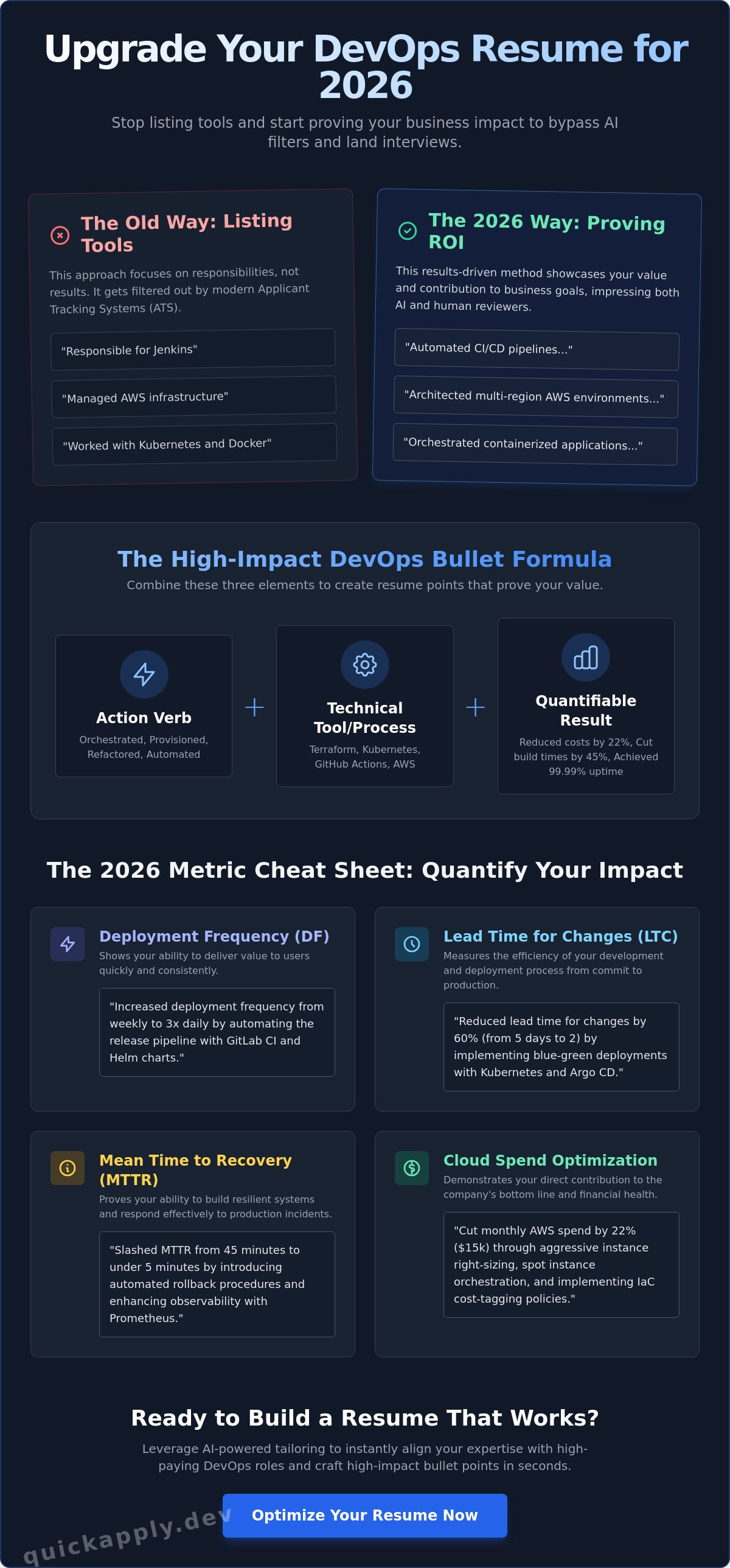
Stop listing tools as nouns. Your resume isn't a hardware inventory; it's a performance report. In 2026, AI screeners ignore candidates who were merely "responsible for" a stack. They hunt for architects who use tools as mechanisms for business growth. To get past the filters, you must align your experience with core DevOps principles that prioritize speed, reliability, and measurable outcomes. If you're still writing "Responsible for Jenkins," you're failing the first test. Shift your focus. You didn't just "use" Jenkins; you automated CI/CD pipelines to eliminate manual bottlenecks.
The 2026 DevOps Formula is mandatory: [Action Verb] + [Technical Tool/Process] + [Quantifiable Result]. If a bullet point lacks one of these elements, it's dead weight. AI algorithms prioritize impact verbs because they correlate with high-performance engineering cultures. They look for "orchestrated," "provisioned," and "refactored" rather than "assisted" or "monitored." Your devops engineer resume bullet points must prove you understand the "why" behind the "how."
The DevOps ROI Formula
The Action-Context-Result (ACR) framework transforms daily tasks into career-defining achievements. Start with a punchy verb. Follow with the specific environment, such as Kubernetes 1.36.1 or Terraform 1.15.6. Finish with the data. Most engineers struggle to find "hidden" metrics. Look at your last sprint. Did you reduce build times? Did you cut cloud costs? A weak bullet says, "Managed AWS infrastructure." An optimized bullet says, "Architected multi-region AWS environments using Terraform to achieve 99.99% uptime during peak traffic."
Quantifying Your Impact: The 2026 Metric Cheat Sheet
High-performing teams live by DORA metrics. Use them. Senior roles require proof of systemic improvement. Focus on Deployment Frequency (DF) and Lead Time for Changes (LTC). These numbers tell a recruiter exactly how fast you move. Don't forget Mean Time to Recovery (MTTR). It's a senior-level differentiator that proves you can handle production fires. For cost-aware organizations, phrase your cloud spend optimization as a percentage of the total budget. "Reduced monthly AWS spend by 22% through aggressive right-sizing and spot instance orchestration" beats "Reduced cloud costs" every time. Efficiency is the only currency that matters in 2026. Use it to build your devops engineer resume bullet points and secure your next interview.
DevOps Bullet Points for CI/CD and Pipeline Automation
Manual deployments are a liability. In 2026, high-performance engineering teams demand "zero-touch" pipelines where code moves from commit to production without human interference. When crafting your devops engineer resume bullet points, you must emphasize your ability to orchestrate these complex workflows rather than just executing isolated tasks. Recruiters want to see how you built the engine, not just how you turned the key. Your narrative should focus on the transition from fragile, manual builds to robust, automated delivery systems that scale with the business.
A comprehensive DevOps engineer resume guide will highlight that quality gates are non-negotiable. You need to show how you integrated automated testing and vulnerability scanning into the pipeline. With 41% of QA teams now evolving into Quality Engineering (QE) units, your resume must reflect this shift. Describe how you enforced standards at every stage, ensuring that only high-quality, secure code reaches your users. If you need help visualizing how to structure these achievements, look at these good resume examples for inspiration.
Build and Release Orchestration
Optimization is the name of the game for Jenkins 2.567, GitLab CI, and GitHub Actions. Don't just say you "managed" them. Instead, describe how you refactored them for speed. Mention containerized builds using Docker 29.5.3 and multi-stage pipelines that strip away bloat. A high-impact bullet point looks like this: "Reduced CI/CD build times by 45% by implementing layer caching and multi-stage Docker builds within GitHub Actions." This proves you understand resource efficiency and developer productivity. If your current document lacks this level of detail, consider tailoring your resume to highlight these specific technical wins.
Deployment Strategies (Blue/Green, Canary)
Proving expertise in zero-downtime methodologies separates the juniors from the seniors. Use your devops engineer resume bullet points to showcase GitOps-driven delivery with tools like ArgoCD 3.4.3 or Flux. Quantify how these strategies improved system stability. For example: "Orchestrated Canary deployments using ArgoCD 3.4.3, resulting in a 30% reduction in deployment-related production incidents." This shows you don't just ship code; you protect the production environment. Highlight your ability to manage risk through automated rollbacks and progressive delivery, proving you are a guardian of system reliability.
Infrastructure as Code (IaC) and Cloud Orchestration Bullets
Infrastructure isn't a static asset. It's a dynamic, version-controlled system. In 2026, listing "AWS" as a skill is insufficient. Your devops engineer resume bullet points must emphasize infrastructure scalability and programmatic control. You treat environments as software products. This requires versioning, peer reviews, and automated testing. Focus on the "Code" in Infrastructure as Code. Show recruiters you don't just click buttons in a console; you write the scripts that build the world. This approach eliminates human error and guarantees consistency across every deployment stage.
Efficiency drives the modern cloud. Every bullet point should prove you reduced friction. If you're applying for a role that demands specific provider expertise, you'll need to focus on their unique services. Learning tailoring your resume to a job description is the fastest way to ensure your IaC wins match the hiring manager's stack and the specific needs of their architecture.
Terraform and Ansible Automation
Modular code is the gold standard for modern infrastructure. Don't describe a one-off setup. Describe a reusable system that empowers other developers and scales without manual intervention. Use these high-impact examples to demonstrate your technical depth:
- Engineered modular Terraform 1.15.6 and OpenTofu 1.12.1 providers to standardize environment provisioning across three global business units.
- Orchestrated configuration management for 500+ heterogeneous nodes using Ansible, achieving a 95% reduction in manual patching efforts.
- Optimized CI/CD for infrastructure, reducing the lead time for environment spin-up from 3 days to under 15 minutes through automated validation.
- Refactored legacy CloudFormation templates into reusable Terraform modules, increasing infrastructure consistency by 40% across the organization.
Cloud Migration and Multi-Cloud Strategy
Cloud costs are rising. FinOps is now a core DevOps competency. Your resume must reflect cost-aware delivery and strategic migration. Prove you can manage complex, multi-cloud environments while maintaining a lean budget. Focus on these outcomes:
- Executed a multi-region AWS migration strategy for 200+ microservices, leveraging Reserved Instances and Spot Instances to cut annual spend by $120,000.
- Designed hybrid-cloud architectures using GCP Anthos to manage containerized workloads across on-prem and public cloud environments seamlessly.
- Implemented automated right-sizing scripts that identified underutilized resources, reclaiming 20% of the monthly cloud budget without impacting application performance.
- Managed cross-cloud security protocols using HashiCorp Vault to centralize secrets management for Azure and AWS environments, reducing credential exposure risk.
Quantifying Reliability: Monitoring, Security, and SRE Metrics
Reliability is a feature, not a byproduct. In 2026, maintaining "99.9% uptime" is the bare minimum. It's a "keep the lights on" metric that fails to impress high-growth tech firms. Your devops engineer resume bullet points need to showcase how you evolved system resilience through observability and automated governance. Don't just list tools; prove you reduced the noise. With only 18% of critical dependency vulnerabilities remaining critical after severity adjustment, your value lies in filtering the signal from the noise to focus on high-impact remediations. Maintenance is a cost center. Reliability is a competitive advantage.
Modern Site Reliability Engineering (SRE) demands a proactive mindset. You must prove you can fix things before they break using predictive monitoring and strict error budget management. Recruiters are hunting for engineers who understand SLIs and SLOs as business drivers. If your current document feels like a list of alerts rather than a record of reliability, use our Resume Tailoring service to refocus your impact on senior-level metrics that matter to hiring managers.
Observability and Incident Response
Monitoring tells you when something is broken. Observability tells you why. Use your resume to highlight your mastery of Prometheus 3.12.0 and Grafana 13.0.2. Focus on these high-velocity outcomes:
- Engineered centralized logging using the EFK stack, reducing root-cause analysis time by 60% across 40+ microservices.
- Configured automated alerting thresholds in Datadog, decreasing Mean Time to Recovery (MTTR) by 35% during high-traffic events.
- Designed executive-level Grafana 13.0.2 dashboards to visualize SLIs and SLOs, providing real-time transparency into system health for stakeholders.
- Implemented predictive scaling policies based on custom Prometheus metrics, preventing performance degradation during 3x traffic spikes.
DevSecOps and Compliance
Security is no longer a separate department. It's a pipeline requirement. Shifting security left means integrating vulnerability scanning into the developer's daily workflow. Prove you can secure the perimeter without slowing down the ship:
- Integrated Snyk and Aqua Security into GitHub Actions, identifying and remediating 90% of vulnerabilities before they reached the production environment.
- Automated IAM policy audits to enforce least-privilege access, eliminating over 150 redundant permissions across AWS accounts.
- Streamlined SOC2 compliance by implementing automated infrastructure auditing scripts, reducing manual audit preparation time by 80%.
- Orchestrated automated secrets rotation using HashiCorp Vault, eliminating hardcoded credentials across 20+ legacy applications.
Scaling Your Job Search with AI-Powered Resume Tailoring
Manual resume tailoring is a legacy process. It's the "manual build" of job hunting, a high-latency bottleneck that keeps high-performance engineers trapped in the application phase. You wouldn't deploy code without an automated pipeline, so don't deploy your career using outdated, manual methods. In 2026, the volume of applicants means Tier 1 ATS filters are more aggressive than ever. If your devops engineer resume bullet points don't align perfectly with the specific technical requirements of a job description, you're essentially shouting into a void. Efficiency isn't just about how you work; it's about how you get hired.
QuickApply treats your job search like a deployment pipeline. Our platform uses AI to analyze job descriptions and instantly map your technical expertise to the required stack. This ensures your "Match Score" is high enough to bypass automated gatekeepers and reach human recruiters. By automating this mapping, you maintain the integrity of your technical narrative while ensuring every keyword is optimized for the specific role. To strengthen your application further, use our AI cover letter generator to create a cohesive, professional package that mirrors the technical precision of your resume.
Beyond the Bullet Points: The Full Application Stack
Success in the 2026 market requires a synchronized digital presence. Your tailored resume must reflect your LinkedIn profile to ensure consistency when recruiters perform their due diligence. Use our Application Tracker to monitor your progress and identify which technical keywords are converting into interviews. Once you've mastered the art of the devops engineer resume bullet points and secured the call, transition seamlessly into interview practice. We provide the tools to handle real-time technical assessments and behavioral rounds with the same confidence you bring to a production incident.
Automate Your Career Growth
Stop wasting hours on repetitive editing. QuickApply empowers you to apply to 10 or more tailored roles in under 5 minutes, giving you a massive competitive advantage. Our platform doesn't just help you find your next job; it helps you plan your entire career trajectory. Leverage the Promotion Roadmap to identify the skills you need for Senior or Lead roles and track your progress toward your next salary milestone. Don't let manual tasks slow down your professional evolution. Stop manual editing; tailor your DevOps resume with QuickApply now and start operating at the speed of the modern web.
Automate Your Path to Senior Engineering
The transition from a technical contributor to a high-value architect depends on how you communicate your impact. You've learned to move beyond tool-dumping and embrace the ACR formula to prove business ROI. By focusing on modern DORA metrics and shifting security left, you've established yourself as a guardian of system reliability. However, even the most optimized devops engineer resume bullet points need a high-velocity delivery system to reach the right desks.
Don't let manual application bottlenecks throttle your career growth. You need a platform that mirrors the efficiency of your own pipelines. QuickApply provides AI-powered match scoring for tech roles and automated job application tracking to keep your search organized. Use our Promotion Roadmaps to map your journey toward senior leadership and lead roles. Tailor your DevOps resume for 2026 with QuickApply and stop fighting the system. Your next high-impact role is waiting for you to hit deploy. You've got the skills; now get the interview.
Frequently Asked Questions
How many bullet points should a DevOps resume have per job?
Stick to four to six high-impact bullets for your most recent role. Older positions should have fewer, typically two or three, focusing only on the most relevant technical achievements. Quality outweighs quantity. Each line must earn its place by proving you solved a specific bottleneck or improved a system metric.
What are the best action verbs for a DevOps engineer?
High-performance verbs include orchestrated, provisioned, refactored, and hardened. Avoid passive language like "assisted" or "helped." Use "automated" when describing manual process elimination and "migrated" for cloud transitions. These verbs signal a bias toward action and technical ownership that hiring managers prioritize in 2026.
How do I quantify my impact if I don't have access to company financial data?
Financial data isn't the only metric that matters. Use technical performance indicators like Deployment Frequency (DF), Mean Time to Recovery (MTTR), or Lead Time for Changes (LTC). You can also highlight resource efficiency, such as reducing CPU utilization by a specific percentage or cutting build times in half. These numbers prove ROI without requiring access to the company's ledger.
Should I list every tool I have ever used in my bullet points?
Avoid the "alphabet soup" trap. Only list tools that are relevant to the target job description or demonstrate your mastery of a specific domain. Listing 50 different tools suggests a surface-level understanding. Focus on your core stack to maintain a clear narrative of expertise and system-level thinking.
How do I optimize my DevOps resume for ATS in 2026?
Match your devops engineer resume bullet points to the specific keywords found in the job description. Use standard headings and a clean, single-column layout to ensure AI filters can parse your data correctly. Focus on the Action-Context-Result formula to ensure the ATS identifies both your skills and the impact of your work.
What is the difference between a DevOps engineer and an SRE resume?
DevOps resumes emphasize delivery velocity and the automation of the software development lifecycle. SRE resumes prioritize system reliability, error budgets, and incident response metrics. While the toolsets often overlap, the narrative of an SRE resume should focus on maintaining 99.99% uptime and reducing operational toil through engineering. Your devops engineer resume bullet points should instead focus on pipeline efficiency and developer empowerment.
Can I use ChatGPT to write my resume bullet points?
Use AI as a drafting tool, but never as the final editor. Generic AI output lacks the specific technical nuance and verifiable data required for 2026 engineering roles. You must verify every technical claim and ensure the tone matches your professional experience. AI can help you structure the ACR formula, but the specific metrics must be yours.
How do I describe a failed project on a DevOps resume?
Frame failed projects through the lens of post-mortem analysis and systemic growth. Describe the specific technical challenge, the root cause you identified, and the automated safeguards you implemented to prevent recurrence. This demonstrates maturity and a commitment to continuous improvement, which are essential traits for senior engineering leadership.


