

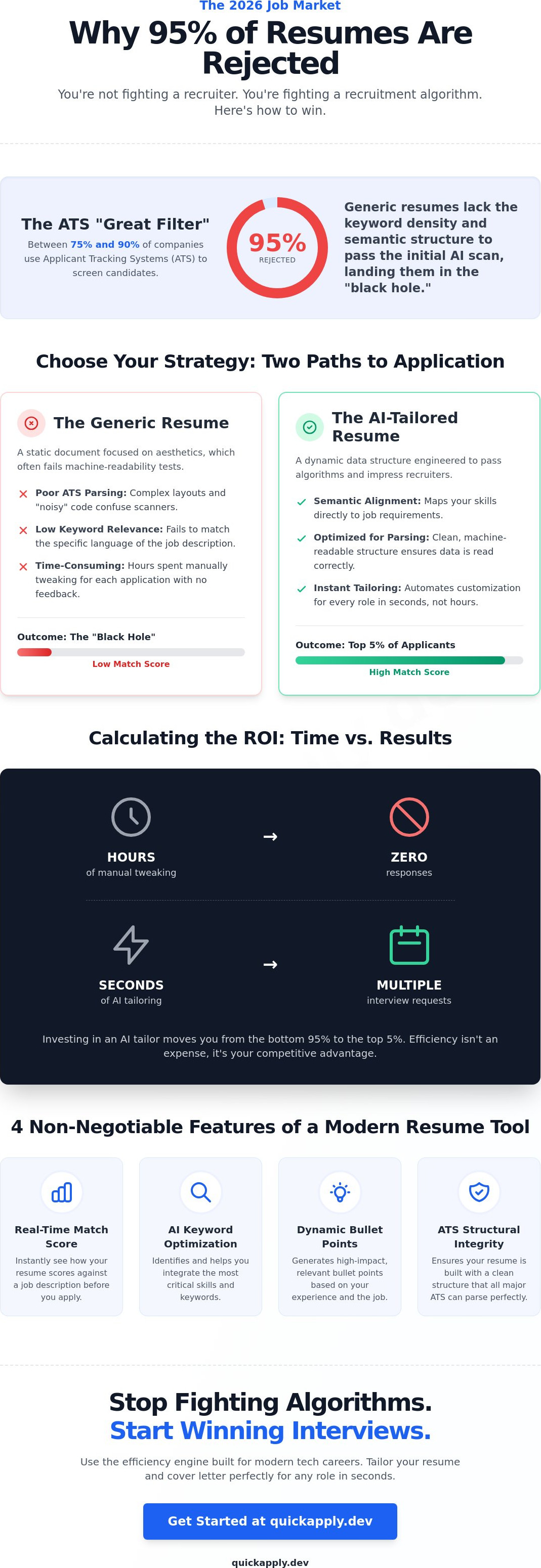
Between 75% and 90% of companies now use an Applicant Tracking System (ATS) to filter candidates before a human recruiter even looks at a screen. In this hyper-automated environment, you're likely asking: is it worth paying for a resume builder just to get past a bot? If you've applied to 100 jobs and received zero responses, the issue isn't your talent. It's the math. You're fighting a losing statistical battle against algorithms designed to favor optimization over raw experience.
We know the frustration of spending hours manually tweaking bullet points only to be met with silence. You want a resume that feels engineered for the role, not a generic template. This analysis discovers if paid tools deliver a genuine algorithmic advantage or if you're better off with free alternatives. We'll break down the 2026 ROI of automated resume tailoring and cover letter generation to see if these tools can actually boost your interview-to-application ratio. You'll learn how to stop wasting time and start deploying a high-impact strategy that connects your skills directly to the recruiter's filter.
Key Takeaways
- Stop fighting 2026's recruitment algorithms with static documents and learn why 95% of generic resumes are discarded by AI filters.
- Evaluate the "Time-to-Hire" metric to decide if it is worth paying for a resume builder that replaces hours of manual work with instant tailoring.
- Transition from aesthetic-focused layouts to semantic alignment tools that map your tech skills directly to specific job description requirements.
- Master the four non-negotiable features every professional needs to pass a direct ATS parsing test and secure high-impact interviews.
- Optimize your workflow using an efficiency engine that automates tailoring for everything from FAANG roles to high-growth startups in seconds.
The 2026 Job Market: Why Generic Resumes are Dead on Arrival
The 2026 job market operates on a brutal reality. AI-driven recruitment filters now discard 95% of applications before a human eyes them. If you're sending the same PDF to every opening, you're essentially volunteering for the trash bin. A modern resume builder is no longer a layout tool for choosing fonts. It's an optimization engine. It's the difference between a static document and a high-performance data structure designed to satisfy a specific algorithm.
Looking back at the history of the résumé, the goal was simple storytelling. Today, that narrative has been replaced by semantic alignment. One-size-fits-all resumes trigger immediate rejection in high-volume tech roles because they lack the specific keyword density and structural hierarchy required by modern ATS. You're not writing for a person. You're writing for a machine that ranks you based on statistical relevance.
The Rise of the 'Black Hole' Application
Recruiters are currently buried under a mountain of AI-generated application spam. To cope, they've implemented stricter filters that rely heavily on Match Scores. This score determines exactly where you appear in a recruiter's dashboard. If your score is low, you're invisible. Using generic templates often results in poor parsing, where the system fails to recognize your actual skills. This creates a "black hole" where qualified candidates disappear because their data wasn't structured for the scanner. You're losing jobs you're perfectly qualified for because your document isn't machine-readable.
Free vs. Paid: The Illusion of Choice
Many candidates wonder: is it worth paying for a resume builder when free options exist? The answer lies in the underlying code. Free tools often produce "noisy" HTML or complex CSS that breaks ATS scanners. You see a pretty layout; the machine sees a garbled mess. There's also the hidden cost of "free." These platforms often survive by selling your professional data to third-party aggregators. You aren't the customer. You're the product.
Investing in a paid tool ensures structural integrity and data privacy. A good resume example in 2026 isn't just about what's on the page. It's about how that data is packaged for the digital ecosystem. When asking is it worth paying for a resume builder, consider the cost of silence. If a paid tool moves you from the bottom 95% to the top 5% of the pile, the ROI is immediate. Efficiency isn't an expense. It's a competitive advantage.
Resume Builders vs. AI Tailors: Understanding the Value Gap
Most candidates treat their resume like a static marketing brochure. In 2026, that's a tactical error. When deciding is it worth paying for a resume builder, you must distinguish between a template tool and an optimization engine. Standard builders focus on the "Pretty" resume. They offer elegant fonts and clean PDF exports that look impressive to humans but provide zero assistance with algorithmic filters. AI tailors focus on the "Effective" resume. They prioritize semantic alignment and data hierarchy, ensuring your document speaks the specific language of the job description.
A major pitfall for tech pros is the "ChatGPT Problem." Using raw AI prompts often results in hallucinated skills and generic fluff that recruiters easily detect. To truly AI-proof your resume, you need a system that maps your actual experience to the job's requirements without sacrificing authenticity. Layout matters far less than how your data is structured for machine consumption. If the ATS can't map your skills to its internal database, your design choices are irrelevant.
The Anatomy of a High-Tech Resume Builder
Modern tools provide real-time feedback loops that show your Match Score as you edit. This isn't just a gimmick; it's a direct reflection of how a recruiter's dashboard will categorize you. Advanced platforms use dynamic bullet point generation based on hard data from the job description. This ensures your resume tailoring for tech jobs is precise and relevant. You get the speed of automation with the accuracy of a custom-built document. Stop guessing what keywords to include and start using a system that verifies your relevance instantly.
Static vs. Dynamic: Why You Need 50 Versions, Not One
The 2026 strategy is simple: one application, one custom resume. Sending a generic document to 50 companies is a waste of bandwidth. You need 50 distinct versions of your professional story. Software handles this version control nightmare by organizing your history into a single source of truth and deploying tailored variations in seconds. There is a massive technical difference between a formatted document and a tailored one. A tailored document uses job-specific skill mapping to ensure you rank at the top of the pile every single time. You can start building your tailored resume library today to gain this competitive edge.
When you ask is it worth paying for a resume builder, consider the cost of manual labor. Manually mapping 50 job descriptions to a single resume takes weeks. An AI tailor does it in minutes. You're paying for the ability to scale your job search without compromising on quality.
Calculating the ROI: Is the Subscription Worth Your Time?
Stop viewing a resume builder as a monthly expense. It's a high-yield productivity investment. When you ask is it worth paying for a resume builder, you need to calculate your specific Time-to-Hire metric. For a tech professional earning an average salary of $150,000, a single month of unemployment costs $12,500 in lost wages. If a tool shortens your job search by just one week, it has effectively "earned" you over $3,000. The math is simple. The cost of the software is a rounding error compared to the cost of a prolonged search.
Manual tailoring is a massive time sink. Spending 2 hours meticulously mapping your experience to a job description is a legacy workflow. An AI-powered engine completes this task in 30 seconds. If you apply to 20 targeted roles, you're choosing between 40 hours of manual labor or 10 minutes of automated optimization. Your time is better spent on technical interview practice or networking. Opportunity cost is the silent killer of tech careers. In 2026, premium roles often close within 48 hours of posting. If you can't deploy a tailored application instantly, you've already lost the race to a faster candidate.
The Tech Professional's Math
Consider the hourly rate calculation. If your time is worth $75 per hour, saving just 10 hours a month via automation delivers $750 in value. A $20 or $30 subscription pays for itself 10x over before you even land an interview. Career automation ROI is the ratio of reduced time-to-hire against tool cost, a vital metric in a market where 80% of enterprise software vendors have embedded GenAI to filter candidates instantly. You aren't just buying a document. You're buying the speed required to compete with other high-velocity applicants.
Beyond the Resume: The Ecosystem Advantage
The value proposition extends far beyond the initial PDF export. Modern platforms provide an integrated ecosystem designed to manage the entire lifecycle of your search. You gain access to application trackers that eliminate the need for manual spreadsheet management. This centralizes your data and ensures no follow-up falls through the cracks. Most premium subscriptions now bundle several high-impact tools into one workflow:
- Interview Practice: AI-driven simulations tailored to specific tech stacks.
- Salary Negotiation Guides: Data-backed frameworks to maximize your total compensation package.
- Promotion Roadmaps: Strategic planning tools to help you secure your next internal level-up.
This isn't a one-time purchase for a single job hunt. It's a long-term career management system. Using these tools for salary negotiation alone can result in a five-figure bump in your starting offer. When you look at the total package, the question isn't is it worth paying for a resume builder, but rather how much it's costing you to operate without one.
How to Vet a Resume Builder: 4 Non-Negotiable Features
Not all software is created equal. If you're still asking is it worth paying for a resume builder, the answer depends entirely on the feature set. A tool that just provides a pretty layout is a glorified word processor. You need a system built for the 2026 technical landscape. To secure a competitive edge, prioritize these four non-negotiable pillars of career automation.
- Direct ATS Parsing Test: Between 75% and 90% of companies use an ATS to screen you. Your builder must produce clean, machine-readable code. If the tool can't show you exactly how a bot "sees" your text, don't use it.
- Real-Time Match Scoring: You shouldn't have to guess your relevance. High-tier builders provide a live score that updates as you edit. This score tells you precisely why you're a fit, or where your data structure is lacking compared to the job description.
- One-Click Tailoring: Speed is your primary weapon. You need the ability to generate 10 tailored versions of your resume in 10 minutes. If the process takes longer, the software is failing its core mission of efficiency.
- Integrated Application Tracking: Stop using fragmented spreadsheets. A professional builder should manage your entire funnel, tracking every version sent and every response received in one centralized dashboard.
When you audit your current job search workflow, these features represent the difference between high-volume success and manual burnout.
Red Flags to Avoid in 2026
Avoid builders that prioritize aesthetics over architecture. Over-designed graphics, multi-column layouts, and complex tables often "break" when read by text-based scanners. This results in a garbled profile that gets automatically rejected. Be wary of tools that don't allow for instant export to standard Docx and PDF formats. Finally, stay away from legacy systems that rely on "keyword stuffing." Modern algorithms look for semantic relevance and skill mapping, not just a list of buzzwords hidden in white text.
The 'AI Authenticity' Test
The is it worth paying for a resume builder debate often centers on quality. You must maintain a "Human-in-the-loop" workflow. Avoid the best ai resume builders that don't let you audit and edit the AI's claims. Hallucinated skills are a fast track to a failed interview. Your tool should suggest, but you must verify. Privacy is equally critical. Ensure your data is stored in encrypted environments and isn't being sold to third-party recruiters. You're paying for a service, not to become a data point for advertisers. Demand a tool that respects your technical expertise and your personal security.
QuickApply: The Efficiency Engine for Modern Tech Careers
QuickApply represents the definitive answer to the question: is it worth paying for a resume builder? It is not just a layout tool. It is a high-velocity job search command center. While legacy builders focus on static aesthetics, QuickApply functions as a comprehensive optimization engine. It replaces fragmented spreadsheets and manual workflows with a unified, data-driven system. You stop managing a document and start executing a high-impact career strategy.
The platform handles the heavy lifting of automated tailoring for tech roles at every scale. Whether you're targeting FAANG giants or high-growth startups, the system generates custom assets in seconds. This speed allows you to be the first to apply when new roles drop, a critical advantage in a market where 80% of enterprise software vendors have integrated AI filtering. By using semantic mapping instead of simple keyword stuffing, you ensure your experience is structured to rank at the top of any recruiter's dashboard.
The power of the Match Score provides a level of transparency previously unavailable to candidates. You see your odds before you hit "Apply." This real-time feedback loop allows you to refine your profile until it meets the specific threshold required by the algorithm. You're no longer shouting into a void. You're deploying a precision-engineered application that is statistically optimized for visibility.
Why QuickApply Wins in 2026
QuickApply was built by tech pros for tech pros who value speed and precision. It is currently the only tool that combines advanced AI tailoring with a real-time application tracker. This integration eliminates the friction of switching between different platforms. The focus remains strictly on "low-effort, high-volume" output that actually converts into interviews. You gain the ability to scale your job search without sacrificing the quality of your professional narrative. The math is clear: when you automate the tedious parts of the process, your interview-to-application ratio increases while your time-to-hire drops.
Start Your Optimized Search Today
Stop building resumes. Start executing a job search strategy. The 2026 market doesn't reward the most patient applicant; it rewards the most efficient one. Join the thousands of engineers, developers, and students who have already automated their path to interviews. QuickApply provides the ecosystem you need to manage your entire career lifecycle, including integrated tools like:
- Salary Negotiation Guides: Data-backed frameworks to maximize your total compensation.
- Promotion Roadmaps: Strategic planning to secure your next internal level-up.
- Interview Practice: Technical simulations tailored to your specific stack.
When you consider the salary bump from landing a better-fitting role, the question of is it worth paying for a resume builder becomes a matter of simple ROI. Don't leave your career to chance. Optimize your tech resume with QuickApply now and take command of your professional future.
Master the Machine and Secure Your Technical Edge
The 2026 job market is an algorithmic battlefield where manual effort is a liability. You aren't just looking for a job; you're optimizing a data pipeline. When you evaluate is it worth paying for a resume builder, remember that you're investing in a distinct competitive advantage. You need a tool that bridges the gap between your real-world expertise and the digital filters designed to hide you. Efficiency is the only metric that matters in a high-speed search.
Use AI-powered Match Scores to verify your relevance before a recruiter even opens your profile. Automate your application tracking to eliminate administrative drag and keep your funnel full. This isn't about shortcuts. It's about using the same high-tech systems that enterprise companies use to screen you. You've built the skills. Now, use the right engine to deploy them and secure the compensation you deserve.
Stop wasting time and start tailoring with QuickApply. Your next breakthrough role is just one optimized click away. Take command of the process and let the technology work for you.
Frequently Asked Questions
Is it worth paying for a resume builder if I'm a student?
Yes, students gain a significant advantage by using professional builders to bridge the gap between academic projects and industry requirements. Since you likely have less work history, a builder helps you identify and map transferable skills that trigger ATS filters. It ensures your first applications aren't part of the 95% discarded before a human review, making the investment a smart move for your early career trajectory.
Can recruiters tell if I used an AI resume builder?
Recruiters care about the accuracy and relevance of your data, not the tool used to format it. High-quality builders allow for human-in-the-loop editing, which prevents the generic fluff or "hallucinated" skills associated with raw AI prompts. In 2026, using an optimization engine is seen as a sign of technical literacy and efficiency rather than a shortcut to be penalized.
Do paid resume builders actually help with ATS ranking?
Paid platforms provide a direct boost to your ranking by using semantic alignment and machine-readable code. When asking is it worth paying for a resume builder, consider that these tools provide real-time match scoring. This feature tells you exactly how to structure your data to appear at the top of a recruiter's dashboard, effectively bypassing the "black hole" of automated rejection.
How much should a good resume builder cost in 2026?
Market rates for professional tools generally range from $10 to $50 per month depending on the depth of AI features. Some platforms offer low-cost trials for around $2 to $3, while comprehensive career command centers might sit at the higher end of that scale. The cost is negligible when compared to the thousands of dollars in lost wages incurred during a prolonged job search.
Is a paid builder better than using ChatGPT for my resume?
Dedicated builders are superior because they provide structural integrity that raw LLMs lack. While ChatGPT can write text, it often produces "noisy" code that breaks ATS scanners or hallucinates technical experience. A professional builder maps your actual history to specific job descriptions using verified data structures, ensuring your document is both authentic and machine-optimized.
What happens if I cancel my resume builder subscription after I get a job?
Most users cancel once they've secured a role, but you may lose access to your dynamic version history and tracking data. Many professionals choose to keep a basic tier active to utilize features like a Promotion Roadmap or Salary Negotiation Guide. These tools are vital for internal level-ups and ensuring your compensation remains competitive throughout your tenure.
Can a resume builder help with career transitions or industry changes?
Builders are exceptionally effective for transitions because they excel at cross-functional skill mapping. The software analyzes your target industry's job descriptions and highlights relevant experience you might have overlooked. This capability makes the question is it worth paying for a resume builder a clear "yes" for anyone trying to pivot into a new tech stack or role.
Do paid resume builders offer cover letter generation too?
Premium platforms include Cover Letter Generation as a standard feature to ensure your entire application is semantically aligned. The system uses the same job description analysis from your resume to build a consistent narrative across all your documents. This saves hours of manual writing and ensures every part of your package is engineered to pass the initial filter.


