

A rejection isn’t a permanent block. If you’re asking whether it is okay to re-apply for a job at the same company, yes, when you have a strong reason to try again. For the same job, wait about a week before reapplying; after an interview rejection, consider waiting 3-6 months unless the recruiter invites you to apply sooner. There’s no useful one-size-fits-all application count: timing and what has changed matter more.
It’s frustrating to see a role reposted after you’ve already invested time in applying. But a new listing, stronger qualifications, or a different opening can make it worthwhile to apply again. Reapplying without new information or a clear reason is less likely to help.
Learn when to apply again, whether to contact the recruiter, how to assess a reposted role, and how often to apply. The key is to make each application a deliberate update, not just another submission.
Key Takeaways
- Before applying again, follow any waiting-period instructions from the recruiter and send one focused message if you’ve already built a connection.
- When a role reappears, compare its job ID, hiring manager, location, and requirements to see whether it’s a new opening or a repost.
- After an interview rejection, use what you learned to strengthen your application; a rejection for one role doesn’t automatically rule out another at the company.
- There’s no universal application limit. Reapply when something meaningful has changed, and avoid sending repeated applications without a clear reason.
1. Should you email the recruiter before reapplying?
Yes, if you’ve already spoken with the recruiter or interviewed. Send one concise email before submitting another application. Mention the role, your earlier application, and what has changed since then, such as new experience that directly matches the job requirements. If you were given a waiting-period instruction, follow it before contacting them.
Timing depends on where you left the process. For the same job, wait about a week before reapplying. After an interview rejection, consider waiting 3-6 months unless the recruiter invites you to apply sooner. Some companies, especially big tech companies, may wait about 1 year before interviewing candidates they previously rejected. Check the recruiter’s instructions and the employer’s stated policy first.
Use this workflow to keep your next move focused:
- Review the rejection or withdrawal message for a waiting period or invitation to return.
- Compare the role’s requirements with your current experience, skills, and qualifications.
- Update your resume and cover letter with relevant changes, while keeping employment dates and official job titles consistent.
- Email your previous contact once, if you progressed reasonably far, and explain your continued interest briefly.
- Apply through the company’s process when eligible, then record the submission and follow-up in your tracker.
Reapply when you can make a stronger case, not simply because the application remains open. A new skill, degree, certificate, or corrected application detail gives the recruiter something concrete to reassess. If you use the same resume and cover letter, check that they still match the role’s requirements. Tailor the resume to the top 5 requirements and make your fit clear quickly.
You can reapply after withdrawing an application or declining a job offer. In your message, say that you previously withdrew or declined, then explain why you’re interested again. A brief, direct note helps the recruiter understand what changed without repeated emails or unexplained applications.
2. Distinguishing a reposted job from a new opening
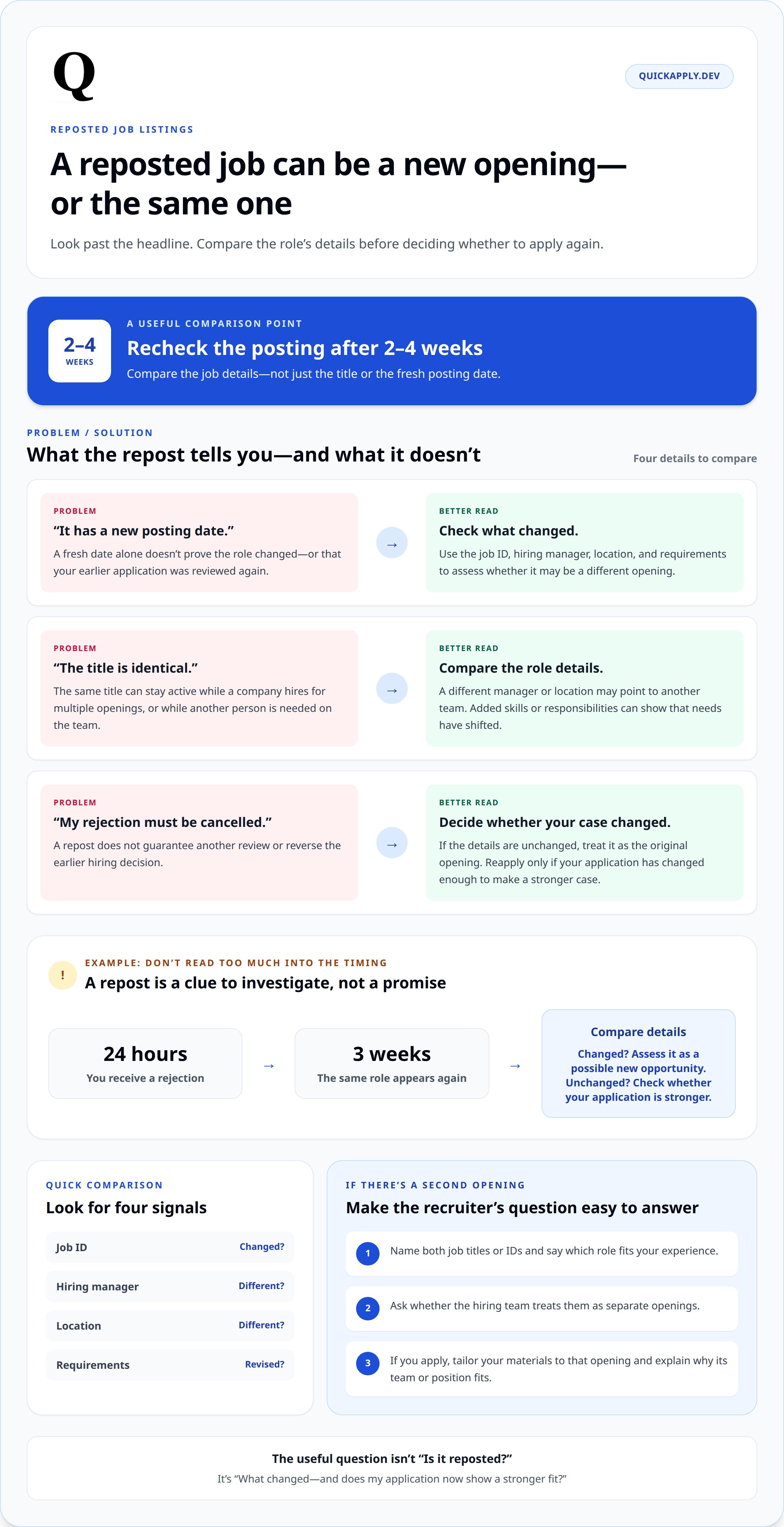
A repeated listing can represent another vacancy, not a recycled decision. A company hiring for multiple engineering openings may keep one description active while filling them. The job title can stay the same even when the team needs another person. Compare the details, not just the headline. A fresh posting date alone doesn’t prove the role has changed or that your earlier application was reviewed again.
After 2-4 weeks, compare the job ID, hiring manager, location, and requirements. A changed job ID may signal a new requisition, while a new manager or location can point to a different team. Revised requirements matter too: added skills or responsibilities may show the employer has adjusted its needs. If those details remain the same, treat the listing as a repost of the original opening. Your earlier application could help or hurt with the same team and hiring staff.
Consider this example: you receive a rejection within 24 hours, then see the same role reposted three weeks later. Don’t assume the repost cancels the decision or guarantees another review. Check whether the job ID or hiring details changed. If they did, assess the opening as a possible new opportunity. If not, decide whether your application has changed enough to justify another submission.
If the company lists a second opening, contact the recruiter with a specific question. Name both job titles or IDs, explain which role fits your experience, and ask whether the hiring team treats them as separate openings. Keep the message focused on your fit, not on challenging the earlier decision. For example, a software engineer could explain how recent project work matches the newly listed team’s requirements.
Apply to the second role when its requirements align with your background, and tailor your materials to that opening. Your cover letter should explain why that team or position fits, rather than repeat your previous application unchanged. Tracking job IDs, teams, and application dates helps you avoid duplicate submissions and gives the recruiter a clear picture of your interest.
3. What if you were rejected after an interview?
An interview rejection closes one decision, not every future opportunity. You can apply again if the company considers you a good match for another opening. Rejection from one position doesn’t automatically prevent you from pursuing a different role there. Focus your next application on a clear fit, not on reversing the earlier decision.
Explain your renewed interest directly. In your cover letter, acknowledge the previous application and say what draws you to this role now. Then connect your experience to its requirements. For example: “After interviewing for the analyst position, I remained interested in the company’s work. This operations role matches my recent experience improving reporting workflows.” Keep the explanation brief and forward-looking.
Give the hiring team evidence that your candidacy has developed. Review what you learned from the earlier process, then strengthen the resume or cover letter where it addresses the role. If a technical test exposed a skills gap, describe relevant projects or training that show progress. A reported candidate returned a month after failing a technical test, retook it, and was hired. Another person reported getting their previous role within six months of rejection. These are individual outcomes, not a timetable or promise.
Multiple applications can make sense when each role is a distinct fit. Name both positions only if it clarifies your interest, then explain how each matches different skills. For instance, a candidate might pursue a product analyst role for data experience and a research role for user-study work. Don’t submit the same materials unchanged; tailor each application to its responsibilities and team.
Before sending another application, use this three-part check: identify what changed, show how it strengthens your fit, and explain why this specific role appeals. If you can’t give a concrete answer to each point, wait until you have a stronger case. That turns a repeat submission into a focused next move.
4. How Many Times to Apply to the Same Company
There’s no universal application limit for one company. The useful limit is the point where another submission adds no new evidence. Apply again when a role is reposted, your qualifications have improved, or you’ve corrected important application information. For example, a new certification can strengthen your fit for a technical opening.
Think in terms of relevant opportunities, not repeated attempts at one unchanged vacancy. A different team or hiring manager may assess your application independently. If you find two roles with distinct requirements, apply to both when your experience genuinely fits each. Tailor your materials to the responsibilities instead of sending identical applications across the company.
Before each submission, use a simple decision test: identify what’s different, show how it strengthens your candidacy, and connect it to the role. A new project could support an application for a product position; added customer research experience might better fit a research opening. If you can’t identify a meaningful change or role-specific match, pause instead of resubmitting automatically.
Repeated applications can become counterproductive when they target the same unchanged listing without new information. Avoid bombarding hiring managers with follow-up emails or duplicate submissions. Keep a record of each job title, team, application date, and update. That makes it easier to spot whether you’re pursuing a genuinely new opportunity or repeating the same application without improving it.
Use the same standard after a rejection: each application should have a clear reason to exist. A reposted listing, stronger qualifications, or a separate role can justify another attempt. Make the difference visible in your resume and cover letter, then submit through the company’s process. To sharpen your case for a specific opening, prepare a role-specific cover letter that connects your experience to its requirements.
QuickApply
QuickApply helps turn a deliberate reapplication plan into clear, organized action. Tailor your resume and cover letter to a specific opening, keep applications organized with the application tracker, and prepare for interviews. That’s useful when pursuing a reposted role or applying to different teams, because each submission can reflect the position rather than repeat the same materials.
Keep your job titles, employment dates, and qualifications consistent while making relevant experience easy to spot. Track each role and application so you can distinguish a new opportunity from a duplicate submission. Use interview practice to prepare a focused explanation of why you’re interested again and what makes you a fit now.
If you’d like support organizing your next application, contact QuickApply.
Make Your Next Application Count
Whether it’s okay to re-apply for a job at the same company depends less on the number of attempts than on the strength of your next case. Treat each application as a fresh opportunity to show how your experience fits the role today. A clear reason for applying again helps you move forward with purpose instead of getting stuck on an earlier decision.
Before you submit, make your materials reflect the specific opening and prepare to explain your interest with confidence. QuickApply can help you organize that next step and build a focused application. Get application help from QuickApply and keep your job search moving. Your next application can be sharper, more intentional, and ready to show what you bring.
Frequently Asked Questions
How many times can you apply to the same company?
Yes, it can be okay to re-apply for a job at the same company when each application has a clear purpose. There’s no universal application cap. Treat each opening as a separate decision: apply when your skills fit its requirements, and avoid sending duplicate applications for the same unchanged vacancy. Keep a record of the role and team so you can spot overlap.
How long should you wait before applying again?
For the same job, wait about a week before reapplying. After an interview rejection, consider waiting 3-6 months, unless the recruiter invites you to apply sooner. Any stated waiting period takes priority over a general timeline. If you’re applying to a different role, assess its fit separately and follow the employer’s instructions for that application.
How do you tell whether it’s the same job or a new posting?
Compare the job ID, hiring manager, location, and requirements. A different team or substantially different responsibilities can indicate a separate opening, even if the title looks familiar. For example, a “software engineer” listing focused on infrastructure may differ from one focused on product development. Check the full description, not just the title or posting date.
Should you email the recruiter before reapplying?
Email the recruiter if you’ve already had direct contact, especially after an interview or substantive conversation. Keep the note brief: identify the role, refer to your earlier discussion, and state what you’re asking. For example, ask whether a reopened listing represents a new opening. Avoid sending repeated messages; one concise email gives the recruiter context without adding noise.
Should you mention that you applied before?
Yes, mention the earlier application when it helps explain your interest or gives the recruiter useful context. In a cover letter, a short line such as “I previously interviewed for the analyst role and remain interested in contributing to the team” is enough. Then focus on the current position’s needs. Don’t make the previous rejection the main point.
What if you were rejected after an interview?
You can pursue another suitable opening after an interview rejection. Use what you learned from the earlier process to prepare a stronger, more specific case, such as refining how you explain a project or answer a role-related question. If you apply to a different team, show why that position fits your experience. Rejection from one position doesn’t automatically bar you from another.


