

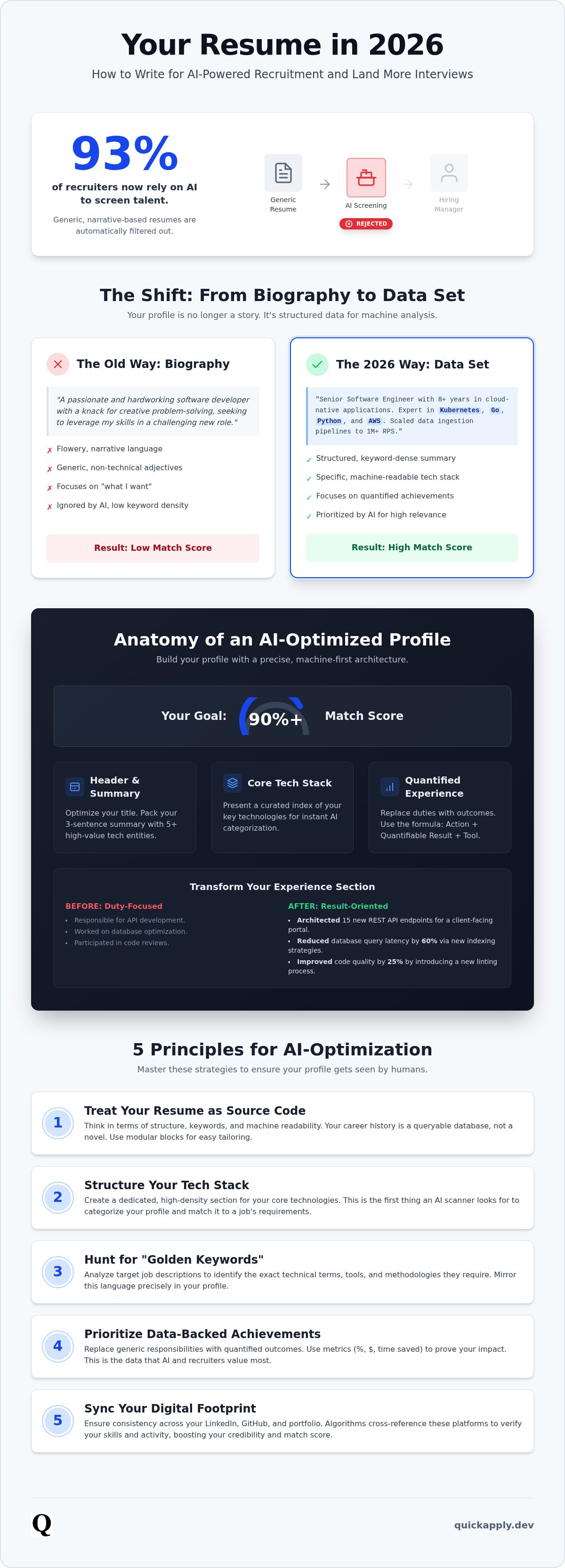
In 2026, your resume profile isn't a biography. It's a structured data set designed to trigger a high Match Score in a recruitment algorithm. With 93% of recruiters now relying on AI to screen talent, your opening statement is the source code that determines if a human ever sees your work. If you're still using generic objectives, you're essentially invisible to the bots. You need high-impact resume profile examples for tech jobs that satisfy both the neural networks and the hiring managers.
It's exhausting to spend hours manually tweaking bullet points only to receive an automated rejection minutes later. We know the frustration of feeling like a statistic in a crowded market. This guide will pull back the curtain on how modern systems parse your experience. You'll gain access to data-backed templates and optimization strategies that secure interview invites. We'll break down exactly how to format your skills to dominate the 2026 tech landscape and move your application to the top of the stack.
Key Takeaways
- Stop viewing your resume as a static document and start treating it as professional source code for AI indexing.
- Learn to structure your core tech stack for instant machine readability to bypass aggressive 2026 ATS filters.
- Analyze role-specific resume profile examples for tech jobs to identify the "Golden Keywords" required for your specific vertical.
- Replace generic responsibilities with data-backed achievements that recruitment algorithms prioritize during the screening process.
- Master a high-speed tailoring workflow that identifies keyword gaps in seconds to ensure a high Match Score for every application.
Defining the 2026 Job Profile: More Than Just a Digital Resume
The static PDF is a relic. In 2026, your professional identity must function as source code for automated recruitment systems. While The history of the resume focuses on human-readable summaries, modern tech hiring relies on machine-readable data sets. If your profile isn't optimized for indexing, you don't exist in the candidate pool. When reviewing modern resume profile examples for tech jobs, you'll notice a distinct shift toward high-density keyword blocks. AI-to-AI recruitment is the new standard. Your profile talks to their bot before a human ever enters the loop.
The Shift from Biography to Data Set
AI filters don't read; they scan for patterns. They prioritize technical keyword density and structured data over flowery narrative. Your profile must be parse-able by Large Language Models (LLMs) that categorize your skills into specific taxonomies. Use Markdown or JSON formats for your master repository to ensure no data is lost during the scraping process. This structure allows algorithms to map your potential to open roles with mathematical precision. A job profile is a strategic data asset for AI-driven hiring.
Digital Presence vs. Application Documents
Your master profile acts as a central repository. It isn't just a document; it's the engine that feeds tools like QuickApply for instant tailoring. Maintaining consistency across LinkedIn, GitHub, and your personal portfolio is non-negotiable. When these platforms sync, they create a high-fidelity digital footprint that boosts your Match Score. This score is the ultimate metric of your visibility in a crowded market. If your GitHub doesn't validate the claims in your resume profile, the algorithm will flag the discrepancy instantly.
Examining successful resume profile examples for tech jobs reveals a clear trend: high-conversion profiles use modular blocks of information. These blocks allow for rapid reconfiguration based on specific job descriptions. Instead of rewriting your history for every role, you simply toggle relevant technical modules. This methodology ensures your profile remains a dynamic asset rather than a stagnant file. It's about systemic automation, not manual labor. By treating your career history as a queryable database, you gain a massive competitive advantage. You move faster. You match better. You win more often.
The Anatomy of a High-Conversion Tech Job Profile
To win in 2026, your profile needs a precise architecture. It starts with a Core Tech Stack section. This isn't a list of every tool you've ever touched. It's a curated index for instant AI categorization. Algorithms prioritize this section to determine your initial relevance. If your stack doesn't align with the job description, you're filtered out before the first scan. High-conversion resume profile examples for tech jobs demonstrate this by placing technical skills in a machine-readable block at the very top.
High-performance profiles aim for a 90% Match Score. This isn't guesswork; it's about mirroring the technical requirements of the role through structured data. When building a comprehensive resume, ensure every entry serves the algorithm. You can check your current Match Score to see exactly where your profile falls short before you hit submit. This allows for rapid iteration based on real-time data rather than intuition.
The Header and Technical Summary
Optimize your title for the role you want next. If you're a mid-level dev aiming for leadership, label yourself as a "Senior Software Engineer" with a specialized focus. Your 3-sentence summary must be a high-density keyword environment. Include at least 5 tech entities like Kubernetes, Python, or AWS. Kill the fluff. Words like "passionate" or "hardworking" are dead weight. AI ignores them. Recruiters skip them. Focus on what you've built and the systems you've mastered.
The Experience Section: Result-Oriented Formatting
Stop listing duties. Start listing outcomes. Every bullet point follows a strict formula: Action Verb + Quantifiable Result + Tool Used. For example: "Scaled microservices architecture by 40% using Go and Docker." This provides the raw data recruiters need to justify your salary. Focus on the last 3 years. Research shows 81% of employers now prioritize skills-based hiring over old credentials. AI algorithms weight recent experience more heavily to ensure your technical skills are current and relevant.
Integrate your digital footprint directly. Link your GitHub contributions and peer-validated skills. In 2026, social proof acts as the verification layer for your claims. If you claim expertise in React, your public repositories should reflect that activity. Peer validation on professional networks adds a layer of trust that automated systems can index. This creates a multi-dimensional profile that proves your value through evidence, not just assertions. It's about building a profile that acts as a high-performance application engine.
Role-Specific Job Profile Examples: Software, Product, and Data
Generic templates fail because they lack technical depth. In 2026, AI filters categorize you by role-specific taxonomies. You need targeted resume profile examples for tech jobs that reflect your specific vertical. A Senior Full Stack profile must emphasize system design and scalability. In contrast, a Data Scientist profile should prioritize model accuracy and inference speed. Identifying the Golden Keywords for your vertical is the first step toward a high Match Score. These terms signal to the algorithm that you're current with industry shifts like LLMOps and edge computing.
The Software Engineer Profile Example
Priority lies in languages, frameworks, and system design contributions. Don't just say you "fixed bugs." That's low-value noise. Instead, say you "reduced latency by 40% using Go." This shows technical mastery and business impact. High-conversion profiles integrate links to GitHub repositories as live documentation. This allows recruiters to verify your code quality in seconds. For 2026, focus on keywords like "Distributed Systems," "Rust," and "WebAssembly" to signal you're ahead of the curve. These specific entities are what modern parsers look for when indexing top-tier talent.
The Product Manager and Data Analyst Profiles
PMs must highlight ROI metrics, stakeholder management, and roadmap delivery. Your profile should prove you can ship products on schedule while managing cross-functional teams. Mention specific methodologies like Agile or Shape Up. Data Analysts need to showcase SQL proficiency and visualization tools like Tableau or Looker. Focus on business intelligence impact. Use a hybrid tone that balances human leadership with AI-driven efficiency. This hybrid approach is critical for leadership roles where human judgment still makes the final hiring decision, even if a bot handles the initial screening.
Profile weight varies by company size. Startups value generalist speed. They want to see you can wear multiple hats and ship code in high-pressure environments. Large-scale firms like the MAMAA group prioritize specialist scale. They need to know you can handle massive traffic and complex legacy systems. Career stage also dictates your profile's focus. Junior profiles should emphasize learning agility and foundational projects. Staff-level profiles must demonstrate architectural influence, cross-team mentorship, and long-term technical strategy. With 81% of employers now focusing on skills-based hiring over credentials, your profile must be an evidence-heavy data set that proves your value instantly.
How to Tailor Your Profile for Every Application Without Losing Time
Manual tailoring is a massive bottleneck. In the high-speed 2026 market, spending an hour on a single application is a losing strategy. You need a modular workflow. Your Base Profile acts as the source code. The Tailored Version is the specific build you deploy for a unique role. Applying with a generic profile is the fastest way to trigger an automated rejection. Reviewing successful tailor resume to job description ai strategies reveals that the most successful candidates use automation to close keyword gaps instantly.
When you analyze high-performing resume profile examples for tech jobs, the difference is always in the precision of the alignment. A profile that hits a 95% Match Score will always beat a generic one, regardless of the candidate's years of experience. You can start tailoring your profile in seconds to ensure you never miss a critical keyword again.
The 5-Minute Tailoring Sprint
Efficiency defines the modern search. Follow this three-step sprint for every application:
- Step 1: Scan the Job Description for hard requirements and mandatory stacks. Identify the non-negotiables.
- Step 2: Use AI to re-order your skill list based on JD priority. If the role emphasizes GraphQL over REST, your profile must reflect that hierarchy.
- Step 3: Update your professional summary to mirror the specific technical language used in the posting. Use the exact entities the company prioritizes.
Beating the ATS with Precision
Invisible rejection is the silent killer of tech careers. Most manual profiles fail initial AI sweeps because they lack the specific data structures algorithms expect. Using an ats resume checker allows you to validate your profile before submission. It identifies the missing entities that would otherwise lead to a "no-match" status. You must balance machine readability with human persuasion. The bot gets you through the door. The quantifiable results keep the recruiter reading once you've passed the filter.
Don't fall into the trap of over-optimizing for bots at the expense of human readers. While the algorithm needs keywords, the hiring manager needs to see your impact. A high-conversion profile uses technical terms to pass the scan and data-backed achievements to win the interview. This dual-focus approach is what separates top-tier applicants from the rest of the pile. It's about being found by the system and then being chosen by the person.
Automate Your Professional Identity with QuickApply
Stop treating your career as a series of static documents. QuickApply turns your professional identity into a high-performance application engine. It treats your experience as the raw source code required to trigger interview invites. By automating the indexing process, you bypass the manual labor that slows down your peers. You don't just apply; you deploy. This system ensures your expertise is always formatted for maximum machine readability and human impact.
Knowledge is your competitive advantage in a crowded market. The Match Score tells you exactly how an algorithm sees your profile before you hit submit. If you don't hit the 90% compatibility threshold, the system identifies the specific technical gaps you need to bridge. Once your profile is optimized, the Application Tracker manages the chaos of 100+ simultaneous submissions. It eliminates the need for messy spreadsheets and missed follow-ups. You stay organized while the AI handles the heavy lifting.
Stop Building, Start Tailoring
Building a resume from scratch in 2026 is a waste of your technical talent. You should be coding or leading, not formatting margins. QuickApply’s AI analyzes the logic used by the best AI resume builders and generates custom versions of your profile in under 10 seconds. These versions leverage the same structural precision found in top-tier resume profile examples for tech jobs to ensure your stack is always indexed correctly. It's about speed without sacrificing the quality that recruiters demand.
Your Career Growth Roadmap
Professional growth requires a long-term strategy, not just a better resume. The Promotion Roadmap helps you plan your next move while you're still delivering value in your current role. It identifies the specific technical entities and leadership milestones you need to reach the next salary bracket. When it's time to move, our Salary Negotiation Guide provides the data-backed leverage you need to secure your worth. Continuous profile optimization isn't just about getting a job; it's about owning your professional trajectory. Optimize your profile and start applying with QuickApply today.
Moving beyond the initial application is where most candidates fail. QuickApply provides Interview Practice tools that simulate 2026's most rigorous technical screenings. You'll enter every conversation with the confidence of someone who has already mastered the system. By the time you reach the final interview, your profile has already done the work of proving your value. You're just there to finalize the details of your next big move.
Dominate the 2026 Tech Market with Algorithmic Precision
Your professional identity is no longer a static document. It's a dynamic data set. By analyzing high-performance resume profile examples for tech jobs, we've seen that success in 2026 requires precise keyword indexing and quantifiable achievements. You now understand how to structure your tech stack for machine readability and how to prioritize the last three years of your experience to satisfy modern recruitment filters. Stop wasting hours on manual labor. Start treating your application process like a high-speed deployment pipeline.
Efficiency is the only metric that matters in a high-volume search. Automate your job search with QuickApply to generate AI-powered tailoring in under 10 seconds. You'll gain access to real-time Match Scores for every job description and an Automated Application Tracker to manage your pipeline with zero friction. Don't let a bot decide your future. Take control of the system, optimize your profile, and secure the interview invites you deserve. Your next career move is waiting for you.
Frequently Asked Questions
What is the difference between a job profile and a resume in 2026?
A resume is a static document, while a job profile is a dynamic, machine-readable data set used as source code for AI-driven hiring. In 2026, profiles are structured for algorithmic indexing, allowing tools to parse your skills instantly. Resumes are the output; profiles are the repository. This distinction is critical because 93% of recruiters now use AI to screen talent, requiring data-heavy profiles over narrative-heavy biographies that bots often ignore.
How do I make my job profile ATS-friendly for tech roles?
Focus on technical keyword density and structured data formats like Markdown. Use high-impact resume profile examples for tech jobs to see how to index your tech stack at the top of the file. Avoid complex graphics or columns that break parsers. Every bullet point must follow the Action Verb + Quantifiable Result + Tool formula to ensure the algorithm identifies your specific impact and technical proficiency. This precision ensures you bypass automated rejection filters.
Should I include a photo in my digital job profile?
No, you should avoid photos in your digital job profile for US-based roles. AI screening tools and Applicant Tracking Systems often fail to parse images correctly, which can lead to technical errors in your file. More importantly, excluding photos helps prevent unconscious bias in the hiring process. Focus your profile space on technical entities and data-backed achievements that actually drive your Match Score and secure the interview invites you need.
How long should a professional job profile be for a Senior Engineer?
A Senior Engineer's master profile should be comprehensive, but the tailored version for applications should stay within two pages. AI algorithms weight the last three years of your experience most heavily, so prioritize recent architectural influence and system design wins. Use modular blocks to toggle relevant experience. While your master repository contains your entire history, your deployed profile must remain a high-density, results-oriented data set that proves your leadership and scale.
How often should I update my master job profile?
You should update your master profile every time you complete a major project or master a new tool. In the fast-moving tech landscape of 2026, a profile that is six months old is already outdated. Continuous optimization ensures your data is ready for instant tailoring when a high-value opportunity appears. Regular updates also help you track quantifiable metrics for your next salary negotiation or your internal promotion roadmap. Consistency across your digital footprint is non-negotiable.
Can I use AI to write my entire job profile?
You can use AI to structure and optimize your profile, but you must provide the raw data of your actual achievements. AI is a powerful tool for identifying keyword gaps and formatting your experience for machine readability. However, 81% of employers focus on skills-based hiring, meaning your profile must reflect real-world impact. Use AI to refine your resume profile examples for tech jobs, not to fabricate your professional history or technical capabilities.
What are the most important technical skills to include in a 2026 profile?
Focus on high-demand entities like LLMOps, Rust, distributed systems, and edge computing. Every tech vertical has specific keywords that signal you are ahead of the curve. For software roles, emphasize system design and cloud-native architecture. For data roles, prioritize model inference speed and visualization proficiency. Including these specific technical taxonomies ensures your profile is indexed correctly by modern AI recruiters who are looking for specialist talent in a crowded market.
How does QuickApply’s Match Score work for tech jobs?
QuickApply’s Match Score uses advanced algorithms to compare your job profile against specific job descriptions in real-time. It identifies technical keyword gaps and calculates your compatibility percentage before you hit submit. A score of 90% or higher significantly increases your chances of passing initial AI sweeps. This metric serves as the ultimate validator, ensuring your profile functions as an efficient application engine for every high-stakes tech role you target. It's about data-backed certainty.


