

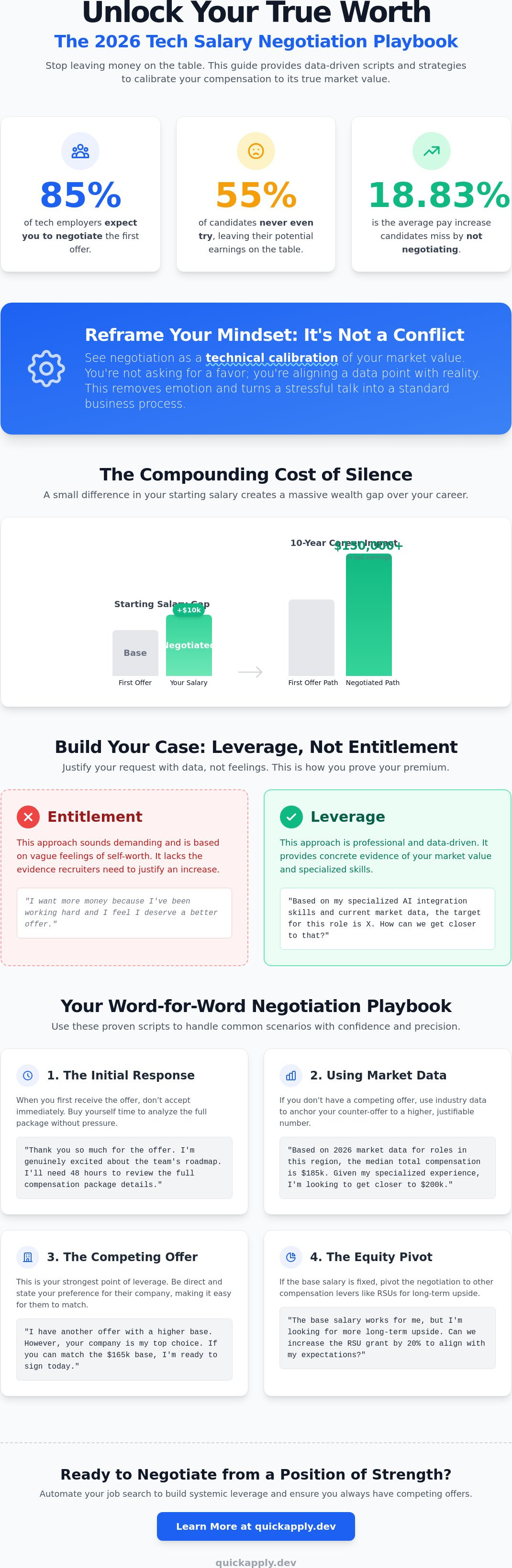
Did you know that 85% of tech employers expect you to negotiate, yet 55% of candidates never even try? By staying silent, you're likely walking away from an 18.83% pay increase before your first day. It's common to fear sounding ungrateful, especially when the pay gap between job-switchers and loyal employees has narrowed to just 1.9 percentage points. You shouldn't have to guess your worth or feel uncertain about complex RSU structures. This guide provides a precise tech salary negotiation script designed for the 2026 market. We'll show you how to optimize your total compensation by $20k to $100k using data-driven tactics that recruiters actually respect.
You'll gain the confidence to handle recruiter pushback and master the exact language needed to secure a higher base pay. We're moving past generic advice to deliver a technical calibration of your market value. This article previews word-for-word playbooks for base pay, equity refreshes, and specialized AI premiums. Stop leaving money on the table. Use a system that turns talent into maximum leverage. Our Salary Negotiation Guide ensures you navigate these conversations with the speed and precision of a high-performance system.
Key Takeaways
- Reframe negotiation as a technical calibration of market value to eliminate social anxiety and maximize lifetime earnings.
- Deploy a word-for-word tech salary negotiation script to navigate initial offers and market data gaps with surgical precision.
- Neutralize high-pressure recruiter tactics, including "top of budget" claims and exploding offer deadlines, using proven counter-responses.
- Optimize your total compensation by identifying often-overlooked levers like RSU refreshes and sign-on bonuses to offset lost equity.
- Build systemic leverage by automating your job hunt to ensure you always negotiate from a position of strength and abundance.
Why Tech Salary Negotiation is a Technical Calibration, Not a Conflict
Negotiation isn't a social conflict. It's a technical calibration. In the 2026 tech market, an initial offer is simply a baseline data point. Your job is to align that point with your actual market value. Many candidates treat this like a high-stakes gamble. They fear that asking for more will result in a rescinded offer. Statistically, this is a myth for professional tech roles. Recruiters have already spent thousands of dollars and dozens of hours sourcing you. They don't want to restart the sprint. They expect a counter-offer in roughly 90% of tech hires. It's a standard part of the recruitment lifecycle.
Adopting a "QuickApply Mindset" means removing emotion from the equation. You aren't pleading for a favor. You're optimizing a contract. By using a structured tech salary negotiation script, you transform a stressful conversation into a routine business procedure. This approach prioritizes efficiency and data over gut feelings or unearned gratitude. Gratitude doesn't pay for your cost of living. Market-aligned total compensation does. You're a high-value asset, and the contract should reflect that reality.
The Cost of Silence in 2026
Accepting the first offer is an expensive mistake. A $10,000 difference in your starting base salary doesn't just cost you $10,000 this year. Over a ten-year career, considering percentage-based raises and compound interest, that gap can swell to over $150,000. In 2026, tech inflation and RSU volatility make negotiation mandatory. If you don't calibrate your entry point now, your future earnings will suffer from a lower baseline. Understanding the principles of salary negotiation is essential for protecting your long-term financial health. Recruiters build "wiggle room" into their initial numbers because they anticipate your counter-offer. If you don't ask, they keep the difference.
Leverage vs. Entitlement
Effective negotiation requires leverage, not entitlement. Entitlement sounds like "I want more money because I've been working hard." Leverage sounds like "Based on my specialized AI integration skills and current market data, the target for this role is X." You must justify your premium with evidence. Start by reviewing resume examples 2026 to see how top-tier talent quantifies impact. When you present concrete evidence of your value, the conversation shifts from a request to a data-driven adjustment. A solid tech salary negotiation script relies on these hard facts to drive results. Whether it's competing offers or documented project successes, your leverage is the engine of your increase. Don't just ask for more. Prove that the market demands it.
The Word-for-Word Tech Salary Negotiation Scripts
Execution is everything. You've done the research and identified your value. Now you need to transmit that data to the recruiter. Implementing effective salary negotiation tips often comes down to the quality of your scripts. A high-performance tech salary negotiation script removes the guesswork. It allows you to stay calm, professional, and focused on the numbers. Use these playbooks to handle the most common scenarios in the 2026 hiring landscape.
The "Initial Response" script is your first line of defense. When the offer lands, don't say yes immediately. Say this: "Thank you so much for the offer. I'm genuinely excited about the team's roadmap. I'll need 48 hours to review the full compensation package details with my family." This buys you time to calculate the real value of the RSUs and bonuses without pressure. If you don't have a competing offer, use the "Market Data" script. State: "Based on 2026 market data for senior DevOps roles in this region, the median total compensation is $185k. Given my specialized experience in AI-driven automation, I'm looking to get closer to the $200k mark. How can we bridge that gap?"
When you have multiple offers, the "Competing Offer" script creates immediate leverage. Tell the recruiter: "I've received another offer that is higher on the base salary. However, your company is my top choice because of the tech stack. If you can match the $165k base, I'm ready to sign today." If the base is fixed, pivot to the "Equity Focus" script. Ask: "The base salary works for me, but I'm looking for more long-term upside. Can we increase the RSU grant by 20% to align with my four-year commitment to the project?"
The 'Magic Sentence' for Every Counter-Offer
Every successful negotiation ends with a clear signal. You must tell the recruiter exactly what it takes to close the deal. The magic sentence is: "If we can get the base salary to $X, I am prepared to sign the offer immediately." This removes the recruiter's fear that you'll take a higher counter-offer back to another company. It shows you're a serious closer. Always lead with your excitement about the team before mentioning the numbers. This maintains the relationship while you push for your market value.
Email Templates for Asynchronous Negotiation
Email allows for precision. For senior roles, keep it direct. "I've reviewed the package. To align with the current market rate for my AI expertise, I'm requesting a total compensation of $X." For entry-level or career switchers, emphasize your trajectory. Applying the same logic used to tailor resume to job description ai ensures your counter-offer reflects the specific needs of the hiring manager. Focus on the value you'll deliver in the first 90 days to justify the increase. For more structured support, our Salary Negotiation Guide offers comprehensive templates for every seniority level.
Handling Recruiter Pushback: Scripts for Common Objections
Recruiters are trained to protect company margins. When you push back, they'll deploy standard scripts to shut down the conversation. You need a counter-system. Most objections aren't hard "no"s. They're tests of your market conviction. If you encounter the "this is the top of our budget" line, don't retreat. Use a tech salary negotiation script that pivots to other levers. Say: "I understand the base salary is capped. To bridge the gap between this offer and the market data for my AI expertise, can we look at a sign-on bonus or an additional RSU grant?"
Another common hurdle is the "experience level" objection. Recruiters might claim your years of service don't justify a higher tier. Counter this by focusing on impact, not tenure. Say: "I recognize my tenure is shorter than some, but the technical complexity of the systems I've scaled matches your requirements for the Senior II level. Let's focus on the $1.2M in infrastructure savings I documented in my previous role." If they insist they only negotiate equity, not base, ask for a guaranteed performance review. "If I hit my first-half KPIs, can we pre-approve a 10% base adjustment for month six?"
Neutralizing Time Pressure
Exploding offers are a psychological tactic. Recruiters use 24-hour deadlines to prevent you from getting competing leverage. Don't panic. Test the deadline. Say: "I'm very interested in this role, but I make major career decisions with due diligence. I need until Friday to finalize my review of the equity vesting schedule." Most "firm" deadlines vanish when you show professional boundaries. If they refuse, it's a red flag about their culture. A tech salary negotiation script is your shield against these artificial pressures.
Turning a 'No' into a 'Later'
Sometimes the budget really is frozen. If you can't get the money today, secure it for tomorrow. Negotiate a 6-month salary review into your offer letter. Link this to specific 2026 milestones like shipping a core AI feature or reducing latency by 20%. Use a promotion roadmap to visualize this trajectory during the hiring phase. This shows the hiring manager you're already thinking about long-term growth. It transforms a temporary "no" into a documented path to your target compensation. Efficiency means winning the long game, not just the initial call.
Negotiating Total Compensation: RSUs, Bonuses, and Remote Perks
Total Compensation (TC) is the only metric that defines your actual market value. In 2026, a competitive base salary is just the entry fee. The real gains live in the rest of the stack. You must look at RSUs, performance bonuses, and specialized stipends as modular components of your contract. If you're walking away from unvested equity at your current firm, don't eat that cost. Companies expect to buy out your "golden handcuffs." Deploy a tech salary negotiation script that targets a sign-on bonus to neutralize the loss. Say: "I'm currently holding $45,000 in unvested RSUs that vest over the next four months. I'm looking for a sign-on bonus to bridge this gap and ensure a neutral transition." This isn't a request for extra cash. It's an adjustment for realized value.
The Equity Playbook
Equity is complex, and the 2026 market rewards those who understand the mechanics. You need to know if you're getting ISOs or RSUs. Public companies offer liquidity, while startups offer high-ceiling potential. Always ask about the vesting schedule. Is there a one-year cliff? Does it move to monthly vesting after that? Use a tech salary negotiation script to protect against market volatility. Ask: "Given the current sector fluctuations, what price-protection mechanisms are in place for the initial grant value?" This ensures your grant value stays stable even if the stock dips before your start date. Don't let a volatile market erase your hard-earned leverage.
Remote and Lifestyle Perks
The 2026 market has shifted. Remote work is standard, but the specific perks are highly negotiable. Don't just ask to work from home. Ask for the infrastructure to do it at a high level. Demand an AI hardware stipend for local LLM testing or high-end development machines. Frame it as a productivity optimization rather than a luxury. Tell them: "To maintain maximum output, I require a $6,000 annual budget for hardware and specialized AI tool subscriptions." You can also negotiate for asynchronous hours or a four-day work week by focusing on deliverables over hours logged. Using an ai resume builder can help you spot which of these perks are becoming standard in your specific technical niche.
Secure your future growth by locking in a $5,000 annual professional development budget. This covers conferences, certifications, and advanced degrees. It's a non-taxable benefit that keeps your skills sharp and your market value rising. To master these complex levers and build a custom total compensation strategy, check out our Salary Negotiation Guide and stop leaving money on the table.
Scaling Your Earning Potential with AI Career Automation
Manual job searching is a bottleneck that destroys your leverage. When you spend hours on a single application, you become emotionally tethered to a single outcome. This attachment is a weakness recruiters detect instantly. In 2026, leverage is a product of volume. By utilizing a high-performance application tracker, you keep your pipeline saturated. This ensures you never enter a conversation from a position of scarcity. A robust pipeline is the hidden engine behind a winning tech salary negotiation script. It gives you the power to walk away because you know other high-value offers are pending. You must treat your career like a product launch. You need multiple stakeholders bidding for your time to drive the price to its true market ceiling.
Optimization means targeting the right tiers from the start. Modern AI tools now identify 'High-Match' roles that carry higher salary bands, saving you from wasting cycles on underfunded positions or low-growth startups. Once you've secured the win, integrate your salary negotiation guide with your long-term promotion roadmap. You aren't just signing a contract. You're initializing a multi-year growth sequence. Efficiency is the difference between a job and a legacy. Every interaction should be a step toward your next promotion before you even finish onboarding.
The Pipeline is Your Greatest Leverage
The search doesn't end at the first offer. It ends when the contract is signed and the hardware arrives. Pausing your search prematurely is a tactical error that reduces your bargaining power. Use QuickApply to manage 50+ applications simultaneously without increasing your manual workload. This high-volume approach changes your psychological profile. You move from 'desperate' to 'selective.' When you have three other final rounds scheduled, your delivery of a tech salary negotiation script becomes naturally more authoritative. You have options. Use them to force a bidding war. Recruiters move faster when they know they're competing against a ticking clock and other top-tier firms.
Executing the 2026 Career Strategy
Transform from a passive job seeker into an active career manager. Use modern systems to handle the heavy lifting of sourcing and tracking. Securing the high-value offers you'll eventually negotiate requires flawless execution in the interview phase. Leverage final round ai to act as your real-time copilot during technical assessments. This ensures you reach the negotiation table with maximum credibility. Stop guessing your worth in a volatile market. Start automating your career growth today. Your potential is a technical problem. Automation is the solution. High-volume output with low-effort input is the only way to stay ahead in a digital-first world.
Secure Your Market Value and Automate Your Future
Negotiation is no longer a social hurdle. It's a technical calibration of your market worth. You've learned how to deploy a precise tech salary negotiation script to dismantle recruiter objections and secure higher total compensation. By treating your career like a high-performance system, you replace emotional guesswork with data-driven results. You now have the playbooks to handle exploding offers, complex equity grants, and specialized AI premiums with surgical precision.
True leverage comes from a saturated pipeline. Don't leave your earnings to chance or manual effort. Use smart technology to maintain a competitive advantage in the 2026 market. Whether it's AI-powered application tracking, tailored resume optimization, or a long-term promotion roadmap, you need tools built for the modern web. It's time to stop leaving money on the table and start optimizing your professional trajectory. The system is ready for you to execute.
Scale your TC and automate your career growth with QuickApply. You've got the talent. Now use the right system to ensure you're paid for it.
Frequently Asked Questions
Can a company rescind an offer if I try to negotiate?
Rescinding an offer is statistically rare in professional tech environments. Recruiters have already invested significant resources into your candidacy and want to close the hire. A polite, data-backed counter-offer is considered a standard business procedure. If a company rescinds simply because you asked for a market-aligned adjustment, it's a major red flag regarding their internal culture and financial stability.
What if the recruiter asks for my current salary during the negotiation?
Don't disclose your current salary. In many jurisdictions, this request is legally restricted. Instead, pivot the conversation to your target compensation based on current 2026 market data. Use a tech salary negotiation script like: "I'm focused on the market value for this specific role and the impact I'll deliver here. Based on my research, I'm targeting a total compensation of $X."
How much of an increase is reasonable to ask for in a tech counter-offer?
A 10% to 20% increase over the initial base offer is a standard starting point for most tech roles. However, if you possess specialized skills in AI or machine learning, you can justify a higher premium. Always anchor your request in documented market data rather than arbitrary percentages. This approach ensures your counter-offer feels like a technical calibration rather than an emotional demand.
Should I negotiate via email or over the phone?
Use the phone for the actual negotiation to build rapport and read the recruiter's real-time reactions. Verbal communication allows for more nuance and faster iterations. Once you reach a verbal agreement, immediately follow up with an email to create a permanent paper trail. This hybrid approach combines the persuasive power of voice with the technical precision of a written record.
What do I do if they say 'this is our best and final offer'?
Accept "best and final" as a hard constraint on base salary, then pivot to non-cash levers. Ask for an increased RSU grant, a larger sign-on bonus, or guaranteed performance reviews at the six-month mark. If the total compensation still falls below your calculated market floor, you must be prepared to walk. Having a full pipeline of applications ensures you make this decision from a position of strength.
How do I negotiate for a remote position if they want me in-office?
Frame remote work as a productivity optimization. Propose a trial period with specific, measurable KPIs to prove that your output remains high outside the office. You can also negotiate for a hybrid schedule or a "remote-first" status that includes a stipend for AI hardware and home office infrastructure. Focus on how the lack of a commute maximizes your deep-work hours for complex engineering tasks.
Can I negotiate my job title along with my salary?
Yes, negotiating your title is a strategic move that affects your internal salary band and future earning potential. If the company can't meet your base salary requirements, a higher title like "Senior II" or "Lead" can unlock higher bonus percentages and RSU tiers. Use your tech salary negotiation script to explain how a title adjustment better reflects the technical leadership and impact you'll provide to the team.
How do I use a competing offer from a smaller startup against a FAANG company?
Use the startup's higher base salary or immediate equity liquidity as leverage against a FAANG company's total compensation package. Tell the FAANG recruiter: "I have a competing offer with a significantly higher base salary. While I prefer your team's scale, I need to consider the immediate financial impact." Large firms often have the budget to match base pay if they risk losing a top-tier candidate to a smaller, more agile competitor.


