

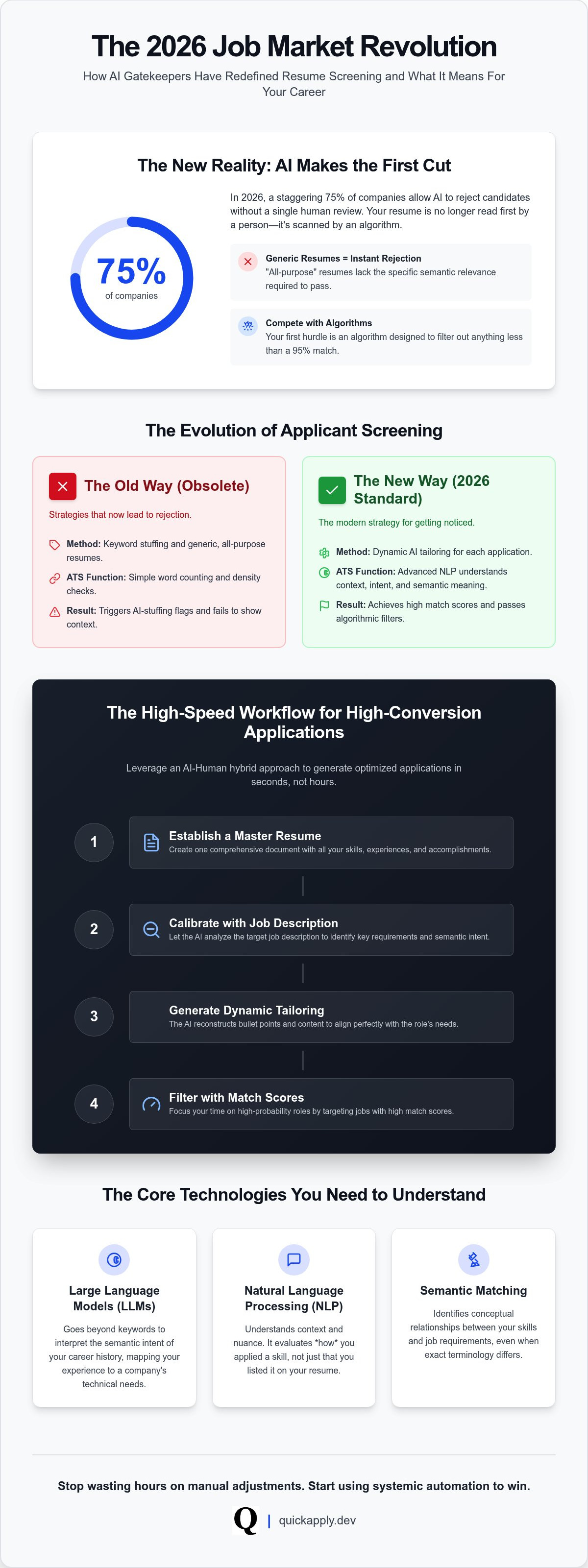
75% of companies now allow AI to reject candidates without a single human review. It's a brutal reality for the 2026 job market. If you're seeing high rejection rates despite being overqualified, you aren't failing because of your experience. You're failing because your tech stack is outdated. Finding the best ai resume optimizer is no longer a luxury; it's a survival requirement for any professional who values their time.
You likely agree that spending hours tailoring a single application is a drain on your productivity. It's frustrating to watch your career stall because a generic resume couldn't trigger a recruiter's dashboard. This guide promises to show you how to leverage high-performance career automation to transform generic resumes into high-conversion job applications in seconds. We'll preview the latest dynamic tailoring tools, compare 2026 pricing for top platforms, and outline a streamlined workflow that delivers more interview invites with zero manual effort.
Key Takeaways
- Understand how semantic intent has replaced simple keyword density in 2026 recruiter screening systems.
- Identify the best ai resume optimizer by prioritizing dynamic tailors that iterate on a per-application basis over static builders.
- Leverage NLP-driven Large Language Models to align your professional experience with specific job requirements instantly.
- Implement a high-speed workflow using a master resume and job description calibration to generate high-conversion applications.
- Use match score technology to filter opportunities and focus your efforts on high-probability tech roles.
The 2026 Job Market: Why Generic Resumes Are Instant Rejections
The era of the "all-purpose" resume is dead. In 2026, 75% of companies allow AI to reject candidates without a single human review. This is a statistical wall you cannot climb with a basic PDF. If your document looks generic, it's an instant rejection. Modern hiring systems don't care about your font choice or a list of buzzwords. They look for semantic alignment between your history and their needs. This shift makes finding the best ai resume optimizer a critical part of your technical stack. Generic resumes fail because they:
- Lack semantic relevance to specific job descriptions.
- Trigger AI-stuffing flags in modern filters.
- Fail to demonstrate context-aware skills.
You aren't just competing with other people; you're competing with algorithms designed to filter out anything that isn't a 95% match. High-performance hiring isn't about how many years you've been in the industry. It's about how those years map to the specific pain points of a hiring manager. A single "perfect" resume no longer exists in tech. Every role has a different hierarchy of needs. If you send the same file to five different companies, you're gambling with your career. You need a dynamic system that treats every application as a unique deployment.
The Evolution of Applicant Tracking Systems (ATS)
Modern platforms like Workday and Greenhouse have evolved. An Applicant Tracking System (ATS) in 2026 uses advanced Natural Language Processing (NLP) to understand context and intent. It doesn't just count the word "Python"; it evaluates how you applied Python to solve a specific infrastructure problem. Over-optimized drafts that try to "hack" the system with hidden text or keyword blocks now get flagged as AI-stuffed. To pass, your document must be tailored to a job description with surgical precision. Relevance is the only currency that matters now.
The Cost of Manual Tailoring
Manual editing is a massive productivity leak. Spending two hours tweaking bullet points for one application is a losing strategy. It limits your output and kills your momentum. In a market where applications per opening have doubled since 2022, you need to move faster than the competition. Low-volume, high-effort applications lead to burnout and missed opportunities. Speed is a feature of your career strategy, not a luxury. The best ai resume optimizer handles this technical heavy lifting in seconds. It allows you to maintain a high-volume pipeline without sacrificing the quality of your output. Stop wasting hours on manual adjustments and start using systemic automation to win.
Decoding the Tech: How Modern AI Resume Optimizers Function
Legacy keyword scripts are obsolete. In 2026, the best ai resume optimizer leverages Large Language Models (LLMs) and Natural Language Processing (NLP) to interpret the semantic intent of your career history. It doesn't just count words; it maps your historical output to the technical needs of a specific engineering squad. This technology identifies the underlying value in your experience, ensuring your profile survives the first wave of algorithmic filtering. If you aren't using a tool that understands context, you're essentially sending blank pages to recruiters.
Modern systems prioritize relevance over volume. They look for a cohesive narrative that proves you can solve the problems listed in the job description. By analyzing your master resume against a specific JD, the software reconstructs your bullet points to emphasize the most critical skills. You can automate this tailoring process to ensure every application is calibrated for maximum impact without wasting hours on manual edits.
Semantic Matching vs. Keyword Stuffing
Recruiter dashboards now prioritize Match Scores as a primary metric. These scores aren't based on how many times you typed "Python" in your header. Semantic matching is the process of using neural networks to identify conceptual relationships between candidate skills and job requirements, even when exact terminology differs. An AI understands that a "Python expert" is often a "Back-end engineer" because it recognizes the architectural context of software development. It identifies transferable skills by analyzing the outcomes of your previous projects. Employers are increasingly weighing the risks and benefits of AI hiring tools to ensure these Match Scores remain accurate and fair.
The "Ghosting" Prevention Mechanism
Don't let a hidden formatting trap kill your application. While modern AI is sophisticated, legacy parsing systems still exist within many corporate infrastructures. Tables, graphics, and non-standard fonts create parsing errors that lead to instant ghosting. If the system can't read your data, the human recruiter never sees it. This is why good resume examples for 2026 look boring. They prioritize a clean, single-column layout with standard headers. This "machine-first" design ensures your file is readable by every version of an ATS. Using the best ai resume optimizer guarantees your document is stripped of problematic formatting while maintaining the semantic depth needed to pass human review later.
Evaluation Framework: Static Builders vs. Dynamic AI Tailors
Stop treating resume optimization as a one-time event. Most candidates confuse "building" a resume with "optimizing" one. Static builders are designed for aesthetics. They provide clean templates and professional fonts, but they lack the technical depth to adapt to specific job descriptions. In contrast, dynamic tailors are built to iterate on a per-application basis. They treat your career data as a modular system that can be reconfigured instantly to meet the unique requirements of every role you target.
The Match Score is the most critical metric in 2026. Recruiters use these scores to prioritize which applications to read first. If your score is below a specific threshold, a human may never see your name. The best ai resume optimizer doesn't just give you a pretty PDF; it provides a real-time calibration against the job description. Integration capabilities like Chrome extensions and LinkedIn imports are no longer optional. They are necessary for maintaining a high-volume application pipeline without sacrificing precision.
Criteria for the "Best" Optimizer
Speed is the primary benchmark for modern career tools. A high-performance system must generate a tailored draft in under 30 seconds to be viable in a fast-moving market. Efficiency also requires a unified ecosystem. Your optimizer should include an accurate AI cover letter generator and an integrated job application tracker. This allows you to manage hundreds of versions of your professional profile without losing track of your progress or your data.
The Hidden Risks of Generic AI Tools
Relying on a ChatGPT resume often leads to failure because generic prompting lacks a structured framework. Large Language Models can fall into the "Generic Voice" trap, producing robotic phrasing that recruiters easily identify and reject. You need a tool that maintains your authentic voice while aligning with technical requirements. Data privacy is another critical concern. Always verify where your career data is stored and how it is used. The best ai resume optimizer protects your intellectual property while maximizing your market value. Don't trade your personal data for a low-quality template that won't get you past the first filter.
The Optimization Workflow: Mastering the AI-Human Hybrid Approach
Efficiency isn't just about speed; it's about precision. The best ai resume optimizer acts as your technical co-pilot. It processes data at a scale you can't match manually, but the output requires your strategic sign-off. This hybrid approach ensures you maintain a competitive edge without burning out. By treating your career as a modular system, you can deploy tailored applications with surgical accuracy. Follow this five-step workflow to master the machine.
- Step 1: Upload your Master Resume. This is your primary data source. It should contain every project, skill, and certification in your history.
- Step 2: Input the specific Job Description (JD). This calibrates the AI to the employer's specific technical requirements.
- Step 3: Review the Match Score. If your score is below 90%, adjust your technical skills or bullet points to better align with the JD's semantic intent.
- Step 4: Human-in-the-loop verification. Read the AI-generated bullet points to ensure they are technically accurate and reflect your actual experience.
- Step 5: Export as an ATS-ready PDF. Use a clean, single-column format to ensure zero parsing errors in legacy systems.
Successful candidates in 2026 don't just "set it and forget it." They use systemic automation to handle the heavy lifting while they focus on high-level strategy. You can start tailoring your applications in seconds using this optimized framework.
Refining AI Output for Human Recruiters
AI is a tool, not a replacement for your judgment. Ensure the "Action-Result" framework remains intact in every bullet point. Every statement must prove your value with concrete data. Verify that the AI hasn't "hallucinated" experience with a tech stack you haven't mastered. A single false claim can kill your credibility during the interview. Finally, adjust the tone to match the company culture. Startups often value disruptive, high-energy language, while enterprise roles may require a more formal, stability-focused approach. The best ai resume optimizer provides the foundation, but you provide the final polish.
High-Volume Application Strategy
Application volume is the only way to overcome modern statistical challenges. Set a daily application target and stick to it religiously. Use an automated job application tracker to manage your pipeline and avoid duplicate entries. Follow the 20/80 rule: automate 80% of the process through AI tailoring and spend your remaining energy on the 20% that requires a personal touch, such as recruiter follow-ups. Managing version control across 50 or more unique resumes is impossible without a dedicated platform. Systemic organization is what separates successful hires from the ghosted masses.
QuickApply: The Systemic Solution for the Modern Tech Search
Optimization isn't a hobby; it's a technical requirement for survival in a 2026 job market. QuickApply provides the systemic infrastructure you need to dominate. It delivers instant tailoring that aligns your deep technical history with specific engineering job requirements. By utilizing the best ai resume optimizer, you eliminate the guesswork of "will this pass the filter?" and replace it with data-driven confidence. It's about moving from a passive search to an active, high-speed deployment.
Integrated match scores allow you to prioritize high-probability roles instantly. You don't have time to chase dead ends or low-match opportunities. The platform identifies which roles match your semantic profile, letting you focus your energy where it matters most. A comprehensive application tracker manages your high-volume pipeline, ensuring you never miss a follow-up or lose track of a specific resume version. This level of organization is the difference between a stalled career and a competitive offer.
The search process doesn't end with a "submit" button. QuickApply offers a salary negotiation guide and promotion roadmaps to ensure your career velocity continues after you sign the offer letter. It serves as a complete career operating system designed for professionals who value their time. You aren't just getting a document; you're getting a strategic ally that manages the entire lifecycle of your professional growth.
Why QuickApply Wins in 2026
QuickApply is built specifically for tech professionals and software engineers. It abandons the "one size fits all" approach of generic competitors that prioritize aesthetics over performance. The platform maintains an unapologetic focus on efficiency. You get low-effort, high-output results through deep systemic automation. It promises continuous productivity without active effort, allowing you to stay ahead of the curve while the competition struggles with manual edits and outdated templates.
Closing the Loop on Your Career Growth
Getting the interview is only half the battle. Use interview practice tools to prepare for AI-vetted roles with confidence. Once the best ai resume optimizer does its job, leverage the salary negotiation guide to maximize your market value. If you're ready to stop building and start winning, explore the best AI resume builders of 2026 to see why tailoring beats building every time. Systemic automation is the only path to a frictionless career search.
Dominate the 2026 Tech Market with Systemic Automation
The 2026 job market doesn't reward manual effort; it rewards systemic efficiency. You've seen why generic drafts fail and how semantic intent has replaced keyword density in modern recruiter filters. Relying on the best ai resume optimizer is the only way to ensure your profile reaches human eyes in a high-volume landscape. You can't outwork an algorithm, so you must outsmart it by treating your career as a modular technical stack.
QuickApply is the career operating system designed to handle this technical heavy lifting. You'll apply to 10x more roles in half the time by leveraging AI-powered match scores calibrated specifically for tech job descriptions. The platform manages everything from end-to-end application tracking to interview prep, ensuring you stay ahead of the curve. Don't let a legacy document stall your career growth or limit your potential. Start Tailoring with QuickApply today and turn your expertise into a definitive competitive advantage. Your next high-impact role is within reach; it's time to go claim it.
Frequently Asked Questions
Is there a free AI resume optimizer that actually works for tech jobs?
Most free tools offer limited functionality that fails in high-volume tech searches. You might find platforms like OphyAI offering five one-time credits or Teal providing unlimited resumes with restricted AI usage. These are entry-level solutions. For a serious tech search, you need a system that handles unlimited tailoring to maintain your competitive edge without hitting a paywall mid-search.
Will my resume be flagged by recruiters if I use an AI optimizer?
Recruiters only flag resumes that utilize "AI-stuffing" or robotic, non-contextual phrasing. Modern systems in 2026 are designed to detect keyword blocks and hidden text. By using the best ai resume optimizer, you focus on semantic intent and professional alignment. This approach ensures your document sounds human and passes through filters like Workday or Greenhouse without triggering fraud detection protocols.
How is an AI resume tailor different from a standard resume builder?
Standard builders focus on aesthetics, offering templates and font choices. They produce a static document. An AI resume tailor is a dynamic engine that iterates on your content for every specific application. It treats your career history as a modular data set, reconfiguring your bullet points to match the unique requirements of a job description in seconds.
Can AI optimizers generate a resume directly from my LinkedIn profile?
Yes, professional platforms allow you to import your LinkedIn data to create a "Master Resume" instantly. This eliminates the manual data entry phase of your search. Once your history is imported, the AI engine uses that data as the foundation for tailoring individual applications. It's the most efficient way to turn your public profile into a high-conversion career document.
Do I still need to edit my resume after using an AI optimizer?
Human-in-the-loop verification is a requirement for technical roles. You must spend a few minutes reviewing AI-generated bullet points to ensure they haven't hallucinated specific tech stack experience or project outcomes. AI handles 80% of the technical heavy lifting, but your strategic sign-off ensures the final document is 100% accurate and ready for a technical interview.
Are AI-optimized resumes compatible with legacy ATS like Workday?
They are, provided you use a clean, single-column export. Legacy systems often crash when processing tables, graphics, or non-standard fonts. Professional optimizers strip away these problematic formatting elements while maintaining the deep semantic data required by modern filters. This dual-compatibility ensures your resume is readable by both 2026-era AI and older corporate infrastructure.
How much does a professional AI resume optimizer cost in 2026?
Industry pricing for AI career tools typically follows a tiered subscription model. Basic plans often start around $9 per month, while Pro tiers featuring full AI suites and interview copilots can range from $19 to $49 per month. Many platforms also offer weekly rates for short-term searches or significant discounts for annual billing. Always check for a 14-day guarantee or free trial before committing.
What is a good match score for a tech job application?
Aim for a match score between 85% and 95%. This range indicates high relevance without appearing over-optimized. Scores below 80% often result in automatic rejection by modern filters. Conversely, hitting a perfect 100% can sometimes look suspicious to recruiters who are wary of "look-alike" applications. Focus on achieving a high-probability score that reflects genuine alignment with the job requirements.


