

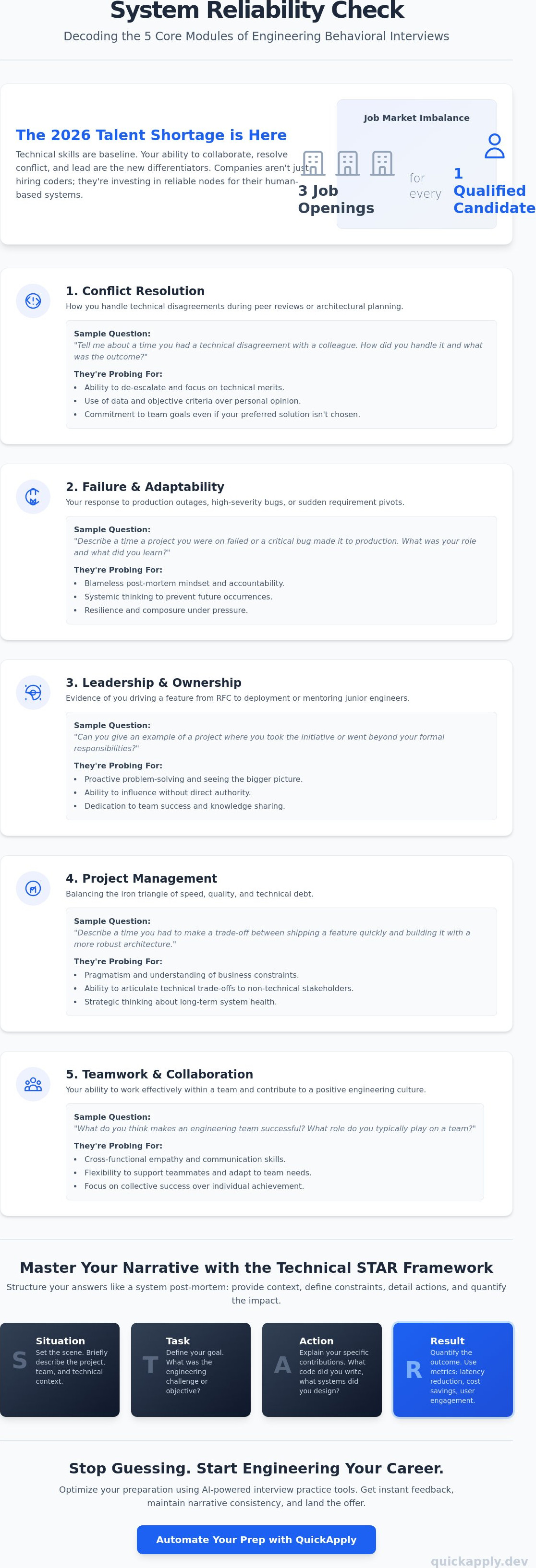
With a 2026 talent shortage creating three job openings for every one qualified candidate, your technical stack is no longer your only differentiator. You likely view common behavioral interview questions for engineers as fluff that distracts from your real output. It's frustrating to waste hours practicing scenarios that feel disconnected from your daily commits or struggle to translate technical wins into non-technical impact. You're built for optimization, yet the interview process often feels like a manual, unoptimized bottleneck.
You can master these high-stakes interactions by treating them like a system post-mortem for human collaboration. Use structured frameworks and AI-driven efficiency to turn "soft" questions into high-resolution data that lands you an elite tech role. This guide provides a curated list of high-probability questions, a repeatable framework for high-impact answers, and the confidence to handle conflict-based scenarios without sounding scripted. Stop guessing what recruiters want. Start delivering the precise data points that prove you're the leader they need. It's time to stop practicing the wrong scenarios and start engineering your career progression with the same precision you bring to your code.
Key Takeaways
- Reframe behavioral interviews as reliability checks for team-based systems to move beyond the outdated "culture fit" trap.
- Identify and categorize the most common behavioral interview questions for engineers into high-probability themes like conflict resolution and production failures.
- Master a technical-first STAR framework that defines specific engineering constraints and quantifies your impact with high-resolution data.
- Optimize your preparation using AI-powered interview practice tools to maintain narrative consistency from your tailored resume to the final offer.
The Shift in 2026: Why Behavioral Interviews Define Elite Engineering Roles
Algorithmic puzzles are losing their dominance in the hiring landscape. While technical proficiency remains a baseline requirement, top-tier tech firms in 2026 now prioritize system integration at the human level. They view the interview process as a reliability check for team-based systems. Common behavioral interview questions for engineers are no longer personality tests; they're diagnostic tools used to predict how you'll perform under architectural stress or team friction. With engineering salaries projected to grow by 4.2% on average this year, companies are protecting their investments by filtering for "culture add." They don't just want someone who fits in; they want engineers who bring diverse problem-solving methodologies to optimize the existing stack.
The era of LeetCode-only hiring is fading as organizations realize that code doesn't exist in a vacuum. High-growth sectors like AI and renewable energy face a severe talent shortage, with three job openings for every one qualified candidate. In this high-leverage environment, technical brilliance is expected, but the real differentiator is your ability to navigate complex organizational structures. Recruiters look for "Systemic Soft Skills," treating your communication and leadership as quantifiable engineering assets that prevent system-wide failures. Candidates often use the STAR method to structure these data-heavy responses, ensuring every anecdote delivers maximum signal with minimum noise.
Soft Skills as Systemic Efficiency
Clear communication is a primary defense against technical debt. When an engineer fails to document a pivot or explain a breaking change to cross-functional stakeholders, project bottlenecks become inevitable. These "Systemic Soft Skills" act as lubricants for complex workflows, including:
- Conflict De-escalation: Resolving technical disagreements before they stall a sprint.
- Contextual Awareness: Understanding how a local code change impacts the broader system architecture.
- Cross-functional Empathy: Translating engineering constraints into business value for non-technical partners.
High-velocity teams rely on collaborative problem-solving to maintain sprint speed. Behavioral interviews evaluate an engineer's operational throughput within a group. By identifying candidates who can articulate technical trade-offs, firms ensure that their development cycles remain lean and efficient.
The Cost of a 'Bad Fit' in High-Output Teams
Individual technical brilliance is useless if it creates team friction. A toxic high-performer is a single point of failure that increases team churn and slows down production. With nearly 50% of the U.S. engineering workforce aged 50 or older, the wave of retirements makes team cohesion critical for knowledge transfer. Hiring managers use common behavioral interview questions for engineers to filter for senior-level ownership and emotional intelligence.
Recruiters need to know you'll take responsibility during a production outage rather than shifting blame. They're looking for evidence that you can mentor junior talent and stabilize a team during shifting requirements. This alignment reduces friction and ensures the team can scale without constant management intervention. In 2026, the cost of a bad hire isn't just a salary; it's the lost momentum of an entire engineering system.
The 5 Core Categories of Engineering Behavioral Questions
Modern hiring managers don't ask random questions. They probe specific architectural weaknesses in your professional history. To master common behavioral interview questions for engineers, you must categorize your experiences into five functional modules. These represent the primary failure points in any software development life cycle (SDLC). By organizing your history into these buckets, you ensure you're never caught without a relevant data point.
- Conflict Resolution: How you handle technical disagreements during peer reviews or architectural planning.
- Failure and Adaptability: Your response to production outages, high-severity bugs, or sudden requirement pivots.
- Leadership and Ownership: Evidence of you driving a feature from RFC to deployment or upskilling junior engineers.
- Project Management: Balancing the iron triangle of speed, quality, and technical debt.
- Communication: Your ability to abstract technical complexity for product managers or executive stakeholders.
Conflict Resolution in Distributed Teams
In 2026, engineering is largely asynchronous. Conflict often arises from misunderstood PR comments or misaligned documentation in remote environments. Interviewers look for your ability to resolve these frictions without escalating to management. Focus on "disagree and commit" scenarios. You must demonstrate that technical rigor doesn't come at the cost of team velocity. High-performing engineers show they can defend an architectural choice with data but pivot quickly if the consensus moves elsewhere. It's about maintaining the system's health over winning an argument.
Ownership and the 'Blameless Post-Mortem' Mindset
Accountability is a senior-level trait. When discussing a project that failed, avoid finger-pointing at legacy code or external APIs. Use the "blameless post-mortem" framework. This mindset treats every error as a system deficiency rather than a human flaw. Explain the specific telemetry or testing gaps you identified and how you patched those systemic holes for the future. Interviewers want to see that you've improved the organization's overall resilience after a personal or team error.
Demonstrating this level of ownership requires rigorous repetition. You can refine these narratives by using high-fidelity interview practice tools that simulate real-world technical scrutiny. They are looking for engineers who build better systems, not just better code. This proactive approach proves you possess the maturity required for elite tech roles. It shows you can handle common behavioral interview questions for engineers by providing high-resolution data instead of vague anecdotes.
Deconstructing the STAR Method for Technical Precision
Generic answers fail technical scrutiny. To conquer common behavioral interview questions for engineers, you must treat your responses like a system architecture diagram. The STAR method (Situation, Task, Action, Result) is the industry standard for a reason. It provides a logical flow that mirrors the engineering process. However, elite candidates in 2026 add a fifth component: Reflection. This turns a simple anecdote into a high-signal demonstration of your senior-level maturity.
- Situation: Define the technical landscape in under 30 seconds. Mention the stack, the scale, and the stakeholders involved.
- Task: Isolate the specific bottleneck or constraint. Was it a latency issue, a security vulnerability, or a team-wide communication breakdown?
- Action: Detail the technical and collaborative steps YOU took. Use "I" instead of "we" to ensure the interviewer can attribute the success to your specific input.
- Result: Close the loop with high-resolution data. If you can't measure it, you didn't fix it.
- Reflection: State what this experience taught you about future system design. This shows you've internalized the lesson for the next deployment.
Quantifying Impact: The 'R' in STAR
Vague claims like "improved performance" are low-signal. High-impact engineers use hard metrics to define their success. When answering common behavioral interview questions for engineers, focus on the delta between the problem state and the solution’s measurable efficiency. Use telemetry that matters to the business:
- Deployment Frequency: Did you move from bi-weekly to daily releases?
- Cost Optimization: Did your refactor reduce cloud spend by a specific percentage?
- Reliability: Did you reduce the mean time to recovery (MTTR) during production outages?
An engineer’s impact is measured by the delta between the problem state and the solution’s measurable efficiency. If you automated a process that saved the team 10 hours a week, lead with that figure. It translates technical labor into business-level ROI.
Common STAR Pitfalls for Engineers
The most frequent error is the "We" trap. Engineers are conditioned to be team players, but an interview is a solo assessment. If you use "we" for every action, the recruiter can't determine your individual contribution. Own your implementation. Another danger is getting lost in the "Situation." Your interviewer doesn't need a five-minute history of the company's legacy debt. They need the context quickly so you can spend 70% of your time on the "Action" and "Result." Finally, don't skip the "Task" constraints. If you don't explain why the problem was difficult, your solution will look trivial. Highlight the tight deadlines or technical limitations that made your success noteworthy.
Common Engineering Behavioral Questions and High-Impact Answers
Preparation is your primary deployment strategy. In a market where elite roles are guarded by rigorous behavioral screens, you cannot rely on improvisation. Recruiters use common behavioral interview questions for engineers to stress-test your resilience and architectural maturity. They want to see how you operate when the build fails or the team disagrees. Your goal is to provide high-resolution data that proves you can handle the friction of modern, distributed engineering.
- Technical Disagreement: "Tell me about a time you had a technical disagreement with a peer." Focus on how you used data, such as benchmarking or load testing, to resolve the conflict rather than personal opinion.
- Project Failure: "Describe a project that failed. What was your role?" Use the blameless post-mortem mindset to identify the systemic gap and the patch you implemented to prevent recurrence.
- Prioritization: "How do you prioritize tasks when faced with multiple urgent deadlines?" Discuss how you balance feature velocity against technical debt and the "iron triangle" of constraints.
- Communication: "Tell me about a time you had to explain a complex technical concept to a non-technical person." Highlight your ability to translate latency or scalability into business-level ROI.
Handling the 'Tell Me About a Time You Failed' Question
Failure is a data point. When an interviewer asks about a mistake, they're looking for self-awareness and a commitment to systemic improvement. Select a "safe" failure; a technical oversight or a process gap that led to a learning moment. Avoid the "humble brag" trap of saying you worked too hard. Instead, focus on the mitigation steps. Explain the specific telemetry you added or the CI/CD guardrails you built afterward. This demonstrates that you don't just fix bugs; you fix the systems that allow bugs to exist. To ensure your narrative is optimized for high-stakes roles, use Interview Practice modules to refine your delivery and eliminate fluff.
Bridging the Gap: Explaining Complexity to Stakeholders
Senior engineers must act as translators. When explaining complex systems to non-technical stakeholders, avoid jargon that creates bottlenecks. Use analogies that resonate with business goals. For example, explain a database migration as moving a library's inventory while the building is still open to the public. Show empathy for business constraints like budget and time-to-market. Linking your technical decisions directly to user value proves you understand the broader product ecosystem. This level of cross-functional empathy is a key marker of senior-level ownership in 2026.
Automating Your Prep: How QuickApply Sharens Your Interview Performance
Manual interview preparation is an unoptimized bottleneck. You shouldn't spend hours memorizing scripts or guessing which anecdotes will resonate. QuickApply's ecosystem automates the tedious parts of the job search, ensuring you're prepared for the most common behavioral interview questions for engineers by simulating real-world technical scrutiny. By treating your career like a deployment pipeline, you eliminate variables and maximize your offer probability. This systemic approach moves you from a passive candidate to a high-value asset with minimal friction.
Efficiency in the 2026 market requires more than just technical knowledge. With an estimated three job openings for every one qualified candidate, the competition is about who can communicate their value fastest. QuickApply provides the tools to manage this high-volume output with low-effort input. You can maintain a consistent narrative from your first application to the final negotiation, ensuring every touchpoint reinforces your senior-level ownership.
AI-Driven Mock Interviews
High-stakes interviews shouldn't be your first time speaking your stories aloud. QuickApply's Interview Practice tool provides real-time feedback on your STAR responses. It uses AI to analyze your delivery, identifying filler words and technical gaps in your storytelling. This high-repetition, low-stakes environment reduces anxiety and builds the muscle memory needed for fluid communication. You'll enter the room with a calibrated narrative that emphasizes your systemic impact and technical rigor. Stop wasting time on the wrong scenarios and start practicing with data-driven feedback that sharpens your edge.
From Application to Offer: The Integrated Career Stack
Success requires narrative consistency across your entire career stack. It starts by tailoring your resume to the job description using QuickApply's automation tools. This alignment ensures the stories you tell during the interview match the expectations set by your application. Use the Application Tracker to manage different prep cycles for specific roles, tracking which anecdotes resonate most with different company cultures. This level of organization allows you to scale your job search without losing quality.
Once you've aced the common behavioral interview questions for engineers, you need to capture your full market value. Transitioning from a great interview to a successful salary negotiation is the final step in the process. With engineering salaries projected to grow by 4.2% on average this year, having a data-backed negotiation strategy is essential. QuickApply's integrated approach ensures you don't just land the role; you secure the compensation package that reflects your true impact on the organization's bottom line.
Engineer Your Career Trajectory
The 2026 engineering market rewards those who treat human collaboration with the same technical rigor as a production environment. You've learned to categorize your experiences into high-impact modules and deconstruct the STAR method using hard engineering metrics like deployment frequency and latency reduction. Mastering common behavioral interview questions for engineers isn't about memorizing scripts; it's about providing high-resolution data that proves you're a force multiplier for any team. As demand for engineering leadership outpaces supply by 18%, your ability to articulate systemic ownership is your greatest competitive advantage.
Manual prep is a legacy process that slows your momentum. Optimization is the only path forward in an exceptionally tight job market. Stop guessing and start practicing with QuickApply's AI Interview Assistant. Benefit from AI-powered STAR response analysis, real-time feedback on your technical storytelling, and integrated application tracking designed for the 2026 job market. You've built the skills. Now, use the right tools to deploy them at scale. Your next elite role is within reach; go claim it.
Frequently Asked Questions
What is the STAR method for engineering interviews?
The STAR method is a structural framework used to answer common behavioral interview questions for engineers by detailing the Situation, Task, Action, and Result. It ensures your narrative follows a logical progression from technical constraints to measurable impact. Use this method to turn vague anecdotes into high-signal data points that prove your operational throughput within a team system. It acts as a diagnostic tool for your professional history.
How do I answer behavioral questions if I have no work experience?
Use academic capstone projects, open-source contributions, or competitive hackathons to demonstrate your technical decision-making. Treat these scenarios as micro-services where you managed specific constraints and delivered functional code. Focus on how you collaborated with peers or handled merge conflicts to show you possess the systemic soft skills required for elite roles. Recruiters value hands-on experience and measurable competencies over traditional degree requirements in 2026.
What are the most common behavioral questions for senior software engineers?
Senior-level questions focus on architectural ownership, cross-functional empathy, and mentoring junior talent. You'll likely face inquiries about handling technical disagreements with senior stakeholders or managing high-severity production outages. These common behavioral interview questions for engineers assess your ability to stabilize a team and maintain system health under significant architectural stress. They look for evidence that you can drive features from RFC to deployment while reducing team friction.
How many stories should I prepare for a behavioral interview?
Prepare five to seven versatile stories that map to different functional modules of the software development life cycle. Each narrative should be flexible enough to address multiple categories such as failure, leadership, or conflict. This high-repetition preparation ensures you have a calibrated response ready for any diagnostic probe the recruiter uses. Organizing your history into these buckets ensures you never waste time practicing the wrong scenarios for high-stakes roles.
Is it okay to talk about a personal conflict in an engineering interview?
Only discuss personal conflicts if they directly impacted technical velocity or system architecture. Frame the situation using a blameless post-mortem mindset, focusing on how you resolved the friction to restore team output. Avoid venting about personality clashes. Instead, highlight your ability to use data and benchmarking to reach a consensus in distributed environments. This demonstrates that you prioritize the system's health over winning an argument with a peer.
How do I quantify my results if I didn't have access to the data?
Use estimated proxies like time-to-market reduction, sprint velocity increases, or anecdotal feedback from senior stakeholders if hard telemetry is unavailable. You can also benchmark your solution against industry standards to prove its efficiency. The goal is to demonstrate that you understand the delta between the problem state and the solution's measurable impact on the business. If you automated a process that saved your team five hours weekly, lead with that figure.
Can I use the same story for multiple behavioral questions?
You can repurpose the same core story by shifting the focus of your STAR response to highlight different competencies. A single production outage story can demonstrate failure analysis, leadership during a crisis, and the implementation of new CI/CD guardrails. Ensure the Action and Result sections are pivoted to answer the interviewer's specific query directly. This approach maintains narrative consistency while providing the specific data points the recruiter needs to see.
How do I handle the 'What is your greatest weakness' question as an engineer?
Identify a real technical or process-based bottleneck you've encountered and explain the systemic patch you've implemented to overcome it. Avoid humble-bragging about working too hard. Instead, discuss a specific skill like public speaking or a legacy framework you're currently optimizing. This shows you have the self-awareness and drive to continuously improve your professional stack. It proves you treat your own career development with the same precision you bring to your code.


