

What if a job description isn’t a pass-or-fail test, but a set of criteria you can assess with evidence? If you feel the fear of being underqualified for jobs I want, it’s easy to treat every requirement as absolute and rule yourself out before anyone else can. But a qualification gap isn’t automatically a reason to stop. It’s a reason to look closer.
That hesitation makes sense. You don’t want to spend time applying for roles that are out of reach or claim experience you don’t have. A more useful approach is to separate essential requirements from preferred extras, then identify relevant proof from projects, coursework, volunteering, or adjacent roles.
This guide will help you assess your fit using evidence, identify transferable skills, and decide when a stretch role is worth pursuing. You’ll also learn how to present your experience honestly and prioritize opportunities with a credible match. A job match score can support your review, but it’s one input, not a verdict on your potential.
Key Takeaways
- Separate essential qualifications from preferred extras, and compare repeated skills with the role’s actual duties.
- Use a two-column evidence matrix to connect job requirements with relevant projects, coursework, internships, volunteering, or adjacent experience.
- When the fear of being underqualified for jobs I want kicks in, review your evidence before ruling yourself out.
- Choose stretch roles where you can make a credible case, tailor your resume and cover letter, and address genuine gaps honestly.
- Use QuickApply’s match score as one signal alongside your evidence, then track applications to keep your search organized.
Fear of Being Underqualified for Jobs I Want: Why It Can Stop You Applying
It’s reasonable to pause when a role asks for skills or experience you don’t clearly have. The fear of being underqualified for jobs I want is doubt about whether you meet a job’s stated expectations. That doubt can alert you to a genuine gap, but it can also turn uncertainty into an automatic “no” before you’ve looked closely at what the work involves.
A long list of qualifications can make applying feel like a pass-or-fail test. You may picture other candidates matching every line and conclude you have no chance. But the list alone doesn’t show how each qualification relates to the role’s daily responsibilities. Some requirements may be central; others may describe a preferred profile. Don’t assume every item is optional, or that every item carries equal weight.
How job descriptions can amplify self-doubt
Read a job description as a collection of clues, not one undivided checklist. It may include core responsibilities, qualifications needed to perform them, preferred extras, and context about the ideal candidate. When these appear together in a dense list, it’s easy to treat each line as a hard gate. That reaction is understandable, but it doesn’t tell you whether your experience fits the work.
Look for the connection between what the role asks for and what the person will do. If a posting names a particular tool several times and describes daily work built around it, that skill deserves close attention. If a credential appears once under preferred qualifications while the core duties focus on work you’ve already done, note the distinction. Employers can set requirements for real reasons, so assess the wording and duties instead of assuming a requirement doesn’t matter.
This is also why self-doubt can feel like evidence when it isn’t. Impostor syndrome, a psychological phenomenon where individuals doubt their accomplishments and fear being exposed as a 'fraud', is a related concept. You don’t need to label yourself to use the practical takeaway: test the thought against specific facts about the role and your experience.
Separate uncertainty from evidence
Pinpoint the exact requirement causing hesitation. Replace “I’m not qualified” with a testable question: “Have I used this kind of data to make a recommendation?” Then sort your answer into two categories: evidence you can point to and evidence you don’t yet have. This helps you see the actual size of the gap instead of letting a general feeling decide for you.
For example, a candidate applying for a project coordinator role might worry about not having that exact job title. They could have organized deadlines for a student project, tracked tasks during an internship, or coordinated volunteers. Those examples may demonstrate relevant planning and communication, though they don’t guarantee a hiring outcome or prove every requirement is covered.
Use this quick test before deciding to skip the application:
- Name the requirement that concerns you.
- Identify a specific example that may demonstrate the same underlying skill.
- Decide whether the gap affects a core responsibility or a preferred extra.
If you can make a credible connection between your evidence and the work, the role may deserve a closer review. If a central requirement is truly missing, that’s useful information too. The goal isn’t to talk yourself into every opening. It’s to decide based on evidence, not on how intimidating the list looks.
How to Read Job Requirements and Spot What Is Truly Essential
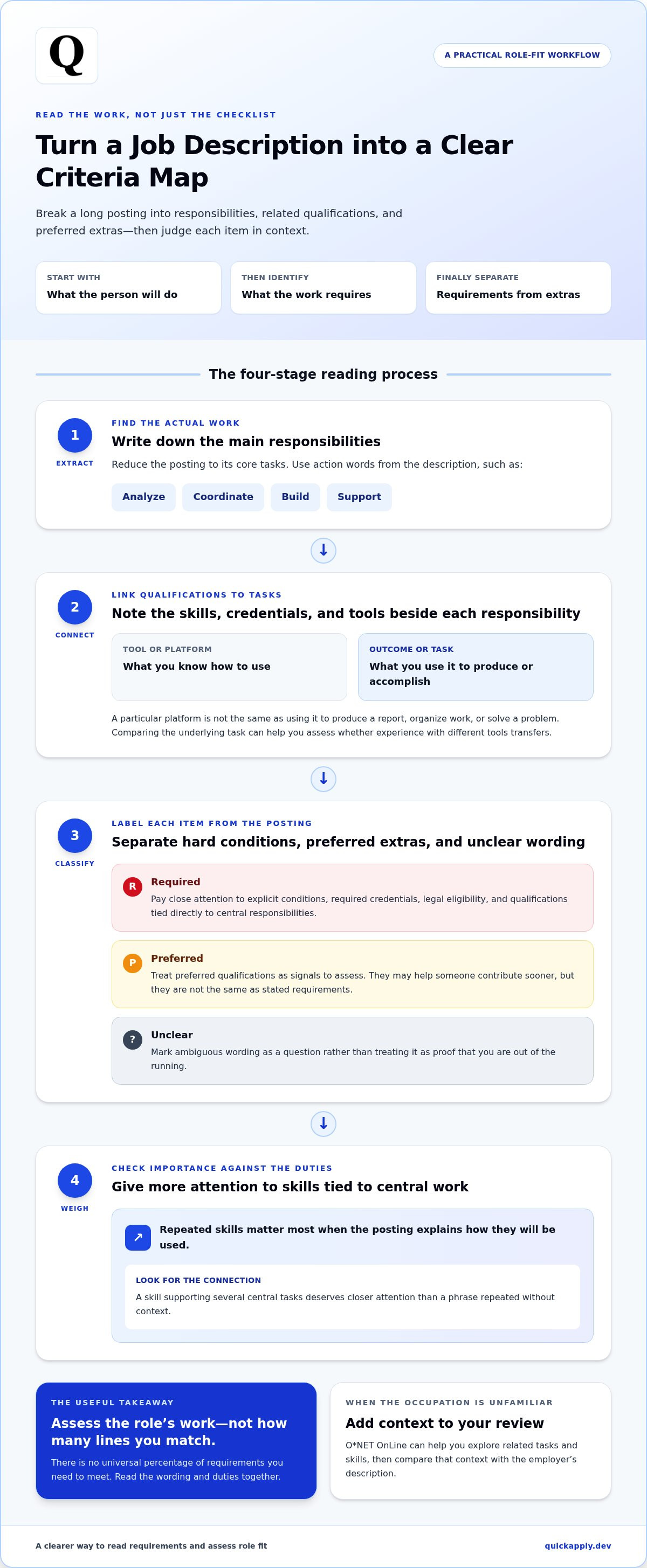
A job description is easier to assess when you stop reading it as one long checklist. Break it into three layers: the work the person will do, the qualifications needed to do it, and the extras that could strengthen an application. This gives you a clearer way to judge fit than counting how many lines you match. There’s no universal percentage of requirements you need to meet.
Which job requirements should carry the most weight?
Start with explicit conditions. Required credentials, legal eligibility, and qualifications tied directly to central responsibilities can be decisive. Next, look at the skills that appear repeatedly and compare them with the actual duties. Repetition matters most when the posting explains how a skill will be used, not simply because the same phrase appears in several sections.
Preferred qualifications are signals to assess, not automatic disqualifiers. They may show what would help someone contribute sooner, but they aren’t the same as stated requirements. If the wording is unclear, mark it as a question rather than treating the ambiguity as proof that you’re out of the running. If you’re unfamiliar with an occupation, O*NET OnLine can help you explore related tasks and skills, then compare that context with the employer’s description.
Turn a long description into a short criteria list
Reduce the posting to its core tasks, then connect each task to the skills named beside it. Separate tools from outcomes: knowing a particular platform is one thing; using it to produce a report, organize work, or solve a problem is another. That distinction helps you assess whether your experience transfers, even if you used different tools.
Try this simple extraction process:
- Write down the main responsibilities, using verbs such as analyze, coordinate, build, or support.
- Under each responsibility, note the stated skills, credentials, and tools.
- Label each item as required, preferred, or unclear, based on the posting’s language.
- Check repeated skills against the duties. Give more attention to skills that support several central tasks.
For example, a posting might ask for a specific analytics platform while emphasizing that the role must turn customer data into clear recommendations. The platform is a tool; the outcome is useful analysis. If you’ve produced recommendations using another platform, record that distinction in your fit assessment. You still need to consider whether the named technology is essential, but don’t overlook relevant capability just because the tool differs.
Once you’ve identified the role’s priorities, focus your application on the most relevant evidence. A thoughtful resume-tailoring strategy for a job description can make that evidence easier to spot without stretching the truth.
If the fear of being underqualified for jobs I want is making every requirement feel like a hard stop, turn the posting into criteria before deciding. QuickApply can help you review role fit and tailor application materials to a job description. Use its match score as one input alongside your own assessment. Explore QuickApply’s job-search tools to support a consistent review process.
How to Assess Whether Your Experience Matches the Job
Now turn the role’s criteria into an evidence check. Create a two-column matrix: list each important requirement on the left and a specific example from your experience on the right. The goal isn’t to make every row look identical. It’s to see where you have direct evidence, where your experience may transfer, and where a real gap remains.
Map transferable skills to role responsibilities
Use examples from projects, coursework, internships, volunteering, or adjacent roles. For each skill, name the task you completed and, where possible, the outcome. “Strong communication” is hard to evaluate. “Presented project findings to a student group and answered questions” gives the skill a concrete anchor. Describe the setting accurately. A class project can demonstrate analysis, but it isn’t employment in an analyst role.
For example, if a role asks for experience coordinating work across teams, you might point to a volunteer event where you aligned schedules with several groups. State what you actually coordinated and what happened, without inflating the scope. To make the connection clear, name the requirement, describe your example, and explain which part of the role it relates to.
Evidence of a skill can come from more than a matching job title. What matters is whether your example supports the capability the role needs. It won’t prove that you’ve done every part of the job, but it gives you a factual basis for assessing your fit.
Identify gaps that matter and gaps you can build
Use the matrix to distinguish missing evidence from a missing qualification. If you’ve done the work but your resume describes it vaguely, strengthen the entry with the task, tool, or result. If you can’t identify an example yet, note that as a gap instead of reframing unrelated experience as proof.
Then mark requirements that may carry more weight: a credential the posting explicitly requires, a responsibility central to the role, or a capability tied to safe performance. These are different from a tool or workflow you could learn. A tutorial may help you get familiar with an unfamiliar software feature, but it won’t replace a required credential or hands-on qualification.
Choose a learning step only when it closes a specific gap that matters to this role. If the posting emphasizes spreadsheet reporting and you’ve never used pivot tables, practicing that task could address a defined skill need. Broad, unfocused studying is less useful than learning tied to an actual responsibility.
- Role requirement: Summarize weekly project progress.
- Specific evidence: Prepared status updates for a coursework team and tracked deadlines.
- Gap to assess: The posting also requests experience with a project-management platform you haven’t used.
Review each row in the same way. The result isn’t a verdict on your potential. It’s a clearer picture of what you can demonstrate, what you can learn, and what may be essential before you apply.
How to Apply for a Stretch Job Without Overstating Your Qualifications
A stretch application should make a credible case, not create a fictional version of your experience. Use a short sequence: choose a role where you can support your fit, select your strongest evidence, tailor your materials, then submit. This turns the fear of being underqualified for jobs I want into a decision you can explain, even when you don’t meet every preferred qualification.
Tailor your application around proof
Start with the role’s central responsibilities. Choose truthful examples that show how you’ve handled similar tasks, built relevant skills, or delivered related outcomes. Use the employer’s terminology only when it accurately describes your work. If you supported a project lead, don’t rewrite that as leading the project. Be precise about your role, the tools you used, and what changed as a result.
Keep your resume and cover letter aligned. If your resume says you assisted with data analysis, your cover letter shouldn’t imply that you owned the full analysis process. Tailoring should make relevant experience easier to find, not make it sound bigger than it was. AI resume tailoring for a specific job can help focus your materials on the role’s language and priorities, but review every claim for accuracy before you send it.
If a genuine gap needs context, address it briefly. For example: “I haven’t used your scheduling platform, but I’ve coordinated project timelines using shared planning tools.” Then return to the evidence that supports your fit. Don’t lead with an apology or bury a relevant strength under a long explanation.
Decide whether to apply now or build first
Apply when you can make a reasonable, evidence-based case that you could perform the role’s core responsibilities. You don’t need to claim mastery of every tool or experience in every setting. You do need to represent your qualifications honestly and show how your demonstrated strengths connect to the work.
Pause for a focused learning step when a crucial eligibility requirement or capability gap prevents you from making that case. If the gap is a specific tool, practice a relevant task and note what you can now do. If the posting requires a credential you don’t have, learning a related software feature won’t resolve that requirement. Separate gaps you can build from conditions that affect whether you’re currently eligible.
Before submitting, run this quick accuracy check:
- Can you point to evidence for each skill you claim?
- Do your resume and cover letter describe your role, tools, and outcomes consistently?
- Have you addressed any important gap briefly without overstating what you can do?
Applying is an informed choice, not a guaranteed route to an interview. If your answers support a credible match, submit and track the application so you can manage your next steps. Tailor your resume and cover letter with QuickApply to bring relevant, truthful evidence forward.
Build a Repeatable Job Search System with QuickApply
Assessing each role from scratch takes time and can make you second-guess the same decision repeatedly. A consistent process gives you a stable review path: check the role’s requirements, compare them with your evidence, decide whether to apply, then prepare and track the application. It won’t remove uncertainty or predict an employer’s decision. It can help you spend less time rethinking your criteria and more time taking deliberate steps.
Use match scores as a prioritization signal
QuickApply’s match score can help you sort opportunities and spot roles that may be worth a closer look. Treat it as a signal, not a verdict on your potential or a forecast of hiring outcomes. Before prioritizing an application, compare the role’s requirements with your evidence matrix. Check whether the score reflects skills you can demonstrate, and look closely at essential criteria that a score alone may not capture.
There’s no universal score threshold that should decide whether you apply. A lower score may prompt you to inspect which requirements are missing or described differently in your materials. A higher score still calls for a review: confirm that you meet key conditions and can support your claims with real examples. The fear of being underqualified for jobs I want can make any single signal feel final. Keep your decision grounded in the full picture.
Keep applications and preparation moving
Once you decide to pursue a role, use resume and cover letter tailoring to bring relevant, truthful evidence forward. QuickApply can tailor both to a specific job description, helping you focus on the evidence that matters for that opportunity. Review the result carefully. Your materials should reflect your actual responsibilities, tools, and outcomes, not simply repeat keywords from the posting.
Then keep the process visible. Use the application tracker to record roles, submission dates, and next steps, such as preparing for a follow-up or reviewing the posting before an interview. A clear record reduces the mental effort of remembering where each application stands. It also lets you see which roles you chose and why, without treating each outcome as a verdict on your qualifications.
After choosing to apply, move to preparation. Interview practice can help you rehearse how to explain relevant experience, describe a skills gap honestly, and connect your strengths to the work. Focus on examples you’ve already verified so your answers stay consistent with your application.
Build a routine that supports sound decisions, not automatic applications. Review each opportunity, use tools to organize the work, and keep your judgment in the loop. Explore QuickApply’s job application tools to tailor materials, review role fit, track applications, and prepare for interviews.
Make Your Next Application a Deliberate Step
You don’t need complete certainty before moving forward. You need a decision you can stand behind: this role is worth pursuing, these are the strengths I can demonstrate, and this is the gap I’ll address honestly. That shift gives the fear of being underqualified for jobs I want less power over your next move.
Choose one opportunity that interests you. Use AI-powered resume and cover letter tailoring to bring relevant evidence into focus, then review every line to make sure it reflects your real experience. Treat a match score as a prompt for closer review, not a final judgment. Keep the application organized in a tracker so your next steps stay clear and manageable.
Your application doesn’t control the outcome, but you can control how thoughtfully you prepare and present your case. Explore QuickApply and make your next application more focused.
A stretch role is an opportunity to make an honest case for what you can do. Let your evidence, not anxiety, guide the decision.
Frequently Asked Questions
Is it worth applying for a job if I do not meet every qualification?
Yes, if you can show relevant capability for the role’s central work and don’t lack a stated must-have. For example, you might apply for a role requesting experience with a particular reporting tool if you’ve produced similar reports using another tool. Consider whether the difference is learnable and whether the employer describes the qualification as required or preferred. Make your decision role by role, not by counting checklist items.
How can I tell whether I am underqualified or experiencing imposter feelings?
Look at the specific reason you doubt your fit. A concrete gap, such as lacking a required credential, differs from feeling unqualified despite having examples that support the work. The fear of being underqualified for jobs I want may involve either, and you don’t need to diagnose yourself to assess it. Write down the concern, then compare it with evidence from completed work. If the concern stays broad, ask someone familiar with your work to help review the examples.
Can I apply for a job that lists a degree I do not have?
It depends on how the degree is described and whether it’s essential for the work or eligibility. If it’s listed as preferred, you can decide whether your relevant experience or other education makes a credible case. If it’s explicitly required, recognize that the employer may use it as a screening condition. Never imply you hold a degree you don’t. State your actual education clearly and let your relevant evidence speak for itself.
Should I mention missing qualifications in my cover letter?
Address a gap only if it’s central enough that leaving it unexplained could distract from your case. Don’t list every preferred qualification you lack. If you’re missing a named tool, briefly say so, then point to a related task or tool you have used. Keep the focus on what you can demonstrate and avoid apologetic language. The letter should explain your fit, not become a catalogue of shortcomings.
How do I explain a skills gap in a job interview?
Be direct, then connect the gap to relevant experience and a realistic next step. For example: “I haven’t worked with that database, but I’ve maintained records in a similar system and can explain how I kept them accurate.” Don’t claim you can perform tasks you haven’t done. If you’re actively building the skill, describe what you’ve practiced and what you can handle now. Specific answers show self-awareness without overstating readiness.
Can an applicant tracking system reject me for missing keywords?
It depends on how an employer configures its application process, so don’t assume every system works the same way. Use accurate terms from the posting when they describe your experience, especially in relevant skills and work descriptions. For instance, if you’ve scheduled project work, use that phrase rather than a vague claim like “organized.” Don’t stuff keywords into your resume or claim skills you lack. Clear, truthful detail helps software and people interpret your background.
What should I do if I keep getting rejected from stretch jobs?
Look for patterns before changing everything. Review whether the roles share a requirement you can’t yet demonstrate, whether your resume makes relevant work easy to identify, and whether you’re reaching interviews. If the gap is specific, build that capability or target roles that let you develop it. If your applications aren’t progressing, revise one part of your materials and track the next results. Rejection is information to examine, not proof that you should stop aiming higher.


