

A high score won’t fix an interview answer if you don’t know what to change. If you’re trying to get feedback on my interview answers online, look for critique that identifies where your answer loses focus, skips evidence, or needs a clearer result, not just a tool that gives you a rating.
Practicing alone can make weak spots hard to hear, while generic praise gives you no useful next step. Good feedback points to specific strengths and gaps, then helps you make a focused revision. This guide compares three options: AI feedback for fast, repeatable practice; peer review for a fresh listener’s perspective; and mock interviews for live, role-specific practice. You’ll learn how to match each format to your interview and answer, assess feedback by the evidence it provides, and use it to revise and practice again. The process is simple: answer, review, refine, repeat.
Key Takeaways
- Share the role, question, your answer, and relevant interview context so reviewers can assess whether your response fits.
- Look for specific comments about relevance, structure, evidence, clarity, and delivery, not praise or scores alone.
- When you get feedback on my interview answers online, choose AI review, peer feedback, or a mock interview based on the skill you want to test.
- Revise one or two high-impact elements at a time so you can tell what made the answer clearer or stronger.
- Track progress by the quality of your evidence and clarity, then revisit priority questions in short practice sessions.
Why get feedback on your interview answers online?
A practice answer can sound clear in your head and still leave a listener unsure what you actually did. That gap is difficult to catch when you’re both the speaker and the only reviewer. Online interview-answer feedback gives you another perspective: it identifies what works, where the answer loses strength, and what to try next. Feedback can be written or spoken, automated or provided by another person. The format matters less than whether the review gives you something specific to act on.
A job interview is a conversation designed to help an employer assess a candidate’s fit for a role. The format and questions vary, as this overview of the Job interview explains. Your answer needs to make relevant experience understandable to someone who wasn’t there. Practicing alone can make that difficult: because you already know the background, you may not notice that you skipped key context, jumped from problem to outcome, or described a result without explaining your contribution.
Actionable interview feedback identifies what answers the question, what evidence is missing, and one specific change to test in your next attempt.
That’s different from reassurance (“You did great”), a score without an explanation, or a complete rewrite that no longer sounds like you. A score may help you track practice, but it can’t tell you whether your example demonstrates the skill the question asks about. A rewrite may polish the wording while erasing the choices and experience that make the story yours. The goal is diagnosis, not a replacement answer.
What useful interview feedback should reveal
Strong critique refers to the answer you gave, not an ideal answer in the abstract. Check whether it:
- Answers the question: Does your example address the specific skill or situation asked about, or drift into a related story?
- Points to evidence: Does the reviewer identify a clear action, decision, or result, rather than offering vague praise such as “good example”?
- Names a priority fix: Does it recommend a focused improvement, such as explaining your individual contribution, without inventing details or changing your experience?
A useful note might say, “Your example fits the question, but I can’t tell what you personally did. Add the decision you made.” That gives you a specific revision to test. “Be more confident” doesn’t. If you’re searching “get feedback on my interview answers online,” look for comments tied to your actual words and a practical next step, not just a rating.
When online feedback can help most
Use feedback to check behavioral stories, role-specific examples, and introductory answers such as “Tell me about yourself.” A second perspective can catch missing context, unexplained technical language, or a result that sounds impressive but isn’t connected to your actions. It can also reveal whether your opening gives a focused snapshot of your experience instead of reciting your full career history.
Feedback can make practice more targeted, but it can’t predict an employer’s decision or guarantee a hiring outcome. Treat each review as input: keep what clarifies your evidence, revise one weak point, and deliver the answer again in your own voice.
How online interview-answer feedback works, and what makes it useful
Most online reviews follow a simple process: you provide the target role, interview question, your answer, and any context that affects how it should be judged. A useful critique checks whether your response fits the question, follows a clear structure, supports its claims with evidence, and communicates the main point effectively. If you share a recording, feedback may also address delivery, such as whether your pace makes the explanation easy to follow.
Separate observable evidence from subjective impressions. “You mention the project outcome but don’t explain your contribution” points to a gap in the answer. “You don’t seem confident” is an interpretation, not proof. Ask which words or moments led to that judgment and whether changing them would help an interviewer understand your experience. Feedback should make your answer clearer, not push you toward someone else’s speaking style.
Act on feedback that is specific, grounded in your answer, relevant to the role, and clear about the next revision.
What context to include with an answer
Provide the job title, question, and expected seniority when relevant. An answer for a senior engineering role may need to show how you handled trade-offs or influenced a team; an entry-level example may focus on your individual approach and learning. Include enough situation and outcome detail for a reviewer to follow the story, while keeping the focus on what you did and why it mattered.
Protect sensitive information before sharing. Replace employer, customer, colleague, and project names with neutral labels, and remove personal or confidential details that aren’t needed to understand the answer. You can preserve useful context without exposing private information: “a customer” or “a deployment project” may be enough.
How to assess AI-generated critique
AI feedback can flag patterns quickly, but speed isn’t the same as accuracy. Test every criticism against the answer you actually gave. If a tool says your response lacks a measurable result, check whether you stated one. If it recommends clarifying your role, find the sentence that leaves your contribution ambiguous. A critique tied to a specific phrase or missing element is easier to verify and use than a broad label.
Reject suggestions that add achievements, metrics, or decisions that didn’t happen. The goal is to make your real experience clearer, not to generate a more impressive story. Treat automated critique as a practice aid, not an employer’s evaluation or a guarantee of an interview outcome. To get feedback on my interview answers online that you can use, keep the answer and role context in view, and use your judgment before revising.
For a repeatable way to work on responses, explore QuickApply’s interview practice tools as part of your broader job-search workflow.
AI feedback, peer review, or mock interview: which fits your answer?
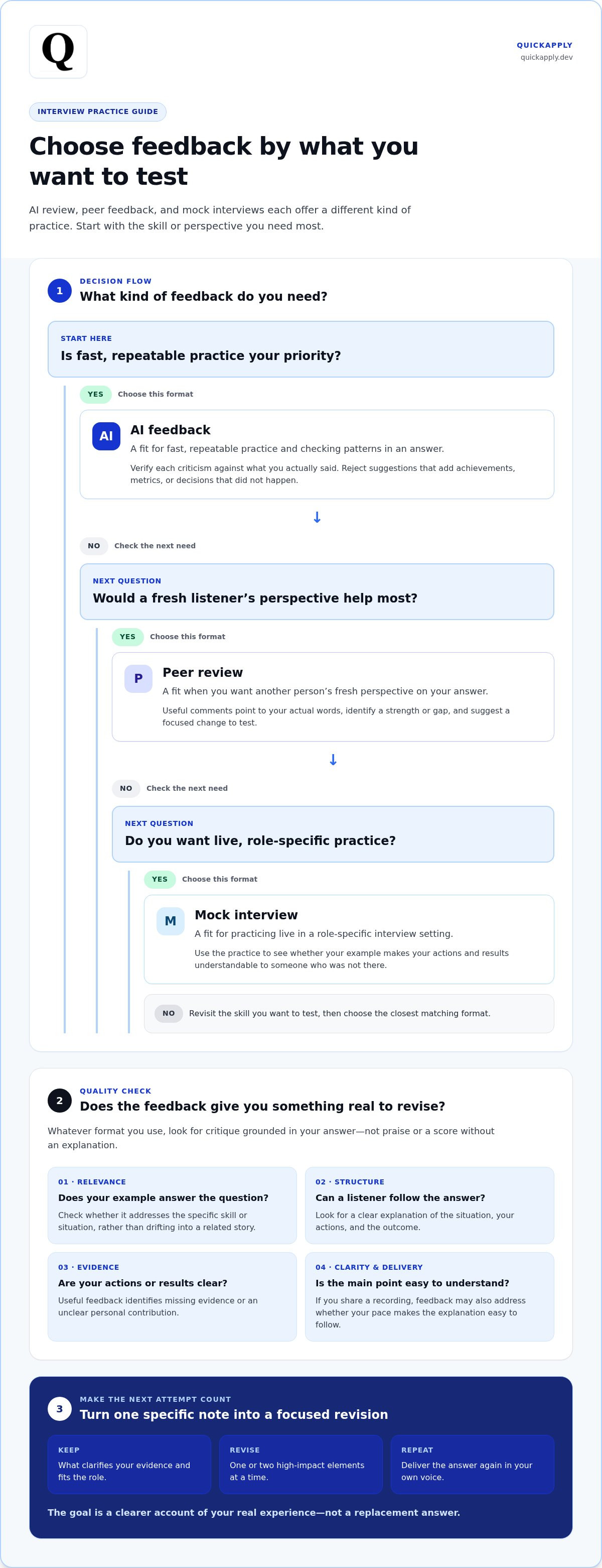
Choose a format based on the skill you need to test. AI can review repeated drafts quickly. A peer can tell you whether your story makes sense to someone who doesn’t already know the background. A mock interview adds a live audience, follow-up questions, and time pressure. No format is the best fit for every answer, so match the method to the question and the gap you want to find.
| Format | Best for | What it may miss |
|---|---|---|
| AI review | Quick, repeatable checks of a draft answer’s relevance, structure, or clarity. | It may misread your intent or suggest changes that don’t fit your actual experience. |
| Peer review | Testing whether a story is understandable and convincing to a fresh listener. | A peer may not know the role or have interview-specific expertise. |
| Mock interview | Practicing spoken answers, pacing, follow-ups, and thinking under pressure. | One session offers less repetition than reviewing drafts on your own. |
Think of these formats as different test environments. AI helps you run repeatable checks on the same answer. A peer tests the audience experience: did they follow the situation, understand your choices, and believe the outcome? A mock interview tests how well your answer holds up to interruptions, follow-up questions, and the need to respond without reading a prepared script.
When AI review is a practical fit
Use AI to review draft answers or revisit a response after a focused edit. It can help you spot recurring issues across practice attempts, but the input shapes the output: include the target role and exact question so the critique has a useful frame. Verify every suggestion against your real experience and the role’s needs. Keep relevant advice; discard edits that distort your story.
When peer or live feedback adds value
Ask a peer unfamiliar with your project to listen for unexplained terms, missing context, or a result that doesn’t clearly follow from your actions. In a mock interview, answer aloud and invite follow-up questions. This reveals whether you can adapt the story instead of reciting it. If you’re exploring real-time interview support, this guide to an AI interview copilot covers that distinct use case.
If you’re deciding how to get feedback on my interview answers online, start with the answer’s biggest uncertainty. Choose AI for repeated draft checks, a peer for audience clarity, or a mock interview for live delivery. Combine formats when useful, then compare the comments, not just the scores: which ones identify a specific issue you can test in your next attempt?
How to get actionable online feedback on an interview answer
Feedback becomes useful when you turn it into a controlled practice loop. Work on one answer at a time, keep the original version, and make each revision easy to compare. If you change the story, wording, and structure all at once, you won’t know which edit helped. Use this sequence:
- Choose one real question tied to the role you’re targeting.
- Capture an honest answer in a format your feedback method can assess, such as spoken audio or written text.
- Add brief context about the role, question, and example so the reviewer can judge relevance.
- Review the critique and sort it into strengths, missing evidence, unclear sections, and optional suggestions.
- Revise and practice again, changing one or two high-impact elements rather than rebuilding the whole answer.
Compare attempts against the question, not an abstract ideal answer. Is the revised response more direct? Are your role and evidence easier to follow? Does the example answer what the interviewer asked, without extra background burying the point? Aim for clear, relevant evidence, not a more polished-sounding script.
Prepare one answer for a useful review
Pick a specific question, such as “Tell me about a time you resolved a technical issue,” rather than submitting several unrelated stories together. Record or write the answer in the format the reviewer will assess. Include only enough context to explain the challenge and outcome. Before sharing, remove names and sensitive employer, customer, or personal details while preserving the actions and decisions that make the example clear.
Turn critique into a stronger next attempt
Sort comments before editing. Keep the strengths, identify missing evidence, mark confusing sections, and set aside optional style preferences. Fix the gap most likely to keep the answer from addressing the question. For example, if the result is clear but your contribution isn’t, add the decision or action you personally took. Don’t add achievements or metrics that aren’t true.
Use a simple answer log to make progress visible. Record the question, a short note on the feedback, the change you made, and what to test next time. For example: “Project conflict question; clarify my role; added the decision I made; check that the outcome follows clearly.” This keeps practice focused and helps you avoid cycling through the same vague notes.
If you want a structured place to continue interview practice, explore QuickApply’s interview practice tools as part of your job-search workflow. The goal is to get feedback on my interview answers online, apply the useful parts, and hear the improvement in your next attempt.
Keep improving interview answers with a repeatable practice workflow
One round of feedback can sharpen an answer. A lightweight routine helps you keep it sharp as the role or interview date gets closer. Build practice around priority questions, not endless rehearsals: choose the stories most relevant to the position, revisit them in short sessions, and leave time to speak each revised answer aloud. If you’re asking how to get feedback on my interview answers online, make the goal a repeatable cycle, not a perfect score.
Build a lightweight answer-practice loop
Keep a focused set of likely questions and role-relevant stories. After each review, record one strength and one change to test next. For example, note that your example clearly shows ownership, then plan to explain the result more directly. At your next practice session, answer the question aloud without reading a script. Written edits only help if they still sound natural in conversation.
Schedule practice around your interview timeline. Early on, identify which examples match the role’s needs. As the interview approaches, prioritize questions most likely to reveal a gap, then revisit revised answers aloud. Leave space between attempts so you can practice from key points instead of memorizing exact wording. That keeps your delivery flexible if the interviewer phrases a question differently.
Review progress through evidence, not score changes alone. Ask:
- Does the opening answer the question directly?
- Can a listener identify your actions and contribution?
- Does the outcome follow clearly from the evidence you shared?
- Can you explain the story aloud without relying on a script?
Keep brief notes for each question: what became clearer, which evidence is stronger, and what still needs work. If an answer sounds smoother but no longer addresses the prompt, the revision missed the target. Keep the useful edit and adjust again.
Connect interview preparation to the job search
Answer practice works best alongside role research and application preparation. Review the job description to identify the skills it emphasizes, then select stories that demonstrate relevant experience. Matching your interview examples to the role helps you focus practice on evidence that matters instead of polishing answers in isolation. For the bigger picture, this guide to the job application process covers how interview preparation fits into the wider workflow.
QuickApply brings interview practice tools together with other career and job-application tools, giving tech professionals and students a way to include answer practice in a broader workflow. Once you’ve picked priority questions and set your next practice session, explore QuickApply’s career tools as a practical next step. Keep the loop simple: prepare, review, refine, and practice again.
Make your next practice session count
Don’t wait until an interview is on the calendar to improve a response. Choose one question connected to a role you want, set a clear goal for your next attempt, and use feedback to check whether your answer meets it. Small, deliberate practice keeps your examples ready to adapt instead of locked into a script.
If you’re ready to get feedback on my interview answers online, turn that intention into a practical next step. QuickApply’s career platform is designed for tech professionals and students, with interview practice tools alongside resume tailoring, cover letter generation, and application tracking. Keep your preparation connected to the rest of your job search.
Explore QuickApply’s career tools and build a practice routine around your goals. Your next answer doesn’t need to be perfect on the first try. Make one focused improvement, practice it aloud, and go into your next interview better prepared.
Frequently Asked Questions
Is AI feedback on interview answers accurate?
AI feedback can help spot patterns in an answer, but it can’t know which details you left out unless you provide them. If it says your example lacks impact, check the original question and the outcome you described before editing. Ask whether the critique points to a specific phrase or omission. Treat the output as a second perspective, not a hiring verdict, and keep only suggestions that fit your facts.
Can I get feedback on interview answers online for free?
Some online tools offer free feedback or limited access, while certain features may require payment or an account. Terms and limits vary, so review them before submitting an answer. You can also ask someone you trust to listen to one response. Compare the usefulness of the comments, not just whether access costs nothing. A clear improvement suggestion is more useful than a vague rating.
How do I get feedback on an interview answer online?
To get feedback on my interview answers online, choose one role-related question and answer it without reading a polished script. Include the job title and, if relevant, whether the answer is for an initial screen or a later interview. Remove identifying details, then compare the review with what you actually said. Make one edit and practice again aloud to check whether the response still sounds natural.
What should good feedback on an interview answer include?
Good feedback should explain how well your example matches the question and distinguish clear points from claims that need more support. For instance, a reviewer might note that you describe a team result but don’t identify your own contribution. The comment should offer a testable next step, such as adding the decision you made. A score without reasoning can’t show you what to change.
Can I get feedback on spoken interview answers online?
Yes, depending on the practice method. Some approaches use spoken responses, while others review text. Spoken practice can help you notice whether you rush through a key detail, rely on filler words, or struggle to explain a technical term aloud. Written feedback can help you inspect the answer’s content. Choose the format that matches what you want to test, and avoid sharing unnecessary identifying details.
Should I use AI or ask a person to review my interview answers?
Choose based on the question you want answered. AI can help you review several versions consistently, while a person can tell you where they lost the thread or wanted more explanation. For a technical answer, you might use AI to check whether the response stays focused, then ask a peer unfamiliar with the project to explain what they understood. Keep every revision true to your experience.
Is it safe to paste interview answers into an online tool?
Use care before sharing interview content. Remove employer and customer names, proprietary project details, contact information, and personal information that isn’t needed to assess the answer. If you plan to submit a recording, review the tool’s privacy information to understand how it handles recordings and whether deletion controls are available. When in doubt, rewrite sensitive details in general terms while keeping the example understandable.


