

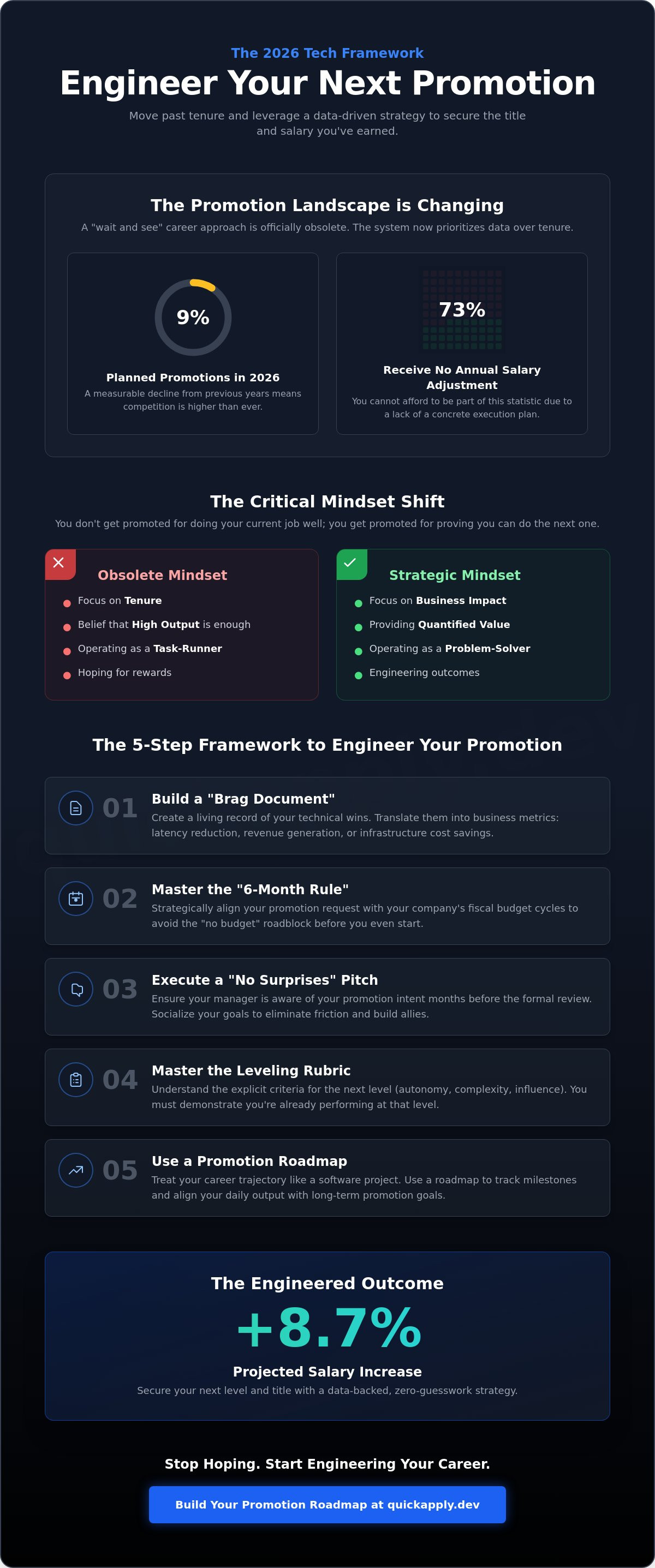
In 2026, employers plan to promote just 9% of their workforce. This is a measurable decline from previous years, which means a "wait and see" approach to your career is officially obsolete. If you feel stuck in your current role despite hitting every KPI, you are fighting a system that prioritizes data over tenure. Mastering how to ask for a promotion in tech requires moving past sentiment and into the realm of technical frameworks and strategic leverage.
We understand the anxiety that comes with the "ask" conversation. It is difficult to lead a career-defining meeting when you lack clarity on your company's internal leveling rubrics. You deserve a clear path to higher compensation and the title that matches your actual impact. Currently, 73% of the tech workforce receives no salary adjustment annually; you cannot afford to be part of that statistic because you lacked a concrete execution plan.
This article provides the exact 2026 framework you need to secure your next level and a projected 8.7% salary bump with zero guesswork. We will analyze current merit increase trends, explain how to build a performance data portfolio, and show you how to utilize a Promotion Roadmap to automate your trajectory. It is time to stop hoping for a raise and start engineering one.
Key Takeaways
- Shift your mindset from tenure-based rewards to a business-impact model. High output alone does not trigger a title change; a quantified business case does.
- Build a living "Brag Document" that translates technical wins into business metrics. Focus on data like latency reduction, revenue generation, or infrastructure cost savings.
- Master the "6-Month Rule" to align your request with fiscal budget cycles. This timing is the strategic foundation of how to ask for a promotion in tech without hitting "no budget" roadblocks.
- Execute the "No Surprises" pitch strategy. Ensure your manager is aware of your promotion intent months before the formal review to eliminate friction during the meeting.
- Leverage an automated Promotion Roadmap to track milestones in real-time. Treat your internal career trajectory with the same technical precision you apply to your software development.
Beyond the Code: Why Tech Promotions Require a Mindset Shift
High output is a baseline requirement. It isn't a promotion trigger. Many engineers fall into the Seniority Trap, assuming that tenure or a high commit count automatically unlocks the next title. In the 2026 tech market, this assumption is a bug in your career logic. You don't get promoted for doing your current job well; you get promoted because you've already started doing the next job.
Your manager doesn't just want to reward you. They need to justify a budget increase to their own stakeholders. You aren't making a simple request. You're presenting a business case. This shift in perspective is the first step in learning how to ask for a promotion in tech. You must prove that your impact has outgrown your current salary band and title.
This transition requires you to become a force multiplier. While an individual contributor (IC) focuses on their own tickets, a Senior or Staff engineer focuses on enabling the entire team. They identify bottlenecks, mentor peers, and improve systemic efficiency. Promotion is simply the formal recognition of this increased scope and the value you've already delivered to the organization.
The Reality of the Tech Leveling Matrix
Tech companies use standardized levels to manage talent: Junior, Mid, Senior, Staff, and Principal. Each tier has specific expectations for autonomy, complexity, and influence. These expectations are managed through a formal performance appraisal process to ensure equity across different engineering teams. A leveling rubric is the objective yardstick for tech career progression.
Understanding these rubrics is vital. If you don't know the criteria for the next level, you can't hit the targets. Use a promotion roadmap to align your daily output with these specific requirements. This ensures your efforts are visible and measurable during review cycles.
Moving from Task-Runner to Problem-Solver
Stop counting tickets. Junior and Mid-level engineers are often task-runners who focus on execution. Senior engineers are problem-solvers who own systems. To master how to ask for a promotion in tech, you must identify high-leverage opportunities that move the needle for the business. This might mean reducing infrastructure costs, improving deployment velocity, or refactoring a legacy system that blocks new features.
Business impact outweighs lines of code every single time in 2026. Managers value engineers who understand the "why" behind the code. When you can link your technical decisions to revenue growth or cost savings, your promotion case becomes undeniable. You aren't just an employee; you're a strategic asset.
Engineering Your Case: Building a Data-Driven Promotion Brag Document
Your manager likely oversees multiple engineers and concurrent projects. They don't have the bandwidth to track every micro-optimization you ship. A Brag Document solves this problem. It functions as a living record of technical wins that you update weekly. When figuring out how to ask for a promotion in tech, this document is your primary evidence locker. It transforms vague claims of "working hard" into a verifiable business case that makes your advancement a logical necessity for the company.
Efficiency is the core of 2026 engineering. You must quantify your impact using hard data. Did you reduce API latency by 15%? Did your refactor save the company $20,000 in monthly cloud spend? Use the Harvard Business Review framework to structure these wins by focusing on the problem, your specific action, and the measurable result. This approach mirrors the ChatGPT resume logic of framing achievements through impact rather than just listing responsibilities. By adopting this mindset, you treat your career progression like a software project: defined by metrics and successful deployments.
Quantifying Technical Impact
Every Pull Request (PR) should link to a business KPI. If you optimized a checkout flow, track the conversion rate increase. If you implemented a new caching layer, document the reduction in database load. These metrics prove you aren't just closing tickets; you're driving growth. Record architectural decisions that prevented technical debt. This demonstrates the foresight required for senior-level roles. You want to show you are already operating at the next level before the title change happens. In 2026, companies plan to promote only 9% of their workforce. Your data must be sharper than the other 91% to secure your spot.
The Power of Peer and Cross-Functional Feedback
Technical skill is only half the equation. You need social proof. Collect feedback from product managers, designers, and fellow engineers. A "thank you" Slack message regarding a smooth launch is a valuable data point. It shows you are a force multiplier who simplifies the work of others. Document every instance where you mentored a junior engineer. This is a high-signal indicator of senior-level leadership. If you find tracking these milestones manually is too time-consuming, consider using a Promotion Roadmap to automate the process. This ensures you never miss a data point that could lead to your next salary bump.
Strategic Timing: Navigating Performance Reviews and Leveling Rubrics
Don't wait for your annual review to start the conversation. That is a rookie mistake. By the time the formal review begins, the budget is already allocated. In 2026, companies plan to reserve a median of 5% of base payroll for salary increases, including promotions. If you haven't secured your spot in that 5% months in advance, you've already lost. This is the "6-Month Rule." You need to signal your intent and begin documenting your case at least two quarters before the official cycle.
Strategic timing also means reading the room. Economic stability concerns are driving 66% of employers to shrink their salary budgets this year. If your company just announced a hiring freeze or missed quarterly earnings, an out-of-cycle promotion is unlikely. However, if you've mastered how to ask for a promotion in tech by aligning your request with a major product launch or a successful system migration, you create leverage. You become a critical asset the company can't afford to lose during a pivot.
Hacking the Performance Review Cycle
Use your weekly 1-on-1s as a staging ground. Ask your manager directly: "What does Level 5 impact look like for me specifically?" This forces them to reference the leveling rubric, which is the technical DNA of your career path. If your current rating is "meets expectations," don't panic. 88% of employees in this category still received a median raise of 3.5% in 2026. Your goal is to use the rubric to build a "promotion-ready" roadmap that moves you into the "exceeds" category. In that bracket, raises jump to a 5% median.
In larger organizations, your manager isn't the only decision-maker. A "Promotion Committee" often reviews the data. This is why your Brag Document must be airtight. It needs to speak for you when you aren't in the room. You're giving your manager the technical ammunition they need to defend your case to the committee. Make their job easy by providing clear, quantified evidence of your impact.
Identifying Your Manager’s Incentives
Your manager actually wants to promote you. It increases their team's prestige and proves they can develop talent. It's a retention win for them. When you make your case, frame it as a shared victory. If they raise the "no headcount" objection, address it early. Ask if the barrier is budgetary or performance-based. If it's budgetary, pivot the conversation to a future timeline with clear, agreed-upon milestones. This keeps the momentum alive and ensures you aren't stuck in a holding pattern. Use a Promotion Roadmap to track these specific milestones in real-time, ensuring you stay on the path to your next salary bump.
The Pitch: Executing the Promotion Conversation with Technical Precision
The meeting is the final deployment. It is not a discovery session. If you have followed the 6-month rule, your manager already knows your intent. This meeting is about formalizing the transition. Approaching how to ask for a promotion in tech with this level of preparation eliminates the "I'll think about it" response. You aren't asking for a favor. You're presenting a logic-based proposal for a title and compensation adjustment that reflects the work you've already delivered.
Structure the meeting with technical precision. Lead with evidence. Present your Brag Document to ground the conversation in hard data. Once the impact is undeniable, move to the title change. Finally, discuss the salary adjustment. In 2026, the average pay increase for a one-level promotion is projected to be 8.7%. Knowing this figure allows you to anchor the conversation in market reality. If you're nervous about the delivery, use a real-time copilot to simulate the meeting and practice handling tough objections with confidence.
The Script: Framing the Ask
Don't be vague. Open with authority: "I want to discuss my trajectory to Senior Engineer and the specific impact I’ve delivered since our last review." Hand over your Brag Document. Let the data on latency reduction and cost savings do the heavy lifting. End the segment with a direct question: "Based on this evidence, what specific gaps do I need to close to reach the next level by the next fiscal cycle?" This forces a concrete answer. If the conversation pivots to compensation, use our Salary Negotiation Guide to ensure you don't leave money on the table.
Handling the "Not Yet" Response
A "not yet" is a request for more data. It isn't a final rejection. Differentiate between a budget freeze and a performance gap. If it's a performance gap, demand a specific list of requirements. If it's a budget issue, negotiate for non-monetary growth. Ask for more autonomy, a lead role on a high-visibility project, or specialized training in AI or Cloud Architecture. These are high-demand skills that command higher-than-average salary increases later. Always end by setting a firm date for a follow-up. Send a finalized Promotion Roadmap immediately after the meeting to document the agreed-upon milestones and keep the momentum toward your next level.
Scaling Your Career: Automating the Path to Senior and Lead Roles
Manual career tracking is a legacy process. High-performing engineers don't have time for diaries or sentiment. They build systems. To master how to ask for a promotion in tech, you must treat your professional growth like a product lifecycle. This means implementing a continuous delivery pipeline for your achievements. Your internal promotion case should look exactly like an external job application: data-heavy, impact-focused, and ready for review at any moment.
AI is the engine behind this optimization. Use it to keep your technical resume "promotion-ready" by instantly translating your weekly wins into high-impact bullet points. This eliminates the end-of-year scramble for data. By maintaining a live record, you ensure your value is always visible to leadership. If your current organization lacks a clear path, this same data becomes your leverage in the open market. With software roles projected to grow 15% from 2024 to 2034, the demand for verified talent is increasing. You aren't just an employee; you're a high-value asset in a competitive ecosystem.
Continuous Career Management
The best time to prepare for your next promotion is your first day in a new role. Set up automated triggers for achievement logging. Every time a PR is merged or a system latency drops, it belongs in your data set. Treat your career as a product with regular feature updates. These updates include mastering high-demand skills like AI integration, cloud security, or data science. This proactive strategy ensures that when the fiscal cycle opens, you aren't just another candidate. You're the obvious choice. Use a promotion roadmap to track these milestones in real-time and align your output with the company's long-term goals.
When the Promotion Doesn’t Come
Sometimes the system is the problem. You must recognize "promotion-blocking" cultures where budgets are permanently frozen or leveling rubrics are ignored. If you've delivered quantified impact and the "not yet" response lacks a specific roadmap for improvement, it's time to pivot. Data from 2025 shows that European tech professionals saw average salary increases of 22.3% upon promotion. If your current firm won't match that growth, the market will. Use your Brag Document as the foundation for a new search. Leveraging our Resume Tailoring and Salary Negotiation Guide tools allows you to secure a 20-30% raise at a new firm without the internal wait. Don't let a stagnant hierarchy cap your earning potential. Move fast, use the data, and stay ahead of the curve.
Engineering Your Next Level
Success in the 2026 tech landscape isn't about working more hours. It's about quantifying your influence. You've learned that mastering how to ask for a promotion in tech requires a shift from task execution to system ownership. By maintaining a data-driven Brag Document and aligning your pitch with company fiscal cycles, you eliminate the friction of the "not yet" response. This technical approach ensures that your advancement is a logical business decision rather than a personal request.
Stop leaving your career trajectory to chance or manual diaries. You need a system that works as hard as your code. Automate your path to the next level with QuickApply’s Promotion Roadmap. Our platform features AI-powered achievement tracking and tailored career growth frameworks used by tech leads at top-tier firms. It's time to secure the title and compensation you've already earned. Build your case, deploy your pitch, and take control of your professional future. You have the framework; now execute.
Frequently Asked Questions
How long should I wait before asking for a promotion in a new tech role?
Start social-proofing your impact immediately. While 12 months is the standard for a formal title change, the strategic dialogue begins at month six. You must establish that you are already operating at the next level before the review cycle starts. Use this time to build your Brag Document with quantified wins. This proactive approach ensures you are part of the 9% of the workforce projected for promotion in 2026.
Can I ask for a promotion if the company is currently going through layoffs?
Yes, but you must prove your role is an essential revenue driver or cost-saver. Economic stability concerns are impacting budgets for 66% of employers this year. However, companies still prioritize retaining top talent during restructuring. Frame your request as a retention strategy. Focus on how your promotion ensures the continued stability of critical systems or high-priority projects.
What is the average salary increase for a promotion from Mid to Senior Engineer?
The average pay increase for a one-level promotion is projected at 8.7% for 2026. This is down slightly from 9.3% in the previous year. In high-demand sectors like AI or Cloud Architecture, these numbers can be significantly higher. Always baseline your expectations against these market adjustments to ensure your new salary band matches your increased responsibilities and technical impact.
How do I ask for a promotion if my manager doesn’t have a technical background?
Translate technical metrics into business outcomes like revenue growth or infrastructure cost savings. Non-technical managers care about the "why," not the "how." Use a Brag Document to bridge the gap between code and commerce. When explaining how to ask for a promotion in tech to a non-technical leader, focus on how your architectural decisions reduced churn or improved deployment velocity.
What should I do if my promotion is approved but the salary increase is low?
Pivot to negotiating for non-monetary leverage or a scheduled mid-cycle review. If the 8.7% average is out of reach due to budget freezes, ask for increased autonomy or a lead role on a high-visibility project. Use a Salary Negotiation Guide to identify other high-value items like specialized training budgets. Ensure any agreement on a future raise is documented in your official Promotion Roadmap.
How do I handle a situation where a peer gets promoted over me?
Request an immediate gap analysis against your company’s leveling rubric. Don't let emotion cloud your professional strategy. Ask your manager for the specific technical and leadership milestones you missed. Use this feedback to update your Promotion Roadmap. If the criteria for the peer's promotion remain opaque, it may be a sign of a promotion-blocking culture that requires an external pivot.
Is it better to get a promotion internally or switch companies for a higher title?
Switching companies typically yields a 20% to 30% salary increase, while internal moves average around 8.7%. Internal promotions offer stability and proven influence, but external jumps capitalize on market demand. If you've mastered how to ask for a promotion in tech but hit a budget ceiling, use your data-driven Brag Document to secure a higher title and better compensation elsewhere.
What are the most important technical KPIs for a Staff Engineer promotion?
Focus on cross-functional influence and architectural foresight. Staff roles require you to be a force multiplier who affects multiple teams. Track KPIs like reduction in technical debt across the organization or successful migration of legacy systems. Document your mentorship of senior engineers. These high-signal indicators prove you are managing complexity at a scale that justifies the Staff-level title.


