

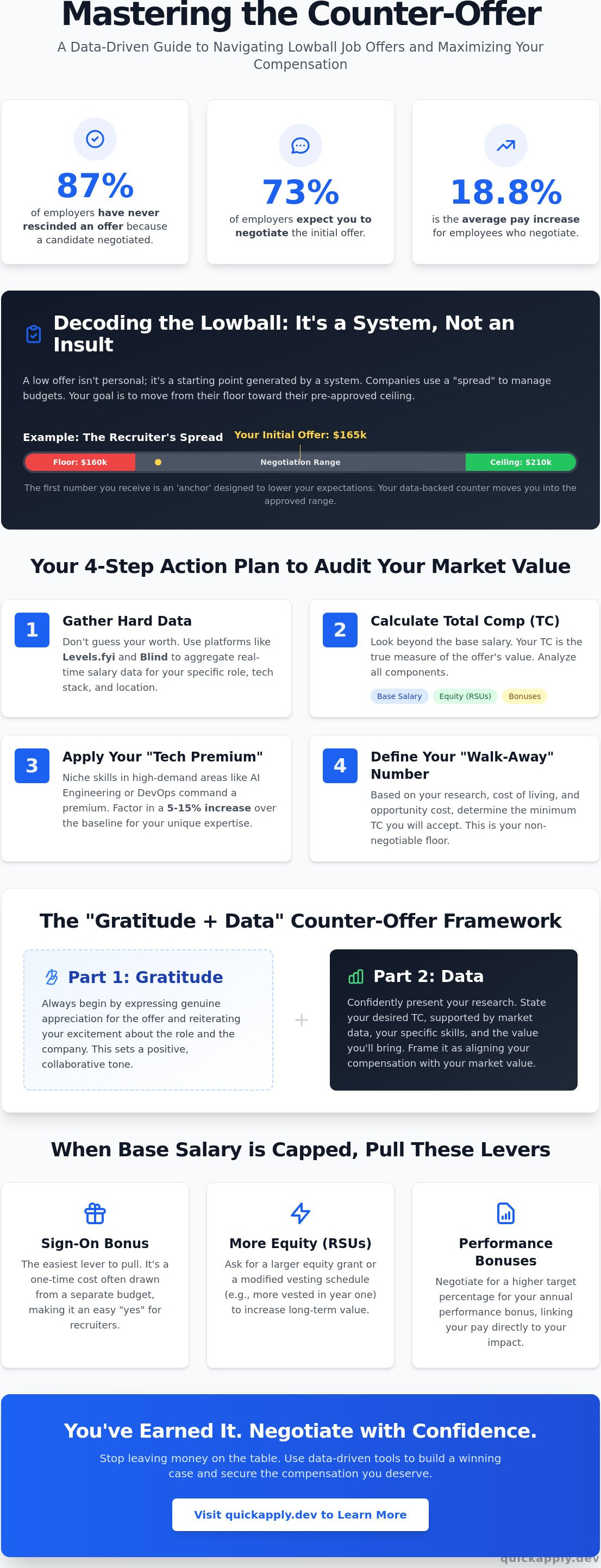
Exactly 87% of employers have never rescinded an offer because a candidate negotiated. Still, many tech professionals hesitate. You've navigated the interview gauntlet only to receive a number that doesn't track with your value. It's a common pain point. You need to know how to counter a lowball job offer without risking the role or sounding entitled. You're looking for a way to bridge the gap between their initial floor and your market worth.
Negotiation works. Employees who push back see an average pay raise of 18.83%. Since 73% of employers expect a counter, you're actually expected to optimize the deal. We'll provide the framework to turn an underwhelming offer into a competitive total compensation package. This guide covers everything from decoding RSU structures to using our Salary Negotiation Guide for maximum leverage. You'll learn to lead with data, secure a higher sign-on bonus, and enter your new role with the respect you've earned.
Key Takeaways
- Reframe the initial lowball offer as a data gathering exercise that reveals the company's negotiation floor.
- Learn exactly how to counter a lowball job offer using a "Gratitude + Data" framework to bridge the gap between their offer and your market value.
- Audit your Total Compensation (TC) by calculating the real-time value of equity, bonuses, and base salary using 2026 tech benchmarks.
- Identify alternative negotiation levers like sign-on bonuses and RSU structures to optimize your package when cash ceilings are firm.
- Use our Salary Negotiation Guide to navigate recruiter "spreads" and secure a top-tier compensation package with confidence.
Decoding the Lowball: Why Companies Start Low in 2026
A lowball offer isn't an insult. It's a system output. In the 2026 tech market, any offer landing below the 50th percentile of the current market rate qualifies as a lowball. Recruiters work within a spread. This is the delta between the absolute floor they can offer and the maximum ceiling approved for the role. They start at the floor to preserve budget. It's basic negotiation theory in action. You're viewing a starting point, not a final verdict.
Many initial offers are now generated by AI benchmarking tools. These systems often rely on historical data rather than real-time talent scarcity. They don't account for your specific edge or unique project history. If you're wondering how to counter a lowball job offer, start by detaching your ego. The number on the screen reflects a corporate algorithm. It isn't a personal judgment on your skills. It's a baseline for optimization.
Recruiters are incentivized to close candidates at the lower end of their approved range. If a role has a spread of $160k to $210k, starting at $165k gives them significant room to move while staying under budget. Understanding this mechanic changes your perspective. You aren't fighting for more. You're moving toward the pre-approved ceiling that already exists in their spreadsheet.
The 'Anchor' Effect in Salary Negotiations
The first number mentioned in a discussion dictates the boundaries of the entire deal. Companies lead with a low figure to pull your expectations downward. Accepting this initial anchor immediately signals that you're undervalued. It suggests you lack the data to challenge the system. In technical terms, the anchor functions as a hard-coded constraint that limits the potential output of the entire negotiation sequence.
Identifying a 'True' Lowball vs. a Market Correction
Don't confuse a shifting market with a bad offer. In 2026, some tech stacks have seen a 4.1% correction in baseline pay according to recent WTW forecasts. A true lowball ignores your specific contributions or mis-levels your seniority. Check internal equity. If your offer is significantly lower than what peers in the same tier earn, the system is broken. You must determine if the company is being cheap or if they simply don't understand the complexity of your stack. Use our Salary Negotiation Guide to identify these discrepancies before you respond. Knowing how to counter a lowball job offer requires knowing exactly where the market stands today. Internal equity is a major factor. Companies must balance new hire costs with existing team salaries to avoid churn. If your offer is low, it might be because the existing team is underpaid. This is a systemic issue you can't fix, but you can use it as leverage to ask for a higher sign-on bonus or equity instead of base salary.
Auditing Your Market Value: Data Over Gut Feelings
Don't guess your worth. In 2026, sentiment is a liability. You need hard metrics to build a case for how to counter a lowball job offer. Start by Auditing Your Market Value across specialized platforms. Generic career sites often fail to capture the nuance of modern tech roles. Aggregate data from Levels.fyi and Blind to see what peers in your specific stack are actually earning. This isn't just about base pay. It's about Total Compensation (TC).
Your TC is the sum of base salary, annual bonuses, and equity. If you have niche expertise in AI engineering or DevOps, apply a "Tech Premium." Demand for these skills remains high. Most professionals secure 5 to 15% increases when negotiating. Switching companies can net 20 to 25%. Use these benchmarks to set your "Walk-Away Number." This figure accounts for your cost of living and the opportunity cost of leaving your current equity on the table.
The Tech TC Stack: Beyond the Base Salary
Base salary is just the foundation. Equity represents long-term wealth. Most tech firms use a four-year vesting schedule for RSUs. If the base salary is capped, pivot to sign-on bonuses. They are the easiest lever to pull. Recruiters often draw sign-on bonuses from a different budget pool than base pay. Don't overlook performance bonuses or annual "refreshers." These components ensure your compensation scales as you contribute value over time. If you want to streamline this analysis, use our Salary Negotiation Guide to build a winning case instantly.
Using AI to Benchmark Your Worth
Optimization requires better tools. Use AI to scan job descriptions for hidden seniority signals. Keywords like "architectural ownership" or "cross-functional leadership" often indicate a higher pay band than the title suggests. Cross-reference your "Match Score" with actual salary data to identify under-leveled offers. You can leverage QuickApply's salary negotiation guide to access data-backed leverage that forces recruiters to adjust their numbers.
Success is a matter of data density. The more verified data points you bring to the table, the harder it is for a recruiter to maintain a lowball anchor. Statistics show that 73% of employers expect you to negotiate. They have already priced in a buffer. Your job is to extract it using a logical, high-impact framework. Stop relying on intuition. Start using the systems that define the modern market.
The Counter-Offer Framework: Scripts for Every Scenario
Data is your ammunition. Execution is your delivery system. To master how to counter a lowball job offer, you need a script that eliminates emotional friction and focuses on market parity. Use the "Gratitude + Data" approach. Start by expressing genuine excitement about the team and the technical roadmap. Then, pivot immediately to the delta between their offer and the 2026 market benchmarks you've gathered.
Don't just ask for more money. Explain why the number is a mismatch for the specific technical ROI you provide. If you have competing offers, use them as leverage. Recruiter reports from May 2026 show a 75% increase in candidates initiating these conversations. They expect the pushback. If you encounter a hard ceiling on base salary, don't walk away yet. Pivot to an "Alternative Lever" like increased equity or a performance-based sign-on bonus. This moves the conversation from whether they can pay you to how they can reach your TC target.
Scenario A: The 15-20% Gap
A significant gap requires a structured response. Use this pivot: "I'm excited about the project, but based on recent data for this stack, there's a 15% gap between this offer and the current market 50th percentile." Focus on the immediate value you'll deliver to their 2026 roadmap. The "Gratitude + Data" approach acknowledges the opportunity while using objective market metrics to justify a higher compensation ceiling. Cite specific project successes to justify the premium. If the gap persists, consult our Salary Negotiation Guide to identify hidden budget pools that recruiters rarely mention upfront.
Scenario B: The Non-Monetary Counter
When learning how to counter a lowball job offer, remember that cash isn't the only variable in the optimization equation. If the base salary is non-negotiable, secure your value through flexibility or future guarantees. Request remote work options, a more senior title, or a dedicated learning stipend for AI certifications. Another high-impact move is the "6-Month Review" clause. Propose a guaranteed salary adjustment after six months based on specific KPIs. This reduces the company's immediate risk while protecting your long-term earning potential. Ensure every verbal agreement is codified in the final offer letter. A promise not in writing is just a suggestion. Use an Application Tracker to keep these details organized as you finalize the deal.
Strategic Leverage: Turning 'No' into 'Not Yet'
Fear is a bug in your negotiation logic. Most candidates hesitate because they fear an offer will be rescinded. The data suggests otherwise. Exactly 87% of employers have never pulled an offer because a candidate attempted to negotiate. In fact, 73% of recruiters expect it. If you're learning how to counter a lowball job offer, you must realize that "no" is rarely a hard stop. It's often a signal that you haven't provided enough data to trigger a budget override.
Buy yourself time. Never accept on the spot. Request 48 to 72 hours to review the total package with your stakeholders. This creates a vacuum that the recruiter will feel compelled to fill. Use the "Reverse Interview" technique during this window. Ask specific questions about the budget constraints for the role. Is the cap based on internal equity or a fixed departmental project budget? Identifying the source of the "no" allows you to pivot your strategy toward a different compensation lever, like a sign-on bonus or RSUs.
Creating Artificial Leverage
The strongest negotiation position is having a high volume of quality leads. If your pipeline is dry, accelerate other interview processes immediately. Inform other companies that you have an active offer to trigger their "fast-track" protocols. Use automated job application trackers to maintain a visible market presence. This signals to the hiring team that you are a high-demand asset. Your current role also provides "stay value." Calculate the cost of leaving your current vesting schedule and use that as your absolute baseline. If the new offer doesn't beat your current trajectory, you have no reason to move.
The Psychology of the Recruiter
Recruiters are your primary interface, not your enemy. They want to close the deal to meet their own performance metrics. Transform the recruiter into your advocate by providing the data they need to sell a higher number to the hiring manager. Frame your request as a way to "get to a yes today." Follow the "Final Ask" rule: consolidate all your requests into one comprehensive counter-offer. Negotiating more than twice creates friction and suggests you aren't serious about closing. To ensure you have every script ready for this final push, get our Salary Negotiation Guide and lock in your market value.
Recognize when to walk away. If a company refuses to meet the 50th percentile of market rates despite clear data, it reveals a "dead-end" culture. This systemic refusal to value talent often predicts stagnant future growth. A lowball offer that won't budge is a warning. It's better to stay in the pipeline than to join a firm that views compensation as a cost to be minimized rather than an investment in performance.
Scaling Your Career ROI with AI Automation
The ultimate leverage isn't a clever script. It's a full pipeline. When you have multiple high-value leads, knowing how to counter a lowball job offer becomes a tactical decision rather than a desperate plea. AI automation has shifted the paradigm from manual job hunting to career portfolio management. By automating the high-volume top of your funnel, you free up cognitive bandwidth for the high-stakes negotiation at the bottom. This is how you win in 2026.
QuickApply handles the repetitive mechanics of the search. It ensures you never enter a pipeline with a lowball ceiling by filtering for roles that align with your market value. Stop wasting time on companies that hide their compensation data. Focus on the 57.8% of postings that now provide salary transparency. This systemic approach guarantees that every conversation you have starts from a position of strength. You aren't just looking for a job. You're optimizing an asset.
Building a Competitive Advantage
Success requires precision. Use AI resume tailoring to align your profile with high-tier salary bands automatically. This isn't about keyword stuffing. It's about demonstrating the specific ROI a company expects for a top-percentile offer. Maintain a continuous "Match Score" audit of the tech market to see where your skills command the highest premium. An "Always-On" application strategy creates a constant flow of opportunities. This persistent market presence is your insurance policy against stagnant wages. It allows you to walk away from insulting offers because you know another lead is already in the final stages. Leverage is built through volume.
Next Steps: Finalizing the Deal
Before you sign, run a final diagnostic. Verify the vesting schedule, the sign-on bonus terms, and the specific KPIs for your first performance review. Transition from a candidate to a top performer by arriving with a 30-60-90 day plan already drafted. This professional momentum justifies the premium you negotiated. You've used the data. You've mastered the scripts. Now, use the tools that keep you ahead of the curve. Optimize your next career move with QuickApply and ensure you never leave money on the table again. Your time is too valuable for manual processes. Focus on the negotiation. Let the software handle the rest.
Secure Your Market Value
A lowball offer isn't the end of the conversation. It's the start of your optimization phase. You've learned that how to counter a lowball job offer effectively requires a shift from emotional reactions to data-driven execution. By auditing your market value and using structured scripts, you move the needle from a basic salary to a comprehensive total compensation package. Success in the 2026 tech market belongs to those who view their career as a high-performance portfolio rather than a series of tasks.
Efficiency is your competitive advantage. Don't leave your earning potential to chance or manual guesswork. Leverage real-time market rate benchmarking and AI-powered salary negotiation insights to lock in the package you deserve. You can tailor resumes for FAANG-tier salary bands in seconds to ensure you always enter the pipeline with maximum leverage. Stop settling for the floor when the ceiling is within reach. Start tailoring your career for higher-paying roles with QuickApply today. You've done the work. Now, get paid for it.
Frequently Asked Questions
Can a company rescind a job offer if I try to negotiate a lowball?
Offer rescission is statistically improbable. Exactly 87% of employers report they've never rescinded a job offer because a candidate attempted to negotiate. In fact, 73% of hiring teams anticipate a counter-offer. As long as you remain professional and rely on objective data, the risk is negligible. Negotiation is a standard protocol in the tech industry that signals you understand your own market worth.
How do I respond to a lowball offer via email?
Respond with a structured "Gratitude + Data" framework. Start by confirming your interest in the role and the team. Pivot immediately to the compensation gap by citing 2026 market benchmarks. End with a clear request for a specific total compensation target. This email structure is the most efficient way to initiate how to counter a lowball job offer while maintaining a positive relationship with the hiring manager.
What is a reasonable counter-offer percentage for a tech role in 2026?
Target a 10% to 20% increase. While the average raise from negotiation is 18.83%, most tech professionals secure 5% to 15% in standard scenarios. If you're switching companies, aim for the higher end of that range. Always justify your number with data from specialized platforms rather than personal needs. A 20% counter is a strong starting point when the initial offer falls below the market's 50th percentile.
Should I tell the recruiter my current salary during negotiation?
Don't disclose your current salary. Your past compensation isn't a benchmark for your future value. Many jurisdictions now prohibit employers from asking this question. If pressed, redirect the recruiter to the market data you've collected for the specific role. Focus the conversation on the target range required to close the deal based on current 2026 tech standards and your specific skill set.
How do I negotiate a sign-on bonus if the base salary is fixed?
Position the sign-on bonus as a bridge for the total compensation gap. If the base salary is at a hard ceiling, ask for a one-time payment to reach your first-year target. Recruiters often have more flexibility with sign-on bonuses because they don't impact the recurring annual budget. Explain that this bonus compensates for the delta between their offer and the market benchmarks you've identified.
What should I do if the company says the salary is 'non-negotiable'?
Explore alternative levers if the base is truly fixed. Ask for an accelerated six-month performance review with a guaranteed salary adjustment. You can also negotiate for additional equity, remote work days, or a more senior title. Knowing how to counter a lowball job offer means looking at the full package. If they won't move on any component, it may signal a rigid culture that won't value your future growth.
How does equity/RSUs factor into countering a lowball offer?
Equity is often the most flexible part of a tech compensation package. If the cash offer is underwhelming, ask for a larger RSU grant to boost your total compensation. Calculate the annual value of the vesting schedule to see the real impact on your bottom line. Since equity doesn't hit the immediate cash budget, companies are frequently more willing to increase stock grants to secure top talent.


