

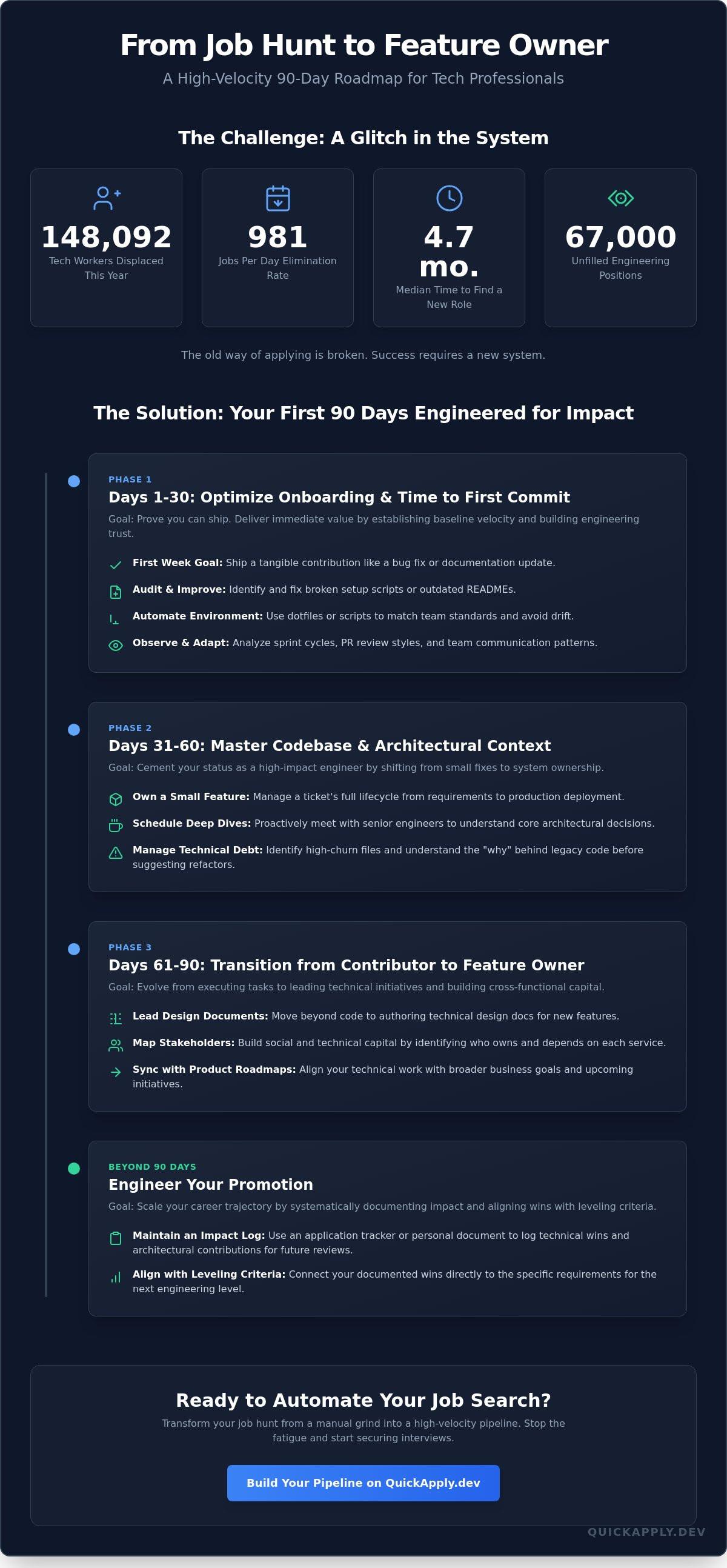
Exactly 148,092 tech workers have been displaced since January 1, 2026, at a staggering rate of 981 jobs per day. If you're feeling the burn of high-volume rejections and manual resume tailoring fatigue, you aren't alone. The median time to find a new role has spiked to 4.7 months, yet 67,000 engineering positions remain unfilled globally. You've likely realized that the old way of applying is a glitch in your career logic. Understanding how to structure your tech job search is the only way to bypass the noise and regain your competitive edge.
You deserve a system that works as hard as your code does. We're going to help you transform your job hunt from a manual grind into an automated, high-velocity pipeline that guarantees a dominant first 90 days. This roadmap isn't just about getting hired; it's about building immediate engineering trust and shipping your first feature within 30 days of your start date. We'll walk through deploying an automated application tracker, using advanced resume tailoring, and executing a promotion roadmap that begins before you even sign the offer letter.
Key Takeaways
- Automate your application pipeline to eliminate manual fatigue and secure interviews with high-velocity efficiency.
- Master how to structure your tech job search to ensure your first commit happens within seven days of your start date.
- Transition from bug fixes to end-to-end feature ownership by mastering architectural context and leading technical design documents.
- Build social capital and technical leverage by mapping stakeholders and syncing with product roadmaps during your first 60 days.
- Scale your career trajectory using a promotion roadmap that documents impact and aligns your wins with specific leveling criteria.
Days 1-30: Optimizing Onboarding and Time to First Commit
Stop viewing the job offer as the finish line. If you want to know how to structure your tech job search, you have to look beyond the interview. The first 30 days of your new role are a high-stakes extension of your candidacy. You're no longer proving you can code; you're proving you can ship. Use this initial period to audit internal documentation and fix broken setup scripts immediately. Outdated READMEs are technical debt that slows down every new hire. By identifying and patching these gaps, you provide instant value before you've even touched the core codebase.
Your first week should culminate in a tangible contribution. Target a small bug fix or a documentation update by the end of week one. It establishes your baseline velocity and signals to the team that you're here to execute. Observe the team sprint cycle and deployment pipeline without disrupting the flow. Watch how PR reviews are handled. Are they pedantic or high-level? Adopting the team's communication style early builds immediate engineering trust. This proactive approach is a natural extension of job searching fundamentals where preparation and efficiency dictate success.
Technical Environment Setup and Tooling Efficiency
Don't wait for a senior developer to hold your hand. Automate your local configuration to match team standards using dotfiles or custom scripts. Identify core dependencies and internal libraries early to avoid environment drift. If you hit a hurdle during setup, document it. Improving the onboarding experience for the next hire is a low-effort, high-impact win. Establishing a baseline for your personal velocity within the team tech stack is critical. It allows you to set realistic expectations with your manager and identify where you need more training.
Navigating Knowledge Silos and Internal Documentation
Real system knowledge lives in the cracks of documentation. When you're determining how to structure your tech job search, you're looking for systemic efficiency. That same logic applies to navigating a new codebase. Analyze the last three months of post-mortems to understand where the system actually breaks. This isn't just about code; it's about context. Map out the data flow for the most critical user path in the application. You need to know how data moves from the UI to the database and back.
Apply the principles found in mastering the job application process to dissect the corporate hierarchy. Understand who owns which service and how decisions get made. Identifying the non-technical stakeholders who rely on your team’s output will help you navigate the political landscape. By the end of day 30, you should have a clear map of the people and the pipes that keep the product running.
Days 31-60: Mastering the Codebase and Architectural Context
The second month is where you cement your status as a high-impact engineer. You've already cleared the initial onboarding hurdles. Now, you must shift your focus toward system ownership. If you're still wondering how to structure your tech job search for long-term success, remember that your search strategy should have already identified these architectural expectations. Transition from minor bug fixes to owning a small feature development end-to-end. This isn't just about writing code; it's about managing the lifecycle of a ticket from requirements to production.
Stop asking for permission. Start scheduling architecture deep dives with senior engineers to clarify system design. You need to understand why the database was sharded this way or why a specific microservice handles authentication. Leverage tools like career exploration and job analysis to understand the specific skill benchmarks required for your engineering level. This ensures your technical output aligns with both industry standards and internal leveling criteria. While you master the codebase, don't lose sight of your career trajectory. Use an application tracker to keep a log of your technical wins and architectural contributions for future reviews.
Analyzing Patterns and Managing Technical Debt
Identify frequently modified files to find high-churn areas in the codebase. These are often the places where technical debt is highest and where your intervention can have the most impact. Audit the technical debt within your specific sub-domain or module. Before you suggest a major refactor, understand the "why" behind the legacy code. Every piece of "bad" code was likely a rational choice made under a tight deadline. Balance your feature delivery with small, incremental code quality improvements. This builds trust with your peers without stalling the product roadmap.
Active Participation in Technical Discussion and Code Reviews
Your participation in code reviews should move beyond syntax checks. Contribute meaningfully by focusing on logic, scalability, and edge cases. Ask clarifying questions in PRs that reveal underlying architectural assumptions. This helps you learn the system while ensuring the team maintains high standards. Communicate your technical decisions with the same precision you used during the hiring process. You can apply final round ai techniques to articulate complex logic clearly during sprint planning. Provide feedback that aligns with team style guides and performance goals. This consistency proves you're a force multiplier, not just a solo contributor.
Days 61-90: Transitioning from Contributor to Feature Owner
By day 60, you've successfully integrated into the team rhythm. You've shipped code and understood the architecture. Now, you must pivot from executing tasks to owning outcomes. This final phase of your 90-day roadmap is where you solidify your reputation as a high-leverage engineer. You're no longer just proving you belong; you're proving you can lead. When you first researched how to structure your tech job search, the goal was to find a role where you could make a measurable impact. This is the month where that impact becomes undeniable.
Lead a technical design document (TDD) for an upcoming sprint item. Don't wait for a senior engineer to hand you a pre-defined spec. Take the initiative to gather requirements, define the technical approach, and solicit feedback from the team. This demonstrates that you can think three steps ahead of the current ticket. While you're at it, measure the business impact of your shipped code using internal metrics. If you optimized a query, quantify the reduction in database load. If you shipped a feature, track the user adoption rate. Clear, data-backed wins are the foundation of a future promotion.
Owning the Full SDLC Lifecycle for New Features
Ownership means managing a feature from requirements gathering all the way through to production deployment. You're the point person for your code. Coordinate with QA and DevOps early to ensure a frictionless release cycle. Don't let your features get stuck in a "ready for deploy" state. Write a single sentence defining your feature impact with a specific metric. For example, "shipped the revamped auth flow which reduced login errors by 12%." This level of clarity is exactly what leadership looks for during performance reviews.
Identifying High-Leverage Process Improvements
High-velocity engineers don't just work within systems; they improve them. Spot bottlenecks in the local development loop or build times that frustrate the team. If the CI/CD pipeline is flaky, find the root cause and propose a fix. Present a data-backed case for a tool or workflow change to your manager, such as using TrackMyBusiness to streamline and manage the team's workflows. Implement one automation that saves the team at least one hour weekly. This could be a script to generate boilerplate code or a Slack bot that tracks PR review times. Finally, mentor a newer hire or intern. Sharing your knowledge demonstrates leadership potential and scales your value across the entire organization.
Stakeholder Mapping: Building Technical and Social Capital
Code doesn't exist in a vacuum. If you've mastered how to structure your tech job search, you already know that landing the role is only the first phase of optimization. Now, you must map the human architecture of your organization. Identify the non-engineering stakeholders who rely on your team's output. Whether it's sales, customer success, or marketing, these groups define the business context for your PRs. Building social capital early ensures that when you propose a technical change, you have the political leverage to see it through. High-impact contributors don't just ship code; they navigate complex systems with precision.
Sync with Product Managers to understand the long-term roadmap. You need to know the reasons behind the features you're building. Participate in user research sessions to gain direct empathy for customer pain points. This insight prevents wasted cycles on technically elegant but commercially useless features. Additionally, learn design system constraints early. Understanding the boundaries of the UI prevents friction during the implementation phase of your sprints. Knowledge of the product vision transforms you from a ticket-taker into a strategic partner.
Syncing with Product and Design Teams
Efficiency is about finding the shortest path to a solution, and that path usually involves people. Understand the user pain points that drive current roadmap decisions. By learning design system constraints, you avoid implementation friction during high-velocity sprints. This proactive communication prevents the "it works on my machine" mentality from infecting the product lifecycle. Participate in at least one user research session per month. It provides the qualitative data you need to justify technical trade-offs to non-technical leadership.
Establishing a Feedback Loop with Engineering Leadership
Your Engineering Manager (EM) is your most critical stakeholder. Establish a recurring feedback loop immediately. Don't wait for annual reviews to discover you're off track. Define exactly what exceeding expectations looks like for your specific level. Request a 60-day mini-review to course-correct before the 90-day mark. This transparency builds trust and demonstrates a commitment to high-velocity growth. Align your personal development goals with the team’s long-term technical vision. If the team is moving toward serverless, your learning path should mirror that shift. To ensure you're always ahead of the curve in your career, use a promotion roadmap to track these social wins alongside your technical output.
Build a peer network across different departments to break information silos. Knowing a dev on the infrastructure team or a designer in another squad provides shortcuts for troubleshooting. These connections are the metadata of your career. They allow you to gather information faster and deploy solutions with greater accuracy. In a crowded market, your ability to build social capital is just as important as your ability to write clean code.
Engineering Your Promotion: Documenting Impact for Future Growth
Your first 90 days are a high-intensity sprint, but your career is a system that requires continuous optimization. If you've followed this roadmap, you've already shipped code and built social capital. Now, you must engineer your visibility. Most engineers fail here because they assume their work speaks for itself. It doesn't. You need to document every PR, bug fix, and process win from day one. This is essentially how to structure your tech job search for the long term. You're building a repository of evidence that makes your next promotion inevitable.
Start a brag document immediately. This isn't just a list; it's a data-driven record of your impact. Link your 90-day wins to the specific leveling criteria for your role. If the senior engineer level requires architectural influence, point to the technical design document you led in month three. Use AI tools to synthesize your technical contributions into business value statements. Don't just say you fixed a bug. Say you reduced API latency by 15%, saving the company compute costs. Setting the stage for your next promotion roadmap begins the moment you finish onboarding.
Tracking Technical Accomplishments for Performance Reviews
Quantify your impact with precision. Record lines of code removed, latency reduced, or specific features shipped. Note every time you unblocked a teammate or improved internal documentation. These small wins accumulate into a compelling case for advancement. Maintain an active application tracker to monitor your ongoing market value. Knowing what competitors are paying for your current skill set gives you the leverage needed for salary negotiations or internal raises. Performance reviews are not the time for modesty; they're the time for data.
Leveraging AI for Long-Term Career Strategy
Optimization doesn't stop at your current desk. Use QuickApply to learn how to tailor your resume to a job description for the next level up. Compare your current output to industry standards for Staff or Lead roles. This gap analysis reveals exactly which skills you need to acquire next. Draft a promotion roadmap that targets a title change within 12 to 18 months. By understanding how to structure your tech job search as a continuous cycle of improvement, you ensure your career trajectory remains high-velocity. You aren't just a developer; you're the architect of your own professional growth.
Deploy Your High-Velocity Career Strategy
The 90-day roadmap isn't just a guide; it's an operating system for your professional life. You've transitioned from your first commit to full feature ownership. By mapping stakeholders and documenting every technical win, you've turned a standard role into a high-leverage career asset. Understanding how to structure your tech job search ensures you aren't just filling a seat. You're engineering a dominant market position from day one.
Stop relying on manual tracking and generic advice. High-performance engineers use high-performance tools to stay ahead. You need a system that automates the friction of professional growth so you can focus on shipping high-impact code. Use tech-focused resources to keep your momentum high and your output visible to leadership. Efficiency is the only metric that matters in a competitive landscape.
Optimize your career trajectory with QuickApply’s AI tools. Access AI-powered promotion roadmaps, automated impact tracking, and tech-focused career growth resources designed for the modern developer. The market is crowded, but your path is now clear. Take ownership of your trajectory and start building your legacy today.
Frequently Asked Questions
What is a 30-60-90 day plan for a software developer?
It's a strategic framework that breaks your integration into three distinct phases: learning, contributing, and owning. In the first 30 days, you focus on environment setup and small commits. By day 60, you transition to owning minor features and understanding architectural patterns. Day 90 should see you leading technical design documents and improving team processes. This structure mirrors the logic of how to structure your tech job search by prioritizing high-velocity output from day one.
How do I measure success in my first 90 days as a developer?
Success is measured by your time to first commit, the quality of your PR reviews, and your ability to unblock teammates. Quantifiable metrics include the number of features shipped and the reduction in technical debt within your assigned module. Qualitative success involves building social capital with stakeholders and demonstrating a deep understanding of the product roadmap. If you've automated a recurring manual task by month three, you're performing at a high level.
What if I haven’t shipped any code by day 30?
Identify the bottleneck immediately and communicate it to your manager. If the delay is caused by environment setup or missing documentation, fix those scripts to unblock yourself and future hires. Use this time to audit internal systems and map data flows. While shipping code is the primary goal, providing value through documentation patches or bug triage is a valid fallback during the initial ramp-up phase. Don't stay silent; visibility is key.
How much time should I spend reading documentation versus coding?
Aim for a 30/70 split in favor of coding as soon as your environment is stable. Documentation provides context, but the codebase reveals the truth. Read docs to understand the high-level architecture, then jump into the code to see the implementation. If you find documentation that contradicts the source code, update it immediately. This proactive behavior demonstrates technical maturity and helps you master how to structure your tech job search for internal promotions.
How do I handle imposter syndrome during the first 90 days?
Treat imposter syndrome as a data gap rather than a personal failing. Focus on executing small, verifiable tasks to build momentum and confidence. Remember that the company hired you based on a rigorous technical assessment of your skills. If you feel overwhelmed, request a 1:1 with a peer to clarify technical assumptions. Action is the best antidote to insecurity. Keep shipping code and the feeling will dissipate as your impact grows.
What are the most common mistakes developers make when starting a new role?
The biggest errors are staying silent when stuck and suggesting massive refactors before understanding legacy constraints. Many developers also neglect building relationships with non-engineering stakeholders, which limits their long-term impact. Avoid the lone wolf mentality. Engage with your team's sprint cycle and ask for feedback early. Failing to document your early wins is another critical mistake that can stall your first performance review and promotion trajectory.
How do I ask for feedback without sounding insecure?
Frame your request around optimization and alignment rather than seeking validation. Ask your manager, "What specific metrics should I target to exceed expectations this month?" or "Are there areas where my PR velocity could improve?" This approach signals a results-driven mindset and a desire for high-velocity growth. It shifts the conversation from your feelings to your output, making you appear confident, proactive, and focused on the team's overall success.
When should I start suggesting major architectural changes?
Wait until after day 60, once you have successfully shipped at least one feature and audited the existing technical debt. You need to earn technical trust before challenging core systems. When you do propose a change, back it with data from post-mortems or performance metrics. Presenting a technical design document (TDD) that outlines the problem, the solution, and the risks will make your suggestions much more authoritative and likely to be adopted by leadership.


