
Your current cover letter is a bloated legacy system that recruiters are programmed to ignore. With 51.7% of recruiters skipping these documents entirely, your message must function as a high-speed data packet that proves ROI in seconds. Mastering how to write a cover letter that gets read in 2026 isn't about being polite; it's about system optimization. You're likely exhausted from submitting hours of work into a black hole of automated rejections and generic AI fluff.
We understand the frustration of being a high-value candidate lost in a sea of low-effort noise. This guide delivers a repeatable framework designed to bypass recruiter apathy and trigger immediate action. You'll stop guessing what hiring managers want and start using a disruptive, results-driven approach that increases your interview invite rates while cutting your application time in half. It's time to stop acting like a generic applicant and start acting like the solution to their most pressing problem.
We'll break down the "Minimum Viable Proof" model, the critical 250 to 400 word density limit, and the specific technical triggers that turn a 30 second scan into a confirmed interview. Get ready to upgrade your application stack and move from ignored to shortlisted.
Key Takeaways
- Learn how to write a cover letter that gets read by treating your application as a high-impact technical pitch rather than a generic introduction.
- Optimize for the 6-second scan by utilizing strategic white space and digital-first typography to ensure your value proposition is decoded instantly.
- Implement the three-paragraph architecture to bridge the gap between your specific technical stack and the employer’s immediate business roadmap.
- Master the balance between automated speed and manual precision to bypass ATS detection while maintaining a high-volume application pipeline.
- Build a 'Master Asset' library that allows you to scale your job search without sacrificing the hyper-personalization required for top-tier roles.
Why 90% of Cover Letters Are Instantly Ignored in 2026
The job market is currently saturated with low-quality data. Most applicants treat their cover letters like a formality, but recruiters view them as a signal-to-noise filter. If your document doesn't provide immediate proof of value, it's discarded. We're seeing a massive noise crisis where generic, AI-generated content has desensitized hiring teams. They've seen every standard prompt and every recycled phrase. To win, you must understand that learning how to write a cover letter that gets read is no longer about following a template; it's about optimizing for a high-pressure UX environment.
Before you start typing, consider the foundational context of What is a Cover Letter? and how its purpose has shifted. In 2026, your letter isn't a biography. It's a high-impact data packet. Recruiters are operating on a 6-second rule. They aren't reading for pleasure; they're scanning for specific ROI markers. If your layout is dense or your opening is weak, you've already lost the lead. You have to treat your application like a conversion-optimized landing page where every sentence justifies its existence.
Using "To Whom It May Concern" is a fatal error in this landscape. It's a loud signal of low-effort automation and a lack of basic research. Modern hiring managers expect an evidence-based strategy. They don't care about your "passionate interest" in the role. They care about your ability to solve their current technical bottlenecks. The shift from interest-based to evidence-based applications is the primary differentiator between candidates who get interviews and those who receive automated rejections.
The Death of the Generic Template
Recruiters can spot a standard ChatGPT prompt from a mile away. When you use high-volume, low-quality application bots, you're effectively spamming the system. This "play the numbers" approach destroys your professional brand before you even get a screening call. Modern ATS and human filters are now tuned to flag zero-edit AI letters. If you don't tailor your technical stack to their specific roadmap, you're just another generic entry in a database of thousands.
The Recruiter’s 2026 Mental Filter
Tech hiring in 2026 is driven by a search for immediate ROI. Recruiters have a mental "Delete" key that triggers the moment they see fluff or corporate jargon. They want to see how your past performance predicts future results for their specific team. Your first paragraph is your only chance to stop their scroll because if you don't quantify your impact in the first ten words, the recruiter will never bother to read the rest of your profile.
The Three-Paragraph Framework for Maximum Readability
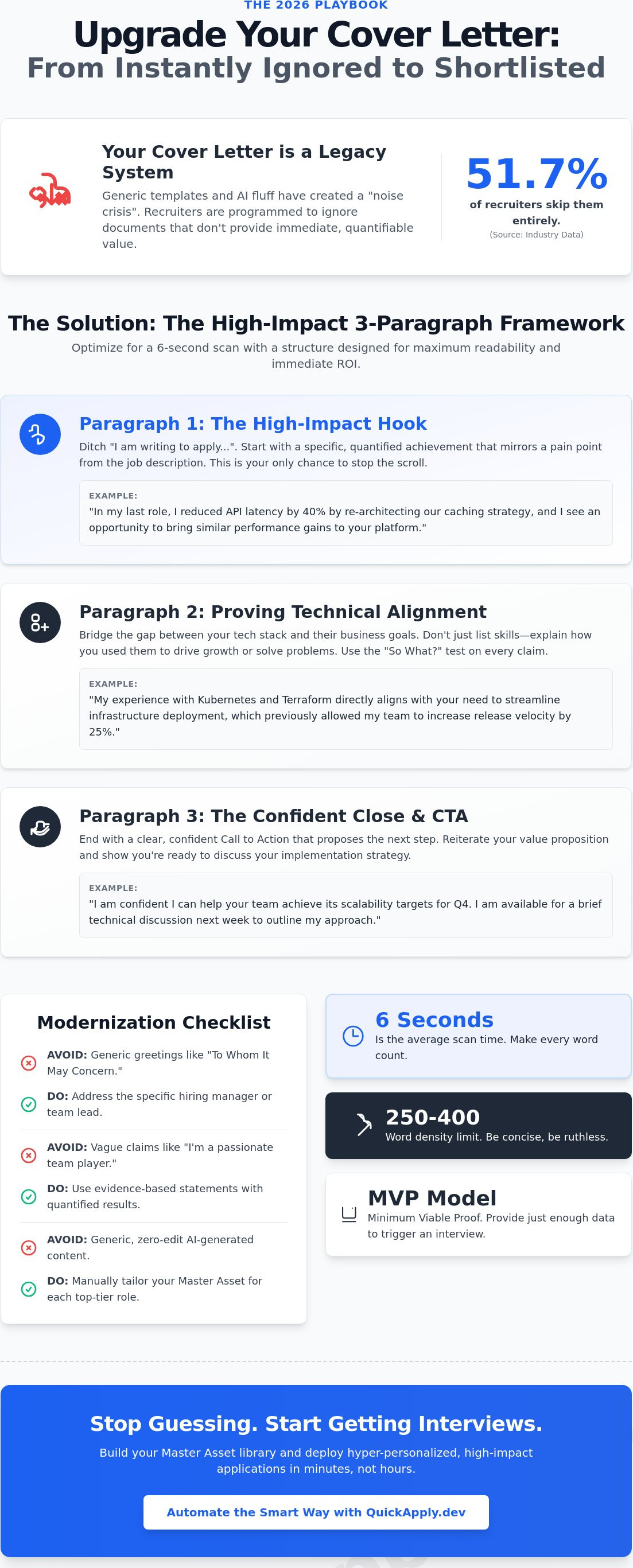
Stop treating your cover letter like a narrative essay. In 2026, the standard has shifted from the traditional one-page document to a hyper-efficient half-page brief. Recruiters don't have the bandwidth for your origin story. They need to know if you can solve their specific technical bottlenecks before they finish their first coffee. Understanding how to write a cover letter that gets read requires mastering a three-paragraph framework designed for rapid consumption and immediate impact.
This framework prioritizes utility over biography. While a National Careers Service guide might offer a foundational view of standard components, the tech-driven market demands more aggression. You're building a bridge between your past performance and their future roadmap. If you can't articulate that value in under 300 words, you haven't done the work to understand the role.
Paragraph 1: The High-Impact Hook
Ditch "I am writing to apply for" immediately. It's redundant and wastes prime real estate. Start with a specific achievement that mirrors a company pain point. If the job description mentions scaling issues, your first sentence should be: "In my last role, I reduced latency by 40%, and I want to do the same for your infrastructure." You identify a "burning problem" by looking for repeated keywords in the requirements. Focus on the outcome, not just the task. This stops the scroll and forces the recruiter to engage with your data.
Paragraph 2: Proving Technical Alignment
This section bridges the gap between your technical stack and their current goals. Don't just list your languages; explain how you've used them to drive growth. Use the "So What?" test for every claim. If you mention mastering Kubernetes, ask yourself "so what?" The answer should be: "so I could reduce deployment times by 15%." For specific phrasing ideas, check out these cover letter examples tailored for modern tech roles. If you're struggling to condense your experience into this high-impact format, our Cover Letter Generation tool can automate the heavy lifting for you.
Paragraph 3: The Confident CTA
Close with a direct, low-friction call to action. Passive phrases like "I hope to hear from you" signal a lack of authority. Instead, suggest a specific conversation topic for the interview. Try: "I'd love to discuss how my experience with legacy migration can support your Q3 roadmap." This shifts the dynamic from a plea for attention to a professional consultation. Use sign-offs that maintain your persona as a tech-literate ally. "Best," "Regards," or "Sincerely" work well when followed by your LinkedIn profile and portfolio link.
Manual Writing vs. AI Precision: The 2026 Efficiency Debate
The 2026 job market forces a brutal choice. You can spend two hours hyper-tailoring a single letter, or you can blast out 50 generic templates in five minutes. Both strategies fail. The "Manual Trap" ignores the reality of modern hiring volume; your ROI drops to zero if you only apply to a handful of jobs each week. Meanwhile, the "Bot Trap" relies on raw AI output that modern recruiters and ATS filters flag as low-effort noise. Learning how to write a cover letter that gets read requires a middle path that uses technology as an engine for your strategy, not a replacement for your brain.
To win, you must tailor your resume to a job description and your cover letter simultaneously. This creates a unified data profile that proves your technical alignment across every document in your stack. If your resume claims you're a React expert but your cover letter feels like a standard Mad Libs template, the discrepancy triggers a red flag. Your application needs to function as a cohesive system designed to bypass digital gatekeepers and demand human attention. Efficiency isn't just about speed; it's about the precision of your data delivery.
Why Prompting Isn't a Strategy
General-purpose LLMs have fundamental limitations for professional career management. Relying on a basic ChatGPT prompt often produces "hallucinated" enthusiasm and generic corporate speak that recruiters instantly recognize. We've debunked several ChatGPT resume myths that apply directly to cover letters, specifically the idea that a general bot understands the nuance of your specific technical stack. Specialized tools outperform general bots because they are built on semantic keyword analysis specific to the tech industry. They don't just generate text; they map your career data to the employer's specific roadmap.
Leveraging QuickApply for Data-Driven Tailoring
QuickApply eliminates the tedious research phase by analyzing job descriptions in seconds. Our system identifies the underlying semantic keywords and pain points buried in the requirements. This allows you to generate letters that match your specific tech stack to the employer's needs without losing your unique professional voice. You maintain control over the high-level strategy while our Cover Letter Generation handles the high-volume output. This approach ensures your application is both precise and scalable, moving you ahead of candidates stuck in manual workflows or generic bot loops.
Formatting for the 6-Second Scan: A Checklist
Your cover letter is a user interface. If the recruiter can't parse your value in six seconds, they'll close the tab and move to the next candidate. Mastering how to write a cover letter that gets read requires a shift from literary standards to digital optimization. You aren't writing a memoir; you're designing a high-conversion data sheet. This starts with aggressive white space management. Paragraphs should never exceed four sentences. Large blocks of text are visual friction that recruiters are trained to avoid. Break your thoughts into bite-sized modules that allow for rapid processing.
Typography choice is a subtle but powerful signal of tech literacy. Ditch traditional serif fonts like Times New Roman. They're designed for print and often blur on high-resolution digital displays. Choose modern sans-serif fonts such as Inter, Roboto, or Open Sans for maximum clarity. These fonts maintain their integrity across different screen sizes and resolutions. Ensure your name and contact details are the most accessible elements on the page. Don't force a hiring manager to hunt for your email address. Use a clear visual hierarchy to guide their eyes toward your quantifiable wins and contact data.
Digital-First Optimization
Recruiters often screen applications on mobile devices during transit or between meetings. Open your PDF on your phone before you hit send. If the text is too small or the layout breaks, your application is dead on arrival. Hyperlink your GitHub profile or portfolio naturally within the body of the letter. This allows a curious recruiter to verify your technical stack with a single tap. Professionalism also extends to your file metadata. Always save your document as 'FirstName_LastName_CoverLetter.pdf' to ensure it's easily searchable in a crowded downloads folder.
The 'F-Pattern' Reading Strategy
Eye-tracking research confirms that digital readers follow an F-shaped pattern. They read the first line of a paragraph and then scan down the left side. Front-load your impact by placing your most important technical keywords in the first two words of every paragraph. Use bold text sparingly to anchor the reader's eye to specific metrics like "22% reduction in server costs" or "15k active users." A dense wall of text acts as an immediate rejection trigger because it suggests you lack the communication efficiency required for a high-speed technical environment. To ensure your layout is perfectly optimized for these modern standards, use our Cover Letter Generation tool to build a scan-ready document in seconds.
Scaling Your Application Strategy Without Losing Quality
The 2026 job market is a numbers game. Winning requires a high-volume output synchronized with surgical precision. You can't rely on a single "perfect" application to land your next role. Instead, you must build a scalable pipeline that maintains high standards across dozens of submissions. Mastering how to write a cover letter that gets read at scale means moving away from manual drafting and adopting a modular approach. You need a system that processes job descriptions and outputs tailored documents in minutes, not hours.
Start by building a 'Master Asset' library categorized by role type. If you're a developer, create distinct pillars for Frontend, Backend, and Fullstack positions. Each asset should contain your core technical wins and metrics relevant to that specific focus. When a new opportunity appears, you aren't starting from a blank page. You're deploying an ai cover letter generator to handle 90% of the structural work. This leaves you with the final 10% for "Human Polish." This last step ensures the tone is perfect and the specific company pain points are addressed, sealing the deal with the recruiter.
Automation as a Competitive Advantage
Efficiency is your primary leverage. You can now apply to 10 high-quality roles in the time it previously took to research a single company. Use a 'Match Score' to prioritize your energy. Focus your deepest tailoring efforts on roles where your technical stack aligns 80% or higher with the requirements. Managing this high-velocity pipeline is impossible without the right tools. Use a dedicated application for job tracker to monitor your conversion rates and follow-up timelines. Data-driven job searching eliminates the emotional drain of "waiting and hoping" by turning your search into a manageable technical workflow.
The QuickApply Workflow
QuickApply is built for candidates who value their time. Upload your master resume once, and our system extracts your core 'Value Pillars' automatically. When you find a role, our Cover Letter Generation tool performs instant tailoring based on the specific job description. This isn't generic text generation. It's a strategic mapping of your career data to the employer's roadmap. You move from a passive applicant to a high-priority interviewee by using tools designed for the modern web. Start tailoring your path to success with QuickApply.
Deploy Your 2026 Application Strategy
The era of the generic document is dead. You've learned that mastering how to write a cover letter that gets read requires a shift from biography to evidence-based proof. By implementing the three-paragraph framework and optimizing for the 6-second scan, you're no longer just an applicant. You're a high-value solution providing immediate ROI to a recruiter's roadmap.
Stop wasting hours on manual drafting and start using systems built for the modern tech landscape. Our platform delivers AI-powered match scoring and unlimited cover letter tailoring to ensure your documents hit every semantic trigger. It's built for tech professionals by tech experts who understand the need for speed and surgical precision. You don't have to choose between volume and quality anymore.
Optimize your job search in seconds with QuickApply. You have the framework and the technology to bypass the noise. Take control of your career roadmap and start landing the interviews you deserve. Your next big role is just an optimized application away.
Frequently Asked Questions
Do recruiters actually read cover letters in 2026?
Yes, recruiters still use cover letters as a critical secondary filter for high-value roles. While one 2024 survey of 948 US hiring managers found that 26% always read them, another study of 625 managers reported that 83% frequently do. Even if a recruiter skips it, 77.1% of HR managers will likely review your letter to assess your professional communication and technical alignment.
How long should a cover letter be for a tech job?
The ideal length for a technical cover letter is between 250 and 400 words. Data shows that 49% of hiring managers prefer a half-page document over a full page. In a fast-paced hiring environment, brevity is a signal of efficiency. Keeping your message under 400 words ensures your key metrics aren't lost in unnecessary fluff.
Can I use AI to write my cover letter without being caught?
You should use AI as a precision engine for tailoring rather than a total replacement for your strategy. A 2025 survey indicated that only 15% of employers like purely AI-written letters, mainly because they lack specific technical nuance. Use automation to handle the data mapping and semantic keyword integration, then apply a final human polish to ensure the tone matches your professional brand.
What is the best way to address a cover letter if I don't know the hiring manager's name?
Address your letter to the specific team or department head, such as "Dear [Department] Hiring Manager" or "Dear [Role] Search Committee." You must avoid "To Whom It May Concern" because it signals a lack of research and low-effort automation. Addressing the specific team shows you understand the company structure even if a specific name isn't public.
Should I include a cover letter if the job application says it's optional?
Always submit one to gain a competitive advantage. Research shows that 73% of hiring managers will read a cover letter even when the application marks it as optional. It's your best opportunity to explain how your technical stack solves their specific business problems. Skipping this step often means losing your only chance to provide evidence of ROI.
How do I make my cover letter stand out if I don't have much experience?
Focus on project-based outcomes and specific technical contributions rather than years of service. Use your letter to bridge the gap between your learning roadmap and the company's current technical bottlenecks. Proving you can solve a problem with a specific tool or methodology is more valuable to a recruiter than a long list of generic responsibilities.
What are the most common cover letter mistakes that lead to rejection?
The most frequent killers are generic templates, lack of quantifiable metrics, and walls of text that ignore the 6-second scan rule. Rejection often happens when a candidate fails to mention specific company pain points in the first two sentences. If you don't show technical alignment immediately, the recruiter will likely hit the delete key before finishing the first paragraph.
Is it okay to use a template for my cover letter in 2026?
You should use a structural framework instead of a static template. Recruiters are desensitized to standard phrasing found on generic career sites. To master how to write a cover letter that gets read, you need a modular system that allows for rapid, data-driven personalization. This approach ensures your letter feels bespoke to the role while maintaining the speed of an automated workflow.


