

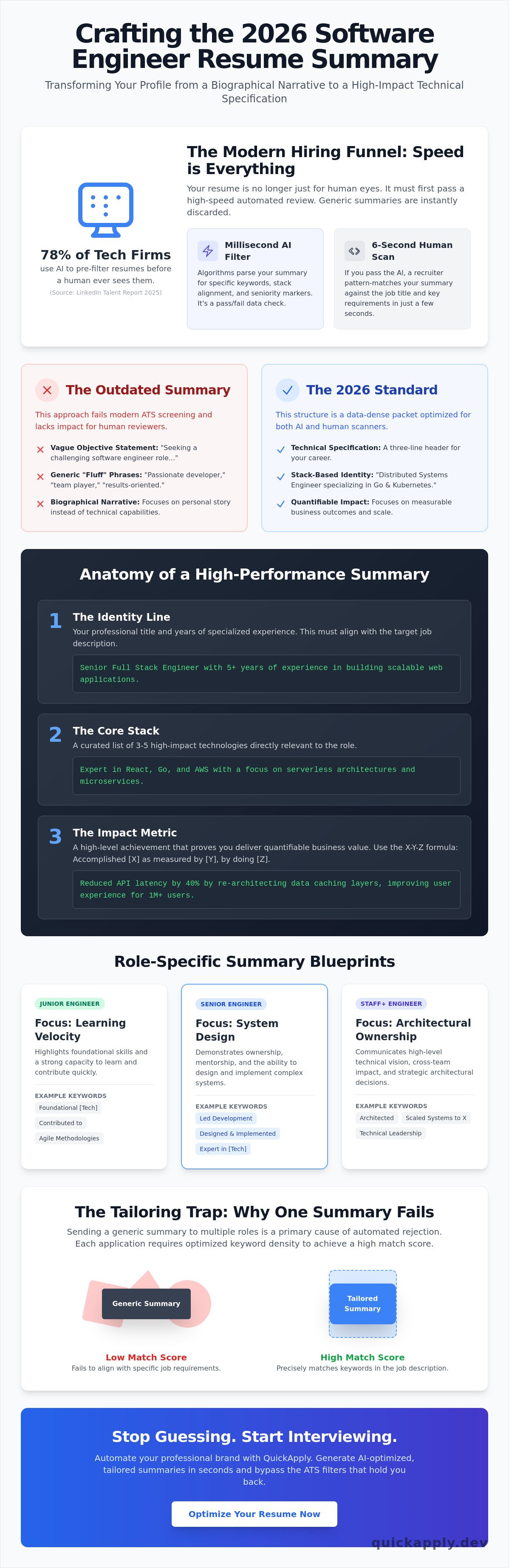
78% of large tech firms now use AI models to pre-filter resumes before a human ever sees them, according to the LinkedIn Talent Report 2025. If you're still using a generic bio, you're likely being discarded by an algorithm in milliseconds. You need to know how to write a resume summary for software engineer roles that functions as a high-impact technical specification. This isn't about your life story. It's about optimizing your profile for a 2026 market that values system design and AI-assisted development over basic syntax.
It's exhausting to be a qualified engineer who can't get past a bot. You deserve a workflow that translates your expertise into a format recruiters actually notice in their six-second initial review. This guide provides a repeatable system for crafting AI-optimized summaries that bypass ATS filters and increase your match score. We'll cover how to prioritize tools like Cursor and GitHub Copilot, integrate quantifiable metrics into your pitch, and use modern resume tailoring to secure interviews at top-tier tech firms.
Key Takeaways
- Transform your summary from a biographical narrative into a three-line technical specification that anchors your professional brand.
- Learn how to write a resume summary for software engineer positions that pairs a clear identity line with a curated stack of high-impact technologies.
- Identify the specific blueprints for every career stage, highlighting learning velocity for juniors and architectural ownership for staff engineers.
- Optimize keyword density for each application to bypass 2026 ATS filters and avoid the pitfalls of generic, static summaries.
- Utilize automated tailoring tools to generate summaries in seconds and achieve high match scores across different job descriptions.
The Evolution of the Software Engineer Resume Summary in 2026
The landscape has changed. In 2026, your resume is a technical specification. The summary is the header file for your entire career. It's no longer a space for fluff or vague career aspirations. Modern systems use Natural Language Processing (NLP) to parse this section first. They look for specific signals to determine if you're worth the compute time for a full scan. The Evolution of the Software Engineer Resume Summary shows a clear shift from personal narratives to high-density data anchors.
Objective statements are effectively dead. Nobody cares what you want from a company; they care what you can ship on day one. A "Summary of Qualifications" won because it prioritizes immediate utility. If you want to master how to write a resume summary for software engineer roles today, you have to treat it as a technical anchor. This three-line section sets your initial "Match Score." It tells the system exactly where you fit in the engineering hierarchy before a human even opens the file.
The 6-Second Human Filter vs. The Millisecond AI Filter
Recruiters are overwhelmed. They spend exactly six seconds on an initial glance. They aren't reading; they're pattern matching. They look for stack alignment and seniority markers. If your summary doesn't scream "Senior Backend Engineer" or "DevOps Specialist," they move on. Speed is the primary constraint of the modern hiring process.
Modern ATS platforms are even faster. They use millisecond AI filters to categorize your level. They analyze the relationship between your stated tools and your years of experience. Your summary must be a mirror of the job description. If the JD asks for "distributed systems," your summary must lead with that exact phrase. Total alignment is the only way to survive the first round of automated rejection. Don't make the system guess your value.
The Death of Generalization
Generic phrases are resume poison. Phrases like "passionate developer" or "team player" are wasted bytes in 2026. They provide zero data for the NLP models. You need a specific, stack-based identity. Don't just be a "Software Engineer." Be a "Distributed Systems Engineer specializing in Go and Kubernetes." This specificity drives higher match scores and captures immediate attention.
The shift toward specificity is non-negotiable. Systems now weight specific keywords higher than broad categories. Your summary is a data-dense technical header designed to trigger high-probability matches in automated screening systems. Mastering how to write a resume summary for software engineer positions means cutting the noise and boosting the signal. Focus on what you've built, the scale you've handled, and the specific tools you used to get there.
The Anatomy of a High-Performance SWE Summary
A high-performance summary is a concentrated data packet. It doesn't tell a story; it provides a specification. To master how to write a resume summary for software engineer roles, you must assemble four critical components. Each line serves a distinct purpose for both the recruiter and the ATS. You have limited space. Every character must contribute to your match score.
- The Identity Line: Your professional title and years of specialized experience.
- The Core Stack: A curated list of 3 to 5 non-negotiable technologies relevant to the specific role.
- The Impact Metric: A high-level achievement that proves you deliver business value.
- The Soft-Skill Signal: Evidence of collaboration or leadership within a technical environment.
Leading with Your Technical Identity
The first ten words determine your trajectory. Don't use the title your current company gave you if it doesn't match industry standards. If your internal title is "Specialist II" but you're applying for backend roles, use "Senior Backend Engineer." You must match the target job description immediately. This isn't about being dishonest. It's about being findable.
Balance breadth with depth. You need enough range to show you understand the ecosystem, but enough focus to prove you're an expert. A weak identity line is vague. A strong identity line is a technical anchor. For example, "Full Stack Developer with 5 years of experience" is weak. "Senior Full Stack Engineer with 5+ years of experience in React, Go, and AWS" is strong. It gives the system exactly what it needs to categorize you.
Quantifying Impact Without "Fluff"
Impact is the differentiator. Most candidates list tasks. High-performers list outcomes. Use the X-Y-Z formula to structure your achievements: Accomplished [X] as measured by [Y], by doing [Z]. This structure forces you to provide concrete data. It eliminates "fluff" and replaces it with engineering reality.
Translate your technical tasks into business value. You didn't just "refactor a legacy service." You reduced API latency by 40%, which improved checkout conversion rates. If your previous work was under an NDA, focus on percentages and scale. Mentioning you "optimized a high-traffic payment gateway serving 1M+ users" provides context without leaking secrets. Building these components manually is tedious. You can use resume tailoring tools to instantly align your impact metrics with specific job requirements.
Don't forget the soft-skill signal. Avoid saying you're a "good communicator." Instead, mention you "led a cross-functional team of six to migrate legacy infrastructure." This proves leadership within a technical context. It shows you can navigate complex systems and people simultaneously.
Role-Specific Summary Blueprints: From Junior to Staff
A one-size-fits-all approach fails because seniority requires different data signals. Understanding how to write a resume summary for software engineer roles depends entirely on your current career tier. Junior engineers must prove they can ship code quickly without hand-holding. Staff engineers must prove their technical choices drive revenue or save millions in infrastructure costs. You need to pivot your summary's focus to match the specific expectations of your target level.
The Junior Engineer: Selling Potential and Stack
Entry-level candidates often lack professional history, so they must lead with velocity. Your summary shouldn't just list your degree. It should highlight specific project outcomes and "time-to-productivity." Show that you've mastered a modern stack and can contribute on day one. Analyzing good resume examples for 2026 reveals a clear trend: leading with certifications like AWS Cloud Practitioner or Google Cloud Professional to bridge the experience gap. Mentioning a specific open-source contribution or a complex capstone project proves you have the hands-on skills recruiters crave.
Mid-level engineers should shift toward end-to-end ownership. Your summary needs to show you can take a feature from ideation to production. Focus on architectural understanding and how you collaborate with product teams. This is the stage where you prove you aren't just a ticket-taker, but a builder who understands the full lifecycle of a service.
The Staff Engineer: High-Level Architectural Impact
At the Staff and Senior levels, your summary moves from "coding" to "systemic problem solving." Don't waste lines on basic languages. Focus on architectural influence and cross-functional leadership. You're no longer just a contributor; you're a force multiplier. Highlight your experience leading large-scale migrations or designing distributed systems that handled massive load spikes during peak traffic.
Link your technical choices directly to long-term business strategy. If you implemented a new caching layer, state how it reduced cloud spend by 15%. If you mentored three junior teams, mention the resulting increase in sprint velocity. You're selling the ability to navigate both complex codebases and complex organizational structures. This high-level impact is what triggers the interest of top-tier tech firms looking for leadership.
Specialized Roles: AI, DevOps, and Security
Niche roles require specific summary tweaks to pass specialized ATS filters. If you're in AI/ML, lead with your experience in model deployment and fine-tuning rather than just broad "Python" skills. DevOps specialists should emphasize automation, CI/CD pipeline optimization, and infrastructure as code (IaC) using tools like Terraform. For security roles, focus on threat modeling and compliance at scale. These specialized summaries act as a technical handshake, signaling your expertise in high-stakes domains instantly.
The Tailoring Trap: Why One Summary Never Fits All
Static resumes are a legacy format. If you're sending the same summary to every job posting, you're effectively invisible to 78% of large tech firms. These companies use AI models to pre-filter candidates based on specific keyword density and relevance. A generic summary fails because it lacks the precision required to trigger a high Match Score. Learning how to write a resume summary for software engineer roles in 2026 means accepting that your summary must change for every single application.
The "Match Score" is a mathematical evaluation of how closely your profile mirrors the job description (JD). Modern ATS platforms don't just look for keywords; they analyze the relationship between your skills and the role's requirements. If the JD prioritizes "low-latency systems" and your summary focuses on "general full-stack development," the algorithm deprioritizes your application. You must tailor resume to job description data points to remain competitive. Manual tailoring is the biggest bottleneck in your job search, often taking 30 minutes or more per application.
Identifying High-Priority Keywords
You need to spot "must-have" skills in under 10 seconds. Focus on the first three bullet points of any "Requirements" section. These are usually the non-negotiables. Follow a strict hierarchy when updating your summary. Languages like Go or Rust take top priority. Frameworks like React or Spring follow. Tools like Kubernetes or Docker come next, followed by methodologies like Agile or TDD. Don't resort to keyword stuffing. NLP models are sophisticated enough to detect lists that lack context. Integrate these terms naturally into your impact metrics to maintain high relevance.
The Efficiency Gap
Precision is useless if you don't have volume. The 2026 job market moves too fast for manual updates. If you spend four hours tailoring five resumes, you've already lost to candidates using automation. Speed to apply is a competitive advantage. You need a system that delivers both high accuracy and high volume without the manual overhead. Calculating the time cost of manual resume updates proves it's a losing strategy for high-growth engineers. Efficiency is the only way to scale your reach. You can eliminate this friction by using automated resume tailoring to align your professional brand with any JD in seconds. This allows you to focus on the interview rather than the formatting.
Automate Your Professional Brand with QuickApply
Manual updates are a waste of your engineering talent. You've learned how to write a resume summary for software engineer roles that hits the right notes, but performing this task manually for dozens of applications is a systemic failure. QuickApply solves this by treating your resume like a dynamic deployment. By using the best ai resume builder 2025 has to offer, you generate high-impact summaries in seconds. This isn't just about speed; it's about precision. The platform analyzes the job description and adjusts your summary to maximize your Match Score instantly. It ensures your technical anchor is perfectly weighted for the specific algorithm reviewing your file.
The system eliminates the guesswork of keyword density. It identifies the relationship between your existing experience and the requirements of top-tier tech firms. Instead of hoping you've included the right frameworks, you get a data-backed summary that bridges the gap between your talent and the opportunity. This automation allows you to maintain a high volume of applications without sacrificing the quality of your professional brand. You stay ahead of the curve while others are still stuck in a text editor.
From Summary to Interview
A high Match Score gets you the interview, but your technical delivery secures the offer. Once your summary clears the ATS filter, the focus shifts to execution. You can use interview practice modules to prepare for the specific challenges of modern engineering interviews. Managing these various versions is simplified through an integrated Application Tracker. It logs which summary variants trigger the most callbacks. This creates a feedback loop that identifies your most marketable skills. The system also generates tailored cover letters that reinforce the data in your summary, creating a cohesive professional package that recruiters can't ignore.
Continuous Career Optimization
Career growth doesn't stop at the hire. Your summary is a living document that should reflect your increasing value. Use the Salary Negotiation Guide to ensure your compensation matches the impact you've documented. Planning for the future requires a Promotion Roadmap to identify the next set of skills for your 2027 summary. Mastering how to write a resume summary for software engineer positions is a career-long process. You need to stay ahead of the curve as the market evolves. This proactive approach ensures you're never caught off guard by shifts in tech demand. Stop fighting the system and start using it. Automate your outreach and land the roles you actually want with AI-powered precision.
Deploy Your Technical Anchor Today
The 2026 job market doesn't reward manual labor; it rewards technical precision. You now understand how to write a resume summary for software engineer roles that functions as a high-density data packet for AI filters. By shifting from vague narratives to quantifiable impact metrics and role-specific blueprints, you position yourself as a high-value asset. Stop letting static resumes throttle your career growth. Generic profiles are a systemic bottleneck that you can easily bypass with the right strategy.
Precision at scale is the only way to consistently secure interviews at top-tier tech firms. You need a system that handles the heavy lifting of keyword alignment and Match Score optimization. QuickApply provides instant resume tailoring for tech roles, ensuring your profile is always optimized for the specific job description. Use the integrated job application tracker to monitor your progress and refine your approach with AI-powered Match Score analysis. This isn't just about applying; it's about winning the algorithmic filter every single time.
Optimize your resume and land more interviews with QuickApply. Your next engineering role is just one optimized deployment away. Build it with precision and start shipping your career to the next level.
Frequently Asked Questions
How long should a software engineer resume summary be?
Keep your summary between 3 and 4 sentences. Aim for roughly 50 words to ensure a recruiter can scan it in under 6 seconds. You need high data density without the fluff. Every character must contribute to your match score or your technical identity. If a word doesn't highlight a skill or a metric, cut it immediately.
Is a resume summary necessary for a junior software engineer?
It's vital for junior roles. Since you lack extensive professional history, the summary anchors your technical identity and learning velocity. It tells the ATS which stack you've mastered through projects or internships. This section functions as your professional hook before the recruiter even reaches your education or project list.
Can I use AI to write my resume summary?
You should use AI to optimize your tailoring process. Using automation to learn how to write a resume summary for software engineer roles ensures your keywords align perfectly with the job description. AI provides the precision required to bypass 2026 ATS filters. Just ensure the final output accurately reflects your actual technical capabilities and impact.
What is the difference between a resume summary and a resume objective?
An objective statement focuses on what you want from a company. A summary focuses on the value you offer to the employer. Objectives are obsolete in the modern tech market. A summary acts as a technical specification of your expertise, proving you can ship code and solve systemic problems on day one.
How many keywords should I include in my summary for ATS?
Include 3 to 5 high-priority technical keywords that match the job description. Focus on the specific languages and frameworks listed in the top requirements of the posting. Avoid keyword stuffing, as modern NLP models penalize lists that lack context. Integrate these terms naturally into your impact statements to maintain high relevance scores.
Should I include my GPA or graduation year in my summary?
Omit your GPA and graduation year from this section. These details belong in the education block at the bottom of your profile. The summary is high-value real estate reserved for your technical stack and quantifiable achievements. Don't waste space on academic metrics that don't directly prove your ability to build and maintain systems.
How do I quantify my impact if I worked on a maintenance team?
Focus on reliability and efficiency metrics. Mention improvements in system uptime, reductions in bug report volume, or the percentage of technical debt cleared during your tenure. You didn't just "fix bugs." You maintained 99.9% service availability or reduced ticket resolution time by 15%. These numbers prove your value in a production environment.
Should I list my soft skills in the resume summary?
Only include soft skills when they're tied to technical leadership. Avoid vague terms like "team player" or "good communicator." Instead, mention you "led cross-functional teams" or "mentored junior developers to improve sprint velocity." This demonstrates leadership through concrete action rather than listing subjective personality traits that an ATS cannot verify.


