

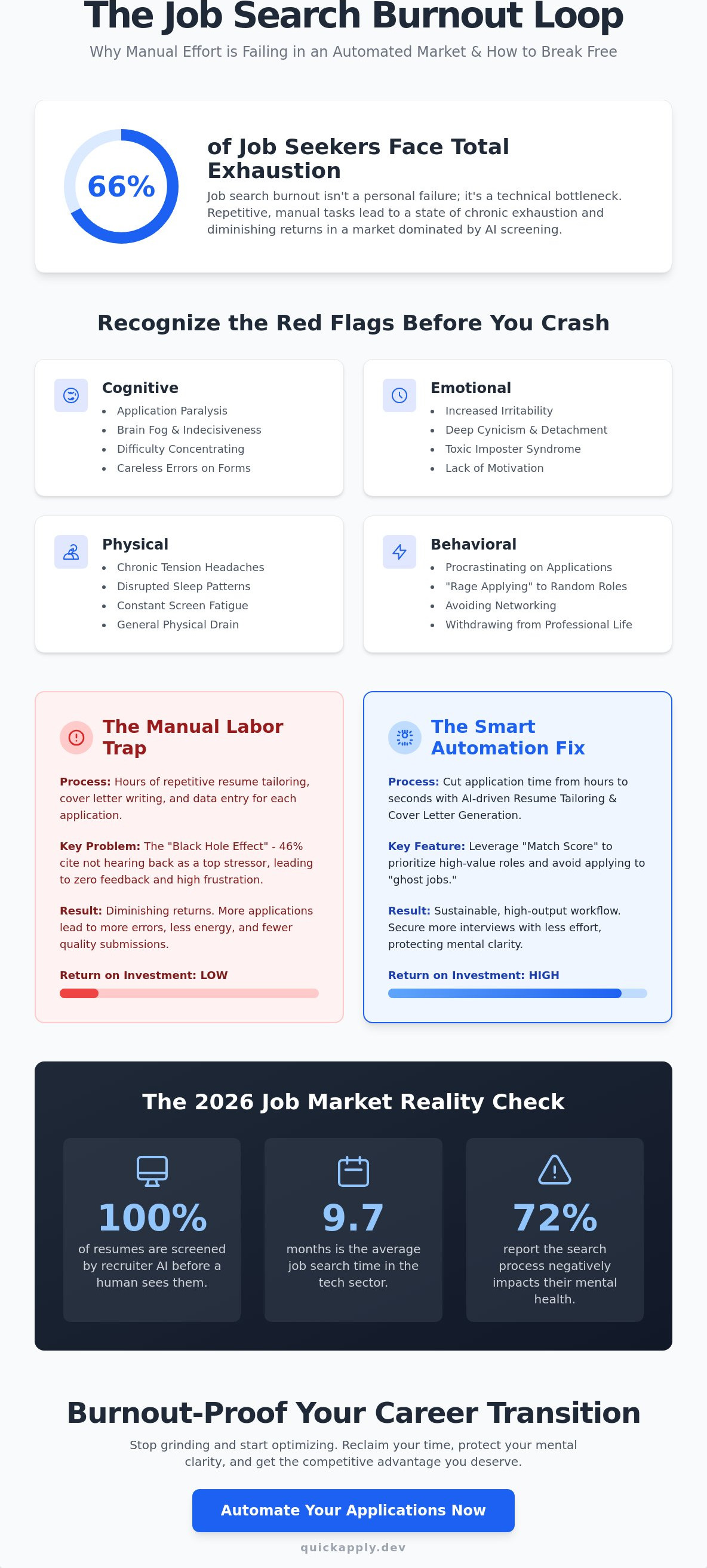
66% of job seekers are currently hitting a wall of total exhaustion. If you feel like you're running a marathon with no finish line, it's because you are. Job search burnout is real, and it's the direct result of applying a manual mindset to an automated market. You spend hours on repetitive resume tailoring only to be met with silence or an automated rejection from a recruiter who never even saw your name. It's a technical bottleneck, not a personal failure.
We know the cycle. You wake up, tweak a cover letter for the fiftieth time, and wait for a response that never comes. You deserve a competitive advantage that respects your time. In this guide, you'll learn how to identify the signs of search fatigue and replace draining manual labor with smart AI automation. We'll show you how to leverage high-tech tools for Resume Tailoring and Cover Letter Generation to secure more interviews with less effort, allowing you to regain your mental clarity and finally break the loop.
Key Takeaways
- Recognize cognitive symptoms like "application paralysis" and brain fog to prevent a total productivity crash before it starts.
- Acknowledge that job search burnout is real to stop internalizing systemic failures and start fixing the technical bottlenecks in your routine.
- Transition from manual labor to AI-driven Resume Tailoring to cut your application time from hours to seconds without losing quality.
- Leverage Match Score features to prioritize high-value targets and eliminate the "Black Hole Effect" of zero-feedback applications.
- Build a sustainable, high-output workflow that delivers more interviews while protecting your mental clarity and professional momentum.
The Anatomy of Job Search Burnout in 2026
Burnout isn't just a mood. It's a systemic failure of your current workflow. In the 2026 tech market, Occupational burnout is defined by chronic exhaustion and reduced professional efficacy. When you apply this to a job search, you get a candidate who is physically drained and emotionally detached. You're working harder than ever, yet you're seeing zero ROI. Job search burnout is real because the modern application process is a high-stakes, low-feedback loop that treats human talent like raw data. It's a technical bottleneck that no amount of coffee can fix.
The "Black Hole Effect" is the primary driver of this exhaustion. You submit a high volume of applications and receive nothing but automated silence. Verified data shows that 46% of job seekers cite not hearing back as a top stressor. For tech pros, this load is doubled. You aren't just applying; you're also expected to upskill, maintain a GitHub profile, and pass complex technical assessments. This double cognitive load creates a state where your brain simply refuses to process one more "About Us" page. It's not a lack of grit. It's a resource depletion.
Why the 2026 Tech Market is Uniquely Draining
The rise of ghost jobs has turned the search into a minefield. Companies post roles they don't intend to fill just to build a talent pipeline. This forces you to spend hours on applications that were never going to result in an interview. When you do get a response, it's often a generic, automated rejection. These digital "no's" trigger the same pain centers in the brain as physical injury. With an average search time of 9.7 months in the tech sector, the cumulative effect of these micro-rejections is devastating. You're managing ten different platforms, each with its own login and unique requirements. This paradox of choice doesn't give you more options. It gives you more work.
The Shift from Resilience to Optimization
Grinding harder is a failing strategy. In a market where recruiters use AI to screen 100% of resumes, your manual effort is a drop in the bucket. 66% of candidates are currently burning out because they're trying to outrun an algorithm. Healthy persistence means staying in the game; clinical burnout means you've lost the ability to play. You've reached the phase of diminishing returns when you start making careless errors on simple forms. Stop trying to prove your resilience through manual labor. The 2026 market demands optimization. If you don't automate the repetitive parts of your search, the search will eventually automate your exit from the industry.
Identifying the Symptoms Before Your Productivity Crashes
Early detection is a survival skill. If you wait until you're completely incapacitated to adjust your strategy, you've already lost weeks of momentum. Job search burnout is real, and it manifests as a series of system failures before the final crash. 72% of job seekers report that the search process negatively impacts their mental health. This isn't just feeling tired. It's a clinical state of depletion that degrades your technical performance and decision-making capacity. Recognizing these red flags allows you to pivot before your output hits zero.
Burnout usually surfaces in four distinct categories. You might notice cognitive symptoms like brain fog that makes a simple LeetCode challenge feel like a senior-level architecture review. Emotionally, you may experience increased irritability or a deep cynicism toward the tech industry. Physical signs are just as common, including disrupted sleep patterns and chronic tension headaches from constant screen fatigue. Finally, watch for behavioral shifts. If you find yourself procrastinating on easy applications or rage-applying to 50 random roles at 2:00 AM, your system is compromised.
The 'Application Paralysis' Red Flag
Staring at a blank screen while trying to draft a cover letter isn't laziness. It's a system error. Each manual decision you make, from choosing which bullet points to highlight to formatting a PDF, drains your finite cognitive resources. This decision fatigue kills your ability to identify high-value opportunities. When you spend three hours on one application, you aren't being thorough; you're being inefficient. The link between manual data entry and mental depletion is direct and measurable. Using an application tracker can offload this mental tax, preserving your energy for the interviews that actually matter.
When Imposter Syndrome Becomes Toxic
Rejection is data, not a character judgment. Yet, when 47% of seekers cite rejection as their top stressor, it's easy to see how constant silence warps your self-perception. You stop thinking "I need to learn a new framework" and start thinking "I am not a good engineer." This is a dangerous pivot that ignores market reality. Constant rejection from automated systems can make you feel like your market value is plummeting, even when your technical skills remain high. An automated rejection from a flawed AI filter doesn't define your professional worth or your technical ceiling. You need to separate your identity from the flawed metrics of an automated hiring funnel.
The Manual Labor Trap: Why 'Applying More' is Failing You
The 'Numbers Game' is a lie. Sending 100 generic applications results in a 0% conversion rate. It's the fastest way to prove that job search burnout is real. You're currently stuck in a manual labor trap. In 2026, Applicant Tracking Systems (ATS) are high-speed AI filters. They don't look for 'effort.' They look for keyword alignment and semantic relevance. If you're manually adjusting every word, you're losing. There is a massive 'Efficiency Gap' between your human input and machine-led filtering. You spend 2 hours per application. AI does the same task in 2 seconds. That's a 3,600x difference in efficiency. You can't outwork an algorithm with manual labor. It's a technical impossibility that leaves you exhausted and unemployed.
Recruiters in the current market prioritize candidates who match their specific tech stack perfectly. When you apply manually, you're guessing what the machine wants to see. This leads to the 'Black Hole Effect' mentioned earlier. Your resume hits the server and is immediately discarded because it lacks a specific 2026-standard tag. You need to stop viewing the job search as a test of your character. It's a data optimization problem. If your process isn't automated, you're essentially trying to compile code by hand. It's slow, error-prone, and ultimately unsustainable.
The Fallacy of the 'Perfect' Manual Resume
A static resume is a dead resume. Even the most polished good resume examples for 2026 require dynamic adjustment for every single job description. Rewriting your bullet points 50 times isn't just tedious. It's a psychological drain. As burnout sets in, your error rate spikes. Typos and formatting glitches slip through. These small technical debts lead to immediate rejections from automated screeners. Your manual effort actually decreases your chances as fatigue accumulates. You're working against yourself. Recruiters spend less than six seconds on a resume. If you spent six hours on it, the math simply doesn't work in your favor.
Quality vs. Quantity in the AI Era
Volume isn't the enemy. Low-quality volume is. You need 'Smart Volume.' This means applying to the right roles with high-precision Resume Tailoring. Stop guessing which jobs to target. Use Match Scores to prioritize your daily application list. Focus your energy where you have a statistical advantage. A robust job application tracker eliminates the friction of duplicate entries. It organizes your funnel so you can scale your output without scaling your stress. Efficiency is the only way to break the cycle. Optimization is your only path to an offer. Stop being the engine and start being the architect of your search.
Tactical Recovery: Reclaiming Your Time with Automation
Mindfulness doesn't get you hired. If you're exhausted, it's not because you lack "zen." It's because your workflow is broken. Job search burnout is real, but it is also a solvable technical problem. Recovery begins with an immediate audit of your stack. Identify every repetitive task you perform daily. If you're copy-pasting job descriptions or re-typing your skill list into proprietary portals, you're bleeding time. Optimization is the only cure for this level of fatigue.
Follow this five-step recovery protocol to rebuild your momentum:
- Step 1: Audit your stack. Map out your current process and flag every manual data entry point.
- Step 2: Automate the tailoring. Implement an AI resume tailor to handle the heavy lifting of keyword alignment.
- Step 3: Time-box your output. Set strict 90-minute "Deep Work" blocks for applications, then close the laptop.
- Step 4: Centralize your funnel. Use an automated Application Tracker to manage follow-ups without manual reminders.
- Step 5: Reallocate your energy. Pivot your reclaimed hours toward high-impact Interview Practice and networking.
When the system handles the logistics, your role changes. You stop being a data entry clerk and start being a candidate. This shift is essential for survival in a market where the average search lasts over six months. Automate your search today to stop the drain on your cognitive resources.
Efficiency as the Ultimate Form of Self-Care
Reducing your "Time-to-Apply" is the most effective way to prevent burnout. Traditional advice tells you to "take a break." We tell you to optimize. You can achieve a 10x output increase without increasing your heart rate by offloading low-value tasks to a machine. Adopt a "Set and Forget" mentality. Let AI handle the boring stuff while you focus on high-level strategy or upskilling. When you see your application volume rise while your physical effort drops, the anxiety of the "numbers game" disappears. Efficiency isn't just about speed. It's about preserving your human capital for the rounds that actually count.
Setting Boundaries with the 'Always-On' Job Market
Responsiveness shouldn't mean constant anxiety. Disable your notification pings. Check your dashboard once or twice during your scheduled blocks. Implement a "Saturday Shutdown" rule where you spend 24 hours entirely offline. No LinkedIn. No email. No coding tests. Automation buys back the mental bandwidth needed to perform at your peak during high-stakes interviews. You need that clarity to negotiate your next salary, not to fill out another address field. Your value is in your expertise, not your ability to endure repetitive manual labor.
Burnout-Proof Your Career Transition with QuickApply
Efficiency is the only sustainable response to a saturated market. QuickApply provides the technical infrastructure to end the emotional drain of your search. Since job search burnout is real, you need a system that prioritizes your energy. Our Match Score feature analyzes job descriptions against your profile instantly. It tells you exactly where you have a competitive advantage. Stop wasting hours on roles you'll never get. Focus on the high-probability targets that actually move the needle. This data-driven approach removes the decision fatigue that leads to the application paralysis we discussed earlier.
Writer's block is a relic of the manual era. Our 1-click AI cover letter generator produces tailored, professional documents in seconds. It eliminates the friction of starting from scratch for every application. When combined with our integrated Application Tracker, the "Where did I apply?" anxiety disappears. You get a centralized dashboard that manages your entire funnel. No more messy spreadsheets. No more missed follow-ups. You maintain full visibility into your pipeline without the mental tax of manual record-keeping.
Tailoring Without the Tears
Beating the ATS requires more than just keywords. QuickApply's AI mirrors recruiter logic to ensure your profile passes every automated screen. We deliver on the "Seconds, not Hours" promise. You can tailor your resume for every role without the cognitive load of manual editing. Our system preserves your unique professional voice while optimizing for the specific technical requirements of the 2026 market. You stay authentic. The machine stays efficient. It's a high-speed bridge between your talent and the right opportunity. This optimization ensures you aren't just applying more; you're applying better.
From Application to Offer: The Full Lifecycle
Automation doesn't stop at the "Submit" button. Use our Interview Practice tool to run through high-stakes scenarios before you ever hop on a Zoom call. Build your confidence with data-driven feedback that sharpens your delivery. Once you land the role, utilize the Promotion Roadmap to plan your next five years of growth. This tool ensures you never fall back into a reactive, manual mindset. We provide the Salary Negotiation Guide to help you maximize your value at the finish line. We don't just help you find a job; we help you engineer a high-performance career. It's time to stop the cycle of exhaustion and start your optimization journey. Start your burnout-free job search with QuickApply today.
Engineer Your Exit from the Application Loop
Manual applications are a legacy process in a high-tech market. You can't solve a systemic bottleneck with more "grit" or "resilience." Acknowledge that job search burnout is real and treat it as a signal to optimize. You've identified the symptoms and exposed the manual labor trap. Now, replace those draining tasks with a high-performance stack that prioritizes your time and mental energy.
Reclaim your momentum by offloading the logistics. You can now tailor resumes in seconds and target the right opportunities with 95% Match Score accuracy. Centralize your efforts with integrated application tracking to eliminate the mental tax of manual follow-ups. You deserve a search process that moves as fast as you do. Don't let a flawed system stall your career growth when the solution is one click away.
Stop the burnout and automate your search with QuickApply. Your next offer is a data optimization problem away. Build your future with the speed and precision of AI. You have the talent; we have the tools to make sure the right people see it.
Frequently Asked Questions
Is job search burnout a real medical condition?
Occupational burnout is officially recognized by the World Health Organization as an occupational phenomenon. While not classified as a standalone disease, it is a clinical state of exhaustion resulting from chronic workplace stress. This status confirms that job search burnout is real; it is a measurable depletion of mental and physical resources that requires a structural change in your routine to resolve.
How many job applications per day is too many for a tech pro?
Applying to more than five roles daily without automation is a recipe for system failure. Tech roles require deep technical alignment that manual tailoring cannot sustain at high volumes. Focus on three to five high-precision applications using automated tools to maintain quality. If you're "rage-applying" to dozens of random roles, you've already crossed the threshold into unhealthy productivity and diminishing returns.
Can AI really help me avoid burnout, or is it just another tool to manage?
AI functions as an efficiency layer that removes the manual "grunt work" from your schedule. It doesn't add a task; it replaces the most draining ones like manual Resume Tailoring and Cover Letter Generation. By offloading these repetitive processes, you preserve your cognitive bandwidth for technical interviews and high-stakes networking. It's the difference between being the engine and being the architect of your career.
What should I do if I feel like I've completely hit a wall in my search?
Stop all manual activity immediately and audit your current stack. If your process relies on repetitive data entry, your system has failed. Shift your energy toward implementing an automated pipeline that handles the logistics while you take a 48-hour tech fast. Recovery starts by eliminating the technical bottlenecks that caused the exhaustion in the first place, allowing your mental clarity to return.
How do I explain a gap in my resume caused by burnout to a recruiter?
Frame the gap as a period of intentional upskilling or a professional sabbatical. Focus on the specific frameworks, languages, or certifications you explored during the break. Recruiters value self-awareness and proactive career management. Explaining that you took time to optimize your technical stack or personal workflow demonstrates a high-level, results-driven mindset that aligns with the requirements of senior-level engineering roles.
Will using an AI resume builder get me flagged by companies?
No, using AI to tailor your resume won't get you flagged by modern hiring systems. Recruiters already use AI-driven Applicant Tracking Systems to filter your profile before a human ever sees it. Using similar technology to align your data ensures the machine can read your value correctly. It's a standard optimization strategy in the 2026 market, not a shortcut that companies penalize.
How can I stay motivated when I'm getting zero responses?
Motivation is a byproduct of visible progress. Switch from measuring "applications sent" to measuring "Match Scores" and "interview conversion rates." When you use an Application Tracker, you see a clear, organized pipeline of your efforts. This data-driven visibility helps you stay focused on the strategy rather than the silence, turning a frustrating search into a manageable technical challenge with clear metrics.
What are the first signs that my job search is becoming unhealthy?
The first signs include "application paralysis" and a cynical attitude toward the tech industry. You might find yourself staring at a screen for hours without completing a single task or feeling intense irritability after every automated rejection. These are system alerts that your cognitive resources are depleted. Since job search burnout is real for 66% of candidates, recognizing these behavioral shifts early is essential.


