

Motivation isn't a feeling you conjure; it's a metric you optimize. With the U.S. unemployment rate at 4.3 percent in April 2026, the market demands more than just grit. You don't need more willpower. You need a better tech stack. Learning how to stay motivated during a long job search starts with acknowledging that application fatigue is a technical bottleneck, not a personal flaw. Stop treating your career search like a manual chore and start treating it like a high-performance funnel.
You're likely frustrated by the "black hole" of ATS ghosting and the mental drain of manual resume tailoring. This constant friction often leads to a loss of professional identity. We'll show you how to replace that emotional labor with high-octane systems and AI-driven efficiency. This guide delivers a repeatable framework to reduce friction, boost your interview conversion rates, and reclaim your sense of control. We'll cover everything from automated resume tailoring and cover letter generation to precision interview practice, ensuring you stay productive until the contract is signed.
Key Takeaways
- Reframe burnout as a technical resource depletion and pivot to a system-first approach using high-intensity 90-minute sprints.
- Learn how to stay motivated during a long job search by offloading repetitive manual tasks to automated systems that preserve your mental stamina.
- Maintain high application quality at scale by using AI-driven resume tailoring and cover letter generation to bypass modern screening filters.
- Transform your search into a career growth phase by building a promotion roadmap and using networking loops to recharge your professional battery.
- Deploy an integrated application tracker to eliminate decision fatigue and maintain a relentless pace in a competitive 2026 market.
The Anatomy of Job Search Burnout in 2026
Understanding The Anatomy of Job Search Burnout is essential for anyone trying to survive the current professional climate. In May 2026, burnout isn't merely a state of exhaustion. It's a systemic depletion of cognitive resources caused by high-volume, low-reward activities. The U.S. unemployment rate hit 4.3 percent in April 2026, meaning 7.4 million people are competing for visibility in a crowded digital space. This creates a high-pressure environment where aggressive AI screening and massive applicant volumes make manual efforts feel invisible. If you're struggling with how to stay motivated during a long job search, understand that your brain is reacting to an inefficient system, not a lack of talent.
You hit the "Friction Point" when the time you spend on manual tailoring no longer correlates with interview invites. This is a technical bottleneck. In the 2026 market, many companies use automated filters that can discard a resume in milliseconds. Attempting to outwork these algorithms with brute force leads to diminishing returns. Shift your perspective immediately. Burnout is a data point; it tells you that your current job-hunting tech stack is broken and requires optimization.
The High Cost of Manual Tailoring
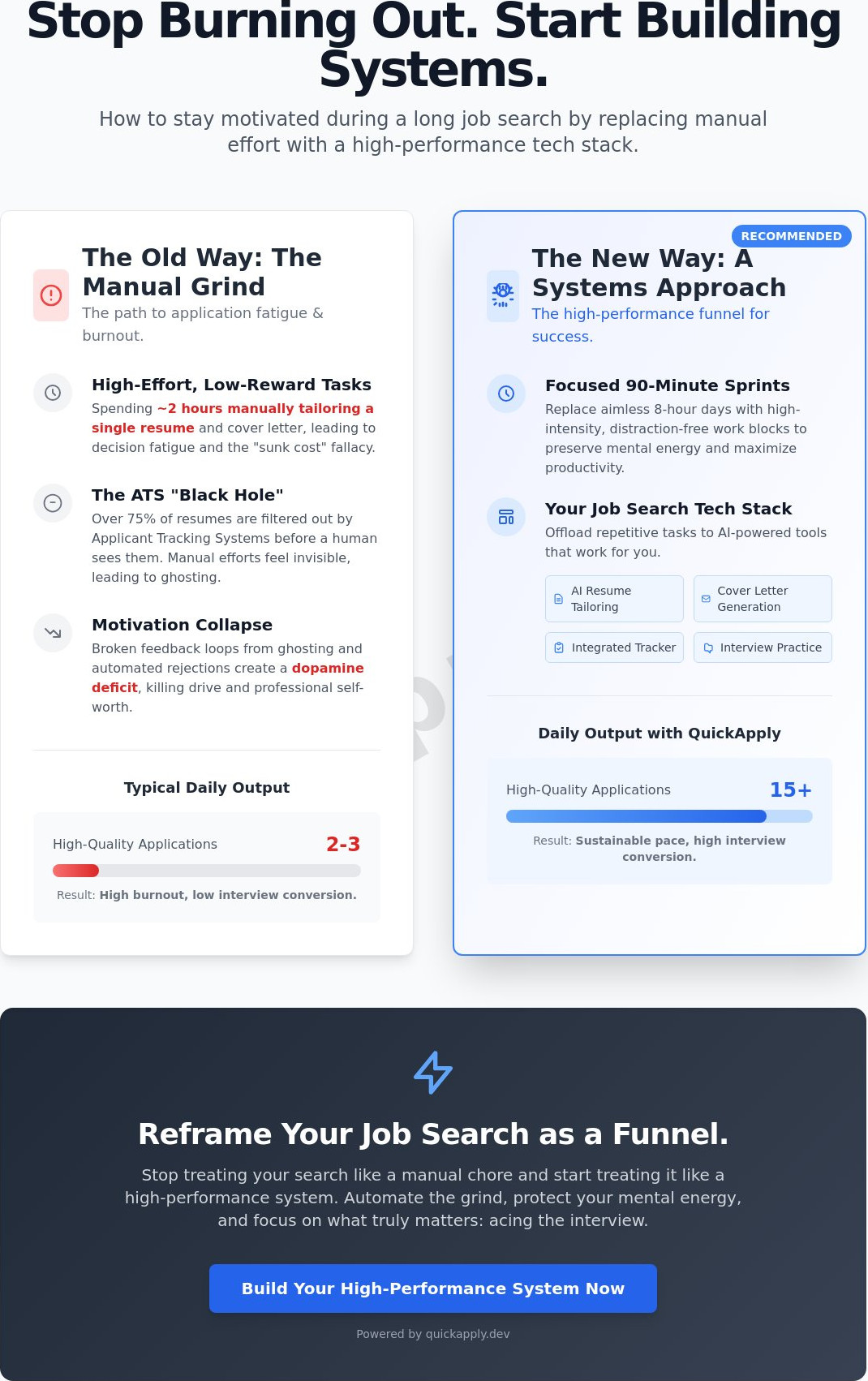
Spending two hours tailoring a single resume is a direct path to psychological collapse. This approach triggers the "sunk cost" fallacy. You become emotionally over-invested in a single outcome because of the labor involved. When that application disappears into a database, the emotional crash is severe. This manual process also induces heavy decision fatigue. By the time you reach the third application of the day, your ability to write persuasively has evaporated. You aren't lazy; your creative bandwidth is simply maxed out by repetitive tasks.
Ghosting and the Dopamine Deficit
Motivation relies on consistent feedback loops. In the 2026 market, those loops are often broken by silence. Automated rejection emails or total ghosting create a dopamine deficit that kills your drive. You must decouple your professional self-worth from these digital interactions to survive. The "ATS Black Hole" is a mechanical hurdle, not a talent judgment. It's a filter designed for speed, not for recognizing human potential.
To fix this, stop viewing each application as a high-stakes gamble. Treat them as data entries in a high-octane funnel. By reducing the manual labor of resume tailoring and cover letter generation, you preserve the mental energy needed for high-value tasks like interview practice. This shift in perspective is the only way to maintain momentum until you land the offer.
Systems Over Goals: Structuring Your Search for Persistence
Outcome-based goals are the enemy of longevity. If your only metric of success is "Get a job," you face a binary failure state every day you don't sign a contract. This is a primary reason why people struggle with how to stay motivated during a long job search. You must pivot from outcomes to systems. Instead of obsessing over the final "Yes," focus on a daily quota, such as applying to five high-match roles. A system is something you can control; a hiring manager's decision is not.
Adopt the "90-Minute Sprint" method. High-intensity work requires deep focus, not eight hours of aimless scrolling. Set a timer for 90 minutes and execute your tasks without distraction. Once the timer hits zero, you are done for that block. This prevents mental fatigue and helps in managing job search burnout more effectively than generic "self-care" advice. Schedule these sprints during your biological peak energy. If you're a morning person, do your heavy lifting at 8:00 AM. Don't force a standard 9-to-5 schedule if your brain operates better at midnight.
Building Your Job Search Tech Stack
Efficiency requires the right architecture. You need a centralized dashboard to prevent the "spreadsheet spiral" where data gets lost and momentum dies. Your stack should include a dedicated Application Tracker, automated Resume Tailoring, and AI-driven Interview Practice. Integrating these tools allows you to visualize progress even when the inbox is quiet. For a deeper dive into setting up your workflow, read our guide on Mastering the Job Application Process: A Comprehensive How-To Guide. Using an integrated Application Tracker ensures you never lose track of a lead.
The "Shelf" Method for Mental Closure
Once you submit an application, put it on the shelf. Mental closure is vital for how to stay motivated during a long job search. Stop refreshing your email and prevent "Interview Anxiety Loops" by assuming the application is done until the system notifies you otherwise. Set strict "Off-Hours" to protect your personal identity. If you don't define when the search ends, it will consume your entire life. Treat your job search like a high-performance engine. It needs downtime to avoid overheating.
The Efficiency Cure: Reducing Application Friction with AI
Most career advice presents an outdated binary: you must choose between "spray and pray" volume or slow, manual quality. This is a false choice. In the 2026 market, high-volume output with high-precision input is the only way to dominate. AI tools allow you to scale your efforts without sacrificing the nuances that human recruiters and ATS algorithms demand. Learning how to stay motivated during a long job search is impossible if every application feels like a mountain. AI isn't just a shortcut; it's the efficiency cure that removes the friction killing your drive.
Reducing your "Time-to-Submit" metric from two hours to sixty seconds is a psychological game-changer. When the cost of applying is low, the sting of a rejection or "ghosting" is minimized. You preserve your creative bandwidth for high-stakes Interview Practice rather than burning it on repetitive formatting. By automating the grunt work, you maintain a relentless pace that manual applicants simply cannot match. You aren't working harder; you're operating a superior system.
Automated Tailoring: Beating the ATS Without the Grind
Modern hiring in 2026 is driven by Match Scores. These scores are calculated based on keyword density and semantic relevance. AI identifies "hidden keywords"—the specific skills and experience markers buried in job descriptions that manual reading often misses. Instead of guessing what a recruiter wants, use technology to align your resume with their exact requirements instantly. For a tactical deep dive into this process, see our guide on How to Tailor Your Resume to a Job Description: The 2026 AI Strategy. This approach ensures your profile clears the mechanical filters every single time.
Cover Letters: From Blank Page to High Conversion
Standard templates are a liability. Recruiters in 2026 can spot a generic "I am writing to express my interest" letter in seconds. To convert applications into interviews, you need role-specific narratives that connect your past performance to a company's future problems. AI enables you to generate these narratives instantly, pulling from your background to create a compelling case for your candidacy. Our AI Cover Letter Generator: Automate Your Path to More Interviews in 2026 builds these high-conversion documents without the blank-page syndrome. Stop staring at a cursor and start hitting "submit."
Strategic Networking and Professional Growth Loops
Networking is often pitched as a desperate hunt for referrals. That approach is draining and inefficient. Instead, treat networking as a "Social Battery" recharge. High-quality interactions with peers remind you of your professional identity. This is a critical component of how to stay motivated during a long job search. Limit "Coffee Chats" to a strict 15-minute window. This prevents the drain of long, directionless meetings while maximizing your networking output. Short, punchy meetings respect everyone's time and keep your energy levels high.
Use this transition period to build a Promotion Roadmap. Don't just look for your next role; plan the one after that. This shifts your focus from "finding a job" to "career architecture." Every interview provides valuable data. If you don't land a specific role, analyze the feedback to identify tech stack gaps. This "Skill-Up" loop turns every "No" into a technical requirement for your next sprint. By focusing on growth, you ensure that your time spent between roles is a productive investment rather than a stagnant gap.
Networking Without the Cringe
Stop asking for favors. Focus on "Inquiry over Asking." Reach out to tech leads to discuss specific challenges in their stack or industry trends. This value-first approach positions you as a peer, not a solicitor. Use AI to draft these personalized outreach messages. Technology should handle the initial drafting so you can focus on the actual conversation. This level of automation ensures your pipeline remains full without exhausting your mental reserves. Engaging with LinkedIn content should be tactical; comment on industry developments to maintain visibility without the need for constant, original content creation.
Maintaining the "Expert" Mindset
Stop identifying as a "Job Seeker." That label implies a position of weakness and desperation. You are a "Consultant in Transition." This psychological shift is vital for how to stay motivated during a long job search. Use a Salary Negotiation Guide to stay anchored in your actual market value. Knowing your worth before the offer arrives prevents you from accepting low-ball numbers out of desperation. It changes the power dynamic of every interview you attend. Confidence isn't a feeling you wait for; it's a byproduct of being well-informed and systematically prepared.
Ready to take control of your career trajectory and stop the burnout? Start building your Promotion Roadmap today.
Automating the Grind: How QuickApply Protects Your Mental Energy
QuickApply functions as the operating system for your professional transition. It replaces the chaos of manual labor with a streamlined, high-octane engine. If you want to know how to stay motivated during a long job search, the answer is simple: remove the pain. Our one-click Resume Tailoring eliminates the decision fatigue that leads to burnout. You no longer have to wonder if your bullet points align with the job description. The system handles the alignment while you focus on the strategy.
The Application Tracker provides a visual "Win" every single day. Seeing your funnel grow from leads to interviews creates a sense of momentum that generic advice can't provide. It turns a "black hole" process into a visible pipeline. Once the interviews start rolling in, our Interview Practice tools ensure you're ready to close the deal. Confidence comes from repetition, not luck. Stop building your own spreadsheets and start using a system designed for speed.
The QuickApply Advantage
The Match Score tells you exactly where to spend your energy. Don't waste time on low-probability roles. Our platform calculates the semantic relevance between your profile and the role instantly. With unlimited Cover Letter Generation, you can maintain high-volume precision for aggressive searches. This is how to stay motivated during a long job search in 2026; you win by out-pacing the competition without out-working your own mental capacity. For more on the best tools in the market, check out The 6 Best AI Resume Builders of 2026: Stop Building, Start Tailoring.
Your Next Career Move Starts with One Click
Reclaim your time and your mental health today. Transition from a "Job Hunter" to a "Career Manager" by leveraging automation. You have the talent. We have the system. Every minute you spend manually editing a document is a minute you aren't preparing for your next role. Stop the grind and start the engine. Your next offer is a byproduct of the system you use. Sign up for QuickApply and automate your search today.
Reclaim Your Momentum and Land the Offer
The 2026 job market is a technical challenge, not a test of your character. You've learned that how to stay motivated during a long job search is a function of your operating system. By shifting from outcome-based anxiety to a system of high-intensity sprints and AI-driven automation, you preserve your mental stamina for the moments that matter. High-precision tailoring and strategic networking loops ensure you remain an expert in transition, not a seeker.
Efficiency is the ultimate antidote to burnout. Stop fighting the algorithms with manual labor and start using a stack built for the modern web. With AI-powered resume tailoring in seconds and an integrated application tracker, you can maintain a high-volume pipeline with zero decision fatigue. Prepare for the final stage with interview practice and salary negotiation tools that protect your market value.
Success isn't about working harder; it's about deploying a superior system. Automate your job search and beat burnout with QuickApply. Your next career move is just a few clicks away. Keep pushing forward.
Frequently Asked Questions
How long does the average job search take in 2026?
Average search timelines vary significantly based on industry demand and education levels. In April 2026, the U.S. unemployment rate was 4.3 percent, with 7.4 million people competing for roles. This high volume of applicants means you should focus on your interview conversion rates rather than the number of weeks elapsed. A faster "Time-to-Submit" using automated tools typically shortens the cycle by increasing your presence in the market.
What are the first signs of job search burnout?
Burnout typically manifests as cognitive resource depletion and a growing sense of cynicism toward the application process. You might experience intense decision fatigue when attempting to tailor a resume or feel a total loss of professional identity. These signals indicate that your manual labor has reached a point of diminishing returns. Transitioning to a system-first approach is the only way to stop this depletion.
Is it better to apply to fewer jobs with more effort?
The choice between quality and quantity is a false binary in the 2026 market. Successful candidates use AI to achieve high-volume output with extreme precision. You can apply to more roles while maintaining high-match scores by automating the tailoring process. This strategy ensures you clear ATS filters without the mental drain of manual editing, giving you a statistical advantage over manual applicants.
How do I handle the emotional toll of constant ghosting?
Handle ghosting by viewing it as a mechanical failure of the hiring company's internal system. Automated silence is often the result of mismatched keywords or high applicant volume, not a personal judgment of your talent. Decouple your self-worth from these digital interactions. Use an Application Tracker to focus on the logic of your funnel rather than the emotional weight of individual rejections.
Can AI tools actually help me stay motivated?
AI tools are the primary solution for how to stay motivated during a long job search because they remove the friction of repetitive tasks. When you reduce the labor of cover letter generation and resume tailoring, you preserve your mental energy for high-value interview stages. Automation provides a sense of control and consistent momentum that keeps your professional drive intact over several months.
What should I do if I feel like giving up on my job search?
If you feel like giving up, your current system has reached a breaking point. Reset your strategy by auditing your tech stack and shifting your focus from outcomes to daily system wins. Complete a 90-minute sprint or an Interview Practice session to rebuild your sense of agency. Small, automated victories provide the psychological fuel necessary to continue until the right offer arrives.
How many hours a day should I spend looking for a job?
Limit your active search to three or four hours of high-intensity work per day. Use 90-minute sprints to maximize your focus and avoid the diminishing returns of aimless scrolling. Working a standard 8-hour day on applications is inefficient and leads to rapid burnout. High-octane systems allow you to achieve more in two hours than manual applicants achieve in a full day.
How do I explain a long gap in my resume during interviews?
Explain a resume gap by highlighting the professional growth loops you executed during that time. Frame the period as a strategic transition where you developed a Promotion Roadmap or mastered new technical skills. Recruiters in 2026 value candidates who can demonstrate continuous productivity. Position yourself as a consultant in transition rather than someone who was simply unemployed.


