
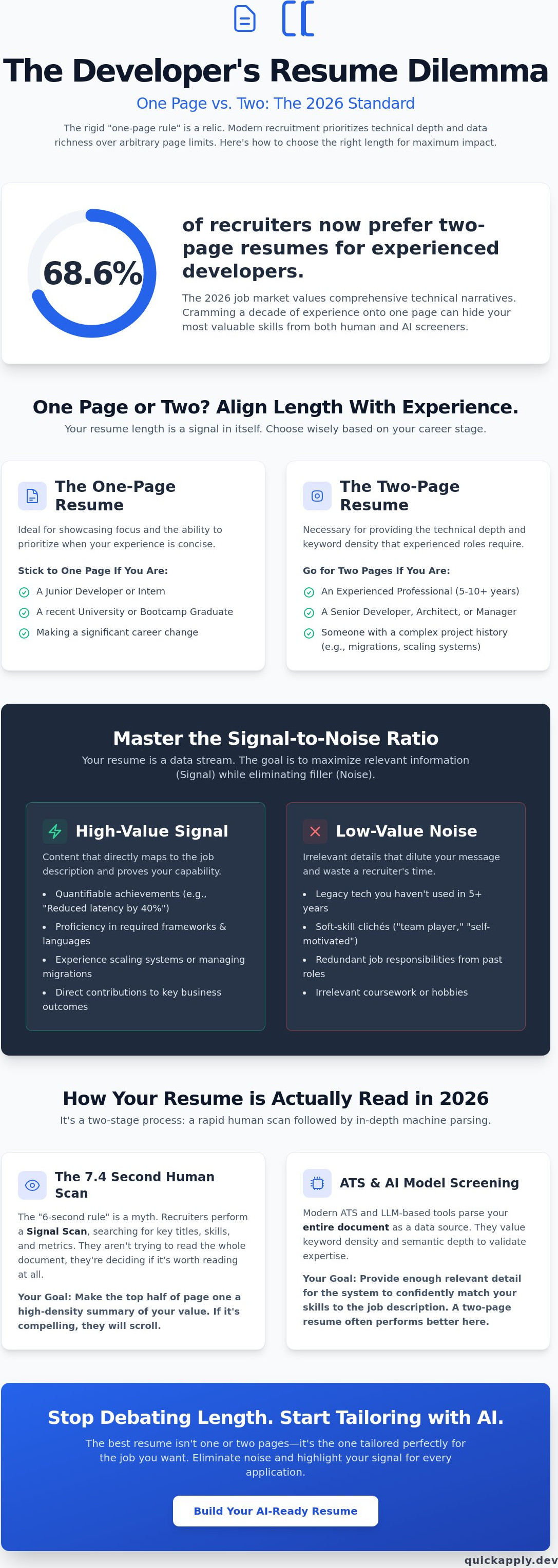
Did you know that 68.6% of recruiters in 2026 now prefer two-page resumes over the traditional one-page format? The rigid "one-page rule" is officially a relic for experienced talent. If you're caught in the one page vs two page resume for developers debate, you're likely paralyzed by two conflicting fears. You don't want to be filtered out by an ATS for missing keywords, but you also dread looking like you can't prioritize your own career highlights. Agonizing over margins and font sizes to cram a decade of technical debt into a single sheet is a low-efficiency strategy that ignores how modern systems actually parse your data.
It's frustrating to feel like your professional growth is being throttled by outdated formatting constraints. You shouldn't have to choose between being "too long to read" and "too short to matter." This guide helps you master the signal-to-noise ratio. You'll learn exactly when to expand your narrative for maximum impact and when to prune the fluff that triggers a recruiter's skip reflex. We'll break down the 2026 standards for signal density and provide a clear rule of thumb to ensure your resume passes both the 7.4-second human scan and the latest LLM-based screening filters.
Key Takeaways
- Abandon paper-era constraints and adopt a digital-first strategy that prioritizes technical depth over arbitrary page limits.
- Resolve the one page vs two page resume for developers debate by aligning document length with your actual years of experience and role seniority.
- Audit your tech stack to eliminate legacy "noise" and ensure every line on your resume serves as a high-value signal for recruiters.
- Optimize multi-page PDF structures to ensure modern ATS algorithms index your full experience without technical parsing errors.
- Implement a "Master Resume" workflow to maintain a comprehensive career log while generating focused, high-conversion tailored applications.
One-Page vs. Two-Page Resume: The Developer’s Dilemma
The "One-Page Rule" is a legacy constraint from the era of physical filing cabinets and expensive postage. Decades ago, keeping a resume to a single sheet was a matter of logistics. Every extra page increased the friction for human handlers. However, modern resume standards have evolved alongside our digital infrastructure. In the 2026 job market, your resume is rarely a physical object. It is a data source. Forcing a decade of high-impact engineering experience into a single page isn't just difficult; it's often a strategic failure that hides your most valuable technical signals.
Digital-first recruitment has fundamentally changed the one page vs two page resume for developers debate. Modern systems prioritize data richness and keyword density over arbitrary page counts. If you've spent years scaling distributed systems or managing complex migrations, a single page likely lacks the semantic depth required for AI-driven screening tools to validate your expertise. The goal is no longer to fit a specific box. The goal is to manage the cognitive load of the reader. If your content is relevant, a second page provides the breathing room necessary for technical clarity. If your content is fluff, even half a page is too long.
The core standard for 2026 is simple: relevance overhauls length every single time. A two-page document that maps directly to a Job Description (JD) will outperform a cramped one-page document every day of the week. You are building a technical specification for your career. Don't sacrifice the "specs" just to meet an outdated formatting myth.
The 6-Second Scan Myth
You've likely heard that recruiters only spend six seconds on a resume. This statistic is often misinterpreted. Recruiters aren't racing to reach the bottom of the page; they are scanning for "Signal." They look for specific technologies, job titles, and quantifiable achievements. Layout and strategic white space impact this scannability far more than your total page count. In a digital PDF, the "Above the Fold" section is your prime real estate. If the top half of your first page clearly communicates your value proposition, the recruiter will happily scroll to the second page to see the technical details.
When One Page is Mandatory
While the rules have relaxed, brevity is still a signal of its own for certain candidates. If you are a junior developer, an intern, or a recent bootcamp graduate, a two-page resume suggests a lack of focus. You likely don't have the career depth to justify the extra space. Instead of stretching your experience, use good resume examples to learn how to maximize the impact of a single page. Avoid the temptation to "fluff" your document with irrelevant coursework or soft skill clichés. High-density, single-page resumes show that you can prioritize information and respect a recruiter's time.
The Signal-to-Noise Ratio: Choosing Your Length
Your resume is a technical document. Like any good API, it should deliver high-value data with minimal latency. In the one page vs two page resume for developers debate, the winner is determined by the signal-to-noise ratio. "Signal" represents the specific skills and experiences that map directly to the job description. This includes your proficiency in specific frameworks, your history of scaling systems, and quantifiable performance wins. "Noise" is everything else. It's the legacy tech you haven't touched in five years, the soft skill clichés like "self-motivated," and the redundant responsibilities that don't add new information to your profile.
The Signal-to-Noise Ratio for technical resumes is the volume of relevant, quantifiable achievements divided by the total word count of the document. If you have to shrink your font to 9pt and eliminate all white space to fit onto one page, you've created a document with high noise. A dense, cramped one-page resume is a UX nightmare for a recruiter. It's much more efficient to move to a breathable two-page layout that uses clear headers and strategic spacing. This approach respects the recruiter's cognitive load and ensures your most important technical signals aren't buried in a wall of text.
If you're unsure which parts of your history are creating noise, using automated Resume Tailoring can help you strip away irrelevant content for specific roles instantly. Even the UC Berkeley guidelines for developers emphasize that while brevity is a virtue, clarity and relevance are the ultimate goals of any professional document.
The Senior Developer Exception
Seniority fundamentally changes your documentation requirements. Once you cross the threshold of 8+ years of experience, a single page often fails to provide necessary architectural context. You aren't just listing languages; you're proving your ability to design systems and lead teams. A second page allows you to balance deep-dive project descriptions with high-level stack summaries. This is also the ideal place to list patents, publications, or significant open-source contributions that establish your authority without cluttering your primary work history.
The Project-Based Portfolio Approach
You can also use a second page as a dedicated "Selected Projects" section. This is a powerful strategy when your most relevant work happened outside of your primary employment. Structure these project bullets using the P-S-T-R method: Problem, Solution, Tech Stack, and Result. This format provides a clear ROI for the reader. Offload granular details by linking to your GitHub or LinkedIn profile. This keeps your main document focused on the narrative while providing a path for deeper technical validation if the recruiter wants it.
How Modern ATS and Recruiters Process Multi-Page Resumes
Stop worrying about the "page break" bug. Modern Applicant Tracking Systems (ATS) in 2026 are no longer the primitive text-strippers of the early 2010s. They utilize Large Language Models (LLMs) to interpret the context of your entire career narrative regardless of document length. In the one page vs two page resume for developers debate, the system actually favors the latter if it provides more relevant data points. Modern ATS parsers utilize optical character recognition and semantic analysis to bridge page breaks, treating your entire PDF as a single continuous data stream. You aren't being penalized for a second page; you're only penalized if that page contains zero relevant signals.
A two-page layout increases your "Searchability Factor" by providing space for a broader range of semantic keywords. Instead of just listing "Python," you have the room to describe how you used Python to optimize a specific CI/CD pipeline. This creates a natural integration of keywords that AI filters prioritize. Avoid the trap of keyword stuffing, though. If a skill isn't backed by a project or a result, it’s just noise that dilutes your authority. While general career advice like How Long Should A Résumé Be? often defaults to a one-page limit, specialized technical roles require more documentation to prove competence.
Parsing Accuracy in 2026
Modern systems are built on robust schemas that map experience chronologically across multiple pages without losing data integrity. Use standard headings like "Professional Experience" and "Technical Skills" to ensure the parser correctly categorizes your data. When you tailor resume to job description, you are essentially providing the ATS with the exact tokens it needs to rank you as a top-tier match. Consistency in your file structure ensures that your second page is indexed as a continuation of your expertise rather than a separate, confusing data fragment.
The Human Review: Page Two Psychology
Humans only see page two if page one earns their attention. Think of the top 25% of your first page as your "Executive Summary" or "System Overview." This is where your most relevant tech stack must live. If you don't hook the recruiter here, they won't bother scrolling. Maintain visual continuity with consistent font styles and header formatting. Use page numbers like "1 of 2" to provide a clear navigational path. If page one is the high-level trailer, page two is the deep-dive feature film for the technical interviewer who wants to see your architectural decisions.
Engineering a Concise Resume: Strategies to Cut the Fluff
Stop treating your resume like a career-long log file. High-performing developers treat their documentation like a production build: optimized, minified, and free of dead code. If you're struggling with the one page vs two page resume for developers balance, the solution isn't just cutting content. It's refactoring it. Every line must justify its existence in terms of "Signal." If a line doesn't help a recruiter say "yes," it's technical debt that needs to be cleared.
Start by auditing your tech stack. If your skills list still features ActionScript, Silverlight, or ColdFusion, you're leaking valuable space. These are deprecated languages that signal a lack of focus on modern ecosystems. Remove them unless you're specifically targeting a legacy maintenance role. Next, apply the "So What?" test to every bullet point. "Maintained a legacy database" is a low-value task. "Optimized SQL queries to reduce API latency by 35%" is a high-value result. If a bullet doesn't include a quantifiable outcome, rewrite it or delete it entirely.
Use AI to identify redundant phrasing and passive voice. Phrases like "Responsible for" or "Tasked with" are wordy and weak. Replace them with strong, imperative verbs like "Engineered," "Architected," or "Automated." This simple swap increases information density and makes your document feel more authoritative. If you want to stop guessing and start winning, use our Resume Tailoring tool to automate this pruning process instantly.
The "Prior Professional Experience" Block
You don't need to describe every project from a role you held over a decade ago. Consolidate your older history by creating a "Prior Professional Experience" section. List the company name, your title, and the years active in a single line. This approach demonstrates your career trajectory and growth without wasting vertical space on legacy responsibilities. Delete any non-tech roles from your early career. Your time as a barista or retail clerk is irrelevant noise that distracts from your engineering expertise.
Formatting Hacks for High-Density Info
Stop fighting with Microsoft Word's erratic margins and page breaks. A specialized tool like the best ai resume builder 2025 handles complex layouts like multi-column skill clouds effortlessly. These clouds allow you to group technologies by category while saving dozens of lines of vertical space. Keep your education and certifications to a single line each. Use 0.5-inch margins and 10pt or 11pt fonts to maximize density without sacrificing human readability or ATS parsing accuracy.
Stop Debating Length and Start Tailoring with QuickApply
Stop wasting cognitive cycles on static page counts. The one page vs two page resume for developers debate is irrelevant when you shift to a dynamic deployment model. Your Master Resume should be a comprehensive, multi-page log of every deployment, stack, and architectural win you have ever achieved. It functions as your career database. Your Applied Resume is the filtered query result. It is the optimized build tailored for a specific job description. QuickApply automates this extraction process, ensuring your application is always the right length with the right level of technical depth for the role in question.
Efficiency is about removing the guesswork from the application process. QuickApply’s Match Score feature provides instant feedback on your alignment with a specific job description. It identifies the critical technical tokens you are missing and highlights the redundant fluff that needs to be purged. You'll know your resume is ready when the score hits the green zone. This systemic optimization ensures you never look overqualified for a mid-level role or under-experienced for a senior position. You are presenting the exact data the system wants to see.
Automated Precision for Tech Jobs
Manual tailoring is a massive bottleneck in your job search. QuickApply identifies the specific keywords that must remain to satisfy both ATS algorithms and human recruiters. It trims the legacy noise that distracts from your current expertise. You can move from a cluttered, two-page document to a high-impact, one-page masterpiece in seconds. Use the Application Tracker to manage multiple versions of your profile and keep your search organized as you scale your output.
Your Career, Optimized
The 2026 job market demands a high-volume, high-precision strategy. You need to move as fast as the technology you build. QuickApply empowers you to dominate the recruitment funnel by automating the most tedious parts of the process. We handle the Resume Tailoring, Cover Letter Generation, and Interview Practice so you can focus on passing the technical screen. This is the ultimate solution to the length debate. Stop building static resumes and start deploying tailored career solutions.
Optimize your developer resume with QuickApply today.
Deploy Your Optimized Career Narrative
Length isn't your primary metric; relevance is. You've learned that modern ATS systems parse context rather than just counting pages, and that your "Above the Fold" content determines if a recruiter scrolls. Navigating the one page vs two page resume for developers landscape requires a mindset shift from static formatting to dynamic data optimization. Pruning legacy tech and consolidating early roles ensures every line on your document serves as a high-value signal that triggers a "yes" from hiring teams.
Stop wasting time on manual formatting and margin hacking. You need a system that scales with your ambition. Stop guessing and start tailoring your resume with QuickApply to leverage an AI-powered Match Score for every application. Our platform provides automated resume tailoring for tech-specific roles, a strategy already used by developers to land roles at top tech firms. You have the technical expertise. Now, use the right tools to ensure it's seen. Your next big career milestone is just one optimized build away.
Frequently Asked Questions
Is a 2-page resume okay for a software engineer with 5 years of experience?
Yes, a two-page resume is perfectly acceptable for a developer with five years of experience if the content is high-density. If you've led multiple projects or worked across different tech stacks, you need the space to provide architectural context. Don't sacrifice readability by cramming your wins into a single sheet. A breathable layout is always more efficient than a wall of text.
Will an ATS reject my resume if it is longer than one page?
No, modern ATS platforms in 2026 do not automatically reject resumes for being longer than one page. In the one page vs two page resume for developers debate, longer documents often perform better because they provide more space for semantic keywords. AI filters use these data points to rank your expertise. Focus on providing high-quality signals rather than worrying about an arbitrary page limit.
What should I remove from my resume to make it fit on one page?
Start by deleting deprecated languages like ActionScript or older versions of frameworks you no longer use. Remove non-technical early roles and generic "Objective" statements that don't add value. Apply the "So What?" test to every bullet point. If a line doesn't describe a specific achievement with a measurable outcome, it's noise that's taking up valuable real estate.
Should I include my GitHub and LinkedIn links if my resume is already two pages?
Absolutely. GitHub and LinkedIn links are essential technical signals that recruiters expect to see in 2026. They allow you to offload granular detail to external platforms, keeping your resume focused on high-level impact. Even on a two-page document, these links provide a path for deeper technical validation that a PDF alone cannot offer.
Do FAANG recruiters prefer one-page or two-page resumes?
FAANG recruiters prioritize clarity, but the one page vs two page resume for developers decision still depends on your career depth. While a junior dev should stick to one page, senior engineers at top-tier firms often use two pages to detail complex system designs. Ensure your most impressive technical wins appear on the first page to hook the reviewer immediately.
Can I use a two-column layout to save space on a developer resume?
You can utilize a two-column layout for your skills section to significantly save vertical space. This allows you to group technologies by category without creating a long, scrolling list. However, keep your professional experience in a standard single-column format. This hybrid approach maintains high human scannability while ensuring modern ATS parsers index your work history with 100% accuracy.
Is it better to have a small font on one page or a normal font on two pages?
It's always better to use a standard font size on a two-page resume than a tiny font on a single page. If a recruiter has to zoom in to read your technical skills, you've already lost the UX battle. Maintain a minimum font size of 10pt for body text. Accessibility and scannability are far more important than hitting an outdated one-page target.
How far back should a developer resume go?
Your resume should generally cover the last 10 to 15 years of your career. In the fast-moving tech sector, experience older than a decade often loses its relevance unless it demonstrates a significant career trajectory. Focus your bullet points on your most recent five years of work. Consolidate your earliest roles into a single-line summary to show your history without the fluff.


