

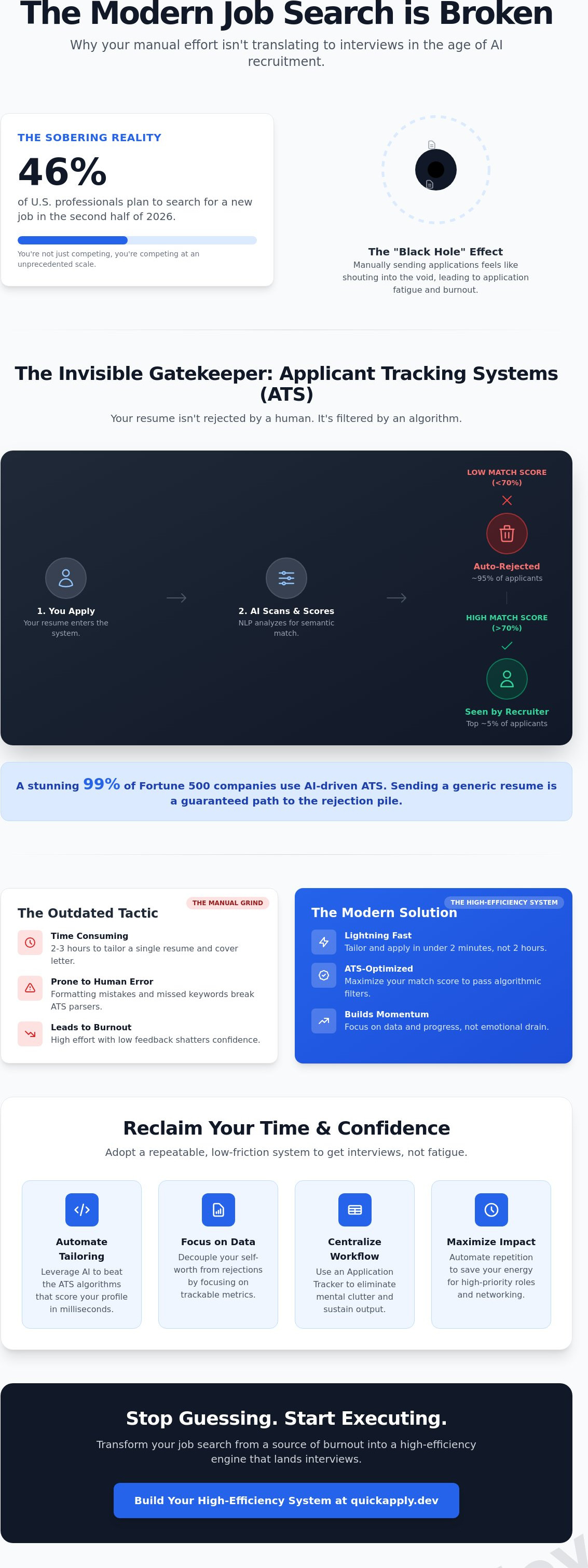
Job search discouragement isn't a mindset failure; it's a systems failure. If you're feeling discouraged job searching, you aren't alone. Data shows that 46% of U.S. professionals plan to hunt for new roles in the second half of 2026. Meanwhile, 99% of Fortune 500 companies use AI-driven Applicant Tracking Systems to filter candidates before a human even sees a resume. You are fighting a high-tech battle with manual, outdated tactics. The "black hole" effect and application fatigue aren't signs of your inadequacy. They are symptoms of an inefficient process that values manual labor over technical optimization.
It's time to stop the manual grind. You can transform your job search from a source of burnout into a high-efficiency engine that actually lands interviews. This guide shows you how to replace friction with automation and restore your confidence through data-driven progress. We will explore a repeatable, low-friction system for resume tailoring and cover letter generation. You will learn to bypass ATS gatekeepers and secure more interviews with significantly less effort. Stop guessing and start executing a strategy built for the modern digital landscape.
Key Takeaways
- Stop the manual grind. Replace outdated tactics with a high-efficiency system optimized for the 2026 job market.
- If you are feeling discouraged job searching, learn to decouple your self-worth from automated rejections by focusing on data-driven metrics.
- Leverage automated Resume Tailoring to beat modern ATS algorithms that score your profile in milliseconds.
- Centralize your workflow with an Application Tracker to eliminate mental clutter and sustain high-volume output.
- Reclaim your time. Automate the repetitive parts of the application process to maximize your match score for high-priority roles.
Why You Are Feeling Discouraged Job Searching in 2026
You aren't failing. You're just using a manual shovel to dig a digital trench. If you are feeling discouraged job searching, it's likely because your current strategy hasn't evolved as fast as the market. In 2026, the gap between manual effort and tangible results has never been wider. You spend three hours tailoring a single resume, only to receive an automated rejection four minutes later. This isn't just a streak of bad luck. It is a systemic mismatch between your output and the algorithms governing recruitment.
The "ATS Black Hole" is particularly brutal for tech professionals who value logic and efficiency. When you apply for a role where you meet 95% of the requirements and still hear nothing, it triggers a psychological breakdown of your professional worth. This discouragement is actually a symptom of "Application Fatigue." You are operating at a high intensity with zero feedback loops. Distinguishing between a tough market and an obsolete workflow is the first step toward recovery. The market isn't closed; your current path through it is simply blocked by high-volume, AI-driven competition.
The Reality of the 2026 Tech Job Market
AI-driven recruitment tools now allow candidates to flood every open role with thousands of applications within hours of posting. This surge has forced recruiters to raise the bar for entry. Your resume now has approximately five seconds to prove perfect alignment before an algorithm or a tired human moves on. Because the external market feels so hostile, many professionals are "Job Hugging" staying in toxic or stagnant roles far longer than they should. This creates a sense of desperation that makes every external rejection feel like a personal indictment rather than a data mismatch.
Identifying the Symptoms of Search Burnout
Procrastination often becomes a subconscious defense mechanism. You find yourself cleaning your desk or checking emails instead of applying because your brain is trying to protect you from another "Ghosting" cycle. This cycle of silence is often more draining than a direct "No" because it provides no data for improvement. This state closely mirrors Occupational burnout, characterized by exhaustion and a sense of reduced professional efficacy. Search Burnout is the point where manual effort exceeds emotional capacity. When you reach this threshold, your productivity drops, your confidence shatters, and your search stalls indefinitely.
The Hidden Cause of Rejection: The ATS Evolution
Your "perfect" master resume is sabotaging your career. If you're feeling discouraged job searching, you're likely fighting an invisible gatekeeper: Natural Language Processing (NLP). Modern Applicant Tracking Systems don't just scan for keywords. They score your entire professional history in milliseconds. In 2026, a 70% match score often results in an automatic "fail" because the volume of applicants is too high. Recruiters only see the top 5% of candidates. If your resume isn't mathematically optimized, it never reaches a human hand.
Generic Resume Syndrome is the fastest way to get ghosted. When you send the same document to ten different companies, you're rolling the dice on parsing errors. These systems are designed to find specific contextual skill verifications. If a job description asks for "cloud architecture" and your resume says "managed AWS environments," an older system might miss it, but a 2026 system expects precise semantic alignment. This technical gap is a primary driver of the stress involved in dealing with job search burnout.
How Semantic Matching Works in 2026
AI filters now analyze the relationship between your skills and your achievements. They look for evidence, not just mentions. This is why good resume examples for the current market focus on high-impact, data-backed bullet points. The Match Score is the only metric that matters. If your score falls below the recruiter's threshold, your application is effectively deleted. You aren't being rejected by a person; you're being filtered by an algorithm that doesn't understand your "potential," only your data.
Why Manual Tailoring is a Losing Game
Manual editing is too slow for the 2026 market. By the time you spend two hours tweaking your experience to fit a role, 500 other candidates have already applied. You cannot outwork a machine. Human error also leads to formatting mistakes that break ATS parsers, such as using complex tables or non-standard fonts. The only way to compete is to tailor resume to job description ai. This ensures a 95% match score in seconds, not hours. High-efficiency candidates use automated resume tailoring to bypass the digital filter and get straight to the interview stage.
Protecting Your Mental Health: Shift from Effort to Impact
Stop treating your inbox like a scoreboard for your life. If you're feeling discouraged job searching, you're likely internalizing the silence of a machine. An automated rejection isn't a critique of your talent. It's a notification that your data didn't align with a specific filter. Shift your focus from effort to impact. Spending ten hours on one application is high effort but low impact. Applying to ten high-match roles in one hour is high impact. This shift protects your mental bandwidth by turning a chaotic emotional experience into a repeatable technical process.
Track your progress through metrics you can control. You can't control whether a recruiter calls, but you can control your average match score. Set strict search hours. Lock the laptop at 5:00 PM. Job hunting shouldn't bleed into your personal life. When you treat the search like a ticket queue, you remove the life-or-death pressure that leads to burnout. Gamify the system. Every application is just a data entry in your broader career strategy. Your value as a professional exists independently of an algorithm's current state.
Managing the 'Rejection Feedback Loop'
Rejections are just data. If you receive a "No," look at your ATS score report. Did you miss a specific certification? Was your formatting off? Use an automated job application tracker to visualize your funnel. Seeing fifty applications in "Pending" and five in "Interview" proves the system is working, even if the "Hired" box is still empty. Data replaces doubt. When you see the numbers moving, the feeling discouraged job searching starts to fade because you have evidence of progress.
The Role of Community and Accountability
Don't vent in generic career forums. Find tech-specific peer groups that prioritize optimization over complaining. Discussing how to hit a 98% match score is more productive than venting about market uncertainty. Use AI to handle the boring parts of the process, such as Resume Tailoring and Cover Letter Generation. This preserves your energy for high-value networking and interview practice. Leverage technology to stay human where it actually matters, and let the software handle the statistical grind.
The 5-Step High-Efficiency Job Search Workflow
Most career advice suggests "taking a break" when you're burnt out. This is a temporary fix for a permanent technical problem. If you're feeling discouraged job searching, the solution isn't less activity; it's better architecture. You need a system that produces high-quality outputs without draining your emotional battery. By shifting to a high-efficiency workflow, you stop fighting the market and start navigating it with a competitive edge.
- Step 1: Centralize your search. Use a dedicated Application Tracker to manage every lead. Stop wasting mental energy remembering which version of your resume went to which company.
- Step 2: Identify high-match opportunities. Don't apply to every role on your feed. Use AI to filter for jobs where your skills hit a 90% match score or higher. Quality beats quantity every time.
- Step 3: Tailor instantly. Generate a custom resume and cover letter for every role in seconds. If you aren't tailoring, you aren't competing.
- Step 4: Audit your LinkedIn. Recruiter AI uses semantic search to find talent. Ensure your profile uses the same technical lexicon as the roles you want.
- Step 5: Automate follow-ups. Set up a system to ping recruiters after seven days. Staying top-of-mind shouldn't require manual tracking.
Automating the Resume Tailoring Process
The "blank page" is the biggest hurdle to starting your day. An ai resume builder eliminates this friction by drafting your content based on your existing data and the job description. It maps your bullet points directly to the employer's requirements. This ensures the ATS sees exactly what it's looking for. AI tailoring is about precision, not fabrication. It highlights your real experience in the language the recruiter's software understands, ensuring you bypass the initial filter without the manual grind.
Streamlining Cover Letters and Tracking
Generic cover letters are useless in 2026. An ai cover letter generator allows you to maintain high quality at scale. It extracts the core needs of a company and aligns your achievements with them instantly. Use a centralized dashboard to see which versions of your resume are generating the most interviews. This data tells you exactly what the market wants. Reducing context switching keeps your focus sharp and your energy high. You can automate your application workflow today to stop the burnout and start getting responses.
QuickApply: Moving from Burnout to Hired
QuickApply isn't just a tool. It is a paradigm shift. If you are feeling discouraged job searching, it's time to stop fighting the machine and start owning it. QuickApply restores your most valuable asset: time. By automating 90% of the application process, you move from manual labor to strategic oversight. You don't have to spend hours on a single cover letter. The system handles the heavy lifting. This allows you to focus on the 10% of the search that actually requires your human touch.
The Match Score is your primary tactical advantage. Stop wasting time on jobs where the algorithm has already decided you aren't a fit. By focusing only on high-match roles, you increase your interview rate while decreasing your effort. This data-driven approach eliminates the emotional weight of "ghosting." You aren't guessing anymore. You are executing a high-probability strategy. Statistical certainty beats hope every time. When you see a high match score, you know your resume will actually reach a human recruiter.
Preparation replaces anxiety. With built-in Interview Practice tools, you can refine your responses before the recruiter even calls. The ROI of this system is measurable. You save hundreds of hours of manual tailoring and gain a consistent stream of interviews. It is the difference between an exhausting search and a streamlined career transition. Time is the currency of the job hunt. Spend it wisely. Moving from a state of burnout to a state of readiness requires the right infrastructure.
The QuickApply Advantage for Tech Pros
Tech is not a monolith. QuickApply offers unlimited Resume Tailoring for every niche. Whether you're a DevOps specialist, a Frontend expert, or an AI engineer, the system understands your specific technical lexicon. It maps your achievements to the exact requirements of the 2026 market. Beyond the application, you gain access to a Salary Negotiation Guide and a Promotion Roadmap. We don't just help you get the job. We help you plan your entire career trajectory. QuickApply acts as your Search Copilot. It navigates the complexities of modern recruitment so you can focus on your craft.
Take Control of Your Career Path
Master the system. Stop being a victim of the ATS. You have the skills. You just need the right delivery mechanism to prove it. If you are feeling discouraged job searching, change your tools. You can get started with a free trial today. See your first Match Score in minutes. Witness the efficiency of automated systems firsthand. The era of the manual grind is over. It's time to get hired. Take the first step toward a more efficient, less stressful professional future.
Upgrade Your Search Architecture Today
Stop treating your career like a game of chance. You've seen why manual methods fail in a market dominated by AI filters and high-volume competition. If you are feeling discouraged job searching, remember that the problem is your workflow, not your talent. By shifting from effort to impact, you can bypass the ATS black hole and reclaim your time. The future of hiring belongs to those who use the same high-tech tools as the recruiters themselves.
Systematize your success. Use AI-powered Match Scores to identify high-probability opportunities and stop guessing which roles are worth your energy. Whether you are aiming for a startup or need to tailor resumes for FAANG in seconds, speed and precision are your new competitive advantages. Manage the entire funnel with an Integrated Application Tracker to maintain momentum without the mental clutter.
Don't let an outdated process stall your professional growth. You have the skills; now you have the system to prove it. Start Tailoring Your Resume in Seconds with QuickApply and turn your next application into an interview. It's time to stop the grind and start getting hired.
Frequently Asked Questions
Is it normal to feel discouraged after only a month of job searching?
Yes, it's a logical response to a high-intensity, low-feedback market. In May 2026, the U.S. unemployment rate stood at 4.3%, with 7.3 million persons unemployed. When 46% of professionals are looking for new roles simultaneously, the competition is dense. If you're feeling discouraged job searching after thirty days, it's usually because your manual effort hasn't triggered a positive feedback loop yet. Shifting to an automated system provides the data points needed to see progress before the first interview call.
How many jobs should I apply to daily to avoid burnout?
Focus on match quality rather than an arbitrary daily quota. Applying to three high-match roles using automated Resume Tailoring is more effective than sending fifty generic applications. Burnout occurs when your manual labor exceeds your emotional capacity. By using technology to handle the repetitive parts of the process, you can maintain a high-volume output without the mental exhaustion of manual editing. Let the software do the heavy lifting while you focus on high-value networking.
Can AI really help me get past the ATS filters?
AI is the only reliable way to clear modern filters in 2026. Since 99% of Fortune 500 companies use an Applicant Tracking System, your resume must be mathematically optimized. These systems use Natural Language Processing to score your profile in milliseconds. AI tools use semantic matching to ensure your skills align perfectly with the job description's internal scoring system. It's about data alignment, not just stuffing your resume with keywords.
What should I do if I'm getting rejections but no interviews?
Rejections without interviews indicate a top-of-funnel conversion problem. This means your resume isn't hitting the necessary Match Score to reach a human recruiter. You need to audit your formatting and technical terminology immediately. Use automated Resume Tailoring to ensure your profile isn't being filtered out by an algorithm. If the system can't verify your skills contextually, you'll stay stuck in the "black hole" regardless of your actual talent.
Is it better to apply for fewer jobs with more effort or more jobs with AI?
The choice between quality and quantity is obsolete in the modern market. You should use AI to apply for a high volume of jobs with perfect, individualized tailoring. This hybrid approach ensures every application is high-quality while maintaining the scale needed to beat the statistical odds. High-efficiency candidates use automation to achieve what used to take forty hours a week in just a fraction of the time.
How can I explain a 'gap' in my resume caused by job search discouragement?
Frame any gap as a period of strategic upskilling or project-based work. Employers in 2026 prioritize demonstrated skills and certifications over continuous employment dates. If you were feeling discouraged job searching, highlight the technical projects or professional development you completed during that time. Focus on the value you added to your own skill set. This shows initiative and resilience, which are premium human traits in an AI-driven world.
Does using AI to tailor my resume count as 'cheating'?
Optimization is a necessity, not a shortcut. Recruiters already use AI-powered digital twins and scoring algorithms to rank your profile. Using AI to tailor your resume simply ensures your real-world experience is translated into a format their software can interpret. It bridges the gap between your talent and their technology. You're not fabricating skills; you're ensuring your existing skills are visible to the systems that screen them.
What are the best ways to stay motivated during a long job search?
Track metrics you can actually control. Instead of focusing only on "Hired," track your average Match Score and the number of applications in your Application Tracker. Motivation follows momentum. When you see your system functioning and your funnel filling up with high-match leads, the emotional weight of the search decreases. Operating on data rather than hope prevents the burnout that stalls most career transitions.


