

What if your job title is the weakest part of your application? In a market where 91% of employers use AI to screen candidates, the question should i put projects on my resume has evolved into a strategic calculation of Proof of Competence. You're likely struggling to balance a strict one-page limit with the need to showcase your latest technical wins. It's a common fear that including older academic work makes you look like a junior rather than a seasoned pro.
We agree that every line on your resume must earn its place through high-impact results. This guide promises to show you exactly how to audit your project history for maximum ROI and technical relevance. We'll break down a decision-making framework that bypasses ATS filters and secures higher match scores for your target roles. Stop guessing and start optimizing your professional narrative for the 2026 hiring standard. Efficiency is your only path to the top of the stack.
Key Takeaways
- Treat projects as Proof of Competence (POC) to validate your technical stack and bypass the limitations of generic job titles.
- Apply our ROI framework to answer "should i put projects on my resume" by auditing each entry for technical complexity and space value.
- Deploy strategic placement tactics tailored to your career stage, ensuring your most relevant technical wins hit the recruiter's eye first.
- Optimize your descriptions for ATS and human readers by adopting a stack-first approach paired with the STAR method.
- Scale your application volume without sacrificing quality by using AI-driven resume tailoring to pick the perfect projects for every role.
The Project vs. Experience Debate: When to Hit Include
Your resume is a high-performance document designed to convert recruiters into interviewers. In 2026, the question "should i put projects on my resume" isn't about filling white space. It's about deploying a Proof of Competence (POC). A POC serves as verifiable evidence that you can execute specific tasks within a modern tech stack. While the foundational definition of what is a resume remains a summary of your professional history, the tech sector now demands more than a list of generic duties. It demands proof of execution.
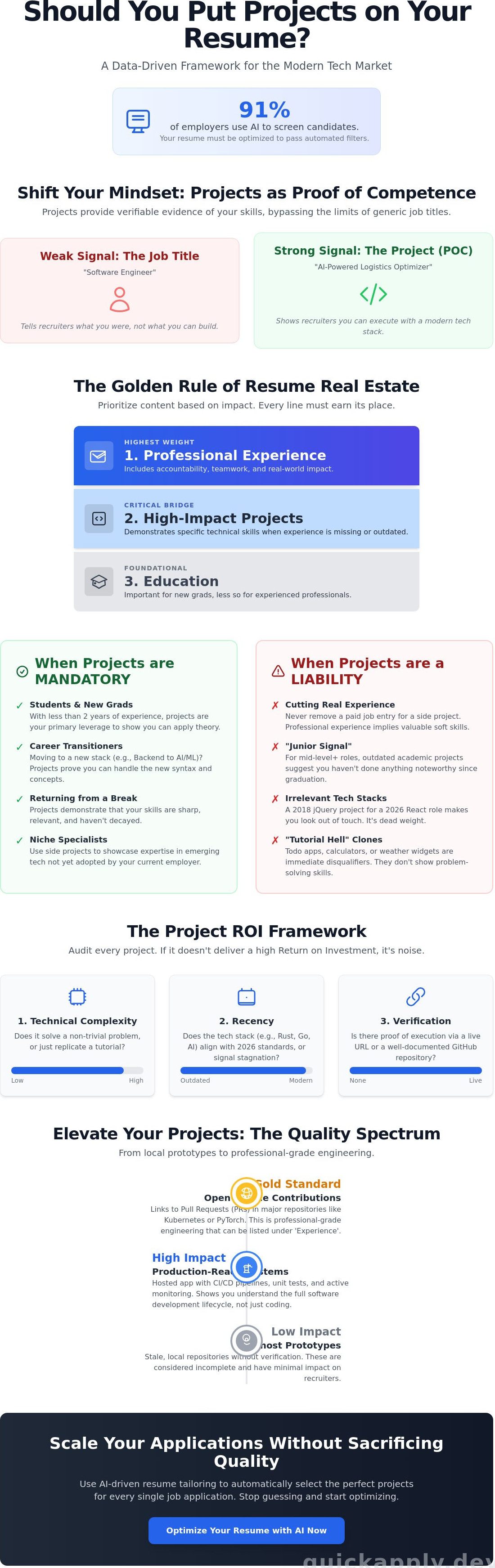
Efficiency dictates a strict hierarchy. We call it the Golden Rule of Resume Real Estate: Experience > Projects > Education. Professional experience always carries the highest weight because it includes organizational accountability and team collaboration. However, projects act as the critical bridge when that experience is missing, misaligned, or outdated. If your project list consists of "tutorial-hell" leftovers like basic Todo apps, calculator clones, or weather widgets, hit delete. Recruiters view these as immediate disqualifiers. They signal that you can follow a video tutorial, not solve the complex, non-linear problems found in production environments.
The Mandatory Inclusion Checklist
Projects are not optional in four specific scenarios. If you're a student or a new grad with less than two years of professional experience, your projects are your primary leverage. They demonstrate you've moved beyond academic theory. Engineers transitioning to a new stack, such as moving from standard Backend Development into AI or Machine Learning, must use projects to prove they can handle the new syntax. If you're returning from a career break, projects prove your skills haven't decayed in a fast-moving market. Finally, niche specialists use side projects to show expertise in emerging technologies that their current employer hasn't adopted yet.
When Projects Become a Liability
Including projects can backfire if you don't audit them for ROI. Never cut a real job entry to make room for a side project. Professional experience, even if slightly less relevant, suggests a level of soft skill and teamwork that solo projects simply lack. For mid-level developers, keeping outdated academic work creates a "Junior Signal." It suggests you haven't done anything noteworthy since graduation. Similarly, irrelevant tech stacks dilute your profile. Listing a 2018 jQuery project when applying for a 2026 React or Next.js role makes you look out of touch. If the tech stack doesn't align with the target role, it's dead weight. Remove it immediately to save space for higher-impact data.
The Project ROI Framework: Auditing Your Portfolio for Impact
Every line on your resume has a cost. If a project doesn't deliver a high Return on Investment (ROI), it's dead weight. When you ask yourself "should i put projects on my resume", you need a data-driven audit. Start with technical complexity. A project must solve a non-trivial problem, not just replicate a tutorial. Recency is your next filter. In 2026, tech stacks move fast. If your portfolio isn't showcasing Rust, Go, or deep AI integration, it signals stagnation. Finally, verify everything. A documented GitHub repository or a live URL is your proof of execution.
Many professionals hesitate to list side work, but claiming your project work is essential for proving hands-on capability. If you built it, own it. This is especially true for senior roles where high-level architectural decisions matter more than simple syntax. Use your projects to demonstrate how you solve systemic problems.
Production-Ready vs. Prototype
Stop submitting local-host prototypes. Recruiters want to see production-ready systems. Production-ready means your project includes CI/CD pipelines and comprehensive unit tests. It's not just about the code; it's about the infrastructure. Mention how you handled traffic spikes or managed data persistence. A hosted app with active monitoring always beats a stale local repository. It shows you understand the full lifecycle of software development.
Open Source: The Ultimate Resume Project
Open-source contributions are the gold standard of project work. Contributing to major repositories like Kubernetes or PyTorch isn't just a hobby; it's professional-grade engineering. Link directly to your Pull Requests (PRs) to showcase your ability to collaborate within complex, distributed teams. Because this work involves code reviews and strict standards, you can often position these contributions within your main Experience section rather than hiding them under a Projects header.
When evaluating "should i put projects on my resume", remember that open-source work is the highest ROI move you can make. It proves you can operate within established codebases and follow enterprise-level standards. This level of transparency builds immediate trust with hiring managers.
If you're unsure which projects hit the highest ROI for a specific role, use resume tailoring tools to analyze your match score instantly.
Strategic Placement: Customizing Project Sections for Your Career Stage
Placement is about narrative control. Your resume layout must dictate where the recruiter’s eye lands first. If you are asking "should i put projects on my resume," the answer depends on which part of your career timeline needs the most reinforcement. A junior dev needs visibility; a senior engineer needs to demonstrate architectural depth. Use good resume examples to visualize how different layouts prioritize these sections based on seniority. Layout is the first thing an ATS or a human recruiter processes. Get it wrong, and your best work stays hidden in the footer.
For entry-level talent, projects are the heavy lifters. You lack years of experience (YOE), so you must lead with your most complex technical wins. Place your projects section immediately following your skills or education. This forces the reader to acknowledge your hands-on ability before they get hung up on your graduation date. It’s a bold move that replaces "potential" with "proof."
Mid-level and senior pros use projects as a precision tool. Here, projects showcase "T-Shaped" skills. This is the ability to go deep into a niche like distributed systems or AI while maintaining a broad engineering foundation. For a senior, a project isn’t a "look what I built" moment; it’s a "look how I architected this" demonstration. It proves thought leadership and technical foresight that a standard job description might miss.
For New Grads and Entry-Level Engineers
Position your projects section at the top of the fold. If your work history is limited to retail or internships, your projects are your real experience. Treat capstone projects and hackathons as mini-work experiences. Don't just list the features. Focus on the "Why." Explain the specific problem your project solved for a user base. This shows you understand the business value of code, which is a rare trait in junior candidates.
For Experienced Pros and Career Changers
Move projects to the bottom or integrate them into a "Technical Highlights" section. If you're a senior Java dev pivoting to a Python and AI role, your projects are your bridge. Frame them as a "Side-Hustle" or consulting work to give them more professional weight. If you're scaling that side-hustle into a startup, you can learn more about GrowthGrid to help you generate the necessary business documentation to back it up. This strategy allows you to pivot without looking like a beginner. You're not starting over; you're expanding your existing expertise with new, verified stacks.
Engineering Your Project Descriptions for ATS and Human Eyes
Engineering your project descriptions is a technical requirement, not a creative writing exercise. You're optimizing for two distinct audiences: the parser and the practitioner. The ATS scans project descriptions for keyword density just as heavily as work experience. This means the decision of should i put projects on my resume hinges on your ability to index those projects for searchability. If your descriptions lack the specific syntax of your industry, they're invisible. You must treat every bullet point as a data entry point that feeds the hiring algorithm.
Efficiency is the goal. A recruiter spends approximately six seconds on an initial scan. If they can't identify your tech stack within the first two seconds of looking at a project, you've already lost. We use the Stack-First rule to solve this. By listing your technologies immediately after the project title, you provide an instant snapshot of your capabilities. This prevents the reader from hunting through paragraphs to find out if you actually know Kubernetes or Terraform. It’s about reducing friction in the decision-making process.
The 2026 Tech Stack Formatting Rule
Modern formatting requires a dedicated tech line. Structure it clearly: Tech: AWS, Terraform, Python, PostgreSQL. This simple line ensures the ATS catches every primary keyword. Use bolding for specific libraries or high-impact frameworks to guide the human eye. This is a critical step when you tailor resume to job description requirements. If the job post emphasizes "Event-Driven Architecture," ensure those terms appear in your project headers. Direct alignment creates an immediate match signal.
Bullet Point Optimization: Action and Result
Ditch passive language. Avoid phrases like "Helped build" or "Worked on." Use high-impact verbs like "Architected," "Implemented," or "Automated." Every bullet must follow the STAR method, even for personal work. Focus on the technical hurdles you cleared. For example, "Reduced API latency by 40% through Redis caching implementation" is a far stronger signal than "Used Redis for a database." Even if the project was small-scale, quantifying the impact shows you think like a business-minded engineer.
Your GitHub documentation is your second resume. Always link to a clean README that explains the architecture and deployment steps. This transparency builds trust and proves you can write documentation for a team. If you want to see exactly which keywords are missing from your project bullets, use QuickApply’s match score tool to audit your descriptions against real-world job descriptions. Stop guessing and start engineering a resume that passes every test.
Automating the Tailoring Process: How QuickApply Optimizes Project Impact
Manual tailoring is a legacy bottleneck. If you spend 45 minutes rewriting your resume for every application, you're failing the efficiency test. The question should i put projects on my resume becomes irrelevant if you can't deliver the right projects to the right recruiter at the right time. Automation is the only way to scale your job search without sacrificing technical precision. You need a system that treats your career history like a database, querying the most relevant entries for every new opportunity.
QuickApply’s AI Match Score eliminates the guesswork from your application strategy. It scans the job description (JD) and cross-references your entire project library against the required technical stack. Instead of deleting valuable work to save space, you maintain a master repository of your technical wins. The system then selects the specific high-impact projects that align with the role’s requirements. This moves you away from "applying" in the traditional sense and toward a model of continuous optimization.
AI-Powered Project Selection
QuickApply analyzes JD keywords to ensure your projects never feel like "fluff" to an automated ATS filter. It identifies the "must-have" technologies and promotes the projects that showcase them. This level of precision is why automation is the standard for 2026. You can explore how these tools are changing the landscape by checking out the best ai resume builder 2025. By ensuring your resume is always "AI-ready," you bypass the 75% of resumes typically filtered out by Fortune 500 screening tools.
Efficiency Metrics: Apply Faster, Get Hired Sooner
The math is simple. Reducing tailoring time from 45 minutes to 30 seconds allows you to target more high-quality roles with zero drop in relevance. You can track application success rates based on different project combinations within the platform. This data-driven approach turns your job search into a measurable funnel rather than a shot in the dark. Stop wasting your time on manual formatting and repetitive edits.
- Store up to 10 projects and let AI select the top 3 for each specific role.
- Identify missing keywords in your project descriptions instantly.
- Monitor Match Scores to prioritize the roles you're most likely to land.
Efficiency is your competitive advantage in a crowded market. When you stop obsessing over "should i put projects on my resume" and start using a system that does the heavy lifting, you reclaim your time for interview prep and skill building. Optimize your projects with QuickApply for free today.
Master Your Technical Narrative for 2026
The modern hiring landscape demands verifiable proof over vague assertions. You've learned that projects act as your Proof of Competence (POC), bridging the gap between talent and opportunity through technical evidence. Every project must pass the ROI audit for complexity and recency to earn its place on the page. The decision of should i put projects on my resume is no longer a guessing game but a strategic calculation of technical alignment. By engineering your descriptions for both ATS parsers and human recruiters, you turn your resume into a high-conversion asset that dictates your professional value.
Efficiency is your only path to a competitive advantage in a crowded market. Stop wasting hours on manual edits that yield low match scores and generic results. Built for tech professionals by tech experts, our platform delivers AI Match Score technology and unlimited resume versions to ensure every application is optimized for success. Stop manually tailoring and start winning with QuickApply AI. You've built the code; now deploy the career you've earned.
Frequently Asked Questions
Do recruiters actually look at projects on a resume?
Recruiters look at projects to validate your technical stack and architectural thinking. In a market where 91% of employers use AI tools to screen resumes, projects serve as essential data points for match scores. They provide the evidence behind your skills list. If you have limited experience, these entries are your primary leverage to prove you can handle production-level code.
Should I include GitHub links for every project?
Include GitHub links only for repositories that are documented and functional. A link to an empty README or a repo with a messy commit history signals a lack of professional standards. If the code isn't ready for a peer review, don't link it. One high-quality repository is better than five broken prototypes that fail to build.
How many projects should I put on my resume?
Aim for two to three high-impact projects that align specifically with the target role. When deciding should i put projects on my resume, prioritize technical complexity over volume. Use the ROI framework to audit your list. Each entry must justify its space by showcasing a specific skill or solving a non-trivial engineering problem.
Can I put school projects on my resume if I have no experience?
School projects are acceptable for entry-level candidates if they go beyond basic classroom tutorials. Avoid listing standard assignments like calculators or simple weather apps. Focus on capstone projects or complex systems that required architectural decisions and real-world data handling. Treat these as mini-work experiences to build a professional narrative that passes ATS filters.
Should I include projects if I have 10 years of experience?
Seniors should only include projects that demonstrate T-Shaped expertise or a recent technical pivot. If your decade of experience is in Java but you're moving to a Rust-based role, a Rust side project is mandatory. Otherwise, your professional track record carries more weight. Use that valuable resume real estate for quantifiable achievements at your previous companies instead.
What kind of projects are best for a software engineer resume?
The best projects are production-ready tools or significant open-source contributions. Build something that solves a specific bottleneck, such as a CLI tool, a data pipeline, or a hosted full-stack application with CI/CD pipelines. These show you understand the entire software lifecycle. Recruiters value projects that demonstrate you can move code from a local environment to a live, monitored system.
How do I describe a project if I worked on it with a team?
Define your specific technical contribution clearly when describing team projects. Avoid generic terms like "helped with" or "assisted." Instead, state exactly what you architected or implemented. For example, you might write: "Designed the PostgreSQL schema and implemented JWT authentication for a team of four." This clarifies your individual impact within a collaborative environment.
Is it okay to include a project that isn’t finished yet?
You can include unfinished projects if they are functional and demonstrate current hands-on skills. Label them as "In Progress" or "Active Development" to set clear expectations. This is a strategic move for engineers learning new stacks. It proves you're actively building and staying ahead of the curve, even if the final UI polish isn't complete yet.


