
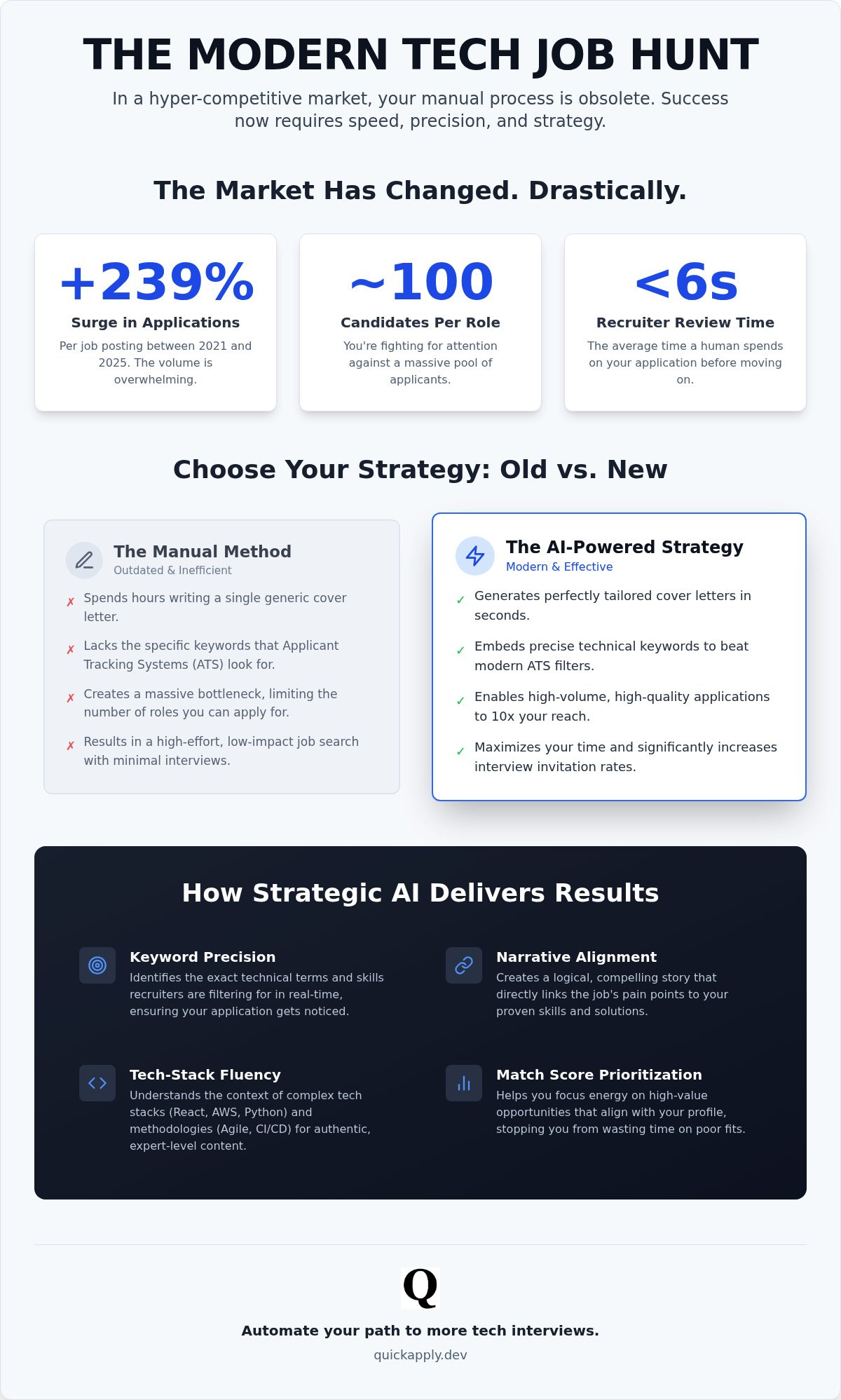
Applications per job posting surged by 239 percent between 2021 and 2025. With nearly 100 candidates fighting for every single open seat, your manual writing process is officially obsolete. You're likely exhausted from spending hours highlighting niche tech stacks only to be met with silence from recruiters. It's a systemic problem; the application volume is simply too high for traditional methods to succeed. You need to leverage AI to tailor your cover letter to the job description, with systems that prioritize speed and precision over poetic prose.
You deserve a strategy that works as hard as your code. This guide shows you how to leverage high-speed AI to generate tech-focused cover letters that beat the ATS and land more interviews. You don't have to sound like a generic bot to move fast. Learn to maintain a high-impact professional voice while optimizing your application pipeline in seconds. We're diving into the exact strategies to align your skills with 2026 hiring requirements and increase your invitation rates through smarter automation. Stop writing and start optimizing your path to a better offer.
Key Takeaways
- Shift from manual drafting to strategic optimization to survive a hyper-competitive tech market defined by high-volume application surges.
- Use high-speed automation to tailor cover letter to job description ai systems, ensuring your niche tech stack is instantly recognized by modern ATS.
- Leverage Match Score technology to prioritize high-value opportunities and stop wasting energy on roles that don't align with your professional profile.
- Master a data-driven workflow that generates professional, tech-literate narratives in seconds without the generic tone of standard AI prompts.
- Transition from a manual job search to a streamlined operation using integrated tools like application trackers to manage your high-volume interview pipeline.
The 2026 Job Market: Why Manual Cover Letters are Obsolete
The 2026 job market doesn't care about your drafting speed. It cares about output. Applications per job posting have increased by 239 percent since 2021, which means your competition is applying to dozens of roles while you're still tweaking a single paragraph. If you want to stay relevant, you must tailor cover letter to job description ai protocols that prioritize high-volume accuracy. Manual writing isn't a sign of effort anymore; it's a sign of inefficiency that creates a massive bottleneck in your career growth.
Using Applicant Tracking Systems (ATS) is how modern firms filter the noise. These systems don't look for passion in a generic sense. They look for specific data points and linguistic alignment between your experience and the job's technical requirements. To survive this filter, you must tailor cover letter to job description ai models to ensure your profile matches the algorithm's expectations. Advanced NLP models have moved past the robotic stigma of the early 2020s. They now produce professional, high-impact narratives that reflect your specific expertise in seconds.
The Volume Challenge in Tech Recruiting
Recruiter screening times have reached an all-time low. In 2026, a human might glance at your application for less than six seconds before moving on. Sticking to a manual process puts you at a severe competitive disadvantage. While you spend an hour on one letter, savvy candidates use automation to apply to 10x more roles daily. You need quality at scale. AI tools allow you to hit that volume without sacrificing the technical nuance required for high-level software engineering roles.
Why Your Current Process is Failing the ATS
Standard templates are a death sentence for your application. They lack the keyword density and structural alignment that 2026 systems demand. To get noticed, your narrative must flow directly from the job description's requirements to your proven results. You need to move beyond the one-size-fits-all document toward hyper-specific targeting that speaks the language of the hiring manager.
- Keyword Precision: AI identifies the exact technical terms recruiters are filtering for in real-time.
- Narrative Alignment: Strategic tailoring creates a logical link between the job's pain points and your solutions.
- Efficiency: Rapid generation ensures you're the first to apply to new listings, giving you an immediate edge.
Stop wasting time on a failing manual process. The transition from a slow-burn strategy to an automated pipeline is the only way to secure a competitive role in today's tech landscape. Success in 2026 requires you to work at the speed of the market, not the speed of your keyboard.
Inside the Engine: How Modern AI Generators Parse Tech Roles
An AI cover letter generator isn't a magic trick. It's a precise mapping engine that aligns your professional history with specific employer demands. Unlike basic chatbots, these platforms analyze the architecture of a job description to identify core requirements. This process involves more than just keyword matching; it requires a deep understanding of recruitment automation and how modern systems rank candidates based on technical relevancy. To effectively tailor cover letter to job description ai systems, the software must parse complex tech stacks and translate your past wins into the specific language of the hiring team.
Dedicated career platforms offer a massive advantage over standard GPT prompts. Generic prompts often produce fluff-filled paragraphs that fail to mention specific dev methodologies. A specialized engine recognizes the difference between a "Frontend Engineer" and a "React Developer" by looking at the underlying requirements. It understands the context of Agile environments, CI/CD pipelines, and microservices architecture. This level of granularity ensures your application doesn't just look human; it looks like a subject matter expert wrote it.
Mapping Experience to Tech Stacks
Modern algorithms identify core technologies like React, AWS, or Python instantly. They don't just list these skills; they weave them into a narrative that highlights your proficiency. If a job calls for "cloud migration," the AI scans your resume for related experiences and quantifies the results. It translates vague project descriptions into recruiter-friendly metrics. For example, "managed servers" becomes "reduced latency by 15% using AWS Lambda." This technical accuracy is vital for maintaining credibility with senior engineers who review your file. You can see this logic in action when you optimize your profile for high-volume roles.
The Role of Natural Language Processing (NLP)
Natural Language Processing (NLP) allows the engine to mimic a confident, results-driven voice. It strips away the typical corporate jargon that clogs traditional letters. The focus remains on impact and efficiency. By utilizing declarative statements, the AI mirrors the direct communication style valued in software development. It eliminates grammatical errors and awkward phrasing that often trigger manual rejection. You get a polished, authoritative document that sounds like you at your most professional.
To tailor cover letter to job description ai workflows effectively, you need a system that understands the nuances of the tech industry. It's about more than just filling a template. It's about systemic automation that bridges the gap between your talent and the specific technical needs of a modern enterprise. This ensures your narrative remains cohesive while hitting every necessary technical beat required for a 2026 interview invitation.
Generic AI vs. Strategic Tailoring: The Match Score Advantage
Relying on a generic ChatGPT prompt is a losing strategy in the 2026 job market. While basic AI can string sentences together, it lacks the technical literacy required to impress a senior engineering manager. Generic bots often produce "hallucinated" fluff or corporate jargon that sounds like a template. To truly compete, you must tailor cover letter to job description ai protocols that prioritize data over creative writing. Strategic tailoring isn't about making a letter sound pretty. It's about ensuring your specific tech stack matches the job's architectural needs with mathematical precision.
Modern career automation platforms move beyond simple text generation. They analyze the underlying requirements of a role to determine if you're actually a fit. This data-driven approach replaces the "spray and pray" method with a calculated application strategy. Instead of guessing which skills to highlight, you receive a clear roadmap based on the job's unique requirements. This ensures your narrative remains focused on high-impact results rather than vague promises.
Why Match Scores Matter
The Match Score is your most valuable asset in a high-volume search. It provides a quantitative analysis of your fit for a role before you hit submit. By focusing your energy on high-probability opportunities, you maximize your interview ROI. This technology identifies the exact strengths you should emphasize in your narrative. If the score is low, you don't waste time. If it's high, the system automatically highlights the specific project outcomes that align with the company's current challenges.
The Efficiency Gap
Manual writing is a massive bottleneck in your career progression. A well-researched, hand-written letter takes approximately 45 minutes to produce. A specialized AI engine completes the same task in 30 seconds. This isn't just about saving time; it's about increasing your total search volume. When you tailor cover letter to job description ai systems, you gain the ability to apply to dozens of roles daily without sacrificing quality. You can also tailor resume to job description ai standards to ensure your entire application package is synchronized and optimized for the ATS.
- Data-Driven Narratives: Replace creative writing with evidence-based impact statements.
- Infinite Scalability: Generate unique versions for every role in your pipeline instantly.
- Technical Accuracy: Ensure your tech stack is described in a way that resonates with hiring teams.
The difference between a generic bot and a strategic engine is the difference between a rejection and an interview invitation. Stop using tools designed for general conversation and start using a system built for professional optimization. Your career deserves a high-tech solution that understands the nuances of the modern tech landscape.
How to Use an AI Cover Letter Generator Without Sounding Robotic
Modern hiring managers spot generic ChatGPT outputs instantly. These drafts are often wordy, vague, and filled with "hallucinated" enthusiasm. To tailor cover letter to job description ai systems effectively, you must prioritize high-fidelity input over manual drafting. Start by uploading a clean, tech-focused base resume. This provides the engine with the raw data required to build a factual narrative. Next, paste the job description exactly as it appears. Don't waste time cleaning the text; let the algorithm extract the requirements for you. This ensures the output is grounded in your actual experience rather than AI-generated fluff.
Use a platform designed for engineering culture. Standard tools don't understand the nuance between a sprint and a marathon. Once the draft is ready, review it for project "flavor." Ensure your unique technical achievements, like a high-traffic repo or a complex cloud migration, are front and center. Finally, export the document and move it into an automated dashboard. This keeps your high-volume pipeline organized and ready for follow-ups without the manual overhead. Efficiency is the only metric that matters in a 2026 job search.
Fine-Tuning the Brand Voice
Senior developers value clarity. They don't want to read complex clauses or passive voice. Opt for punchy, direct sentences that respect the reader's time. Use imperative verbs like "Engineered," "Optimized," or "Architected" to signal technical ownership. Ditch the "I am writing to express interest" cliché. It's dead weight. Lead with value instead. Tell the team exactly how your skills will solve their current technical debt or scaling issues from day one. This directness mirrors the speed of the technology you use.
Adding the Human Tech Layer
Authenticity comes from technical specificity. Mentioning a specific open-source contribution or a tricky bug you squashed adds immediate credibility. Balance your hard skills with soft skills framed within a technical context, such as mentoring junior devs or leading Agile rituals. Ensure your narrative remains consistent with good resume examples for a unified professional brand. This coherence separates savvy candidates from bot-reliant amateurs. Generate your tailored cover letter now to secure your next interview invitation with a professional, tech-literate voice.
QuickApply: Automating Your Path to More Tech Interviews
QuickApply isn't just another basic text generator. It's a comprehensive automation engine built for the high-pressure tech market of 2026. While basic tools leave you managing a messy spreadsheet, our suite provides the infrastructure to tailor cover letter to job description ai outputs that actually convert. We've moved beyond simple drafting into full-cycle career optimization. You get a centralized command center designed to handle the high volume of applications required to land top-tier roles today. This is about systemic precision, ensuring every document you submit is perfectly aligned with employer expectations.
Managing the chaos of a modern job search requires more than just good writing. Our integrated Application Tracker and dashboard centralize your entire pipeline. You can see exactly which versions of your resume and cover letter were sent to which firms. No more searching through sent folders or missing follow-up windows. By automating the repetitive elements of the search, you can focus your energy on interview preparation and technical assessments. We close the gap between your talent and the opportunities you deserve through AI-driven accuracy and high-speed execution.
Total Career Management
Success doesn't stop at the application. Our platform supports your entire professional journey from the first click to the final offer. Tech professionals choose our ai cover letter generator because it's part of a larger ecosystem. Once you secure an interview, you can transition into our interview practice and salary negotiation modules. We even offer a promotion roadmap to help you plan your next move after you're hired. This centralized approach ensures your career growth is consistent, documented, and data-driven.
Efficiency as a Competitive Advantage
Efficiency is your most powerful weapon in a crowded market. QuickApply users apply to more roles in significantly less time than candidates using manual methods. This speed doesn't come at the cost of quality. Because you can tailor cover letter to job description ai standards instantly, your application volume increases while your narrative remains sharp. This removes the psychological friction and burnout associated with repetitive manual tasks. You stay productive without the active effort usually required for a high-volume search.
The 2026 market belongs to those who embrace strategic automation. You've already seen how manual processes create bottlenecks in your growth. It's time to switch to a system that moves as fast as you do. Start optimizing with QuickApply and dominate your job search with a tech-literate ally that understands the value of your time.
Dominating the 2026 Tech Market
The tech landscape has shifted toward high-volume automation. Manual drafting is no longer a viable career strategy; it's a bottleneck that stops you from reaching your full potential. You've learned how to tailor cover letter to job description ai systems to ensure your niche tech stack is instantly recognized by modern ATS filters. By moving beyond generic prompts and utilizing strategic Match Score technology, you can prioritize high-probability opportunities and stop wasting energy on dead-end applications. Efficiency is your most powerful competitive advantage.
Success in this market requires a tool built for the speed of modern hiring. QuickApply is used by tech professionals at top firms to scale their search with unlimited resume and cover letter tailoring. Our Match Score technology is specifically calibrated for the 2026 job market to ensure your profile always hits the mark. It's time to stop fighting the system and start leveraging it to your advantage. Automate Your Job Search with QuickApply and secure the interviews you deserve. Your next high-impact role is just a few optimized clicks away.
Frequently Asked Questions
Do recruiters reject cover letters written by AI?
Recruiters reject low-effort content, not the technology behind it. If you use a professional tool to tailor cover letter to job description ai standards, the results are data-driven and technically accurate. Modern hiring managers value clarity and technical alignment over generic prose. They only reject letters that sound like robotic templates or contain factual hallucinations. High-fidelity automation ensures your narrative matches the role's requirements while maintaining a professional engineering tone.
How does an AI cover letter generator help with ATS?
AI generators bridge the gap between job descriptions and your professional history. They identify core keywords like specific tech stacks or Agile methodologies that Applicant Tracking Systems prioritize. By aligning your narrative with these data points, you increase your visibility in the recruiter's dashboard. This isn't about gaming the system; it's about translating your real-world wins into the specific language the algorithm is programmed to recognize and rank.
Can I use an AI generator for senior software engineering roles?
Senior roles require a focus on architectural impact and leadership results. Dedicated AI tools excel at mapping complex project outcomes to senior-level requirements. They can highlight your experience with microservices or cloud migrations in a way that resonates with hiring directors. Instead of writing a generic letter, the AI focuses on high-impact results and technical ownership. This ensures your leadership profile stands out in a crowded 2026 applicant pool.
Is a cover letter still necessary in 2026?
Cover letters remain a critical component for standing out among hundreds of applicants. While the resume provides the facts, the cover letter provides the technical narrative. It's your chance to explain how your specific expertise solves the company's current challenges. In a market where applications per job have increased by 239 percent since 2021, a tailored narrative provides the extra layer of proof that a standard resume often lacks.
What is the best way to prompt an AI for a cover letter?
The most effective method is to use a dedicated platform rather than a general chatbot. You should provide a clean, tech-focused base resume and the raw job description. A specialized tool will tailor cover letter to job description ai protocols automatically without requiring complex manual prompts. This ensures the output is technically accurate and follows the specific linguistic patterns expected in the software development and engineering sectors.
How much does an AI cover letter generator cost?
Pricing for these tools varies based on the level of automation and features provided. Some platforms offer limited free tiers or pay-as-you-go credits, while professional suites typically use recurring subscription models. QuickApply provides unlimited generations and tracking tools through monthly or annual SaaS subscriptions. This model is designed for active job seekers who need to maintain a high-volume application strategy without worrying about individual document costs.
Does QuickApply track my job applications automatically?
Yes, QuickApply includes an automated Application Tracker as part of its core service. This tool centralizes your entire job search, allowing you to monitor every submission from a single dashboard. It eliminates the need for manual spreadsheets and ensures you never lose track of which version of your resume was sent to a specific company. Managing your pipeline with an integrated tracker is essential for maintaining momentum and high-volume success.
Can I generate multiple versions for different companies?
You can generate unlimited versions of your documents for different companies. High-volume application strategies require unique tailoring for every single role to be effective. Our platform allows you to produce dozens of specific iterations in seconds. This scalability ensures that every application you submit is hyper-targeted to the specific job description. It gives you a massive competitive advantage over candidates who rely on outdated, one-size-fits-all documents.


