

Your 2024 career strategy is officially deprecated. In the AI-augmented landscape of 2026, the distance between a Junior developer and a Staff Engineer isn't measured in years of manual labor, but in how effectively you execute a modern software engineer career path roadmap. You've likely felt the suffocating weight of information overload as Python 3.14.5 and Kubernetes 1.36.1 redefine the baseline every few months. It's frustrating to see AI automate entry-level tasks while you struggle to break through the mid-level plateau.
You deserve a clear path to the $496,000 total compensation typically reserved for Staff-level experts. This guide is your execution framework for the modern era. It replaces generic advice with a structured 5-stage plan to optimize your trajectory. We'll show you how to leverage AI for rapid career growth, provide frameworks for immediate salary bumps, and outline the exact milestones needed to dominate the 2026 market. It's time to stop reacting to the industry and start engineering your own ascent.
Key Takeaways
- Shift your focus from manual "vibe coding" to robust system architecture by mastering AI-native workflows and agent-led execution.
- Follow a structured software engineer career path roadmap to navigate the rapid transition from junior execution to staff-level technical strategy.
- Identify the specific cloud-native patterns and trade-offs required to command top-tier compensation in the 2026 specialized market.
- Optimize your professional presence with automated resume tailoring and application tracking to bypass advanced ATS filters.
- Implement a data-driven promotion roadmap to secure consistent salary bumps and clear career milestones without the manual grind.
The 2026 Software Engineering Landscape: Defining the Modern Roadmap
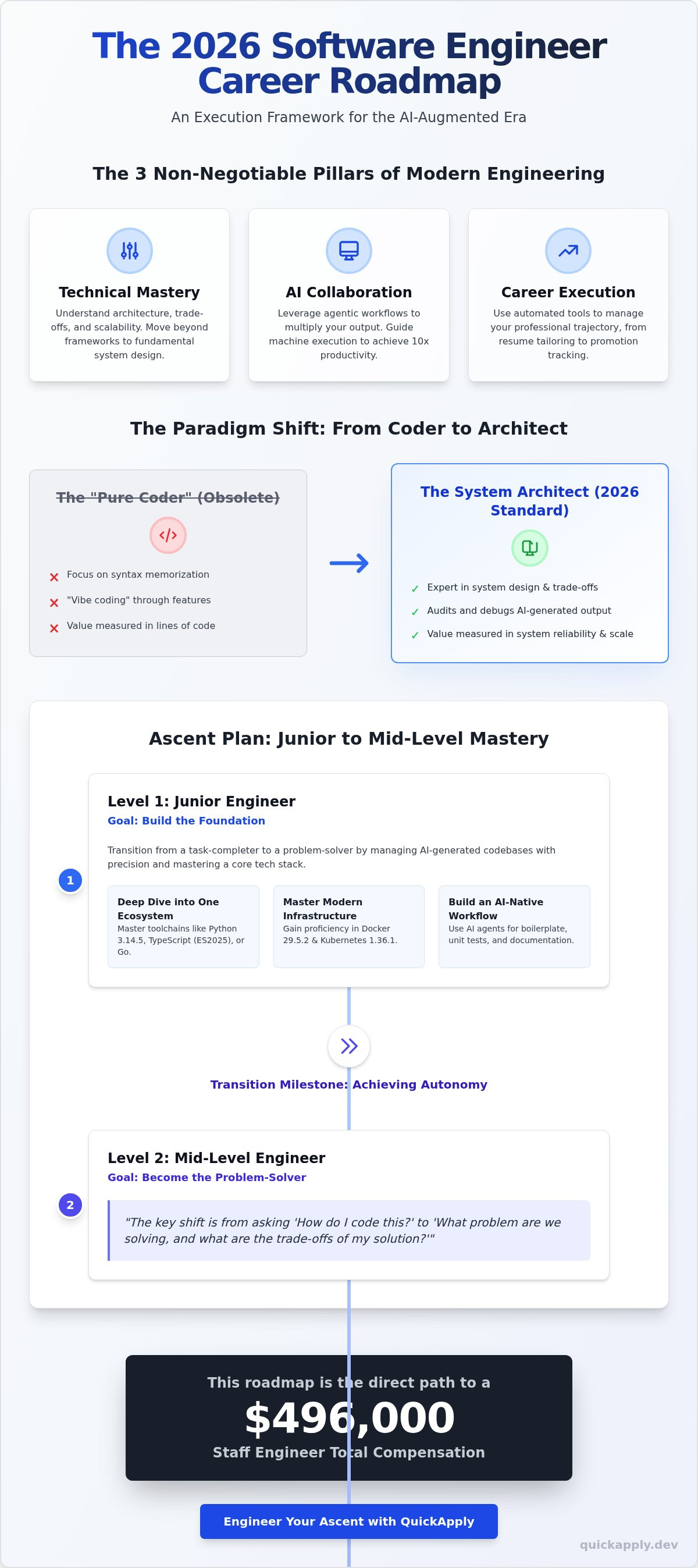
The 2026 software engineer is no longer a code monkey. They're a system architect who orchestrates AI agents to handle the heavy lifting of execution. In this environment, a traditional software engineer career path roadmap that focuses solely on syntax is obsolete. Syntax is now a solved problem. LLMs generate boilerplate in seconds. Success now requires a shift from "vibe coding," where you guess your way through features, to robust system design and high-level scalability.
Traditional roadmaps fail because they treat software engineering as a list of frameworks to memorize. In a high-volume application market, being "good at React" isn't enough. You need to prove you can manage complex systems at scale. The 2026 roadmap stands on three non-negotiable pillars:
- Technical Mastery: Understanding architecture, trade-offs, and scalability.
- AI Collaboration: Leveraging agentic workflows to multiply your output.
- Career Execution: Using automated tools to manage your professional trajectory.
If you miss one, your growth will stagnate. You'll find yourself stuck in the mid-level tier while peers who optimize their workflow bypass you for senior roles.
The Death of the "Pure Coder"
Syntax knowledge is a commodity. When AI can write a perfect Python 3.14.5 script in milliseconds, knowing the library is just the baseline. The real value has shifted to higher-order tasks. You must become an expert in code review, security auditing, and debugging AI-generated output. System thinking is your primary differentiator. You aren't paid to type; you're paid to ensure that individual components interact without breaking the entire stack. This high-level perspective is what separates a Junior from a Staff Engineer in the current job market.
AI-Augmented Development as a Core Skill
Prompt engineering and AI toolchains aren't optional extras. They are mandatory for every level. Juniors who refuse to use AI agents for testing and boilerplate will be replaced by those who can do ten times the work in half the time. AI accelerates the learning curve for complex architectures like Kubernetes 1.36.1, allowing you to master cloud-native patterns faster than ever before. AI-augmented engineering is the standard for 2026, where human intuition guides machine execution to achieve unprecedented output. This mastery is the engine of your software engineer career path roadmap. It allows you to focus on logic and architecture while the machine handles the syntax.
Level 1-2: From Junior to Mid-Level Mastery
The entry-level grind has changed. In 2026, a Junior Engineer isn't just someone who writes code; they're someone who can manage AI-generated codebases with precision. Stalling at this stage is a common failure point that leads to career stagnation. You must transition from a task-completer to a problem-solver to survive. This phase of your software engineer career path roadmap focuses on foundational technical mastery and the rapid adoption of AI-native workflows.
Mastering the 2026 baseline requires more than just knowing a language. You need to understand how your code interacts with modern infrastructure. This means proficiency in Docker 29.5.2 for containerization and Kubernetes 1.36.1 for local development environments. Your goal is to move beyond "Vibe Coding" and start building for scalability from day one. You're building a portfolio that proves you can debug, audit, and secure code that an AI agent might have drafted.
The Junior Phase: Building the Foundation
Start by going deep into one core ecosystem. Whether it's Python 3.14.5 for AI/ML, TypeScript (ES2025) for full-stack, or Go for high-performance systems, you need more than surface-level knowledge. You must master the toolchain. This includes Git workflows and CI/CD pipelines as non-negotiable skills. If you can't manage a deployment pipeline, you aren't an engineer yet.
- Deep Dive: Pick a language and own it. Understand its memory management and concurrency models.
- Contribute to Open Source: This is the ultimate proof of collaborative skill. It shows you can work within a software engineering career path that involves complex, multi-contributor systems.
- Build an AI-Native Workflow: Use agents for boilerplate and unit tests. Your value lies in the logic and architecture, not the typing speed.
Transitioning to Mid-Level: The Autonomy Milestone
Mid-level engineers are defined by autonomy. You stop asking "How do I code this?" and start asking "Why are we building this?". This shift requires taking full ownership of features from the design doc to production. You're no longer just finishing tickets. You're solving business problems. You should be able to drive a feature through its entire lifecycle without constant hand-holding from senior staff.
To jump levels quickly, you need to prove your impact to recruiters and managers. If you're ready for that salary bump, use AI resume tailoring to highlight your ownership of high-impact features. This ensures your profile actually passes the 2026 ATS filters that gatekeep Mid-level roles. Mastering this transition means you've moved from writing scripts to architecting solutions. If you want to track your progress effectively, check out our application tracker to see how the market responds to your new skill set.
Level 3-4: Seniority and Specialized Career Tracks
Seniority in 2026 is no longer a reward for tenure. It is a measurement of your ability to manage complexity and reduce ambiguity. Once you have navigated the mid-level plateau, your software engineer career path roadmap bifurcates. You must decide between deep technical mastery as an Individual Contributor (IC) or organizational leadership in Engineering Management. Both tracks require a radical shift in focus. You are now responsible for the architectural integrity of distributed systems and the long-term scalability of high-availability platforms.
Staff and Principal roles demand more than just coding. You are now an influencer of organization-wide technical strategy. While a Senior Engineer might own a specific service, a Staff Engineer owns the standards that govern all services. This requires a mastery of trade-offs. You must balance immediate delivery against the accumulation of technical debt, ensuring that the system remains maintainable as it scales. In the 2026 market, where AI-generated code can inflate codebases rapidly, your ability to enforce architectural discipline is your highest-value asset.
Mastering Technical Leadership
Technical leadership is about reducing friction for the entire team. You scale your impact by mentoring Juniors and Mid-level engineers, turning your expertise into a force multiplier. This isn't just about soft skills; it's about translating technical constraints into business outcomes for non-technical stakeholders—a core competency for experts at global consultancies like Kagool. You must explain why a migration to the latest Kubernetes 1.36.1 release is a strategic necessity rather than a developer's whim. Seniority means you own the "why" just as much as the "how."
Specialization: AI Engineering vs. Infrastructure
The 2026 landscape has created two primary power lanes for specialization. The AI Engineer has emerged as a critical role, focusing on integrating complex models and frameworks like LangChain into production-ready SaaS products. This isn't just data science; it's robust software engineering applied to non-deterministic systems. Conversely, the value of Infrastructure and Platform Engineering has skyrocketed. As AI automates the "what," the "where" and "how" of deployment become the ultimate bottlenecks. You can pivot between these specialties without losing seniority if you focus on the underlying system design principles. Whether you are optimizing a vector database or hardening a CI/CD pipeline, the core requirement remains the same: high-output execution with low-effort maintenance. If you are ready to target these high-impact roles, you can use a salary negotiation guide to ensure your compensation reflects your specialized expertise.
The Invisible Roadmap: Career Management and AI Leverage
Technical mastery is only half the battle. You can be an expert in distributed systems, but if you can't navigate the hiring algorithms of 2026, you'll remain underpaid and under-leveled. Your software engineer career path roadmap must include a layer of career management that is just as automated as your CI/CD pipeline. Manual job searching is a legacy strategy. It is slow, inefficient, and statistically likely to fail in a market saturated by AI-generated applications. You need to treat your career as a system that requires constant optimization.
Managing your trajectory requires high-speed execution. You must automate the tedious aspects of the search so you can focus on high-impact interviews. This involves using intelligent systems to track your applications and tailor your narrative to specific company needs. If you aren't using technology to bridge the gap between your talent and the market's opportunities, you're leaving your growth to chance.
Beating the 2026 ATS and Market Saturation
Your "perfect" static resume is likely failing ATS checks. Modern talent systems don't just look for keywords; they analyze context and project impact. To compete, you must use AI resume builders to match job descriptions instantly. This isn't about fabrication. It's about translating your experience into the specific technical dialect the recruiter's system understands. If the role demands experience with Kubernetes 1.36.1, your resume needs to reflect that specific versioning and the scale of the clusters you managed.
Adopt a "Match Score" strategy. Don't waste time on roles where your skills align less than 85%. In 2026, high-volume automation means recruiters only see the top percentile of applicants. Focus your energy where you have a competitive advantage. Once you find a match, use an application tracker to manage your pipeline without losing momentum. This allows you to scale your job search while maintaining the precision of a targeted application.
Promotion and Negotiation Mechanics
Growth doesn't happen by accident. You need a structured promotion roadmap to ensure you aren't stagnating at the Mid-level tier. Start by building a "Brag Document." Track every architectural decision, every mentor session, and every production incident you resolved. This data is your primary leverage during performance reviews. It turns vague claims of "hard work" into undeniable proof of business value.
When the offer or review arrives, don't leave money on the table. Use a data-driven Salary Negotiation Guide to benchmark your worth against current market data. Whether you are aiming for the $155,000 Junior ceiling or the $480,000 Staff base salary, data is your only weapon. Career growth requires as much optimization as a production database.
Executing Your Roadmap with QuickApply
A software engineer career path roadmap is just documentation until you deploy it. You've identified the technical pillars and architectural milestones needed for the 2026 market. Now you need to automate the execution. QuickApply turns your career strategy into a high-speed pipeline, removing the manual friction that stalls most engineering transitions. Whether you are scaling from Junior to Mid-level or targeting a $496,000 Staff Engineer role, you can't afford to waste time on low-value tasks.
Tailoring your narrative for Senior and Staff roles requires precision. You must highlight your mastery of trade-offs and system design, not just your ability to write syntax. QuickApply tailors your resume in seconds, ensuring your experience with Kubernetes 1.36.1 and distributed systems is front and center. It aligns your profile with the specific technical dialect of top-tier firms, bypassing legacy filters and getting your expertise in front of decision-makers immediately.
Automated Application Tracking
Stop managing your career in a spreadsheet. It's a legacy approach that doesn't scale. Use a dedicated application tracker to monitor your progress from initial ping to final offer. This system allows you to analyze match scores for every role, identifying the high-probability opportunities where your skills align 85% or better. By automating the tracking process, you reduce application fatigue. This saves your mental energy for what actually matters: technical interview prep and architectural deep dives.
Interview Mastery and Final Steps
Closing the gap between a skill set and a job offer happens in the interview room. You need to perform under pressure, translating complex technical decisions into clear business value. Use Final Round AI as a real-time interview copilot to sharpen your delivery. This tool provides AI-driven insights for both behavioral and technical rounds, ensuring you communicate your seniority effectively. Don't leave your performance to chance when you can use a copilot to maintain your competitive edge. Start your 2026 career roadmap with QuickApply today.
Deploy Your Career Strategy for 2026
The software engineer career path roadmap for 2026 is no longer a suggestion. It's an execution framework for those who refuse to be left behind. You've seen how the landscape has shifted from manual coding to system orchestration. Stagnation is the result of legacy thinking and manual effort. Reaching the $496,000 Staff Engineer tier requires a radical shift in how you manage your professional trajectory. You must master AI-native workflows and architectural trade-offs while automating the tedious aspects of career management.
You need tools that move as fast as the market. QuickApply automates the friction points of your journey. From AI-powered resume tailoring that beats modern ATS filters to real-time interview practice, every feature is built for optimization. Don't leave your growth to chance. Secure your worth with our promotion and salary negotiation resources today. Optimize your career roadmap with QuickApply AI tools. Your next level is already within reach. Build it now.
Frequently Asked Questions
What is the most important skill for a software engineer in 2026?
System architecture and AI orchestration are the most critical skills for engineers today. Syntax has become a commodity, so your value lies in managing complex trade-offs and ensuring system scalability. You must move beyond writing scripts to designing robust environments that leverage AI agents for execution. This high-level perspective is the primary differentiator for those following a software engineer career path roadmap in a crowded market.
Is a computer science degree still necessary for the 2026 career roadmap?
A computer science degree is no longer a strict requirement if you can prove technical mastery through impact. Employers prioritize your ability to work with modern standards like Docker 29.5.2 and Kubernetes 1.36.1 over legacy credentials. Your portfolio must demonstrate your ability to solve real-world business problems using an AI-augmented workflow. Focus on specialized certifications and high-impact projects to prove your worth to recruiters.
How long does it take to move from Junior to Senior Engineer?
Moving from Junior to Senior Engineer typically takes 5 to 10 years of professional experience. However, engineers who adopt AI-native development workflows are reaching these milestones faster by increasing their architectural output. Reaching the Senior tier requires a shift from completing tickets to owning the entire feature lifecycle. You must prove you can manage ambiguity and mentor others to scale your impact across the organization.
Which programming language should I learn first in 2026?
Python 3.14.5 is the best language to learn first due to its dominance in AI, machine learning, and data engineering. If you prefer full-stack development, TypeScript remains the standard following the ECMAScript 2025 updates. Your choice should align with the specific specialization you've targeted in your software engineer career path roadmap. Both languages offer the highest volume of openings in the current 2026 job market.
How can I use AI to speed up my software engineering career path?
Use AI to automate low-value tasks like boilerplate generation, unit testing, and documentation. This efficiency allows you to focus on high-level system design and architectural strategy earlier in your career. Beyond the IDE, you should use AI-driven tools for resume tailoring and application tracking to bypass the manual grind of the job search. Speed of execution in both coding and career management is the fastest way to jump levels.
What is a Staff Engineer vs. a Senior Engineer?
A Staff Engineer focuses on organization-wide technical strategy, whereas a Senior Engineer typically owns specific services or features. Staff roles are part of the individual contributor track but involve cross-team influence and the definition of architectural standards. With total compensation reaching an estimated $496,000, Staff Engineers are technical leaders who ensure long-term scalability. They move beyond feature implementation to define the technical direction for the entire company.
How do I handle the ATS when applying for high-competition tech roles?
Beat the ATS by using AI resume tailoring to match job descriptions with at least 85% accuracy. Static resumes are obsolete because they fail to highlight the specific versioning and architectural impact recruiters demand. You need to include concrete data points and specific technologies like Kubernetes 1.36.1 to pass modern filters. High-competition roles require a dynamic profile that translates your experience into the recruiter's specific technical dialect instantly.
Can I transition into software engineering from a different industry in 2026?
Transitioning from another industry is entirely possible if you master the AI-augmented stack immediately. Focus on building a portfolio that proves you can manage AI-generated codebases and architect scalable solutions from day one. Use automated career tools to bridge the gap between your previous industry expertise and modern technical requirements. The market's 15% projected growth ensures there is significant room for talent who can execute at a high level.


