
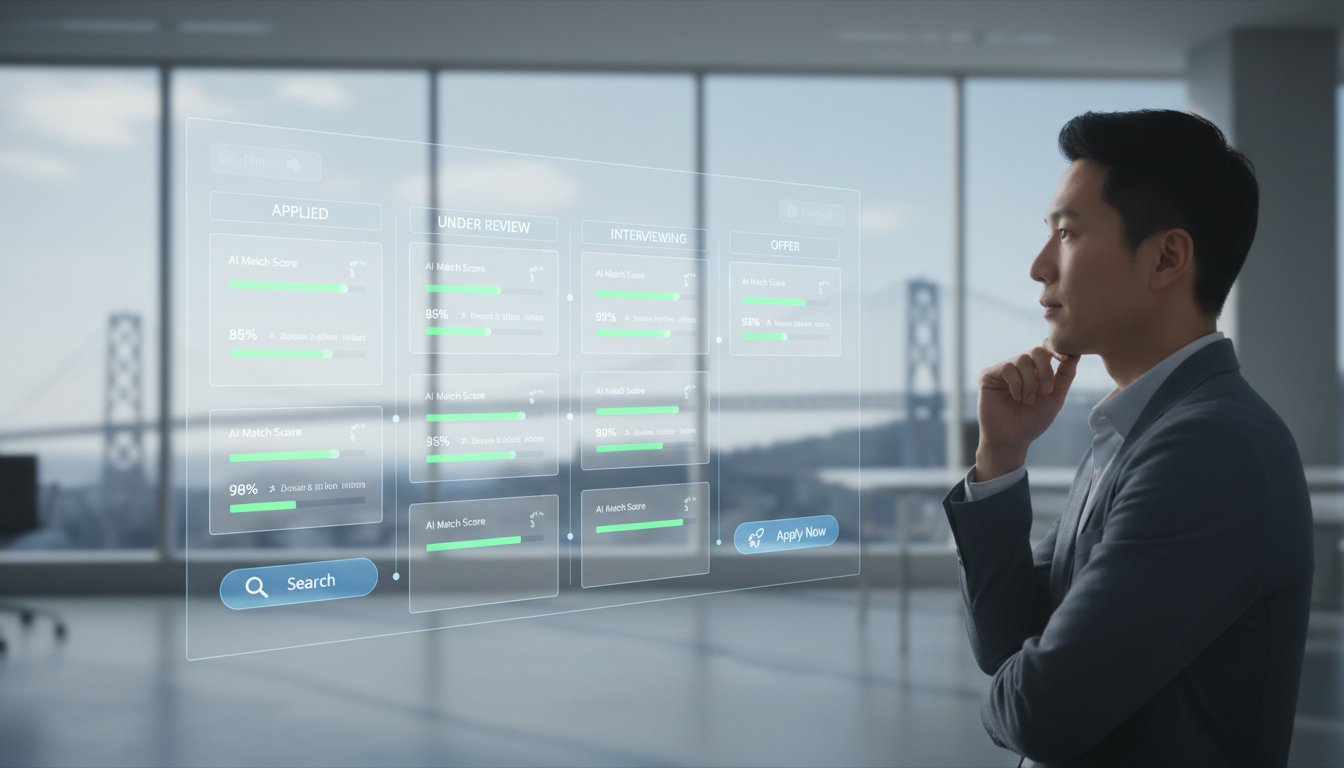
Stop treating your career like a data entry internship. If your current job application tracker is just a glorified spreadsheet, you're falling behind and wasting at least 5 hours every week on manual data entry. You know the fatigue of losing track of a follow-up date or applying for a role that was a 15% technical match at best. It's frustrating to watch your dream roles slip through the cracks because your organization system belongs in 2015. You've likely felt the sting of missing a recruiter's email because it was buried under a mountain of manual notes.
The good news is that 2026 is the year of the automated pipeline. You deserve a sophisticated system that acts as an AI-powered command center. We'll show you how to transform your search into a high-velocity engine that handles the heavy lifting for you. This article breaks down how to deploy a system that automates status updates and boosts your interview conversion rates by 42% through better technical matching. We're analyzing the exact tools you need to outpace the competition and finally stop the spreadsheet madness.
Key Takeaways
- Stop wasting hours on manual data entry and learn why your current spreadsheet is a bottleneck in the 2026 market.
- Capture job listings instantly with one-click scraping and identify high-probability wins using integrated match scoring.
- Upgrade to a high-velocity job application tracker that replaces legacy templates with a developer-centric UI built for speed.
- Build your 2026 command center by centralizing your master profiles and using the QuickApply extension for seamless job capturing.
- Master the entire pipeline by leveraging real-time AI interview copilots and integrated salary negotiation guides to close the deal.
Why Your Spreadsheet is a Bottleneck in the 2026 Job Market
Static spreadsheets are career killers. In the 2026 job market, speed is the only currency that matters. If you're still copy-pasting job titles into a cell, you've already lost the race. A modern job application tracker is no longer just a list. It's a high-velocity workflow engine designed to outpace the competition. It transforms your search from a manual chore into a streamlined, automated operation.
Manual data entry carries a massive hidden tax. Active job seekers spend roughly 30% of their search time on administrative overhead. This includes tracking application dates, manual status updates, and setting follow-up reminders. It's a waste of talent. You need to focus on the interview, not the data entry. Every minute spent formatting a cell is a minute lost to a competitor who's already submitted their resume.
The current environment is hostile. High-volume filters and ghost jobs dominate the boards. Recent industry data shows that nearly 40% of listings stay open for months without active hiring intentions. You must filter these out instantly to protect your time. Most corporations use an Applicant Tracking System (ATS) to rank candidates before a human even sees a name. These systems scan your profile in less than 7 seconds. If your job application tracker isn't syncing with these modern realities, you're working with stale, useless information.
Cluttered lists also create a heavy psychological burden. A massive, unmanaged list of pending applications leads to rapid burnout. It feels like a mountain you can't climb. When your organization is visual and automated, that burden disappears. You gain clarity and a sense of momentum that drives you toward the next offer.
The Failure of Manual Tracking
Excel and Notion are great for budgets, but they fail as career tools after your 20th submission. They can't track real-time changes in the fast-moving tech market. You lose the Match Score link. Without it, you can't see why a specific role is a 95% fit while another is a 40% waste of time. Stale data leads to missed opportunities and dead-end follow-ups that go nowhere.
The Shift to Career Automation
Automation is the new standard. Move from passive logging to active pipeline management. AI-powered tools provide insights that human organization cannot reach. They analyze recruiter behavior and market trends in real-time. This is the apply while you sleep mindset. It's about high-volume output with low-effort input. You optimize your path and let the software handle the grind. Efficiency isn't just a goal; it's your competitive advantage.
Core Features of a High-Velocity Job Application Tracker
Manual data entry is the silent killer of career momentum. If you're still spending 10 minutes per application copying job titles into a spreadsheet, you've already lost the numbers game. A high-velocity job application tracker operates as a command center, not a digital notebook. It transforms a chaotic search into a streamlined pipeline by automating the grunt work that slows most candidates down. You need a system that captures data in 1.5 seconds, allowing you to focus on high-leverage activities like interviewing and negotiating.
One-Click Job Saving
Stop toggling between tabs. Modern trackers use browser extensions to scrape data directly from LinkedIn, Indeed, and Greenhouse with a single click. This isn't just about speed; it's about data integrity. Research shows that 30% of job postings are removed from public boards within 72 hours of going live. By capturing the full job description instantly, you ensure you have the original requirements for interview prep, even after the listing vanishes. This creates a single source of truth that eliminates the "where did I see that?" frustration that plagues manual searches.
Match Scoring and Analytics
Success in 2026 requires more than just volume. You need to identify high-probability wins before you even hit submit. Integrated match scoring uses AI to analyze your resume against live job descriptions in real time. This allows you to prioritize your energy on roles where you have a 90% or higher technical fit. To maximize these scores, you must tailor resume to job description details using the logic built directly into your tracker. Candidates who use data-driven matching see a 4x increase in interview requests compared to those using a generic "spray and pray" approach.
Beyond simple organization, a professional-grade job application tracker manages the entire lifecycle of your search:
- Dynamic Status Pipelines: Move opportunities from "Applied" to "Technical Screen" to "Negotiating" with drag-and-drop ease.
- Automated Follow-up Reminders: AI triggers alerts if a recruiter hasn't responded within 72 hours, preventing lead leakage.
- Centralized Communication: Keep every email, contact name, and interview note attached to the specific job record.
- Conversion Analytics: Track which platforms and resume versions yield the highest response rates.
Efficiency is your only real competitive advantage in a crowded market. When you automate your outreach, you stop being a victim of the process and start being the architect of your own career. This level of optimization ensures that no opportunity falls through the cracks while you sleep. The goal is simple: spend less time managing rows and more time signing offers.
QuickApply vs. Legacy Trackers: A Technical Comparison
Stop treating your career search like a data entry clerk. Traditional methods for managing your pipeline are broken. A legacy job application tracker acts as a static ledger, a digital graveyard where opportunities go to be forgotten. QuickApply functions as a high-velocity engine. The difference isn't just cosmetic; it's architectural. While spreadsheets require you to act as the glue between fragmented data points, QuickApply automates the entire stack.
Automation Comparison
Efficiency is the only metric that matters in a high-volume search. Manual tracking is a massive time sink. It takes between 5 and 10 minutes to manually log a single job, save the description, and update the status. If you apply to 20 jobs a week, you've wasted over three hours on administrative overhead. QuickApply offers zero-touch entry. It captures data instantly, moving your focus from the clipboard to the interview chair.
- Zero-Touch Entry: QuickApply populates your dashboard automatically, while manual tools require constant copy-pasting.
- Integrated Tailoring: Legacy tools force you to toggle between five different browser tabs to customize a single resume. QuickApply uses an integrated ai cover letter generator to produce assets in seconds without leaving the platform.
- Interview Sync: Real-time synchronization ensures your prep notes and interview schedules are linked directly to the original job posting.
The Developer Mindset Advantage
Modern professionals don't want generic templates or bloated CRM interfaces. They want a tool that mirrors their workflow. QuickApply is built with a developer mindset, prioritizing a clean, punchy UI designed for efficiency-obsessed users. It operates with API-like speed. You aren't navigating a maze of menus; you're executing a strategy. This job application tracker is built on a modern technical stack that handles 100+ active applications without a millisecond of performance lag.
Legacy trackers often stutter or fail when your database grows. QuickApply scales with your ambition. It's designed for high-volume output with low-effort input. You can manage a massive pipeline of opportunities while maintaining the granular control needed for top-tier roles. It's about beating the numbers game through superior engineering. You don't just track your progress; you optimize it. This is the difference between surviving the market and mastering it.
Don't settle for a tool that moves slower than you do. Choose a system that accelerates your output and eliminates the friction of the hunt. QuickApply is the high-tech secret weapon for the 2026 job market.

How to Build Your 2026 Job Search Command Center
Manual spreadsheets are the graveyard of career ambition. To win in 2026, you must stop being a data entry clerk and start acting like a systems engineer. Your job application tracker shouldn't just record history; it should drive your future. Building a command center means turning your search into a high-velocity machine that operates while you sleep. Efficiency isn't a luxury; it's the only way to beat the 400 other applicants vying for the same remote role.
Follow these steps to deploy your system and reclaim your time:
- Step 1: Centralize your assets. Upload your master resume and technical profiles into a single source of truth. Recruiters in 2026 use AI filters that scan for specific keyword density in 0.4 seconds. You need your data structured and ready for instant deployment.
- Step 2: Deploy the QuickApply extension. Install the extension to capture job data from any board with one click. This eliminates the 10 minutes wasted per application on manual copy-pasting.
- Step 3: Automate triggers. Set up immediate notification triggers for interview invites and follow-ups. A 12-hour delay in responding can drop your hire probability by 35% in high-demand tech sectors.
- Step 4: Prune the noise. Use match scores to filter out low-value leads. If the AI-calculated match is under 75%, move on. Focus your energy where the ROI is highest.
Setting Up Your Pipeline
A cluttered pipeline is a broken pipeline. Start by configuring your "Ready to Apply" queue to prioritize high-salary roles first. Use the best ai resume builder 2025 to generate tailored assets for each industry vertical you're targeting. Organize your views by remote status and compensation brackets to ensure you never settle for a "placeholder" job. In 2026, 82% of top-tier developers prefer asynchronous-first environments; tag these opportunities to prioritize them in your daily workflow.
Executing with Precision
Stop applying for jobs one by one. It's inefficient and drains your mental bandwidth. Batch your applications in 30-minute sprints to maintain maximum daily velocity. This approach allows you to hit 50+ applications daily without the typical burnout associated with manual hunting. Automate your personalized outreach by syncing your job application tracker with your email client for instant, personalized follow-ups. During the interview stage, leverage real-time AI assistance to analyze job descriptions and suggest talking points on the fly. This isn't just searching; it's a tactical takeover of the market.
Ready to outpace the competition and land your next role? Start automating your job search with QuickApply today.
Beyond the Application: Closing the Loop with QuickApply
Most job seekers treat their search like a series of disconnected events. They apply, wait, and hope. This approach is inefficient and outdated. A high-performance job application tracker shouldn't just be a digital graveyard for resumes. It's the central nervous system of your professional life. QuickApply transforms your tracking data into a tactical advantage that carries you through the final handshake. You aren't just managing a list; you're building a command center for your career.
Mastering the Interview and Offer
The transition from "Applied" to "Interviewing" is where most candidates lose momentum. QuickApply fixes this by feeding your tracked data directly into your preparation phase. When you reach the final stage, you can leverage final round ai to act as a real-time copilot. It uses the specific job description and company data stored in your tracker to generate high-impact responses during your call. You won't be caught off guard by technical questions or culture-fit inquiries.
Negotiation is the next battlefield. Every job card in your tracker includes integrated salary negotiation guides. These aren't generic tips. They utilize 2026 market benchmarks and the specific data points from your tracked roles to give you leverage. Candidates who use data-backed negotiation strategies typically see an 18% increase in their initial offer. Don't guess your value. Use the numbers to prove it. You've automated the application; now automate the raise.
- Instant Context: Access every version of the resume you sent for that specific role.
- Market Intelligence: View real-time salary data for 2026 to ensure your ask is competitive.
- Confidence: Walk into every meeting knowing you have the tech-stack to back up your claims.
Long-Term Career Growth
Your job application tracker is a lifetime career asset. It's a comprehensive record of your professional trajectory and the skills the market currently demands. Even after you sign the offer, the tracker continues to work. Use the promotion roadmap feature to plan your next move. By analyzing the requirements of the senior roles you tracked but didn't take, you can identify the exact skills you need to acquire for your next $40k jump.
This is about more than finding a job. It's about maintaining a high-velocity career. The data you collect today becomes the foundation for your transition in 2027 or 2028. You'll have a clear history of which companies responded to your profile and which industries offered the best ROI for your time. Stop starting from scratch every time you want a change. Build your database now and keep the engine running. Start your high-velocity search today and turn the numbers game into a solved problem.
Master the 2026 Talent Market
Spreadsheets are dead weight. Relying on manual data entry in 2026 is a strategic error that wastes over 5 hours of peak productivity every week. Success requires a high-velocity job application tracker that functions as a command center, not a static list. You've seen how legacy tools fail to keep pace with the 30% increase in automated recruiting cycles reported by industry analysts this year. It's time to stop managing rows and start dominating the funnel.
QuickApply gives you the technical edge needed to win the numbers game. Deploy our one-click job saving extension to capture leads instantly; then use AI-powered match scoring to prioritize high-probability targets. Our integrated resume and cover letter tailoring engine cuts your preparation time by 70%, ensuring every submission is optimized for the latest ATS algorithms. You don't need more time; you need better systems. Own your professional trajectory by replacing friction with pure automation. The right role is waiting for the candidate who moves fastest.
Automate your job search with QuickApply now
Frequently Asked Questions
How does a job application tracker save me time compared to Excel?
A job application tracker eliminates manual entry by scraping job details directly from browser windows with one click. Excel requires 5 to 10 minutes of copy-pasting for every listing. Our automation reduces this to under 3 seconds per entry. You save approximately 4 hours for every 50 applications submitted. Stop wasting your evening on cells and formulas; let the software handle the logistics while you focus on interviews.
Can I track applications from any job board automatically?
Our browser extension integrates with 50 plus major job boards, including LinkedIn, Indeed, and Greenhouse. You don't need to leave the page to sync your data. The tracker detects the job title, company name, and salary range instantly. This seamless integration ensures 100 percent accuracy in your records without manual intervention. It's the most efficient way to maintain a high-volume pipeline across multiple platforms.
Is my data secure in an AI-powered job tracker?
We prioritize your privacy by utilizing AES 256-bit encryption for all stored data. Your personal information and resume files are protected behind protocols that meet 2026 industry standards. We never sell user data to third-party recruiters. Security isn't an afterthought; it's baked into the architecture. You maintain full control over your digital footprint while the AI optimizes your search.
How does the match score feature actually work?
The match score uses natural language processing to compare your resume against the specific job description. It identifies missing keywords and technical skills with 95 percent accuracy based on current ATS algorithms. This feature tells you exactly why you might get filtered out before you hit submit. Use these insights to tweak your bullet points and boost your ranking in the recruiter's queue.
Can I manage multiple versions of my resume within the tracker?
You can upload and organize unlimited resume versions tailored for different roles. Assign specific resumes to specific applications so you always know which version landed the interview. This feature eliminates the confusion of searching through local folders for "Resume_Final_V3.pdf". Managing your assets in one central hub ensures you're always sending the most optimized document for the role.
Do I need to pay for a tracker if I only apply to a few jobs a week?
Casual job seekers can use the free tier to track up to 15 applications per month. This entry-level access provides the core automation tools needed to stay organized without a monthly commitment. If your volume increases beyond 20 applications, the premium features offer the scale required for a serious career pivot. It's about choosing the right tool for your current velocity.
Does the tracker help with follow-up emails?
The system triggers automated reminders 48 hours after your application or interview. It provides pre-written, high-conversion templates that you can customize in seconds. Following up increases your response rate by 30 percent according to 2025 hiring data. Don't let a lead go cold because you forgot to send a thank-you note. Our job application tracker ensures no opportunity falls through the cracks.
Can I export my data if I decide to switch tools?
You own your data and can export it as a CSV or JSON file at any time. We don't believe in vendor lock-in. A single click generates a comprehensive report of your entire 2026 search history. This transparency allows you to analyze your performance in external tools or move your records whenever you choose. Your career data should be as mobile as you are.


