

In 2026, applying for jobs manually isn't just slow; it's a strategic failure. With 93% of recruiters now leveraging AI to filter candidates, your old "copy-paste" method is obsolete. Finding the right tools to speed up job applications is no longer an optional productivity hack. It's a technical requirement for survival in a market where the top ATS platforms manage over half of all job flows. You're likely exhausted from spending hours tailoring resumes for every job description only to be ghosted by an algorithm. Managing your future through messy spreadsheets is a drain on your most valuable resource: time.
We're here to optimize your process. You can master the 2026 job market by deploying a high-performance automation stack that secures more interviews in half the time. This article promises to show you how to apply to 10x more roles with surgical precision while automating the most tedious parts of your search. We'll analyze the best software for resume tailoring, automated cover letter generation, and intelligent application tracking. It's time to stop chasing leads and start engineering your next career move with a savvy, tech-literate edge.
Key Takeaways
- Stop wasting time on manual entries. Recruiters spend less than six seconds on reviews, making AI-driven speed a technical necessity.
- Leverage a curated stack of tools to speed up job applications, focusing on autofill agents and dynamic resume tailoring.
- Use Match Scores to pinpoint technical keyword gaps. This ensures you beat ATS filters before you ever hit the submit button.
- Centralize your professional data to execute high-volume applications with surgical precision and zero manual effort.
- Deploy an all-in-one platform like QuickApply to automate resume tailoring, cover letter generation, and interview practice in one interface.
The 2026 Job Market: Why Manual Applications are Obsolete
The 2026 job market is a high-speed data exchange. If you're still typing your address into Workday forms by hand, you've already lost. Recruiters now spend less than six seconds on a resume before moving on. This isn't just a human habit. It's a systemic filter. Modern hiring relies on an Applicant Tracking System (ATS) equipped with sophisticated AI to rank you before a human ever sees your name. Manual data entry is a low-ROI activity for high-value tech talent. You're wasting cognitive energy on clerical tasks that software handles better.
Job application automation is the strategic use of AI to tailor and submit applications. It isn't just about speed. It's about relevance. By using modern tools to speed up job applications, you bridge the gap between your skills and the algorithm's requirements. You shouldn't be a data entry clerk. You should be a candidate.
The Rise of the AI-Driven Recruitment Cycle
Recruiters use AI to screen. You must use AI to apply. It's a technical arms race. The old "spray and pray" tactics fail in the 2026 tech landscape because systems now detect generic, high-volume submissions with ease. Contextual keyword matching has replaced simple list-building. Your resume needs to speak the specific dialect of the job description. Without using the right tools to speed up job applications, you can't possibly keep up with the volume or the precision required to land at top-tier firms. AI-powered match scores allow you to see your fit before you hit submit, turning your search into a data-driven operation.
Opportunity Cost: The Real Price of Manual Searching
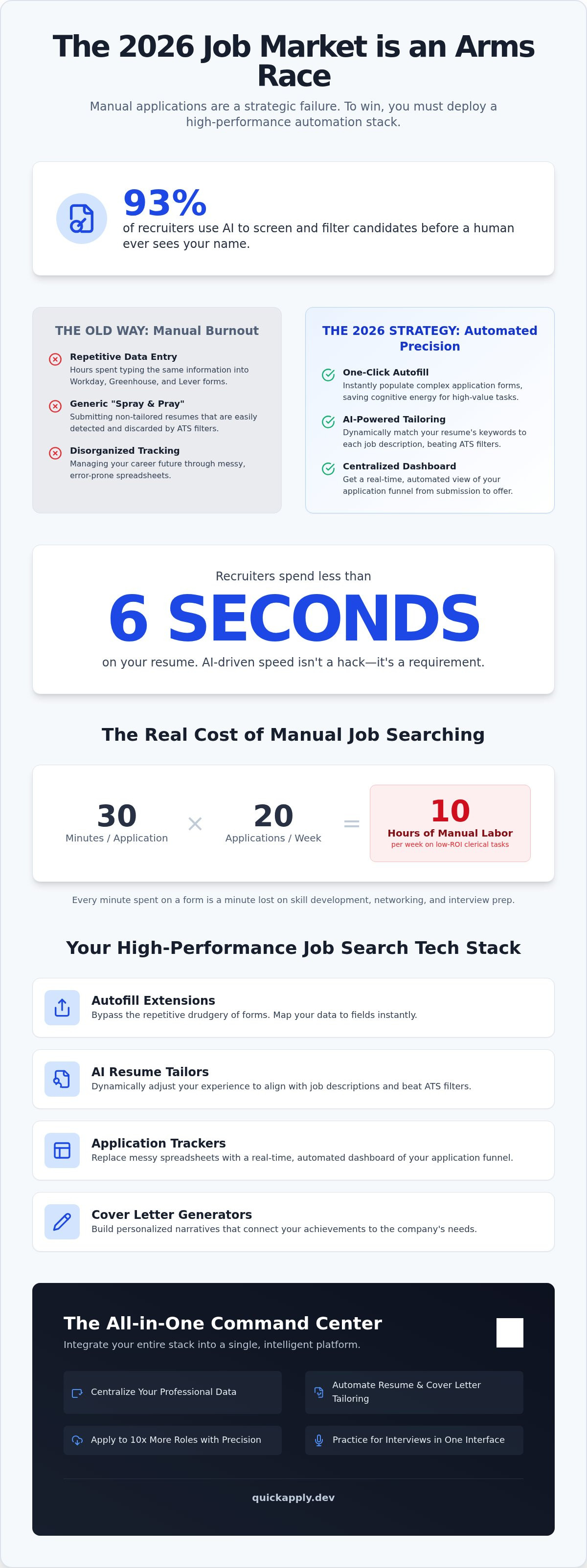
Calculate your burn rate. If you spend 30 minutes on one application and apply to 20 jobs a week, that's 10 hours of manual labor. Most of that time is spent on repetitive form-filling. Automation collapses that timeframe. It frees you to focus on high-impact interview preparation and salary negotiation strategies. Every minute spent on a Greenhouse form is a minute lost on skill development or networking. The Efficiency Gap is the measurable distance between your current manual output and your potential automated reach. Closing this gap is the only way to secure a competitive advantage in a market where 162,000 new jobs were added in August 2026 alone. Stop working harder. Start deploying better systems.
Core Categories of Tools to Speed Up Job Applications
Building a modern career requires more than just talent. It requires a stack of professional software designed to navigate the digital gatekeepers of 2026. To truly optimize your search, you need to understand the four pillars of efficiency. These categories of tools to speed up job applications work in tandem to eliminate manual labor and maximize your interview rate.
- Autofill Extensions: These scripts bypass the repetitive drudgery of Workday, Greenhouse, and Lever forms. They map your data to form fields instantly.
- AI Resume Tailors: These engines dynamically adjust your experience to align with specific job descriptions. They ensure your technical skills are highlighted for the algorithm.
- Application Trackers: These dashboards replace messy spreadsheets. They provide a real-time view of your funnel from initial submission to final offer.
- Cover Letter Generators: These tools build personalized narratives. They eliminate writer's block by drafting letters that connect your past achievements to the company's future needs.
Autofill vs. Intelligent Tailoring
Don't confuse speed with effectiveness. Autofill handles the "what" by populating name, email, and history fields. However, software engineers and tech leaders need more than just data entry. You need to explain the "why." Using a dedicated ai resume tailor for tech jobs ensures that your specific stack matches the hiring manager's requirements. While resources like CareerOneStop offer foundational guidance on career exploration, your daily workflow should rely on automation that understands technical nuances. Speeding up the process is useless if you're submitting generic data. You can automate your resume tailoring to ensure every submission is high-impact.
Automated Tracking and Organization
Manual job tracker spreadsheets are the biggest bottleneck in a high-volume search. They require active maintenance that saps your productivity. Centralized dashboards solve this by capturing application data automatically as you apply across multiple platforms. This visibility allows you to manage the funnel from "Applied" to "Offer" with zero manual input. You'll never lose track of a follow-up or miss an interview request in a cluttered inbox again. By deploying the right tools to speed up job applications, you transform a chaotic search into a streamlined pipeline. High-performance tracking provides the data you need to pivot your strategy if certain roles aren't converting.
AI Resume Tailoring: The Secret to Beating ATS Filters
Quality beats volume. In 2026, the most effective tools to speed up job applications prioritize intelligent alignment over mass submission. Modern filters don't just count keywords. They analyze context. If your resume lists skills without connecting them to the job's specific requirements, the ATS will bury your profile. AI tailoring identifies these technical gaps instantly. It scans the job description, compares it to your master resume, and suggests precise adjustments to your bullet points. By integrating these intelligent tools to speed up job applications, you transform your search from a guessing game into a technical operation.
The Match Score is your pre-submission diagnostic. It's a data-driven prediction of how well you'll rank. Knowing your score before you hit submit allows you to iterate until you reach the top tier. Sophisticated NLP ensures these updates don't look like a robot wrote them. You maintain truthfulness while optimizing for algorithmic visibility. This isn't about lying; it's about translating your experience into the recruiter's specific dialect. You present your real achievements in a format the system is programmed to reward.
Contextual Keyword Optimization
Stop keyword stuffing. It doesn't work anymore. You must tailor resume to job description by focusing on semantic relevance. If the role requires a specific tech stack, your resume must reflect project-based evidence of that stack in action. AI tools identify the nuances between "Java" and "Java Spring Boot for enterprise scale." This level of detail passes technical screens that generic resumes fail. Your goal is to provide proof of competence that the algorithm can verify instantly.
The Cover Letter Efficiency Hack
Personalized narratives still matter for high-tier tech roles. Recruiters at top companies want to see how your GitHub activity connects to their specific mission. An ai cover letter generator serves as a bridge. It connects your raw technical experience to the company's specific challenges. You can generate a compelling narrative in seconds that would take a human writer an hour to draft. This is how you maintain a high application volume without sacrificing the personal touch that closes the deal. It turns a static resume into a dynamic story of fit and function.
Building a High-Performance Job Search Tech Stack
Success in the 2026 market isn't about finding one magical app. It's about engineering an integrated ecosystem. You need a modular stack that functions like a software deployment pipeline. Relying on a single extension is a amateur move that leads to data silos and missed opportunities. By selecting the best tools to speed up job applications, you create a workflow where each component handles a specific layer of the funnel. This systemic approach ensures that your output remains high without sacrificing the technical precision required to pass elite screening processes.
Constructing this stack follows a logical four-step progression. Start by centralizing your master resume and professional data in a single source of truth. Next, deploy a browser-based autofill agent to handle the rapid entry of biographical data. The third layer must be an AI tailoring engine that modifies your bullet points for every unique submission. Finally, synchronize all activity to an automated job application tracker. This gives you a bird's-eye view of your conversion rates and interview pipeline.
Setting Up Your Automation Command Center
Your command center is where strategy meets execution. Configure your professional profile for maximum compatibility across major job boards like LinkedIn and Indeed. This ensures that your automated tools to speed up job applications can scrape and map data without errors. Set up "Loops" or triggers for new job alerts so your system identifies fresh postings the moment they go live. You want to be among the first ten applicants for any high-value role. Audit your tech stack for redundancy by identifying tools that share overlapping API permissions or duplicate data entry tasks. Streamlining your stack prevents lag and keeps your focus on the roles that actually matter.
Maintaining the Human Touch in an Automated World
Automation is your engine, but you are the pilot. Never hit submit without a final review of tailored content. AI is powerful, but it can occasionally miss the subtle cultural nuances of a specific company. Use the time you've bought through automation to engage in personalized LinkedIn networking with hiring managers. This dual-track strategy combines machine speed with human connection. Balance your submission velocity with the good resume examples that recruiters actually love. You want a document that looks polished and professional, not just a list of keywords optimized for a machine. High-performance searching is about being faster than the competition while remaining more relevant than the rest. Deploy your automated command center now to start securing more interviews.
QuickApply: The All-in-One Command Center for Tech Careers
Most job seekers suffer from tool fatigue. They juggle five different extensions, three spreadsheets, and a dozen browser tabs. This fragmentation is a major productivity bottleneck. QuickApply solves this by consolidating resume tailoring, tracking, and generation into a single high-performance interface. It stands out among tools to speed up job applications because it eliminates context switching. You don't need a separate app for every step of the funnel. You need one command center that manages the entire lifecycle of your search.
The Match Score is your primary prioritization metric. Don't waste your bandwidth on low-probability roles. Use the AI-powered score to identify which job descriptions align most closely with your technical stack. Focus your energy where the algorithm already favors your profile. By applying only to high-match roles, you increase your interview conversion rate while decreasing total effort. This data-driven approach transforms a chaotic search into a targeted operation with measurable results.
Beyond the Initial Application
The search doesn't end at "Submit." True efficiency means preparing for the next stage before the calendar invite even arrives. Transitioning from "Applicant" to "Candidate" requires shifting gears into interview practice. QuickApply provides the resources you need to master the technical screen with an interview practice copilot designed for the 2026 market. Long-term career management is built into the system. You get access to a salary negotiation guide and promotion roadmaps. These tools ensure you don't just get hired; you get paid your full market value and secure a clear path for advancement.
The QuickApply Advantage for Tech Professionals
This platform was built by engineers, for engineers. It understands the nuances of the tech recruitment cycle, from specific framework requirements to the importance of project-based evidence. While other tools to speed up job applications simply autofill forms, QuickApply maintains your momentum through continuous productivity. The platform works in the background, refining your strategy and tracking your progress even when you aren't actively searching. It acts as a bridge between your talent and the opportunities you deserve in a digital-first world. Efficiency is the only competitive advantage that scales. Stop building resumes and start tailoring with QuickApply today.
Engineer Your Career Growth
The 2026 job market demands a shift from manual effort to systemic automation. You've seen why traditional methods fail and how AI-powered tailoring bypasses algorithmic gatekeepers. Deploying the right tools to speed up job applications isn't just about saving time; it's about reclaiming your professional value. By centralizing your data and automating the boring parts of the search, you focus on what actually matters: landing the offer.
It's time to stop fighting the system and start using it to your advantage. QuickApply offers a full-funnel solution that moves with you from the initial click to the final handshake. With AI-powered Match Scores, automated resume and cover letter tailoring, and integrated salary negotiation and promotion roadmaps, you're always one step ahead. Take control of your tech career with QuickApply's automation suite. Your next high-tier role is waiting. Build the future you want with the efficiency you deserve.
Frequently Asked Questions
Are tools to speed up job applications safe to use on LinkedIn and Indeed?
Yes, professional automation tools are safe if they operate within platform guidelines. Avoid aggressive bots that trigger security flags or violate site terms. Reputable extensions focus on assisting your manual search by automating data entry and tailoring. This approach maintains the integrity of your LinkedIn or Indeed profile while maximizing your output. You get the speed of automation without the risk of account restrictions.
Does using an AI resume tailor actually help pass ATS filters?
AI tailoring is the most effective way to beat modern ATS filters. These systems rank candidates based on semantic relevance to the job description. By using tools to speed up job applications, you ensure your resume includes the specific technical keywords the algorithm is programmed to find. This isn't about gaming the system. It's about ensuring your real skills are visible to the recruiters who need them.
What is the best way to track job applications automatically in 2026?
Deploy a centralized Application Tracker that integrates directly with your browser. Manual spreadsheets are obsolete and prone to error. An automated dashboard captures every submission, follow-up, and interview invite in real time. This gives you a data-driven view of your job search funnel. You can see which roles are converting and where you need to optimize your strategy without any manual data entry.
Can recruiters tell if I used an AI cover letter generator?
Sophisticated NLP tools produce content that is indistinguishable from human writing. The key is to avoid generic, robotic templates. High-quality generators analyze your background to create a narrative that links your specific projects to company goals. Recruiters value relevance. If your cover letter clearly explains why you're a fit, the method of drafting becomes secondary to the quality and precision of the content.
How much time can I realistically save by using job application automation?
Automation can save you over 10 hours of manual labor every week. Instead of spending 45 minutes on a single application, you can complete the process in under five minutes. This efficiency gap allows you to scale your search without burning out. You can apply to 10x more roles while maintaining a high standard of quality. This saved time is better spent on high-impact interview preparation.
What features should I look for in an AI resume builder for tech jobs?
Prioritize platforms that offer AI-powered match scores and automated tailoring for specific engineering stacks. A good builder must understand the difference between various programming languages and frameworks. It should also include features for interview practice and salary negotiation guides. Look for a command center that treats your career as a continuous pipeline rather than a one-time document. Technical accuracy and efficiency are the most important metrics.
Is it better to use an auto-apply tool or a tailoring tool?
Tailoring tools are significantly more effective than simple auto-apply scripts. While auto-apply increases your volume, it often results in generic submissions that modern ATS filters reject instantly. Tailoring ensures that every application is optimized for a specific role. Using tools to speed up job applications that prioritize quality over raw quantity results in a much higher interview rate and better long-term career outcomes.
How do I ensure my tailored resume remains accurate and truthful?
Use AI as a technical ally to rephrase your existing experience, not to invent new skills. The goal is to translate your achievements into the language used in the job description. Always perform a final review of every tailored resume before you hit submit. This manual check ensures that all data points are accurate and that the narrative remains a truthful representation of your professional history.


