

What if your lack of a traditional computer science degree wasn't the reason for that "unfortunately" email, but rather your inability to speak the language of a Workday algorithm? You've spent months shipping code and refining your repositories. It's frustrating to watch your commits gather dust while candidates with less technical skill land interviews simply because they have the right pedigree. You know your projects are "real" experience, but the current hiring systems don't always agree.
This guide changes that dynamic. You'll learn exactly how to showcase github projects on resume structures that bypass rigid education filters and translate your raw code into high-impact professional narratives. We're moving past simple links to a strategy that beats modern semantic matching. We will cover the 2026 framework for professionalizing your repositories to match enterprise needs, optimizing your layout for the 60% of the market controlled by top-tier ATS vendors, and using smart automation to scale your job search. It's time to stop manually tweaking every line and start letting your code do the heavy lifting.
Key Takeaways
- Master the functional-hybrid layout to learn how to showcase github projects on resume sections that command immediate recruiter attention.
- Shift your narrative from hobbyist to system architect by mapping repository features to professional enterprise requirements.
- Bypass rigid education filters through semantic relevance, ensuring your technical execution outweighs a missing university degree in 2026.
- Eliminate the manual application bottleneck by using AI-driven tailoring to map your unique project history to specific job descriptions instantly.
- Optimize your profile to target the top three ATS platforms that currently control over 60% of the Fortune 500 hiring market.
Why GitHub is Your Most Powerful Credential in 2026
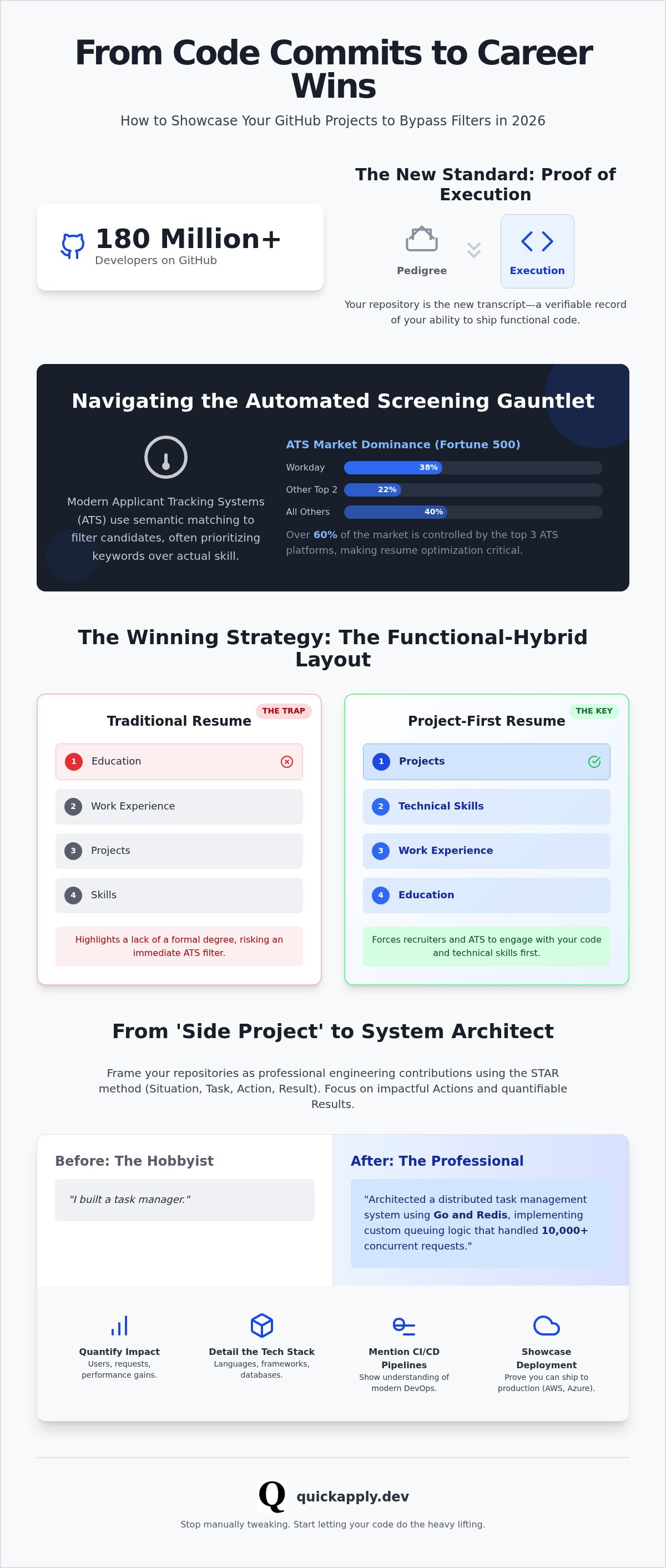
The traditional academic degree has lost its status as the primary gatekeeper for tech talent. By late 2025, GitHub's user base surged past 180 million developers. This growth signals a massive shift toward a decentralized talent pool where execution matters more than pedigree. Tech giants like Google and Tesla have already deprioritized formal degrees, choosing instead to hire based on "Proof of Work." This model forces a transition to a "Proof of Execution" framework. Your repository is the new academic transcript. It provides a granular, verifiable look at your ability to ship functional code under real-world pressure.
Understanding what is GitHub and mastering its version control features is only the baseline. To compete in 2026, you must understand how to showcase github projects on resume layouts that prioritize technical output over school names. Self-taught developers now hold a strategic advantage. You demonstrate autonomy, speed, and proficiency in modern stacks without the four-year lag of a university curriculum. Your commit history proves you don't just understand theory; you understand delivery.
The 2026 Hiring Landscape for Developers
In a saturated 2026 market, hiring managers are overwhelmed by application volume. With 36 distinct ATS platforms currently in use, including Workday's 38% market share, the screening process is almost entirely automated. These systems now use semantic matching to identify specific technical markers. If your resume lacks a clear bridge to a repository that demonstrates these markers, you'll likely face an automatic rejection. Position your non-traditional background as a feature. It signals that you are a self-starter who masters complex systems through direct application rather than passive observation.
GitHub as a Living Technical Document
A repository outweighs a degree because it's a living document. It shows, rather than tells. It proves you understand branching strategies, pull request etiquette, and documentation standards. Modern software engineering happens in production, not in a classroom. Use your GitHub profile to prove you can operate within a professional environment from day one. This transparency eliminates risk for the employer. Since 90% of Fortune 100 companies now use GitHub Copilot, showing AI-assisted workflows in your project history is vital. It proves you're optimized for the high-speed nature of modern tech teams. It turns your personal projects into a high-impact professional narrative that beats the algorithm.
Building the Project-First Resume Structure
Leading with a traditional chronological resume is a tactical error for self-taught developers. Traditional layouts highlight a lack of formal experience or prestige degrees. To win in 2026, you must adopt the functional-hybrid layout. This structure prioritizes technical evidence over job titles. By moving your "Projects" section to the top of the resume hierarchy, you force recruiters and ATS algorithms to engage with your code immediately. This is the most effective way to showcase github projects on resume templates that bypass standard credential filters.
Your "Technical Skills" section requires equal optimization. Don't just dump keywords into a comma-separated list. Group them by category: Frontend, Backend, DevOps, and Languages. This improves readability for human recruiters while helping modern ATS platforms identify your stack proficiency. If you find the manual process of reordering these sections for every job description tedious, you can use resume tailoring tools to automate the layout optimization in seconds.
Professionalizing Your Independent Projects
Stop describing your repositories as "side projects." Treat them as professional engineering contributions. Use the STAR method to frame your work. Focus on the Action and the Result. Instead of saying "I built a task manager," use high-impact phrasing: "Architected a distributed task management system using Go and Redis, implementing a custom queuing logic that handled 10,000+ concurrent requests." Quantify your impact. Mention performance gains, user counts, or the specific architectural complexity you solved. Highlighting your use of CI/CD pipelines and AWS deployment proves you understand the full software development lifecycle.
The Education Section: Honesty without the Highlight
The education section should be a footnote, not a focal point. If you lack a formal CS degree, move this section to the absolute bottom of the page. Build credibility through specialized certifications like AWS Certified Developer or Azure Solutions Architect. These carry weight in 2026 because they represent standardized technical mastery. List "Relevant Coursework" from platforms like Coursera or edX to demonstrate a disciplined, structured approach to learning. This proves you possess the foundational knowledge of data structures and algorithms without needing a four-year university name to validate it. You're trading a degree for a track record of execution.
Mapping GitHub Skills to Enterprise Requirements
Most developers fail because they describe what they built, not why it matters to a business. To master how to showcase github projects on resume entries, you must identify the hidden requirements in a job description. These aren't always explicitly listed in the "Requirements" section. They're often buried under "plus" skills like containerization, unit testing, or system architecture. A hiring manager doesn't just want to know you can code; they want to know you can code within their specific ecosystem. You can see how top-tier candidates bridge this gap by reviewing good resume examples that prioritize enterprise-ready vocabulary over generic descriptions.
Translating Your Stack into Business Value
Enterprise hiring managers aren't looking for hobbyists. They're looking for engineers who understand scalable systems. Saying "I built a React app" is weak. Instead, describe it as "Engineered a scalable UI component library with a focus on atomic design principles." This signals that you understand modularity and reuse. Map your self-taught curriculum directly to Computer Science fundamentals. If you built a search feature or a sorting tool, explain it through the lens of Data Structures and Algorithms. Mention time complexity and space complexity. Highlight your proficiency in professional workflows. Mention your use of Git for version control, Jira for task management, and your adherence to Agile methodologies. This proves you can integrate into a high-velocity team without a significant learning curve. It shows you've already mastered the "how" of professional software delivery.
The Power of Open Source and Contributions
Open-source contributions provide the ultimate social proof. Treat your merged pull requests to major repositories as professional experience. This validates that your code has passed a rigorous peer-review process from senior engineers. If you're just starting, search for "Good First Issues" in popular repos. These contributions carry more weight on a professional resume than ten isolated personal projects. Quantify your social proof by mentioning GitHub stars and forks. These metrics act as external validation of your technical competence. They suggest that other developers find your work valuable enough to use and build upon. In 2026, a single merged PR to a high-traffic library is worth more than a dozen low-effort "todo" apps. It demonstrates that you can navigate complex codebases and collaborate with a global team.
Beating the ATS Filter Without a University Name
Recruiters at Fortune 500 companies rely on systems like Workday, which currently commands 38% of the market, and Greenhouse at 12.6%. These platforms don't just scan for degree titles anymore. They use semantic matching to build a candidate score based on technical proficiency. If you want to know how to showcase github projects on resume sections that actually move the needle, you must understand that the algorithm is looking for evidence of execution. It values a verified skill set over a static university name. You can find detailed technical steps in this tailor resume to job description guide to ensure your document satisfies these high-tech gatekeepers.
Keyword Strategy for the Degree-Less Developer
Stop chasing keyword density. Modern AI-driven screening analyzes the context of your technical mentions. Identify high-intent keywords like "Microservices," "Kubernetes," or "TypeScript" within the job description. Place these within your project bullet points rather than a detached list. This creates a narrative of application that the ATS recognizes as valid experience. Avoid keyword stuffing. It triggers spam filters and lowers your match score. Focus on relevance. If the role requires React, describe how you managed state or optimized rendering in your latest repository. This proves you have the specific skills the company needs right now.
Formatting for Machine Readability
Standard PDF layouts are your best friend. Complex graphic designs, icons, or multi-column templates often break the parser, leading to immediate data loss. When the "Education" field is required but you lack a degree, don't leave it blank. List your most rigorous technical certifications from AWS, Azure, or Google Cloud. Structure these as equivalent academic achievements. This satisfies the system's logic. It prevents your profile from being filtered out in the first round. You are essentially hacking the system by providing the data it expects in a format it can digest. Remember that 36 distinct ATS platforms are in active use. Consistency in formatting ensures your data translates across all of them.
The manual effort required to optimize these fields for every application is the biggest hurdle for self-taught devs. You shouldn't spend hours on one resume when you could be shipping code. Use AI-powered resume tailoring to automate the keyword mapping and formatting process instantly. This ensures your technical evidence is always front and center, regardless of your academic background. You save time while increasing your match score.
Scaling Your Search with AI-Powered Tailoring
Manual tailoring is the primary bottleneck for self-taught developers in 2026. Traditional advice suggests spending hours manually adjusting every bullet point for every single application. This approach is a relic of a slower era. In a high-volume market, you need speed. If you're still wondering how to showcase github projects on resume layouts that actually get read, the answer lies in systemic automation. You can't afford to be slow when 78% of tech leaders are looking to increase permanent headcount and competition is fierce.
QuickApply automates the tedious task of mapping your code to specific job descriptions. Our AI analyzes your unique GitHub project history and identifies the exact technical markers an employer wants to see. It generates real-time match scores for job fit, allowing you to prioritize roles where your technical evidence is strongest. Once your resume is optimized, you can pair it with a custom cover letter to complete the high-impact package in seconds. This eliminates the friction between finding a role and submitting a high-quality application.
From 1 Application a Day to 50
Application volume is critical. In 2026, the entry-level market requires a high-volume strategy to overcome statistical hurdles. QuickApply allows you to scale your search without sacrificing accuracy. You can apply to dozens of roles with highly tailored documents that maintain technical integrity. Use the Application Tracker to monitor your progress and refine your strategy based on callback data. This focus on high-volume output with low-effort input is your competitive advantage. It ensures you're always ahead of the curve in a crowded market.
Closing the Gap: From Resume to Job Offer
Landing the callback is only the first step. You must defend your code during the technical interview. QuickApply offers interview practice tools that generate questions based directly on the projects you've highlighted. This builds the confidence needed to explain your self-taught journey with professional authority. Mastering how to showcase github projects on resume sections is only half the battle; you must also articulate the business value you've delivered. When you prove your "Proof of Work" narrative with data and conviction, the missing degree becomes irrelevant. You've successfully bridged the gap between talent and opportunity by finding the most efficient path through systemic automation.
Ship Your Career at Scale
The tech landscape in 2026 demands evidence over promises. You've seen that a project-first layout isn't just a design choice; it's a strategic necessity to bypass rigid education filters. By mastering how to showcase github projects on resume sections, you're translating raw code into the business value that enterprise recruiters crave. You're no longer just a developer with a hobby. You're an engineer with a verifiable track record of delivery.
Stop losing hours to manual document tweaks. Optimization should move as fast as your deployment cycle. You can tailor your self-taught resume in seconds with QuickApply to ensure every application hits the mark. Leverage AI-powered ATS optimization, monitor your progress with automated application tracking, and use real-time match scores to target the highest-probability opportunities. This systemic approach moves you from a passive job seeker to a high-volume candidate who commands attention.
Your code is ready. Now, make sure the world sees it. The gap between your talent and your next role is smaller than it looks when you use the right tools. It's time to stop fighting the algorithm and start making it work for you.
Frequently Asked Questions
Can I get a software engineering job without a degree in 2026?
Yes, you can land a high-paying role without a traditional degree. Major tech employers like Google and Tesla have shifted their focus toward "Proof of Execution" rather than academic credentials. The 2026 market prioritizes your ability to ship functional, scalable code. By providing a verified repository of work, you bypass traditional education filters and prove your value through direct technical evidence.
How do I list my self-taught skills on a resume?
List your skills in a categorized "Technical Skills" section grouped by stack, such as Frontend, Backend, or DevOps. Don't just list keywords; integrate them into your project descriptions using the STAR method. This proves you understand application, not just theory. Mastery of how to showcase github projects on resume sections involves framing your self-taught curriculum as professional engineering deliverables.
What projects should a self-taught developer have on their resume?
Prioritize projects that demonstrate full-stack proficiency, system architecture, and modern deployment. Avoid basic "todo" apps. Instead, build distributed systems, custom API integrations, or contribute to major open-source repositories. These projects show you can work within complex, production-ready environments. Recruiters in 2026 look for evidence of scalability, security, and clean documentation within your commit history and pull requests.
Should I mention I am self-taught on my resume?
No, you don't need to explicitly label yourself as "self-taught" in your professional summary. Your code serves as your credential. Focus on your job title as "Software Engineer" or a specific stack specialist. Let your "Proof of Work" narrative speak for your competence. Professionalizing your presentation means leading with your technical output and repositories rather than highlighting the lack of a formal academic background.
How do I pass the ATS without a CS degree?
You pass the ATS by prioritizing semantic relevance and technical certifications over the education field. Modern platforms use AI to score your profile based on technical proficiency markers. Use automated resume tailoring to ensure your project descriptions match the job's high-intent keywords. This satisfies the algorithm's logic and ensures your match score remains high even if the education field is not your strongest asset.
Are coding bootcamps considered "education" on a resume?
Yes, coding bootcamps are valid educational credentials, but they carry more weight when listed alongside professional-grade projects. Treat them as intensive technical training. In 2026, recruiters view these as evidence of disciplined, structured learning. However, you must still prove your execution through a robust GitHub profile to validate that the bootcamp knowledge has been successfully applied to real-world codebases.
What is the best resume format for a developer with no experience?
The functional-hybrid layout is the gold standard for developers without corporate experience. This format places your "Projects" and "Technical Skills" at the top of the page, forcing the recruiter to see your code immediately. It de-emphasizes your work history and education. This structure is the most effective way to learn how to showcase github projects on resume templates that prioritize technical skills over job titles.
How do I handle the education section if I dropped out?
List the institution and your relevant coursework without highlighting the lack of a degree. Move this section to the bottom of your resume. Focus the recruiter's attention on your technical certifications and repository history instead. In 2026, your ability to solve complex problems and ship production code is a far more valuable metric for hiring success than a completed academic transcript.


